

The era of cost-reimbursement flexibility effectively ended on April 30, 2026, when the Executive Order on Promoting Efficiency, Accountability, and Performance in Federal Contracting mandated firm-fixed-price agreements as the new default for federal procurement. You've likely felt the mounting pressure of these tighter regulatory thresholds, where even a minor technical oversight in your volume can trigger a DCAA audit failure or damage your CPARS narrative. We understand the frustration of watching your Subject Matter Experts burn out over repetitive question cycles while win rates stagnate due to rushed, non-compliant submissions.
In this guide, we'll demonstrate how to transform your proposal process from a reactive scramble into a high-win-rate strategic operation by integrating AI-driven precision with human-in-the-loop expert oversight. You'll discover how specialized RFP response management services can help you navigate the 2026 mandate, reduce turnaround times for complex technical volumes, and ensure every submission is audit-ready. We'll examine the shift from simple acquisition planning to a continuous compliance model that secures your long-term success in the federal marketplace.
Key Takeaways
- Understand the fundamental shift in federal procurement toward firm-fixed-price mandates and how a strategic framework ensures your submissions remain competitive and compliant.
- Discover how professional RFP response management services eliminate SME burnout by replacing repetitive manual cycles with scalable, AI-driven automation.
- Learn to identify the "Compliance Gap" in generic software and why federal solicitations require specialized tools like FARIFY.ai for audit-ready documentation.
- Identify the key metrics for evaluating strategic partners, focusing on their depth of expertise in FAR, DFARS, and DCAA compliance consulting.
- Master the 5-stage lifecycle to transform your proposal department into a high-efficiency operation capable of producing precise technical volumes in record time.
What Are RFP Response Management Services in the Federal Sector?
In the 2026 federal marketplace, acquisition has evolved into a high-stakes environment where strategic compliance is the only path to success. We define RFP response management services as a specialized discipline that aligns your technical capabilities with the rigid legal requirements of a Request for Proposal (RFP). This framework ensures your submission isn't just a persuasive document, but a legally sound response that survives the most rigorous agency scrutiny. It's a method of transforming complex solicitations into structured, winnable opportunities.
To better understand the foundational elements of this process, watch this helpful video:
Managing the procurement lifecycle effectively requires a shift from reactive writing to proactive capture management. While commercial bids often prioritize marketing language, federal solicitations demand a technical precision that addresses every sub-factor in Section L and M. As agencies adopt the 2026 firm-fixed-price mandate, the role of AI-driven automation has become essential for maintaining the speed and accuracy required to remain competitive. This shift allows your team to focus on technical innovation while we handle the complex regulatory architecture of the bid.
The Stakes of Federal Proposal Compliance
Non-compliance in a single clause can lead to immediate disqualification before your price is even considered. Your RFP responses serve as the foundation for future CPARS narratives and past performance ratings. In this landscape, "good enough" writing fails under Section L and M scrutiny because it lacks the technical depth required to mitigate agency risk. Every technical volume must be mapped perfectly to the solicitation requirements to ensure it survives the initial compliance review.
Managed Services vs. Internal Proposal Teams
Maintaining an internal team with the deep FAR and DFARS expertise required for modern bidding is often cost-prohibitive. By utilizing our proposal writing services, you gain the ability to handle multiple concurrent solicitations without increasing permanent overhead. This managed approach provides scalability and access to specialized knowledge that internal teams typically lack. We ensure your technical volumes are audit-ready from the first draft, allowing your SMEs to stay focused on their core mission-critical tasks.
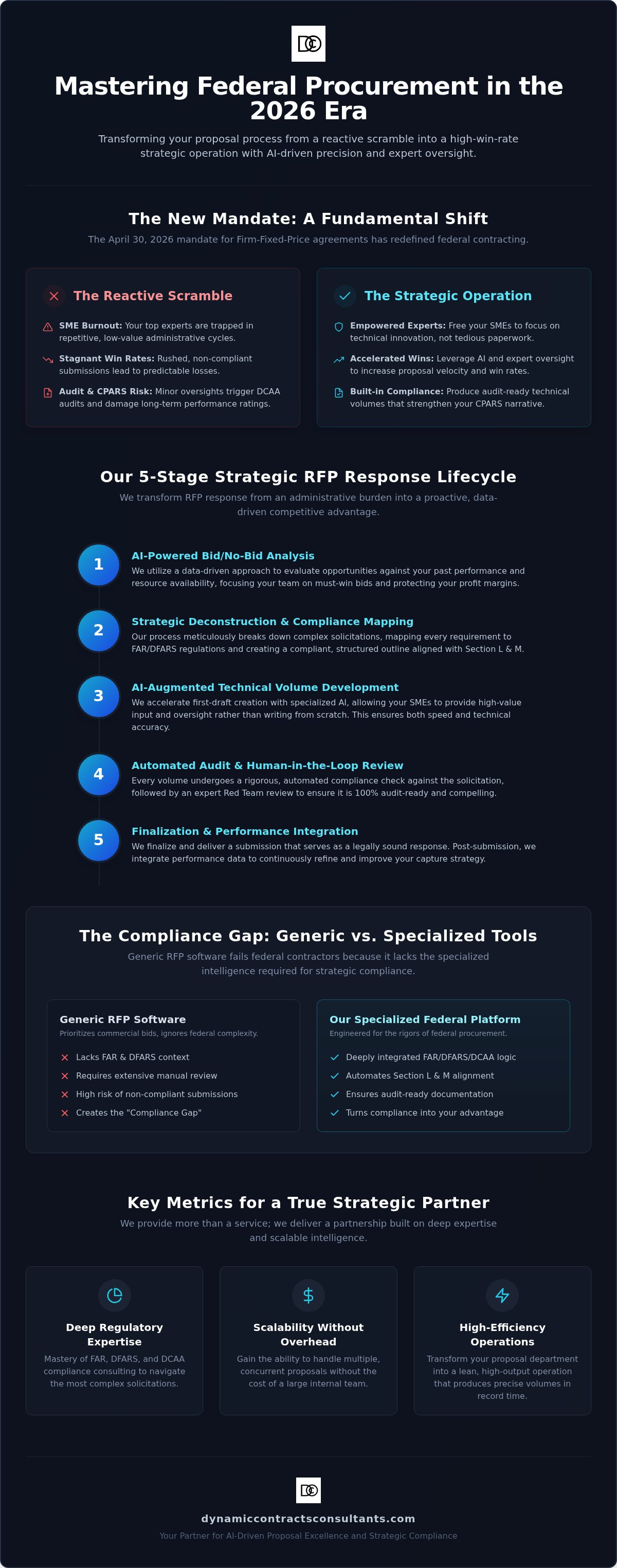
The 5-Stage Strategic RFP Response Lifecycle
Winning a federal contract requires more than just meeting the deadline; it necessitates a disciplined adherence to the federal acquisition process. We've developed a five-stage lifecycle that transforms RFP response management services from a reactive administrative burden into a proactive competitive advantage. Each stage is designed to address the specific rigors of Section L and M alignment, ensuring that your technical approach is as compliant as it is compelling. By treating the response as a structured data operation rather than a simple writing task, we eliminate the guesswork that often leads to non-compliant submissions.
Optimizing the Bid/No-Bid Decision
The most critical decision occurs before a single word is written. By utilizing AI for bid-no-bid analysis, we help you evaluate opportunities against your past performance and resource availability. This data-driven approach protects your profit margins and prevents the resource drain associated with "long-shot" bids. We focus your energy on must-win opportunities where your technical solution aligns perfectly with agency requirements, ensuring that your capture strategy is rooted in reality rather than optimism.
Once the decision to pursue is made, we move into Stage 2: Compliance Matrix Generation and Gap Analysis. This isn't just a checklist; it's a structural map that ensures every requirement in the solicitation is addressed. Following this, we transition to Stage 3: AI-Powered Technical Volume Drafting. Using platforms like FARIFY.ai, we generate initial drafts that serve as a high-quality baseline for your Subject Matter Experts (SMEs). This significantly reduces the time your engineers and program managers spend on administrative drafting, allowing them to focus on high-value technical innovation.
Technical Drafting and SME Integration
Our "Human-in-the-loop" methodology ensures that while AI handles the heavy lifting of requirement extraction, your technical experts provide the nuanced insights that distinguish your proposal. We integrate flow-down clauses into the technical narrative from the outset, ensuring that post-award obligations are clear and manageable. This early alignment prevents the technical disconnects that often lead to performance issues after the contract is awarded. It's about building a bridge between the proposal and the actual execution of the work.
The process concludes with Stage 4: Red Team Review and Regulatory Alignment. This phase mimics the agency’s evaluation process to identify and rectify any remaining weaknesses before they reach the Contracting Officer. Finally, Stage 5 ensures Submission Readiness through a meticulous check of all administrative requirements, followed by post-submission support during the clarification or protest phases. If you're looking to refine your current lifecycle, you can consult with our strategic team to identify gaps in your proposal operations.
Why Generic RFP Software Fails Federal Contractors
Many organizations invest in high-rated commercial RFP software, only to find these tools struggle with the rigid structure of federal solicitations. Commercial platforms are designed for the "persuasive pitch" model; however, federal RFP response management services require a "compliance-first" architecture. Generic software doesn't recognize the nuances of DFARS or specific agency supplements, creating a dangerous "Compliance Gap" where your technical volume might look professional but fail to address mandatory Section L requirements. Relying on tools built for commercial sales in a federal environment is a risk that often leads to immediate disqualification.
The most common objection we hear is whether AI can be trusted with contract compliance. The answer is simple: generic AI cannot. Standard Large Language Models (LLMs) often hallucinate clauses or invent regulatory references that don't exist. This is why expert-led services are the necessary safeguard. We don't just provide software; we provide a "human-in-the-loop" layer where veteran consultants verify every AI-generated output against current FAR standards. This ensures that the speed of automation never comes at the expense of regulatory precision.
DCAA Compliance and Financial Realism
A federal proposal is more than just a technical solution; it's a financial commitment. Generic tools fail to integrate cost and price analysis with the technical narrative, leaving a gap that can be fatal during an audit. Our approach includes DCAA compliance consulting to ensure your accounting systems and pricing models meet federal standards during the bid phase. We help you demonstrate financial realism, ensuring that your "price-to-win" doesn't become a "price-to-lose" during rigorous post-award audits or contract renegotiations.
The FARIFY Advantage: AI Built for Acquisition
Unlike general-purpose AI, FARIFY.ai is specifically trained on the federal acquisition lifecycle and the unique requirements of the DoD, EPA, and NOAA. It understands the complex relationship between Section L instructions and Section M evaluation criteria. This allows us to generate audit-ready Performance Work Statements (PWS) and Statements of Work (SOW) in minutes. By using a platform built specifically for acquisition, we ensure your technical volumes are perfectly aligned with agency expectations, effectively eliminating the risk of non-compliance that plagues generic commercial tools.
How to Evaluate RFP Response Management Partners
Selecting the right partner for RFP response management services is a high-stakes decision that dictates your firm's long-term standing with federal agencies. Many providers offer document production, but few possess the operational depth to understand how a proposal's language impacts contract execution. You must verify if a potential partner has served as a prime contractor or a subcontractor on significant awards. This distinction is vital because a partner with "boots on the ground" experience understands the administrative friction of the DoD or State Department. They won't promise technical solutions that are impossible to deliver under FAR constraints.
Evaluate their technological maturity by looking beyond the marketing buzzwords. Are they using generic, off-the-shelf LLMs that risk hallucinating clauses, or are they utilizing specialized intelligence like FARIFY.ai? A partner using acquisition-specific tools demonstrates a commitment to precision that generic writing shops cannot match. This technical edge should be balanced with a deep mastery of agency-specific supplements, such as the DFARS for defense contracts or the GSAM for GSA schedules. We recommend asking for specific examples of how they've handled Section L and M alignment in past successful bids.
Lifecycle Management and Risk Assessment
Expertise shouldn't end when you hit the "submit" button. A strategic partner understands that the federal contract lifecycle management process begins during the capture phase and extends through closeout. They should perform rigorous financial risk assessments during the proposal phase to ensure your pricing models are sustainable and audit-ready. This connection between the bid and post-award compliance is what prevents CPARS damage and ensures you remain profitable under the new 2026 firm-fixed-price mandates. If a partner doesn't discuss post-award risk, they're only doing half the job.
Credentials and Certifications to Look For
Look for consultants who hold industry-standard certifications such as Certified Professional Contract Manager (CPCM) or Certified Federal Contract Manager (CFCM). These credentials indicate a formal mastery of the regulatory environment that goes beyond simple writing skills. Additionally, partnering with a minority-owned small business can provide significant strategic teaming advantages, helping you meet agency socio-economic goals while accessing elite expertise. Your partner must also be able to integrate seamlessly with your government proposal team roles, providing the structure and templates necessary to maintain a high win rate across multiple concurrent solicitations.
If you're ready to move beyond generic support and adopt a compliance-driven strategy that secures your future in federal contracting, contact our federal acquisition experts today to evaluate your current proposal operations.
Dynamic Contracts Consultants LLC: Your Strategic Proposal Partner
We serve as the critical bridge between traditional federal expertise and the next generation of AI-driven procurement. Our RFP response management services aren't merely about document production; they're about engineering a compliant, data-driven path to contract award. By combining decades of federal acquisition experience with the scalable intelligence of FARIFY.ai, we offer a "human-in-the-loop" assurance that generic software providers can't replicate. We understand that in the 2026 regulatory environment, speed is useless without the precision of a veteran strategist who knows the system's inner workings.
Our "Simple Solutions to Complex Problems" philosophy is designed to reduce the administrative burden on your internal teams while ensuring every submission is audit-ready. As a minority-owned small business founded in 2015, we've built our reputation on the disciplined application of FAR, DFARS, and DCAA standards. We manage the entire lifecycle, from initial acquisition planning and bid-no-bid analysis to post-award contract administration and closeout. This continuity ensures that the promises made in your technical volume are executable and profitable throughout the life of the contract.
Our Proven Approach to Proposal Success
We've successfully supported prime and subcontractors in securing acquisitions for high-stakes agencies, including the DoD, EPA, and NOAA. Our proposal writing services utilize customized templates that do more than just fill space; they serve as pre-structured compliance frameworks. These tools allow your Subject Matter Experts to focus on technical innovation rather than formatting or requirement mapping. By streamlining the submission process, we've helped our partners reduce turnaround times for complex technical volumes by significant margins without compromising on accuracy.
Ready to Scale Your Federal Bid Capacity?
Scaling your federal bid volume shouldn't lead to burnout or increased compliance risk. We invite you to schedule a professional consultation to assess your current RFP response framework and identify gaps where AI-driven automation can drive operational efficiency. You'll gain direct access to FARIFY’s rapid document generation platform, allowing you to produce compliant Performance Work Statements and technical narratives in minutes. Don't let the complexity of modern federal contracting limit your firm's growth potential. Leverage our expert insights for your business growth and transform your proposal operations into a high-win-rate strategic asset.
Securing Your Competitive Edge in the 2026 Federal Marketplace
The transition toward firm-fixed-price mandates and tighter regulatory thresholds means your proposal operations must evolve or risk obsolescence. Specialized RFP response management services bridge the gap between rapid document generation and the strict compliance required by the FAR. By integrating the AI-powered speed of FARIFY with the "human-in-the-loop" oversight of CPCM and CFCM certified consultants, you ensure that every technical volume is both visionary and audit-ready. This approach eliminates the "Compliance Gap" that often leads to disqualification in high-stakes federal solicitations.
Our experience as a prime contractor for the DoD, State Department, and EPA provides us with the unique insight needed to navigate Section L and M requirements without the burnout associated with traditional manual cycles. You don't have to choose between speed and precision. We provide a single continuum of support from capture management to post-award compliance, protecting your CPARS narrative and your profit margins. It's time to transform your bid process into a high-win-rate strategic operation that scales with your ambitions.
Partner with Dynamic Contracts Consultants LLC for expert RFP response management and let us help you lead the next wave of federal acquisition success. We're ready to secure your future in the complex world of government contracting.
Frequently Asked Questions
What are RFP response management services?
These services represent a strategic framework designed to manage the entire federal acquisition lifecycle, from initial capture to contract award. They synchronize technical writing, regulatory compliance, and administrative oversight to ensure every submission is audit-ready. Unlike simple writing tasks, professional RFP response management services provide the structural architecture needed to navigate complex Federal Acquisition Regulation (FAR) requirements and agency-specific mandates.
How does AI improve the RFP response process for federal contracts?
AI-driven automation, particularly through specialized platforms like FARIFY.ai, accelerates the extraction of requirements and the generation of technical volumes. This technology reduces manual drafting time, allowing your Subject Matter Experts to focus on high-value technical innovation. By utilizing acquisition-trained models, we ensure that automated drafts remain aligned with Section L and M instructions, effectively eliminating the risk of hallucinated clauses found in generic tools.
What is the difference between an RFP response and a federal solicitation?
A federal solicitation, often referred to as the RFP, is the government’s formal request for a solution, outlining the scope of work and evaluation criteria. Your RFP response is the legally binding proposal you submit in reply. Federal responses are significantly more rigid than commercial bids, requiring strict adherence to Section L formatting and Section M evaluation factors to avoid immediate disqualification by the Contracting Officer.
Can RFP management services help with DCAA compliance?
Yes, integrated RFP response management services incorporate DCAA compliance consulting to ensure your pricing models and accounting systems meet federal standards during the bid phase. We perform financial risk assessments to align your cost volume with the technical narrative. This proactive approach prevents the financial disconnects that often trigger audit failures or performance issues during the post-award phase of the contract lifecycle.
How do I choose between RFP software and a managed service provider?
Software provides the tools for document production, but a managed service provider offers the "human-in-the-loop" expertise necessary for federal compliance. While generic software often lacks an understanding of DFARS or agency supplements, a managed partner provides veteran consultants who verify every output. We recommend a hybrid approach where specialized AI technology is guided by certified experts to ensure both speed and regulatory precision.
What is a compliance matrix, and why is it critical for RFPs?
A compliance matrix is a cross-reference map that links every solicitation requirement to a specific section and page in your proposal. It serves as a roadmap for government evaluators, proving that you've addressed every mandatory factor. Without this matrix, you risk omitting critical clauses, which is the leading cause of non-responsiveness and technical disqualification in the federal sector.
How can we improve our proposal win-rate in the federal sector?
You can improve your win-rate by implementing a rigorous bid/no-bid analysis to focus resources on opportunities where you have a clear competitive advantage. Aligning your technical approach directly with Section M evaluation criteria ensures your proposal scores higher during the source selection process. Consistent use of customized templates and strategic capture management further refines your ability to submit winning, compliant bids.
What happens after the RFP is submitted in the federal lifecycle?
Submission is followed by the evaluation phase, which may include clarifications, deficiency notices, or formal discussions with the Contracting Officer. Once an award is made, the focus shifts to post-award contract administration and ensuring compliance with all flow-down clauses. We manage this transition to ensure your operational execution matches the promises made in your proposal, protecting your firm's CPARS narrative and future past performance ratings.


