

We help you prepare for agency events and follow through afterward. An agency Industry Day can help you understand upcoming procurement needs, hear directly about agency priorities, and identify potential teaming partners. We work with you to approach each event deliberately so your preparation and follow-up support your business-development goals.
Balancing agency outreach, business development, and the search for partners with complementary capabilities can be challenging. We guide you through researching agencies and attendees, preparing for Industry Day, connecting with Women’s Business Centers and Veterans’ Business Opportunity Centers, and building mutually beneficial teaming relationships. We also show you how to use LinkedIn and other professional networking platforms to maintain relevant connections between events.
Key Takeaways
- We help you set a clear objective for each event and research the agencies, attendees, and procurement priorities most relevant to your business.
- We recommend using Women’s Business Centers and Veterans’ Business Opportunity Centers to identify support and strengthen your approach to government contracting.
- We help you approach Industry Day as a forum for learning about agency needs and potential opportunities, not simply as a place to make introductions.
- We help you build teaming relationships by listening, identifying complementary capabilities, and following up with a specific, relevant next step.
- We recommend using LinkedIn to maintain professional connections and share useful industry insights between in-person events.
1. Researching attendees, agencies, and opportunities before an event
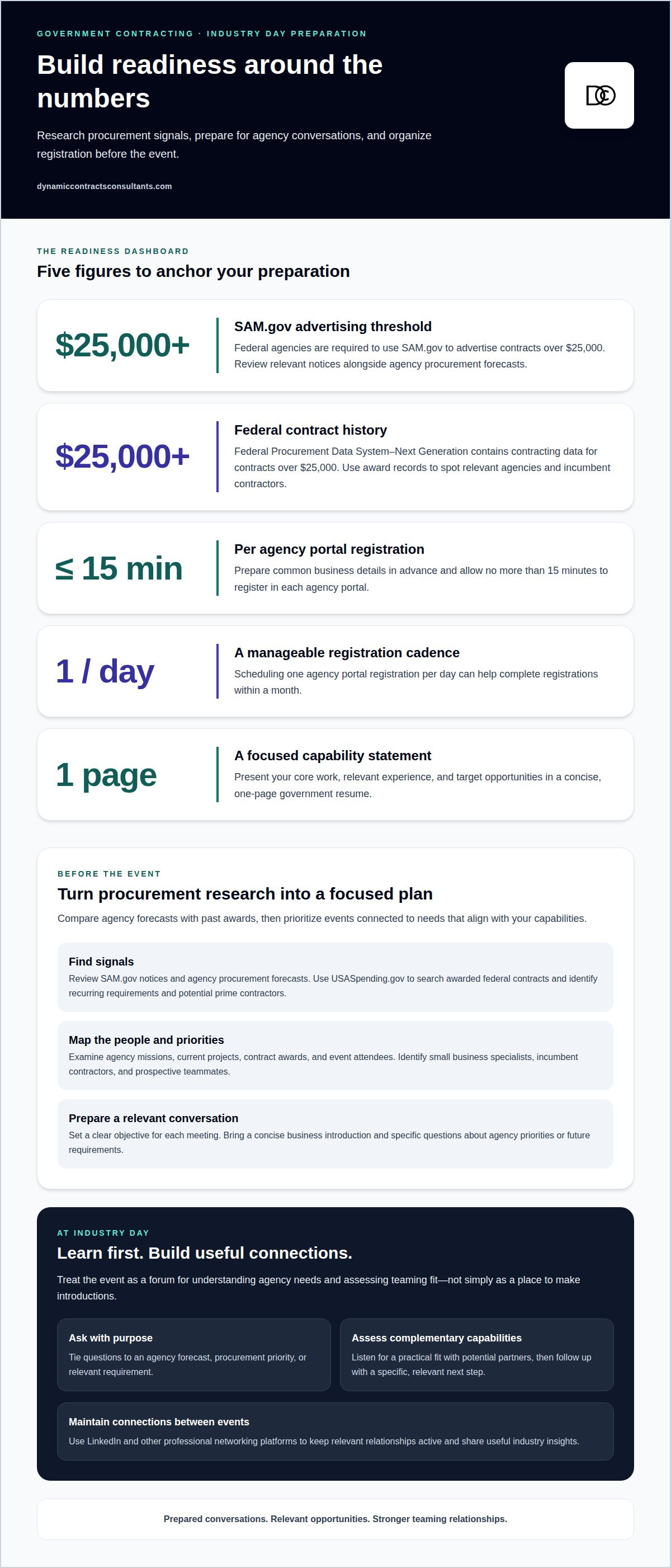
We use SAM.gov and agency procurement forecasts to identify opportunities before networking. According to the Federal Acquisition Regulatory Council, federal agencies are required to use SAM.gov to advertise contracts over $25,000. We review relevant notices alongside agency forecasts, which can include opportunities for small and disadvantaged businesses, then prioritize events connected to those needs.
We prepare by examining target agencies’ missions, current projects, and contract awards. The Federal Procurement Data System–Next Generation contains federal contracting data for contracts over $25,000. Its records can show which agencies buy relevant services and which contractors hold awards. USASpending.gov also provides searchable information about awarded federal contracts, helping us identify recurring requirements and potential prime contractors.
We turn research into a focused event plan by comparing agency forecasts with past awards and noting opportunities that align with your business’s capabilities. We research the organizations and companies attending, including potential agency contacts, incumbent contractors, and prospective teammates. Before the event, we help prepare a concise introduction that explains your business profile and core strength, along with specific questions about agency priorities or future requirements.
- We identify agencies whose missions and awards fit your capabilities.
- We review forecasted opportunities and relevant contract histories.
- We identify agency small business specialists and potential prime contractors attending.
- We recommend a clear objective for each meeting, such as understanding a requirement or assessing a teaming fit.
Small business specialists can help clarify an agency’s engagement channels and small-business priorities. We use event information to identify the appropriate specialist and prepare to discuss your capabilities and relevant opportunities. A specific question about an agency forecast is more likely to lead to a useful exchange than a general pitch.
We also make registration readiness part of event preparation. Contractors attending Industry Days are advised to maintain complete, compliant registrations in SAM and DSBS. Federal agencies use SAM.gov for contract advertisements over $25,000, so an accurate profile supports the procurement process. For agency and prime-contractor vendor portals, we recommend preparing common business details in advance and allowing no more than 15 minutes to register in each agency portal. Scheduling one agency portal registration per day can help complete registrations within a month.
We treat changes in regulations, funding, and agency priorities as ongoing preparation factors. We review official agency updates and current procurement notices before an event, then adjust your target list and questions accordingly. These government contracting networking tips help connect each conversation to an agency mission, forecast, or award pattern.
2. Connecting with Women’s Business Centers and Veterans’ Business Opportunity Centers
We help you use Women’s Business Centers and Veterans’ Business Opportunity Centers as strategic starting points for entering federal contracting. Before a meeting, we recommend defining your target agencies, capabilities, and questions. For example, ask how to present your experience to federal buyers or identify events that fit your market. With a focused discussion, we can help you direct available support toward a specific business-development objective.
We also encourage you to build relationships with Small Business Administration Business Opportunity Specialists. Prepare a concise account of your business, the work you perform, and the agencies you want to reach. Ask about relevant SBA training, contracting resources, and ways to connect with agency buyers. Bring a clear example of your work so you and the specialist can focus on fit rather than a broad introduction.
When networking with buyers, we recommend learning about SBA contracting assistance programs and relevant socioeconomic certifications. Small businesses must meet eligibility requirements and certify their socioeconomic status before bidding on set-aside contracts reserved for participants in SBA contracting assistance programs. We can help you treat certification as one factor in identifying aligned opportunities—not as a substitute for relevant capabilities.
We recommend using Small Business Search to identify other small businesses that could become partners. Search by capabilities and compare profiles with the work your team can perform. Then approach a potential partner with a specific collaboration idea, such as complementary technical expertise or support for a defined contract requirement. A targeted introduction gives you and the prospective partner a practical basis for assessing fit.
- We recommend using your SAM registration information to populate your Small Business Search profile.
- We can help you keep the profile aligned with your current capabilities and federal contracting focus.
- Prepare a one-page capability statement that summarizes your business for agency buyers and potential partners.
- Bring the statement to a meeting in a format you can share or discuss.
We view a capability statement as a one-page government resume. Make its purpose clear by identifying your core work, relevant experience, and target opportunities. Use precise language instead of broad claims. For example, describe your service area and applicable project experience rather than calling yourself a “full-service” provider. We recommend keeping the statement aligned with your SBA profile so buyers receive a consistent presentation.
After you meet with a center representative or specialist, we recommend recording the next step and following through. That could mean refining your capability statement, contacting a prospective partner, or attending a relevant event. If you need to discuss how your contracting priorities fit together, contact our team for a focused conversation.
3. What is an Industry Day in contracting?
An Industry Day is an event where federal agencies share information about contracting opportunities and gather feedback from industry participants. We help you use these events, along with training and networking hosted by agency small business offices, to identify opportunities and understand agency priorities. They also give you a chance to build relevant relationships before pursuing federal work.
Federal agencies’ Offices of Small and Disadvantaged Business Utilization, or OSDBUs, typically organize Industry Days. Agency representatives may discuss projected opportunity timelines, rough contract-size estimates, contract vehicles, set-aside status, and technical requirements. We recommend using these briefings to understand how an opportunity is structured and frame your questions around your capabilities and the agency’s stated needs.
SBA matchmaking events and government procurement conferences generally connect you with agency representatives, prime contractors, and potential partners through scheduled or informal discussions. We can help you prepare a concise introduction and identify the people or organizations you want to meet. Focus on learning about procurement needs and establishing a basis for follow-up, rather than treating each conversation as a sales presentation.
To find relevant events, we recommend monitoring announcements from target agencies’ small business offices and OSDBUs. For military opportunities, focus on events hosted by federal agencies whose missions align with your capabilities, including agency briefings and local government workshops. Match each event to a specific goal, such as learning about a technical requirement or meeting a prospective teammate.
Professional associations can extend your network beyond agency-hosted events. The National Defense Industrial Association (NDIA) and the Association of Procurement Technical Assistance Centers (APTAC) are relevant communities for government contractors. We suggest reviewing their event schedules and identifying sessions that connect to your target market. LinkedIn can also help you find event announcements, learn about speakers, and connect with attendees before a meeting.
We recommend planning whom to meet before registering. Review the agenda, identify agency representatives and companies relevant to your target, and arrange conversations where possible. Prepare focused questions about requirements, timelines, and partner needs. After the event, follow up with a personalized message that refers to your discussion and proposes a practical next step.
Costs for conferences, matchmaking events, and Industry Days depend on the organizer and event format. We encourage you to consider registration, travel, and accommodation as part of your total attendance expense, weighing these practical considerations against the agenda and your business-development priorities.
For ethics, we advise keeping interactions with government officials professional, avoiding gifts, and following the event’s rules and the agency’s ethics guidance. Networking is for understanding requirements and building professional relationships, not for seeking preferential treatment or using improper influence.
4. Building mutually beneficial teaming relationships
We help you build strong teaming relationships by clarifying what each business contributes. Before a conversation, we recommend identifying the capabilities, experience, and capacity your organization can bring. We also help you assess what you need from a prospective partner, such as specialized expertise or access to complementary resources. A specific objective helps both parties determine whether collaboration makes practical sense.
We encourage you to listen carefully during networking conversations and ask how you can support the other person’s goals. Show agency stakeholders genuine interest in their work and share relevant insights. With contracting officers, keep discussions professional and focused on agency needs, procurement information shared through appropriate channels, and your company’s capabilities. Do not treat an introductory conversation as a request for special consideration.
We can help you assess prime contractors as potential partners for subcontracting work. Match your capabilities to the prime’s requirements, then explain how your contribution could support delivery. Matchmaking events can create structured opportunities to meet primes seeking subcontracting partners. After an introduction, follow up within a few days with a tailored note that recalls the discussion and proposes a relevant next step.
For example, we might advise a small business with specialized technical capabilities to approach a prime whose projects require that expertise. The first conversation should establish potential fit, not assume an award or commitment. Discuss the work your team can perform, the prime’s stated needs, and what further information would help assess alignment. Clear communication at this stage reduces misunderstandings as discussions advance.
We help you evaluate joint ventures as a way for small businesses to combine efforts when competing for a contract award. A small business with an SBA Mentor-Protégé program relationship may form a joint venture with its mentor, including a large business, to compete for contracts reserved for small businesses. We recommend structuring the arrangement for mutual benefit and an equitable working relationship, rather than relying on the partnership name alone.
We help you sustain long-term relationships through consistent attention after the first meeting. Share useful insights, make relevant introductions, or provide resources when they can help a partner. Keep existing connections active while building new ones, and follow through on commitments made during prior conversations. If a potential teaming opportunity moves toward award, coordinated post-award compliance can help partners manage contractual responsibilities, including applicable flow-down clauses.
5. Government contracting networking platforms
We help you use LinkedIn to extend government contracting relationships between agency events, matchmaking sessions, and industry conferences. You can present your experience, share industry-related content, engage with relevant professionals, and join government contracting groups. We recommend treating the platform as a professional channel for building context and maintaining connections, not as a substitute for procurement notices or formal agency communications.
We recommend starting with a clear profile that explains your capabilities, experience, and target markets. A potential agency contact or teaming partner should be able to understand what your business does and where it may fit. We help you keep your profile consistent with the capability statement and business information you use in federal contracting. For example, if your company supports cybersecurity projects, describe the specific work it performs instead of relying on broad claims.
We help you identify relevant connections before sending a request. Look for professionals whose roles relate to your target agencies, contract areas, or potential teaming needs, then explain why you want to connect. A tailored note might refer to a shared Industry Day, a discussion about an agency requirement, or a mutual interest in a defined procurement area. Specific context gives the recipient a reason to recognize your connection.
After an event, we recommend personalizing each LinkedIn request instead of sending the same message to every attendee. Mention the event and one useful point from your conversation. If a contact discussed a relevant agency priority, refer to that topic and suggest continuing the exchange. You can also follow up through a thank-you message, a relevant article, or an offer to share a useful resource.
We encourage consistent activity to keep your professional presence useful. Share content that demonstrates your expertise, such as a considered perspective on an industry issue or a summary of a public agency briefing. Engage thoughtfully with posts from government agencies, industry associations, and potential partners. Rather than turning every interaction into a sales pitch, offer relevant insight and make your business interests clear when they apply.
We recommend using groups as targeted communities, not simply as a source of contacts. Join government contracting groups related to your capabilities or target market, then contribute useful, specific information to discussions. For example, you could explain how your technical experience relates to a publicly discussed agency need, without implying access to inside information or preferential treatment.
We suggest maintaining a simple connection record outside the platform, noting each person’s role, shared topic, and agreed next step. This makes your follow-up more deliberate and helps you distinguish active teaming conversations from general professional connections. Review your network periodically and reconnect when you have a relevant update, introduction, or resource to offer. To align your networking activity with your broader procurement strategy, discuss your contracting goals with our team.
Dynamic Contracts Consultants LLC: Post-Award Contract Administration
We provide Post-Award Contract Administration for businesses managing obligations after a government award. Turn to us when your team needs structured support administering contract requirements and maintaining a disciplined approach to the post-award phase. Effective networking can create opportunities, while our careful administration helps you manage the commitments that follow an award.
For needs earlier in the procurement lifecycle, we also offer Proposal Writing, Grant Writing, and DCAA Compliance Consulting. These services address distinct business requirements, from developing a proposal to strengthening financial compliance processes. We help you choose support that matches your current contracting stage and keeps your priorities focused.
To discuss Post-Award Contract Administration for your organization, contact us.
Turn your next connection into a deliberate next step
We help you create value from strong professional relationships by connecting them to clear business decisions. After a promising conversation, we work with you to identify what your organization needs to advance: a better-defined opportunity, a prospective teaming arrangement, or stronger alignment between your capabilities and a requirement. This discipline keeps your networking connected to your procurement priorities rather than treating every new contact as an immediate pursuit.
We recommend making these government contracting networking tips part of a repeatable business-development process. Together, we can record meaningful conversations, follow through on agreed actions, and reassess whether an opportunity fits your organization’s capacity and strategic direction. As a relationship moves toward a potential award, we can help you consider the operational work required to manage the contract responsibly. Good preparation helps us turn a professional connection into a considered path forward.
Dynamic Contracts Consultants LLC can support your organization as you work through government contracting requirements. Contact Dynamic Contracts Consultants LLC to discuss a practical next step for your business, and continue building relationships with purpose and confidence.
Frequently Asked Questions
What is an Industry Day in contracting?
An Industry Day is an agency-hosted event where government representatives discuss contracting needs and engage with industry. For example, an agency may outline an upcoming requirement and invite questions about its scope or technical priorities. We recommend using these events to understand the procurement context and identify appropriate next steps. We encourage you to learn, not to seek nonpublic information or special consideration.
Why Should You Attend Industry Day?
We recommend attending when an agency’s mission or forecasted work aligns with your capabilities. An Industry Day can help you clarify requirements, understand how an opportunity may be structured, and identify relevant agency contacts or potential partners. Before registering, we suggest reviewing the agenda and deciding what information would help your business assess fit. A well-defined objective makes it easier for you to focus your questions and decide whether follow-up is worthwhile.
How can small businesses network with government contracting officers and buyers?
We recommend using agency events and publicly identified engagement channels to introduce your capabilities and learn about procurement needs. For example, after a briefing, you can ask a contracting officer where the agency has published information about a relevant requirement. We advise keeping the exchange professional and focused on public procurement information. If you meet a buyer through an event, follow up with a concise message that recalls your discussion and describes a relevant capability.
Where can contractors find federal, state, and local government networking events?
We recommend looking for event announcements from federal agency small business offices, including OSDBUs, and reviewing professional association calendars. The National Defense Industrial Association and the Association of Procurement Technical Assistance Centers are relevant industry communities. For state and local connections, check announcements from government entities whose work matches your business and attend government meetings or workshops. LinkedIn groups and event posts can also help you identify relevant gatherings.
What should a capability statement include, and how should it be shared at networking events?
We describe a capability statement as a one-page government resume. We recommend presenting your business identity, core capabilities, relevant experience, and contact details in a concise format that an agency buyer or prime contractor can scan quickly. Tailor the emphasis to the event: foreground expertise relevant to an agency briefing, or complementary services when meeting a potential teammate. Bring digital and printed copies, and share them when they support the conversation.
How can contractors prepare an effective 30-second government contracting elevator pitch?
We recommend using 30 seconds to state your company’s core strength, the work it performs, and the type of government need it can address. For example: “We provide environmental analysis for infrastructure projects, and our team supports agencies managing complex field requirements.” Keep the example accurate and specific to your business. End with a relevant question about the other person’s priorities, so your introduction opens a conversation rather than delivering a one-way sales pitch.
How do small businesses build relationships with prime contractors and find subcontracting opportunities?
We recommend identifying primes working in your market, then determining where your capabilities could complement their delivery needs. Matchmaking events can provide introductions to primes seeking subcontracting partners. Explain the specific work your team can perform and ask about the prime’s supplier engagement process. A practical next step could be sharing a capability statement or arranging a focused discussion about a defined technical area.
How can contractors follow up after meeting a contracting officer or prime contractor?
We recommend sending a personalized follow-up within 48 hours, referring to the event and a specific point from your conversation. For a contracting officer, keep the message professional and tied to public agency information. For a prime contractor, mention the capability or potential teaming fit you discussed. You can also share a relevant resource or thank the contact for their time. Record any agreed next step and follow through promptly.


