

Marketing your business to the federal government requires more than responding to solicitations. We focus on building a federal-ready presence, connecting your capabilities with agency needs, and establishing a disciplined process for tracking opportunities and managing capture. To compete for federal procurement and contracts, we must register, and SAM.gov registration is required before we can win federal work.
We understand the focus on open bids, but effective federal marketing often starts earlier with agency research, targeted outreach, and relationships with prime contractors. We can use a tailored capability statement and focused opportunity search to connect our strengths with relevant procurement needs.
In this guide, we explain how to reach government buyers and prime contractors, tailor an agency-specific capability statement, monitor opportunities, and use NAICS codes to position your products or services. We also examine how capture management connects research, qualification, and proposal planning, so we can focus our federal marketing efforts with greater discipline.
Key Takeaways
- We establish a federal-ready business profile and make your capabilities easy for agency buyers and prime contractors to understand.
- We tailor your capability statement to each agency’s priorities rather than relying on a single generic message.
- We use a consistent opportunity-monitoring process to identify relevant solicitations and potential subcontracting paths.
- We align your NAICS and Product and Service Codes with the work you offer to improve your market positioning.
- We connect agency research, opportunity qualification, and proposal planning through a disciplined capture management process.
1. Marketing to government buyers and prime contractors
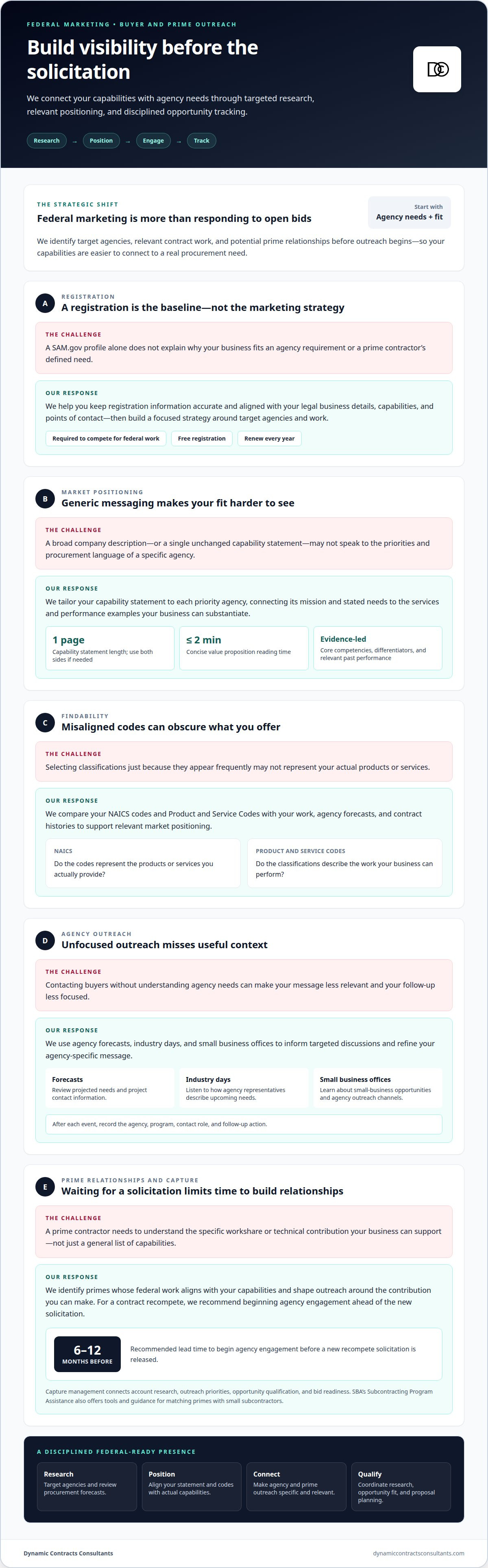
We help you market your business to the federal government by building a credible, searchable profile and clearly explaining your capabilities. Government buyers assess whether your work aligns with an agency requirement, while prime contractors seek partners who can fill defined gaps. We develop a focused federal strategy that identifies target agencies, relevant contract work, and potential prime relationships before outreach begins. For example, we can help a cybersecurity firm prioritize agencies with related procurement forecasts and primes pursuing security work.
We help you treat registration as a baseline requirement, not a marketing strategy by itself. Your business must register in the System for Award Management, or SAM.gov, to compete for federal procurement and contracts; registration is free and must be renewed every year. We can help ensure your registration information accurately reflects your legal business details, capabilities, and points of contact. Our readiness assessment can review your registration status, business positioning, evidence of past performance, and capacity to pursue selected work before outreach begins.
We also assess how your business codes shape the way buyers and primes find potential suppliers. Our readiness review can determine whether your North American Industry Classification System (NAICS) codes represent your actual products or services, and whether relevant Product and Service Codes describe your work. We compare classifications with agency forecasts and contract histories instead of selecting codes solely because they appear frequently. We can also identify capability gaps, such as limited federal past performance or insufficient proposal resources, that affect which opportunities merit pursuit.
For small businesses, we can help you build visibility with a searchable profile that enables potential buyers to learn about your capabilities. We help ensure your profile aligns with your SAM information and describes specific capabilities in language relevant to buyers. Agency Recurring Procurement Forecasts can reveal projected needs and project contact information, supporting targeted discussions with procurement specialists and contracting officers. Because these officials have distinct responsibilities, we help you keep outreach concise, relevant to an agency need, and directed through appropriate public channels.
We help you develop a separate value proposition for prime contractor outreach. Identify primes whose federal work aligns with your capabilities, then explain the specific workshare or technical contribution your business can support. SBA’s Subcontracting Program Assistance offers tools and guidance for matching primes with small subcontractors and understanding subcontracting relationships. For a contract recompete, we recommend beginning agency engagement six to twelve months before a new solicitation is released. Our capture assessment can coordinate account research, outreach priorities, and bid readiness, helping you build a network before a solicitation reaches the public.
2. Creating an agency-specific capability statement
We help you make your fit with an agency clear before a buyer reviews your proposal. Keep your capability statement to one page, using both sides if needed. We recommend leading with capabilities that address the target agency’s procurement needs, not a general company history. Include your core competencies, differentiators, relevant past performance, and business identifiers to help an acquisition team assess your fit. Your concise value proposition should take no more than two minutes to read. Every detail should support the same message: what you do, which need you address, and why your experience is relevant.
We develop a distinct statement for each of your priority agencies. We start with market research, then compare the agency’s mission, published priorities, and procurement language with your actual capabilities. We search USAspending by fiscal year and agency to review federal contract spending. This research can reveal which agencies buy work resembling yours and which program areas merit further analysis. For example, a technology firm might identify relevant spending patterns and then emphasize only services it can substantiate. We help you avoid claims that imply experience or capacity your company cannot demonstrate.
We turn research into agency-specific messaging. We use terms that reflect the target agency’s stated needs, while keeping every claim precise and supportable. If an agency prioritizes data modernization, we describe the specific data services your business provides and connect them to relevant performance examples. We differentiate your company through evidence, not broad claims such as “best-in-class.” We align the mission language, capabilities, and proof points so procurement staff can quickly understand the fit. We review the document whenever your offerings, past performance, or target program changes.
We use industry days and agency small business offices to add context beyond published procurement information. We help you use industry days to hear how agency representatives describe upcoming needs and build relevant professional relationships. Agency small business offices can discuss opportunities reserved for small businesses and explain agency-specific outreach channels. We recommend preparing a concise introduction and focused questions about the agency’s requirements. After each event, record the agency, program, contact role, and follow-up action. We use what you learn to refine your statement instead of sending an unchanged document to every contact.
We use market research to determine which evidence deserves space. We compare agency spending patterns with your capabilities, then prioritize contract examples that demonstrate relevant scope, outcomes, and performance. If your work supports a broader program, we help you explain the specific contribution your team can make without overstating its role. A clear statement serves as a practical introduction, not a substitute for solicitation-specific proposal content. For focused support refining your agency positioning and capability narrative, discuss your federal contracting goals.
3. Monitoring current procurement opportunities
We turn procurement notices into a prioritized pipeline rather than an unfiltered list. We search SAM.gov using your capabilities, relevant NAICS codes, target agencies, and contract terms, then screen notices for scope, deadlines, eligibility, and submission requirements. This helps you distinguish a plausible opportunity from one that would consume proposal resources without matching your delivery capacity. For each qualified notice, we record the solicitation, agency, decision date, responsible buyer, and next capture action.
According to the General Services Administration, the Governmentwide point of entry is the single public electronic access point for government business opportunities greater than $25,000. We monitor relevant notices there and organize them by agency, procurement category, and stage. SAM.gov searches become more useful when keywords and filters reflect how buyers describe a requirement, not only how a vendor markets its services. Federal agencies also communicate procurement needs through recurring procurement forecasts, solicitation notices, industry days, and agency small business offices.
How can we help your business find federal contracting opportunities on SAM.gov? We review your capabilities and codes, configure a focused search, and assess notices against scope, timing, and proposal readiness. We then help you prioritize pursuits and track amendments or deadlines, reducing the risk of overlooking material changes.
Our opportunity tracking considers market risk, not just notice volume. We assess whether the requirement matches your delivery model, whether the solicitation schedule is feasible, and whether your evidence supports the proposed solution. A forecast may identify a potential need, but procurement timing and requirements can change before a solicitation appears. We record each opportunity’s source, status, decision rationale, and follow-up owner to keep your pipeline actionable.
How do federal agencies market their procurement needs to vendors? Agencies publish solicitations and forecasts, hold industry days, and use small business offices to communicate procurement priorities. We connect each announcement with the buyer, program, and relevant follow-up channel.
GSA Schedules give government customers a route to acquire supplies and services from commercial suppliers, but a Schedule contract does not guarantee orders; vendors still compete for contracts or orders. We assess whether the Schedule route aligns with your offering, identify relevant agency demand, and structure a pursuit plan around the applicable buying requirements. For GSA eBuy, we organize relevant opportunities and coordinate response priorities with your broader pipeline.
How can we help your business use GSA Schedules to sell products and services to federal agencies? We connect Schedule positioning with market research, opportunity qualification, and proposal planning, while tracking each pursuit through its decision and response stages. We also keep subcontracting in view as another potential route to relevant opportunities.
4. Identifying products and services with NAICS codes
The North American Industry Classification System (NAICS) helps classify products and services across more than 1,000 industries. A well-matched code makes your business easier to categorize during federal market research and opportunity screening. Select codes based on the work your organization actually performs, not every adjacent service it might consider offering. We can map your core deliverables to likely classifications, then compare those codes with agency procurement descriptions and spending patterns.
Start with the principal service or product that best represents your federal offering. Then assess additional codes for distinct lines of business supported by real capabilities. For example, NAICS code 561720 covers janitorial services. Its listed size limit is $18 million, based on three years of average annual receipts. That example shows why code selection matters beyond search visibility: the applicable classification can affect how a business is assessed for a particular opportunity.
Code selection should connect to a target market, rather than stand alone. We can review agency forecasts, prior contract descriptions, and solicitation language to identify the classifications buyers associate with relevant work. Our analysis distinguishes your primary business from secondary capabilities, then centers outreach on the strongest match. This makes opportunity searches more precise and supports better qualification decisions when an agency’s stated need does not align with your delivery model.
NAICS and Product and Service Codes serve different classification purposes in federal procurement. NAICS codes describe an industry, while PSC codes help categorize the products or services acquired. Using both can clarify how your offering relates to an agency requirement. We can compare the solicitation’s codes with your capabilities and past performance, then flag mismatches before your team invests in a response. For example, a service description may seem relevant while its acquisition category points to a different deliverable.
The SBA Dynamic Small Business Search profile should reflect the same business focus as your federal positioning. Align its descriptions and codes with your actual products, services, and supporting experience. Consistency between the profile and capability materials helps buyers and prime contractors understand how your classifications relate to your work. Review the profile when your offerings change or market research identifies a stronger agency fit.
Federal small-business set-aside programs reserve certain opportunities for eligible small businesses. Examples include 8(a), HUBZone, WOSB, and SDVOSB programs; eligibility depends on the requirements of the relevant program and applicable certification or self-certification. Agencies also reserve opportunities for businesses with certain federal certifications and self-certifications. We can assess how your classifications and small-business status relate to target opportunities without treating a code as proof of program eligibility.
Use your code strategy to build a focused federal pipeline. We can organize searches around priority NAICS and PSC codes, compare opportunities with agency spending, and document why each pursuit fits. Reassess the codes when procurement language, agency priorities, or your product and service mix changes. This keeps business development, market research, and buyer relationships aligned around work your organization can credibly deliver.
5. Federal marketing and capture management
We help you build a position before a solicitation appears and turn that position into a qualified pursuit through disciplined capture management. Our process connects an agency’s mission and procurement priorities with buyer relationships and your ability to deliver. We develop a target account plan for each agency, documenting its programs, known requirements, incumbent landscape, and relevant contract history. This gives you a clear basis for deciding where your organization can compete and which opportunities warrant deeper investment.
We ground agency strategy in published priorities, not assumptions. We review each target agency’s five-year strategic plan to identify mission objectives and upcoming needs, then compare those priorities with agency forecasts, past awards, and your capabilities. For example, if an agency plan emphasizes modernization and your team provides relevant technical services, we test whether procurement activity supports that fit. We record the evidence, source, and remaining questions in an account plan, then update it as new notices or agency information emerge.
We establish decision gates before proposal production begins. First, we qualify each opportunity against mission fit, scope, competition, delivery capacity, and available proof points. Next, we identify decision-makers and stakeholders, map likely evaluation concerns, and define a customer-specific value proposition. Then we assign owners and dates for research, teaming discussions, solution design, and proposal inputs. Our written bid/no-bid rationale helps you keep pursuit decisions consistent when several opportunities compete for limited staff and management attention.
Federal sales cycles can last multiple years, so we help you plan for sustained investment and staged measures. We track meaningful progress, such as agency conversations, validated requirements, partner relationships, and advancement into procurement. If you are entering the federal market, we help you budget for an initial period in which federal marketing is likely to have negative ROI. We make pipeline discipline essential: leadership should review pursuit costs, timing, strategic fit, and expected workload instead of treating every notice as a forecast of near-term revenue.
GSA’s Multiple Award Schedule provides access to federal, state, and local agencies seeking products and services. We help you treat a Schedule as a route to market, not a substitute for opportunity-specific positioning or competition. The GSA Vendor Support Center provides resources on market research, business exposure, and bidding opportunities. We align those resources with target agency demand, relevant contract channels, and your sales capacity. For IT firms, the federal government has over $90 billion in annual IT spending, making agency-level qualification more useful than pursuing the market broadly.
We help you manage federal marketing as an evidence-based operating process: select agencies, validate mission fit, qualify pursuits, assign actions, and review results. SBA Procurement Center Representatives advocate for qualified small businesses to receive the maximum opportunity to compete for federal contracts. We coordinate outreach with your capture plan and keep agency priorities, partner discussions, and bid decisions connected. Discuss your federal capture strategy with us to structure a focused pursuit process.
Dynamic Contracts Consultants
Dynamic Contracts Consultants LLC helps businesses turn federal market research into a structured pursuit strategy. When agency priorities, opportunity tracking, and bid decisions need coordinated execution, our Capture Management supports qualification and proposal planning. We also provide AI-driven proposal writing, Proposal Writing, Grant Writing, and DCAA Compliance Consulting to support your procurement objectives and compliance strategy.
Engage us when your team needs a more disciplined approach to federal marketing, a clearer pursuit pipeline, or support preparing a competitive response. Our proposal work combines AI-driven development with your organization’s requirements, capabilities, and procurement lifecycle priorities.
Contact Dynamic Contracts Consultants LLC to discuss your federal contracting goals.
Turn Federal Market Intent Into a Growth Plan
Make federal growth part of your operating rhythm. Assign clear ownership for opportunity decisions, proposal inputs, and compliance coordination so market development connects to execution rather than remaining a separate initiative. A durable approach to marketing your business to the federal government depends on consistent decisions and practical alignment between your growth priorities and internal capacity.
When you need specialized support to move that work forward, Dynamic Contracts Consultants LLC offers Proposal Writing, Grant Writing, and DCAA Compliance Consulting. We can help align these capabilities with your organization’s objectives and procurement plans, giving your team a clear path from strategic intent to action.
Contact Dynamic Contracts Consultants LLC to discuss your federal growth priorities. A focused next step can help your organization build with greater clarity and purpose.
Frequently Asked Questions
How can we help your small business register to sell to the federal government?
We can organize your registration information, review your business profile for consistency, and explain how registration supports your pursuit strategy. Federal contractors must register in SAM.gov to compete for federal procurement and contracts, and registration must be renewed every year. We can also help align your registration details with your codes and capability materials, reducing conflicting descriptions across the records buyers use to assess vendors.
How can we help you obtain a UEI and register in SAM.gov?
We can guide your organization through the SAM.gov registration workflow, including the UEI step, and help coordinate accurate entity information. Consistent legal business details and points of contact make it easier to maintain a coherent profile. We can also help track registration progress and renewal timing. SAM.gov registration is free, but completing the process does not replace opportunity research, qualification, or proposal preparation.
What registrations, certifications, and documents do you need as a federal contractor?
SAM.gov registration is required before your business can win federal work, while certifications and submission documents depend on the opportunity and applicable program. A solicitation identifies the forms, representations, supporting records, and proposal components required for that procurement. We can help you treat its instructions as controlling and organize a response file around those requirements. Certifications should reflect your actual eligibility and status, not be selected solely to broaden visibility.
What are common risks and mistakes when marketing to the federal government?
We help you identify common risks, including pursuing work outside your delivery capacity, making claims unsupported by past performance, and submitting inconsistent information across registration and proposal documents. A rushed response can also miss an amendment or fail to address an evaluation requirement. For example, your proposal may describe a strong technical approach but omit a mandatory attachment from the submission package. We use structured review gates and clear responsibility for final checks to help limit these avoidable process failures.


