

Could a single overlapping responsibility be the silent killer of your next $10 million contract bid? In the high-stakes environment of federal procurement, even the most experienced firms struggle when government proposal team roles aren't clearly defined. You've likely felt the frustration of a compressed RFP window where technical experts and writers duplicate efforts. This lack of coordination often leads to narrative inconsistencies that fail to meet rigorous DCAA standards or the latest 2026 regulatory requirements.
We recognize that operational precision is the foundation of a successful submission. This article provides a structured framework for aligning your personnel through customized federal proposal templates. By standardizing these workflows, you'll learn how to eliminate narrative gaps and ensure strict adherence to the 2026 FAR revisions, including the new thresholds for certified cost data. We'll explore how a methodical approach to team accountability directly translates into higher win-rates and more secure contract awards for your organization.
Key Takeaways
- Establish clear accountability by defining specific government proposal team roles, ensuring that technical narratives and compliance requirements never overlap or fall through the cracks.
- Discover how customized templates serve as a strategic roadmap, maintaining structural consistency even when multiple subject matter experts contribute to a single submission.
- Learn to integrate DCAA-compliant accounting structures and FAR-specific requirements directly into your proposal narratives to survive rigorous Section L and M audits.
- Implement a methodical workflow that identifies existing resource gaps and replaces inefficient processes with templates tailored to your specific NAICS codes.
- Leverage AI-driven development and professional consulting to augment your internal team's capabilities and maximize win-rates in the 2026 procurement landscape.
Essential Government Proposal Team Roles and Responsibilities
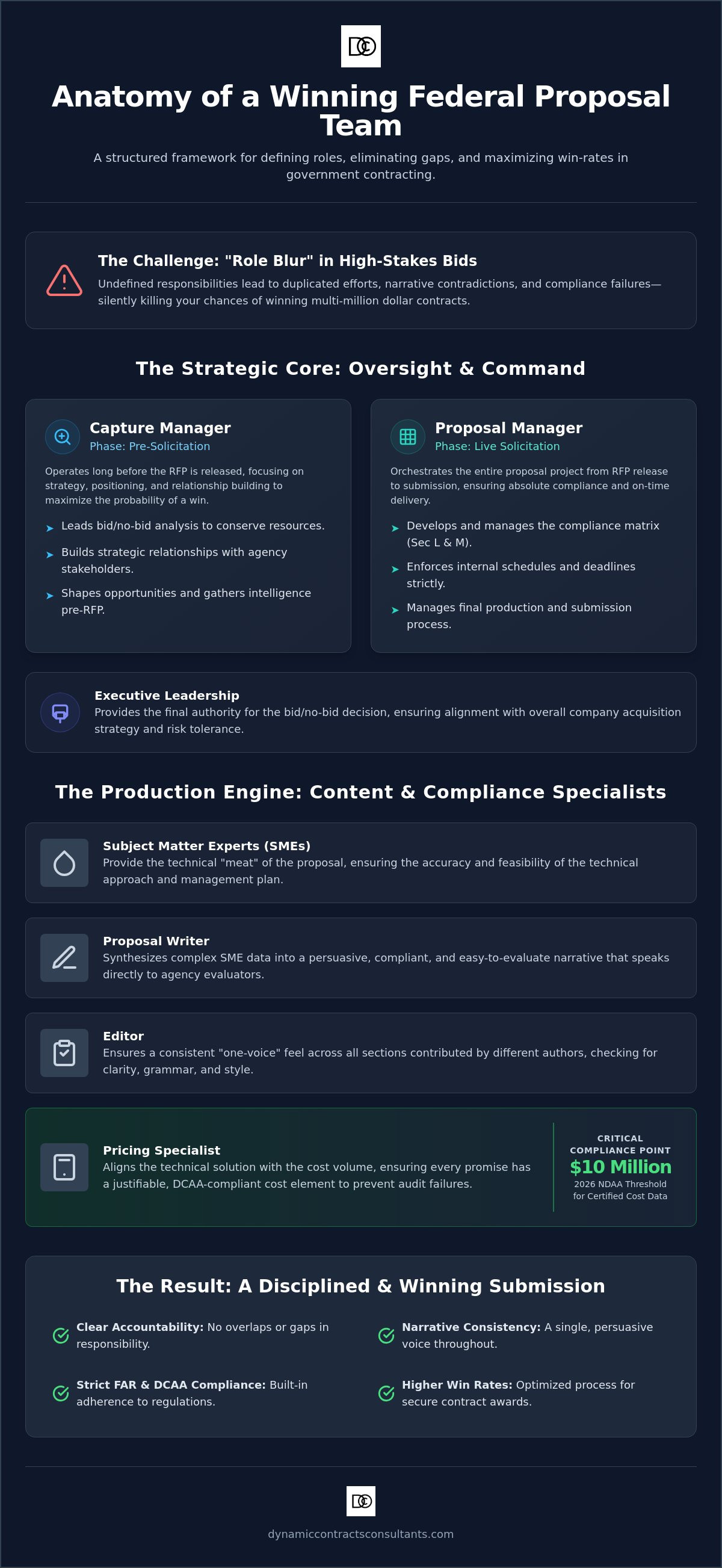
Executing a successful government contract proposal requires more than just technical aptitude. It demands a disciplined organizational structure where every contributor understands their specific lane of responsibility. We've observed that firms often struggle with "role blur," where the lack of clear government proposal team roles leads to duplicated efforts and narrative contradictions. To maximize your win-rates, you must distinguish between strategic oversight and tactical production.
The Strategic Core: Capture vs. Proposal Management
The distinction between capture and proposal management is the difference between winning the "war" and winning the "battle." The Capture Manager operates primarily in the pre-solicitation phase. Their focus remains on long-term strategy, relationship building, and pre-RFP positioning. They lead the bid/no-bid analysis, ensuring your firm doesn't exhaust resources on opportunities where the probability of win (Pwin) is low. This role is essential for identifying high-value federal opportunities before the formal RFP hits the street.
Once the solicitation is live, the Proposal Manager takes command. They don't just manage a document; they orchestrate a complex project. Their responsibilities include:
- Developing the compliance matrix to ensure every Section L and M requirement is addressed.
- Maintaining the proposal schedule and enforcing strict internal deadlines.
- Orchestrating the final production and submission process to avoid last-minute portal failures.
Executive leadership plays a vital role here, too. They shouldn't be in the weeds of writing, but they must provide the final authority for the bid/no-bid decision. This ensures the pursuit aligns with your company's overall acquisition planning and risk tolerance.
Technical and Narrative Specialists
Subject Matter Experts (SMEs) provide the technical "meat" of the submission. They're responsible for the technical approach and management plan's accuracy. Without deep SME involvement, a proposal remains a collection of generic marketing claims. However, technical experts often struggle to write for evaluators. This is why the Proposal Writer is indispensable. They synthesize SME data into a persuasive, compliant narrative. Our proposal writing services focus on this synergy, ensuring your solution is both technically sound and easy for an agency official to score.
Consistency is maintained through the editor and pricing specialists. The editor ensures a "one-voice" feel across disparate sections, while pricing specialists align the technical solution with the cost volume. With the 2026 NDAA threshold for certified cost data now at $10 million, the pricing specialist's role in maintaining DCAA compliance is more critical than ever. They ensure that every technical promise has a corresponding, justifiable cost element, protecting your firm from post-award audit failures.
How Customized Federal Proposal Templates Standardize Team Performance
Standardization in federal procurement isn't merely an aesthetic choice; it's a functional requirement for high-stakes compliance. While identifying Essential Government Proposal Team Roles provides the necessary personnel structure, these individuals require a centralized framework to operate with precision. Customized federal proposal templates serve as this roadmap. They transform abstract government proposal team roles into a sequence of concrete deliverables, providing role-specific content prompts and hard deadlines that keep the entire project on track.
A primary challenge during short RFP windows is "blank page syndrome," particularly for technical Subject Matter Experts who may not be professional writers. Templates solve this by providing pre-structured technical prompts that guide SMEs to provide the exact data points required by Section L. This ensures that the technical "meat" of the proposal is captured efficiently without requiring the Proposal Manager to constantly chase down missing information. By maintaining a centralized compliance framework within the document itself, every team member remains aligned with the solicitation's mandatory requirements from day one.
Enforcing Narrative Consistency
Multi-contributor submissions often suffer from the "Frankenstein" effect, where disparate sections vary wildly in tone and quality. Templates mitigate this risk by embedding style guides and professional brand voice requirements directly into the drafting environment. This ensures that government proposal team roles, from the narrative writer to the technical lead, utilize a unified vocabulary. These frameworks prevent redundant information across executive summaries and technical volumes. They enforce the use of active verbs and persuasive, scoreable headers that make the evaluator's job easier, ultimately increasing the likelihood of a high technical rating.
Accelerating the Development Lifecycle
Efficiency is the ultimate competitive advantage when dealing with complex federal solicitations. By utilizing pre-built section frameworks, your team can reduce the time-to-first-draft by approximately 40%. This acceleration isn't about cutting corners; it's about facilitating seamless hand-offs between writers, editors, and compliance reviewers. When the structure is predetermined, the review cycle becomes an audit of quality rather than a fix for formatting. Our proposal writing services leverage these specialized templates to ensure that your submission is ready for rigorous DCAA or FAR scrutiny well before the deadline.
If your current workflow feels fragmented or inconsistent, you might benefit from a more structured approach to document development. You can reach out to our team for an evaluation of your current proposal assets and team alignment strategies.
Role-Specific Template Requirements for FAR and DCAA Compliance
Regulatory compliance isn't a secondary task; it's the primary filter through which your proposal is evaluated. The role of the Compliance Manager is foundational to the integrity of any federal submission. Within the context of government proposal team roles, this individual serves as the final auditor, ensuring that every template response aligns perfectly with Section L instructions and Section M evaluation criteria. This isn't just about formatting. It's about verifying that the technical solution doesn't inadvertently violate regulatory constraints or miss mandatory response elements.
Integrating DCAA-compliant accounting structures into pricing narratives is particularly critical following the 2026 National Defense Authorization Act (NDAA) changes. For contracts awarded after June 30, 2026, the threshold for certified cost or pricing data has increased from $2 million to $10 million. While this reduces the administrative burden for smaller bids, templates must still be structured to support a DCAA audit if required. Our templates guide your pricing specialists to provide the necessary cost justifications that satisfy federal auditors, even as Cost Accounting Standards (CAS) thresholds for full coverage rise to $100 million.
Subject Matter Experts must also use templates to address complex FAR and DFARS flow-down clauses. For instance, the new FAR clause 52.222-90, effective as of April 2026, prohibits certain DEI activities and must be addressed in all solicitations. Templates ensure that SMEs don't overlook these mandatory provisions. Additionally, specialized staffing plan templates help your team meet specific labor category requirements, ensuring that proposed personnel qualifications match the government's defined standards exactly.
Navigating Regulatory Scrutiny
A successful proposal is only the beginning of a long-term commitment to federal standards. We help firms address their DCAA compliance consulting needs by embedding audit-ready documentation standards into the initial proposal framework. This proactive approach includes using templates to document past performance in a format that meets federal evaluation metrics. Ensuring this alignment early on facilitates a smoother transition to post-award compliance and long-term contract health.
The Compliance Matrix Integration
Mapping every RFP requirement to a specific template section and team lead ensures that nothing is overlooked during the production cycle. We utilize templates that allow for automating compliance checks, which prevents disqualification on technicalities before the proposal even reaches the evaluator's desk. A compliance matrix is a mandatory roadmap that links solicitation requirements to specific proposal pages to guarantee 100% responsiveness. This tool is the primary mechanism within government proposal team roles for maintaining total accountability across the entire submission.
Implementing a Template-Driven Proposal Workflow
Transitioning from a disorganized drafting process to a template-driven workflow requires a methodical approach that aligns your personnel with your technical assets. We've seen that even the most talented teams fail when they lack a repeatable process. To establish a high-performing environment, you must move beyond ad-hoc document creation and implement a structured implementation plan. This ensures that government proposal team roles are not just titles on an organizational chart but active components of a synchronized production engine.
- Step 1: Conduct a gap analysis. Evaluate your current team’s capabilities against your existing proposal library. Identify where roles overlap or where technical expertise is missing.
- Step 2: Procure or develop customized templates. Ensure these frameworks are tailored to your specific NAICS codes. A template for a construction contract under the Department of Veterans Affairs requires different compliance markers than an IT services bid for the Department of Defense.
- Step 3: Train SMEs and writers. Content injection is a skill. Your technical leads must learn how to provide data within the template’s constraints without compromising the narrative flow established by the writers.
- Step 4: Establish a multi-stage review process. Utilize Pink, Red, and Gold Team reviews to audit the document at various stages of maturity.
- Step 5: Conduct post-submission debriefs. Use feedback from the government to refine your templates for future pursuits, ensuring your library evolves with every bid.
The Review Cycle: From Pink Team to Gold Team
The review cycle is where the template structure proves its value. During the Pink Team stage, the focus remains on strategy and win-themes. The template ensures that these high-level concepts are mapped to the correct sections early. By the Red Team stage, the focus shifts to compliance and narrative "one-voice" consistency. Because the template pre-defines the layout, reviewers can spend their time on content quality rather than fixing formatting errors. This facilitates faster feedback loops, which is essential during high-pressure windows where every hour counts. The Gold Team provides the final polish, ensuring the submission is error-free and ready for the portal.
Continuous Template Optimization
Your template library shouldn't be static. It must evolve alongside the regulatory landscape. For example, the "Revolutionary FAR Overhaul" proposed rules released in June 2026 require contractors to be more agile in their acquisition planning. You must update your core templates to reflect these changes, as well as agency-specific preferences. DoD evaluators may prioritize different technical metrics than NASA officials. Scaling your library to include these nuances allows you to grow your federal market footprint with confidence. If you need assistance developing these specialized frameworks, you can consult with our strategic advisors to build a customized proposal infrastructure.
Optimizing Your Acquisition Strategy with Dynamic Contracts Consultants LLC
Internal alignment is the foundation of success, but external expertise often provides the necessary edge to secure high-value awards. At Dynamic Contracts Consultants LLC, we specialize in refining government proposal team roles to meet the rigorous demands of the 2026 federal market. Our methodology isn't just about personnel. It's about a holistic integration of strategy, compliance, and advanced technology that allows your firm to operate with the precision of a much larger organization.
AI-Enhanced Proposal Development
The modern federal marketplace moves too fast for purely manual processes. We leverage FARIFY.ai to augment your existing team, allowing your personnel to focus on high-value strategy rather than repetitive administrative tasks. This AI-driven platform streamlines the initial bid/no-bid analysis and acquisition planning phases by rapidly parsing solicitation requirements against your firm's core competencies. By automating the creation of compliance matrices and initial section frameworks, we help you reduce overhead costs and eliminate the human error often associated with short-turnaround submissions.
Integrating AI-generated templates with human expertise allows for a more rigorous acquisition strategy. While the software handles the data-heavy lifting of compliance tracking, our senior consultants provide the nuanced narrative "win-themes" that resonate with agency evaluators. This hybrid model ensures that every submission is not only compliant with the latest FAR revisions but also strategically positioned to maximize your technical score.
Partnering for Federal Success
One of the most significant challenges for small and mid-sized contractors is the perceived gap in resources when competing against large primes. We directly address this by providing small businesses with the same level of technical and regulatory depth found in Tier 1 firms. Our solution-driven approach covers the entire contract lifecycle, from pre-award strategy to post-award compliance and administration. We ensure your team is prepared for the increased scrutiny of the 2026 SBA 8(a) program changes and the modernized DCAA audit landscape.
Investing in professional proposal writing and DCAA compliance consulting isn't just about winning a single contract; it's about building a scalable infrastructure for long-term growth. Whether you're navigating the new $10 million TINA thresholds or implementing the latest cybersecurity standards required by the 2026 NDAA, we provide the meticulous oversight your firm needs to remain compliant and profitable. Our comprehensive support ensures that your legal and contractual obligations are handled with the highest level of professional care, allowing you to focus on delivering excellence to your government customers.
Maximizing Your Federal Competitive Advantage in 2026
Defining your government proposal team roles is only the first step toward securing high-value federal contracts. Long-term success requires a precise synthesis of specialized personnel and standardized documentation. By implementing customized templates, you ensure that every technical narrative remains compliant with the latest 2026 FAR revisions and DCAA standards. This methodical approach eliminates the common inefficiencies of role overlap and narrative inconsistency that often plague high-pressure RFP windows. It's about building a repeatable engine for growth.
As a Minority-Owned Small Business with extensive prime contract experience, we understand the complexities of competing against large organizations. Our team includes Certified Professional Contracts Managers (CPCM) who possess deep expertise in FAR, DFARS, and DCAA compliance protocols. We provide the strategic infrastructure you need to scale your federal footprint. Don't let regulatory complexity hinder your organization's growth. Schedule a consultation to optimize your proposal team today and secure your firm's position in the 2026 marketplace. Your path to consistent contract wins begins with a disciplined, compliant, and expert-driven strategy.
Frequently Asked Questions
What are the most critical government proposal team roles for small businesses?
Small businesses must prioritize the Capture Manager, Proposal Manager, and Subject Matter Expert (SME) to maintain a competitive edge. The Capture Manager identifies opportunities and leads strategic positioning, while the Proposal Manager ensures total compliance with Section L and M requirements. Because resources are often limited, these individuals must work in close coordination. Defining these government proposal team roles early prevents the duplication of effort and ensures that the final submission is both technically sound and strategically aligned.
How do customized federal proposal templates improve win-rates?
Customized templates improve win-rates by enforcing structural consistency and ensuring every mandatory FAR requirement is addressed. Evaluators score proposals based on specific criteria; templates provide a roadmap that makes it easier for them to find and award points for your solution. By reducing the time spent on formatting and administrative tasks, your team can focus on refining win-themes and technical innovations. This methodical approach leads to higher-quality submissions that survive rigorous agency scrutiny.
What is the difference between a Capture Manager and a Proposal Manager?
The Capture Manager focuses on the pre-solicitation phase, while the Proposal Manager takes command once the RFP is released. Capture management involves relationship building, competitive intelligence, and determining the probability of win. In contrast, the Proposal Manager is a tactical lead responsible for the production schedule, compliance matrix, and final delivery. Both roles are essential for a successful acquisition strategy, but they operate at different stages of the contract lifecycle to ensure long-term success.
Can AI replace human roles in a government proposal team?
AI cannot replace human expertise in government contracting, but it can significantly augment standard government proposal team roles. Tools like FARIFY.ai automate repetitive tasks such as compliance tracking and initial draft generation, allowing your team to focus on complex strategy and relationship management. Human oversight remains mandatory for final technical validation and ensuring that the narrative reflects your firm's unique value proposition. AI acts as a force multiplier that increases efficiency without sacrificing professional judgment.
How do templates ensure DCAA compliance during the proposal phase?
Templates ensure DCAA compliance by providing pre-structured sections for cost justifications and accounting data that meet federal audit standards. With the 2026 NDAA raising the TINA threshold to $10 million for contracts awarded after June 30, many contractors must still provide detailed cost data for larger bids. Specialized templates guide your pricing specialists to use the correct labor categories and indirect rate structures. This proactive documentation reduces the risk of audit findings and protects your firm's financial integrity.
What should be included in a standard federal proposal template?
A standard federal proposal template must include a compliance matrix, a detailed style guide, and pre-formatted sections that mirror Section L instructions. It should provide specific prompts for technical approaches, management plans, and past performance citations. Effective templates also incorporate placeholders for mandatory FAR and DFARS clauses, such as the April 2026 DEI activity prohibitions. These elements work together to ensure that the final document is responsive, persuasive, and easy for government officials to evaluate.
How do I manage SME input when they are not professional writers?
Managing Subject Matter Expert (SME) input requires the use of structured technical prompts within your templates. Instead of asking SMEs to write entire sections, provide them with specific questions that extract the necessary technical data. The Proposal Writer then synthesizes this information into a compliant narrative. This process allows your technical leads to focus on solutioning while ensuring the final document remains professional and strategically aligned with the government's requirements.
What is the "Red Team" review and why is it essential for compliance?
The Red Team review is a formal evaluation of the near-final proposal to simulate how a government source selection board will score the submission. This stage is essential because it identifies compliance gaps and narrative weaknesses before the final submission deadline. Reviewers act as adversaries who critique the document against Section M evaluation criteria. This rigorous internal audit ensures that the final proposal is 100% responsive and maximizes your firm's probability of winning the contract.


