

With the federal government projected to commit $375.5 billion to prime contracts in 2026, the margin for administrative error has never been thinner. You're likely feeling the weight of recent FAR rewrites and the DCAA's transition to a "hub" model; these shifts have transformed oversight from a periodic hurdle into a constant, data-driven presence. Mastering federal contract lifecycle management in this climate requires more than just administrative diligence. It demands a strategic discipline where compliance and profitability are inextricably linked.
We understand that the fear of DCAA audit failures or the exhaustion of chasing low-probability bids can stifle your firm's growth. This guide provides a strategic framework to help you master the complexities of the federal contract lifecycle, from strategic capture to post-award compliance. We'll explore how to leverage AI-driven proposal development and rigorous bid/no-bid analysis to increase your win rates while maintaining an audit-ready posture. By following these expert-led methodologies, you'll reduce your administrative burden and scale your federal footprint with confidence.
Key Takeaways
- Learn how to integrate AI proposal writing with strategic capture management to accelerate submission timelines while improving technical accuracy and bid/no-bid decision-making.
- Understand the critical requirements for DCAA-compliant accounting systems and indirect rate structures to ensure your firm's eligibility for lucrative cost-reimbursement contracts.
- Discover how to effectively manage post-award administration and flow-down clauses to protect your interests and maintain rigorous performance standards throughout the contract term.
- Shift your perspective by treating federal contract lifecycle management as a multi-phase strategic framework rather than a series of disconnected administrative tasks.
- Identify why specialized consulting expertise is essential for bridging the gap between automated software solutions and the nuanced regulatory demands of the 2026 federal marketplace.
The Fundamentals of Federal Contract Lifecycle Management
Many organizations mistakenly view Contract Lifecycle Management (CLM) as a simple administrative checklist or a software-driven workflow. In the federal marketplace, this narrow perspective represents a significant strategic risk. True federal contract lifecycle management is a multi-phase framework that demands rigorous adherence to the Federal Acquisition Regulation (FAR) and agency-specific supplements like the DFARS. While commercial contracting often allows for flexibility and negotiation, federal agreements are governed by a rigid legal structure where non-compliance can lead to severe financial penalties or debarment.
Adopting a "cradle-to-grave" approach is essential for maintaining your firm's long-term organizational stability. Every action, from the initial capture phase to the final audit, contributes to your federal reputation and past performance record. A single "Material Weakness" identified during a DCAA audit can disqualify you from future cost-reimbursement contracts; therefore, methodical oversight is a prerequisite for growth. We help you move beyond the reactive nature of many small firms by establishing a lifecycle that anticipates regulatory hurdles before they impact your bottom line.
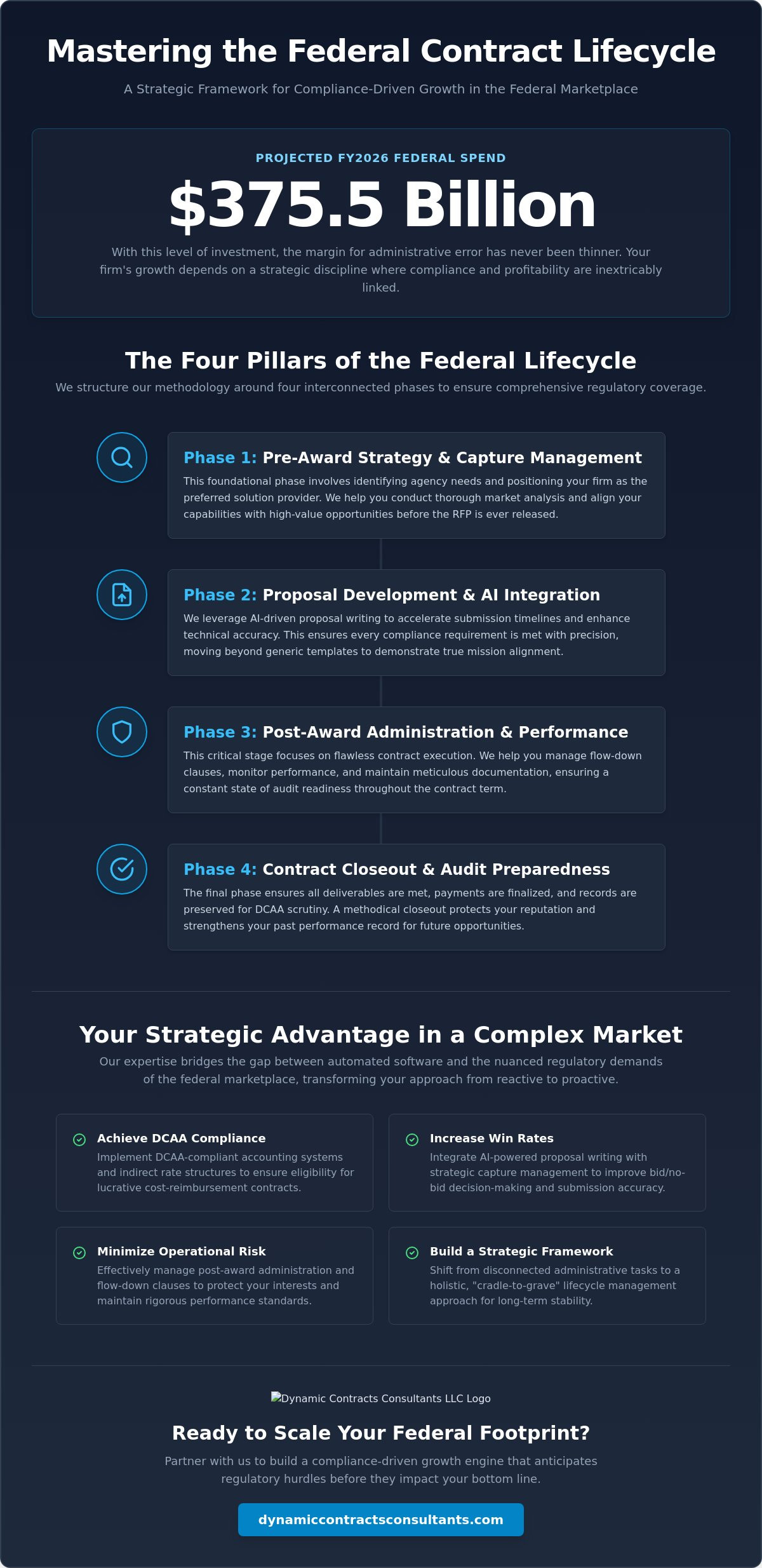
The Four Pillars of the Federal Lifecycle
We structure our methodology around four distinct yet interconnected phases to ensure comprehensive coverage of the regulatory landscape:
- Phase 1: Pre-award strategy and capture management. This phase involves identifying agency needs and positioning your firm as the preferred solution provider before the RFP is released.
- Phase 2: Proposal development and AI integration. We utilize AI proposal writing to accelerate submission timelines while ensuring every technical and compliance requirement is met with precision.
- Phase 3: Post-award administration and performance monitoring. This stage focuses on executing the contract, managing flow-down clauses, and maintaining audit readiness through consistent documentation.
- Phase 4: Contract closeout and audit preparedness. The final phase ensures all deliverables are met, payments are finalized, and records are preserved for DCAA scrutiny.
Strategic Importance of Acquisition Planning
Effective lifecycle management begins with disciplined acquisition planning. This process aligns your organizational capabilities with federal agency mission requirements, ensuring you aren't wasting resources on low-probability bids. By conducting thorough market analysis, we help you identify high-value opportunities that match your specific certifications, such as SDVOSB, WOSB, or 8(a) status. Establishing a regulatory roadmap before the first solicitation is released allows you to address potential compliance gaps early. This strategic foresight transforms your approach from reactive bid-chasing into a proactive, compliance-driven growth engine that maximizes your win potential while minimizing operational risk.
Strategic Pre-Award Execution: Capture and Proposal Development
Winning a federal contract requires more than meeting technical specifications; it requires a seamless transition from intelligence gathering to narrative execution. We often observe firms that fail because they treat capture and proposal development as isolated silos. In our framework, the intelligence gathered during the capture phase serves as the direct foundation for your proposal. This ensures that every response addresses the specific mission objectives and pain points of the awarding agency, moving beyond generic compliance to demonstrate true mission alignment.
Strategic capture is the engine of effective federal contract lifecycle management. It's where we transform raw market data into a persuasive narrative that highlights your unique value proposition. By utilizing customized proposal templates, we ensure your submission meets rigorous agency-specific formatting requirements, whether you're targeting a GSA Schedule or a complex DoD acquisition. This methodical approach prevents the technical disqualifications that often plague firms relying on one-size-fits-all documentation.
The Bid/No-Bid Decision Framework
Resource allocation is critical when the federal government is projected to spend approximately $375.5 billion on prime contracts in FY2026. You shouldn't pursue every opportunity that appears on SAM.gov. Our disciplined bid/no-bid analysis evaluates technical feasibility and past performance requirements against the competitive landscape. We perform a quantitative risk assessment to calculate the true cost of pursuit, ensuring you only invest in opportunities where you have a clear path to victory. If you need assistance refining your selection process, our team provides expert Capture Management services to maximize your return on investment.
AI-Driven Proposal Development
Speed often determines success in high-stakes procurement, especially during the heavy Q4 spending period where agencies complete 35-40% of their annual obligations. We integrate AI proposal writing to draft compliant technical responses and past performance citations with unprecedented efficiency. This technology allows us to manage complex, multi-volume submissions without sacrificing technical accuracy. However, AI is a tool, not a replacement for expertise. Every AI-generated draft undergoes rigorous human review to ensure it meets strict FAR and DFARS standards. This hybrid approach streamlines the RFP response management process, allowing your subject matter experts to focus on the high-level strategy that differentiates your firm from the competition.
DCAA Compliance and Regulatory Risk Mitigation
Securing a federal award is merely the initial phase of a successful partnership; maintaining that award requires a financial infrastructure capable of withstanding rigorous scrutiny. Effective federal contract lifecycle management hinges on your ability to demonstrate total financial transparency and regulatory alignment from day one. For firms pursuing cost-reimbursement contracts, a DCAA-compliant accounting system isn't just a best practice; it's a mandatory prerequisite. We focus on ensuring your systems can accurately segregate direct and indirect costs, which is the cornerstone of passing a Pre-Award Survey (SF 1408).
The regulatory environment in 2026 has introduced new complexities that demand your attention. As of June 30, 2026, the threshold for Certified Cost or Pricing Data has increased to $10 million, and the Cost Accounting Standards (CAS) applicability threshold has risen to $35 million. While these increases provide some relief for smaller contracts, they don't exempt you from the fundamental requirement of maintaining an audit-ready posture. We help you navigate the interplay between FAR Part 31 cost principles and DFARS requirements to ensure your financial reporting remains beyond reproach, regardless of contract size.
Essential DCAA Audit Preparation
The DCAA's April 2026 reorganization into a "hub" model has increased the prevalence of virtual audits and data-driven assessments. To stay ahead, you must maintain a "single source of truth" for all contract-related financial data. This involves more than just software; it requires a culture of compliance. We recommend the following steps to identify potential red flags before an auditor does:
- Conduct regular internal compliance audits to verify the accuracy of labor distribution.
- Implement rigorous staff training on timekeeping standards; even minor errors in labor charging can trigger a "Material Weakness" finding.
- Ensure all documentation for unallowable costs is clearly segregated and easily accessible to demonstrate transparency.
Indirect Rate Consulting Strategies
Your indirect rate structure determines both your competitiveness in the bidding phase and your ability to recover costs during execution. We provide strategic frameworks for DCAA indirect rate consulting that balance these two competing needs. By optimizing your cost pools, including fringe, overhead, and G&A, we help you remain lean enough to win bids while ensuring you don't leave money on the table. Managing the transition from provisional to final indirect rates requires meticulous year-end incurred cost submissions (ICS). Our approach ensures you're prepared for these negotiations, preventing the financial strain that occurs when final rates are significantly lower than anticipated.
Post-Award Administration and Flow-Down Management
Transitioning from a successful award to operational execution marks a critical pivot in federal contract lifecycle management. While winning the bid is a significant milestone, your firm's long-term profitability depends on your ability to translate proposal promises into compliant performance. This phase requires rigorous oversight to ensure every deliverable meets the agency's technical standards while adhering to the financial constraints established during the capture phase. Effective administration prevents scope creep and ensures that contract modifications are handled through formal Requests for Equitable Adjustment (REA) when necessary.
We see many prime contractors struggle with the administrative weight of managing subcontractors. You aren't just responsible for your own performance; you're legally accountable for the compliance of your entire supply chain. Managing this risk requires a sophisticated understanding of how to protect your firm from subcontractor-driven audit failures or performance delays. Our experts specialize in Post-Award Contract Administration to ensure your execution phase is as strategic as your capture phase.
Effective Flow-Down Clause Management
Protecting your interests as a prime contractor necessitates a strategic approach to flow-down clauses. You must distinguish between mandatory flow-downs, which the FAR requires you to include in every subcontract, and discretionary clauses that mitigate your specific operational risks. For instance, if your prime contract includes strict DCAA accounting requirements or CMMC cybersecurity standards, these must be mirrored in your agreements with subcontractors to prevent a break in the compliance chain. We help you establish oversight frameworks that verify subcontractor compliance before issues arise, ensuring that your "hub-model" DCAA audits remain clean across all tiers of performance.
Contract Closeout Protocols
The lifecycle doesn't end when the final deliverable is shipped. Standardized procedures for contract closeout are essential for resolving outstanding funding issues and finalizing indirect rate adjustments. In the 2026 regulatory environment, where agencies are increasingly data-driven, your closeout efficiency directly impacts your future past performance citations. You must ensure that all final invoices are submitted and that the government's 4.125% prompt payment interest rate is applied correctly to any late payments. Archiving this data properly allows you to build a robust library of past performance that serves as the foundation for your next strategic growth effort.
The Consultant Advantage in Federal CLM Optimization
Many organizations assume that purchasing a high-end software suite solves their administrative challenges. In reality, software is a passive tool that lacks the contextual awareness required for high-stakes federal contract lifecycle management. A platform can track a deadline, but it can't interpret the strategic intent behind a specific RFP requirement or navigate the professional judgment required during a DCAA audit. We provide the human expertise necessary to bridge the gap between automated workflows and the complex reality of federal procurement. This expert-led oversight protects your organization from "contract risk," which often stems from subtle misinterpretations of flow-down clauses or indirect rate allocations that software alone cannot detect.
Our approach at Dynamic Contracts Consultants LLC integrates cutting-edge technology with decades of hands-on experience. We don't just provide a service; we act as a strategic partner that minimizes your operational risk while maximizing your growth potential. By focusing on "audit readiness" as a continuous state rather than a reactive task, we ensure your firm is always prepared for the next opportunity. This partnership model is particularly valuable for small to mid-sized firms that need the authority of a full-scale compliance department without the associated internal costs.
Integrating AI with Human Expertise
We leverage AI-driven proposal development to handle the labor-intensive aspects of submission, such as initial technical drafting and past performance cross-referencing. This allows our consultants to focus their efforts on strategic nuance and win-theme development. Our customized proposal templates serve as a force multiplier for small teams, providing a professional, compliant structure that meets the specific formatting demands of different agencies. By utilizing these advanced tools, we significantly accelerate the proposal lifecycle without sacrificing the technical accuracy that federal evaluators demand. AI-driven proposal development at Dynamic Contracts Consultants reduces the time required for complex RFP responses, enabling your team to pursue a higher volume of opportunities without increasing your internal overhead.
Securing Your Federal Future
Investing in professional contract administration isn't a cost; it's a strategic investment in the long-term ROI of your business. A disciplined CLM framework allows you to build a scalable operation that can withstand the scrutiny of the DCAA's new "hub" model and evolving FAR/DFARS standards. By outsourcing the complexities of compliance to specialized experts, you free your leadership team to focus on mission delivery and business development. This methodical oversight protects your firm from the financial penalties and past performance damage that result from administrative negligence. Contact Dynamic Contracts Consultants LLC for a strategic CLM audit today.
Securing Your Competitive Edge in the 2026 Federal Marketplace
The 2026 federal landscape demands a shift from reactive administration to a proactive, compliance-driven methodology. By integrating AI-driven proposal development with expert-led capture management, your firm can navigate the complexities of procurement with speed and precision. We've demonstrated how maintaining an audit-ready posture through rigorous DCAA compliance consulting isn't just about risk mitigation; it's a strategic prerequisite for high-value awards. Mastering federal contract lifecycle management ensures that every phase, from initial market analysis to final contract closeout, strengthens your firm's reputation and past performance record.
As agencies transition to data-driven oversight and the DCAA implements its "hub" model, the value of a specialized partner becomes clear. We help you bridge the gap between software automation and the strategic nuance required to win and execute complex government contracts. It's time to transform your administrative burden into a scalable growth engine. Request a Strategic Consultation for Federal Contract Success today. We're ready to help you navigate this complex environment and secure your firm's future growth.
Frequently Asked Questions
What is the primary difference between commercial and federal contract lifecycle management?
The primary difference lies in the regulatory governance of the Federal Acquisition Regulation (FAR) and agency-specific supplements. While commercial contracts are governed by the Uniform Commercial Code and mutual negotiation, federal agreements include non-negotiable clauses that apply by operation of law. This environment requires a level of transparency and audit readiness that's absent in the private sector, making specialized federal contract lifecycle management a necessity for organizational survival.
How does DCAA compliance consulting help in the pre-award phase?
DCAA compliance consulting prepares your firm for the Pre-Award Survey (SF 1408) by validating your accounting system's ability to segregate costs. This is a critical prerequisite for receiving cost-reimbursement awards. Consultants identify potential deficiencies in your labor distribution and timekeeping policies before the government conducts its assessment. This proactive approach ensures your internal controls meet the rigorous standards required to compete for lucrative, high-stakes federal opportunities.
What are flow-down clauses and why are they critical for federal contractors?
Flow-down clauses are provisions from a prime contract that you must incorporate into your subcontracts to ensure compliance across the supply chain. They're critical because the prime contractor remains legally responsible for the subcontractor's performance and adherence to regulations like CMMC or labor standards. Failure to manage these clauses correctly can lead to performance delays and severe financial penalties during a government audit of your contract administration processes.
Can AI truly write a compliant federal proposal?
AI can generate technical drafts and past performance citations with high efficiency, but it can't produce a fully compliant proposal without expert review. Federal solicitations contain unique, complex instructions that require human strategic nuance to ensure every requirement is met. We use AI as a force multiplier to accelerate timelines, while our consultants provide the final layer of scrutiny to ensure the submission aligns with FAR standards.
What is a bid/no-bid analysis and why is it essential for ROI?
A bid/no-bid analysis is a quantitative assessment of your probability of win (PWin) compared to the resources required for the pursuit. It's essential for ROI because it prevents your firm from wasting capital on opportunities where you lack technical feasibility or past performance. By focusing only on high-probability bids, you maximize the efficiency of your capture management budget and increase your overall win rate in a competitive marketplace.
How long does a typical federal contract closeout process take?
The duration of the closeout process depends heavily on the contract type. Firm-fixed-price contracts are typically closed within six months of physical completion. However, cost-reimbursement contracts can take several years because they require the settlement of final indirect rates and a final DCAA audit. Maintaining organized records throughout the federal contract lifecycle management process is the only way to prevent these timelines from extending indefinitely.
What happens if my accounting system is not DCAA compliant?
If your accounting system is found to be non-compliant, you'll be ineligible for cost-reimbursement contracts and progress payments. Under the DCAA's 2026 guidelines, serious deficiencies are classified as "Material Weaknesses," which can trigger increased audit scrutiny and the withholding of payments. This lack of compliance effectively caps your firm's growth potential and damages your reputation with contracting officers who prioritize low-risk, audit-ready partners.
Why should I hire a consultant for post-award administration instead of using software?
Software is a passive data-tracking tool, but a consultant provides the professional judgment needed to navigate complex regulatory shifts. Experts can interpret the strategic impact of FAR rewrites or negotiate Requests for Equitable Adjustment (REA) during performance. While software can alert you to a deadline, a consultant understands the nuances of the DCAA's "hub" model and can manage the high-stakes communications required to protect your firm's financial interests.


