

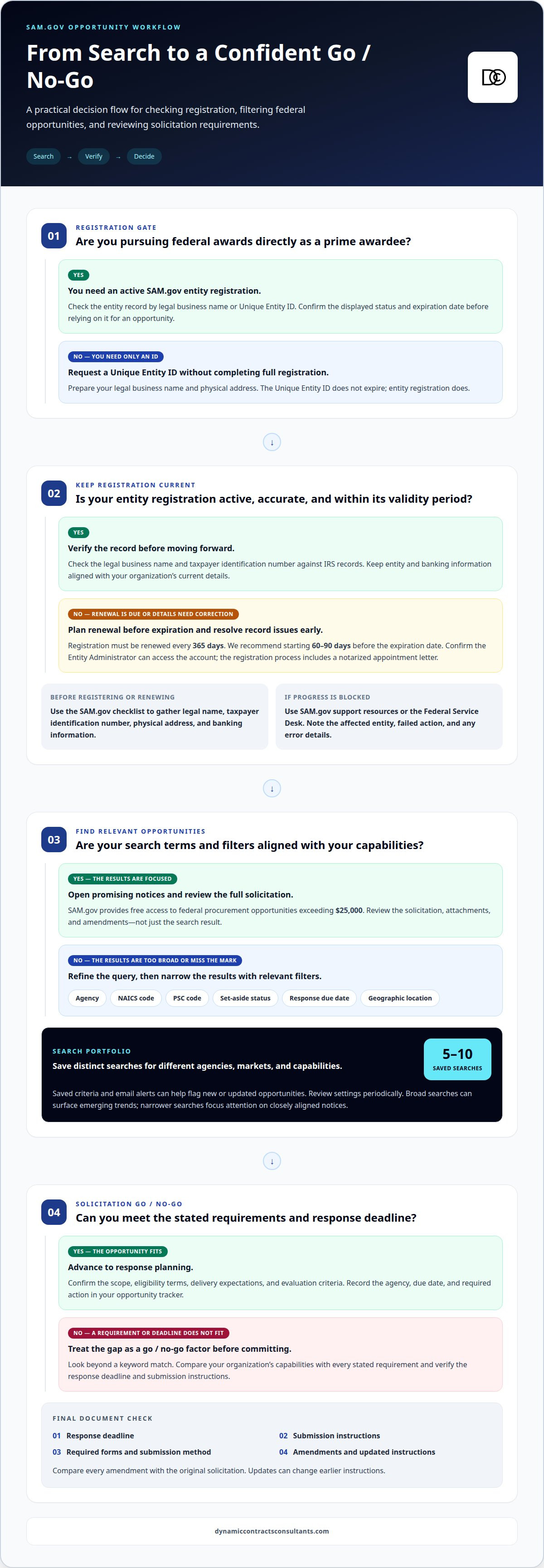
We help you use SAM.gov effectively by narrowing searches with relevant filters, keeping your registration active through renewal every 365 days, and maintaining accurate entity and banking details.
Finding a federal opportunity is only one part of your procurement process. We also help you keep your registration current and find the support you need. This guide explains how to search and filter opportunities by agency, NAICS code, location, and response date, then covers registration renewal, banking-detail updates, and support resources. Together, we’ll clarify your process for using SAM.gov in your federal contracting workflow.
Key Takeaways
- We help you choose between entity registration and a Unique Entity ID based on whether you need to pursue federal awards directly.
- We recommend building focused opportunity searches, saving useful queries, and using alerts to track new postings.
- We help you align NAICS and PSC codes with your capabilities, then narrow results by agency, location, and other filters.
- We recommend using SAM.gov self-service tools and the federal service desk to address account, registration, and opportunity questions.
- We recommend keeping banking details and entity information aligned with your organization’s current federal profile.
Annual registration renewal
We help you keep your entity registration active by renewing it every 365 days. Together, we can choose the correct SAM.gov path, monitor status, and resolve errors before they interrupt your federal contracting actions.
- We help you decide whether you need full entity registration or only a Unique Entity ID. Organizations pursuing federal awards directly as prime awardees need an active SAM.gov registration. If you need only a Unique Entity ID, we can guide you through requesting one without completing registration, using your legal business name and physical address. The ID does not expire, but registration does.
-
Check Entity Registration Status
We recommend searching SAM.gov entity registrations by legal business name or Unique Entity ID. Check the displayed status and expiration date before relying on the record for a federal opportunity. A search result helps you find the entity record, but it does not renew the registration. If details look incorrect, we can help you confirm that you have the right entity before taking action.
- We recommend starting renewal 60-90 days before the registration expiration date. SAM.gov registration must be renewed every 365 days to remain active, so use the expiration date as your planning reference. Review the entity name and taxpayer identification number against IRS records. Mismatches can cause delays or rejection. We can help you update information during renewal or at another time and submit changes through the appropriate entity administrator.
We help you resolve account access and role issues before submitting. The entity appoints an Entity Administrator, and the registration process includes a notarized appointment letter. Make sure the responsible administrator can access the account and complete the required actions. Correcting an inaccurate entity record early helps maintain continuity throughout your procurement lifecycle.
-
Use Registration Checklists and Support
We recommend using SAM.gov’s entity registration checklist to gather the required information before registering or renewing. Prepare consistent details for the legal name, taxpayer identification number, physical address, and banking information. For a Unique Entity ID request without registration, prepare the legal business name and physical address. The checklist helps distinguish this limited request from full registration.
If an account, role, or registration issue blocks progress, we can help you use SAM.gov’s support resources or contact the Federal Service Desk. Describe the affected entity and the action that failed, such as submitting a renewal or accessing the administrator account. Keep the registration record and error details handy. Clear information helps pinpoint whether the problem involves account access, entity data, or a pending registration action.
Searching federal contract opportunities
We use SAM.gov to help you find federal contract opportunities and organize searches around your capabilities. Together, we can apply a focused process to separate relevant solicitations from broader procurement activity.
- Open the Contract Opportunities search and enter a capability, agency, or NAICS code. SAM.gov provides free access to federal procurement opportunities exceeding $25,000. Use filters such as agency, set-aside status, response due date, and geographic location to narrow results. We recommend beginning with a relevant term, then refining results rather than relying on one broad keyword.
-
Filter and Review Solicitation Details
Open promising notices and review the solicitation, amendments, and attachments. Before deciding whether to pursue an opportunity, find the response deadline, submission instructions, required forms, and designated submission method. Amendments can change earlier instructions, so compare every update with the original solicitation. We help you treat the deadline and submission requirements as key go/no-go factors.
- Assess whether the opportunity fits your organization’s capabilities and procurement strategy. Read the scope, eligibility terms, delivery expectations, and evaluation criteria in the solicitation. Record the agency, due date, and required action in your opportunity tracker. We recommend looking beyond a strong keyword match to confirm your business can meet every stated requirement.
-
Save Searches and Set Email Alerts
Refine your search terms and filters, save the search, and enable email notifications where available. We recommend creating separate searches for distinct markets, such as one focused on an agency and another on broader capabilities. Saved searches retain useful criteria, while alerts can flag new or updated opportunities. Review the settings periodically to keep them aligned with your priorities.
- Maintain a balanced search portfolio rather than depending on one query. We recommend creating 5-10 saved searches across your business interests and market segments. Broad searches can reveal emerging trends or unexpected opportunities; narrower searches concentrate attention on closely aligned notices. Together, we can use SAM.gov effectively while tracking distinct opportunity areas.
- Consider using a small-business profile search alongside your SAM.gov opportunity research. Keep your business profile consistent with the capabilities and markets covered by your searches. Contracting teams may use profile details to assess whether a small-business source is relevant, so clear capability descriptions can help them find your organization. We recommend treating the profile as a complement to, not a substitute for, reading solicitations.
Search access on SAM.gov is free for federal opportunities exceeding $25,000. Paid third-party services are separate from SAM.gov access; evaluate any proposed service independently before paying. We recommend locating the deadline and submission instructions in the notice and associated documents, then reviewing amendments for changes before you prepare a response.
Filtering opportunities by NAICS code, agency, location, and value
We recommend starting with your organization’s capabilities, then narrowing federal opportunity results using SAM.gov filters. To use SAM.gov effectively, combine relevant codes with agency, location, set-aside, and response-date criteria that align with your business priorities.
-
Select NAICS and PSC Codes
We recommend choosing NAICS codes that match the work your business performs, rather than every service it might offer. SAM.gov searches can filter by NAICS, so select codes that accurately describe your capabilities. Add PSC codes when they help identify the product or service an opportunity requires. Compare each code with the solicitation description: a code match alone does not establish that the work fits.
-
Identify Relevant Codes and Opportunities
Review your core offerings and identify 5-10 NAICS codes that represent them. For example, an engineering firm should choose codes reflecting its specific engineering work. Search each code in SAM.gov, then compare notices with your capabilities. A broader set may reveal adjacent opportunities, while a focused selection can reduce unrelated results. We recommend treating code selection as a starting point, not a final eligibility decision, as you learn how to use SAM.gov effectively.
- Filter by agency when you have identified departments whose missions align with your services. We recommend comparing results across agencies, since notices may describe similar work differently. Then use the geographic filter to narrow opportunities by location. Read each solicitation for the actual place of performance; the search filter cannot replace the notice’s specific requirements.
- Use response due dates to match search results with your proposal capacity and review schedule. A due-date filter helps you separate immediate actions from future planning. Record the deadline and status for each relevant notice, and check for amendments that could change your next steps. A revised due date, for example, may require a different internal review sequence.
- Use award-value information as an initial screening factor when it appears in an opportunity record. Compare the stated value with the scope, deliverables, and contract structure. Treat an estimate as a screening detail, not a confirmed award amount. If SAM.gov offers a value filter, select a range suited to your delivery capacity, then review the solicitation for context.
- Assess filtered results as a whole instead of relying on an individual code match. For example, compare results for one NAICS code across agencies, locations, and response dates. Adjust your criteria if relevant federal contracts disappear from view, and save useful combinations for later searches. Keep your entity profile’s capability information aligned with your selected codes, and review it when your business activities or registration details change. We can help you refine your search criteria to support informed opportunity decisions.
Getting help through self-service resources and the federal service desk
We recommend using SAM.gov’s self-service resources for routine account and registration questions, then contacting the Federal Service Desk if an issue remains unresolved. For a grant or procurement question, identify the specific notice, entity, or requirement involved before seeking help. We can help you clarify the relevant process.
- Start with SAM.gov’s self-service help resources and choose the topic that matches your task. For example, distinguish a login problem from a question about entity registration status. Read the relevant instructions before repeating a registration action. We can help you clarify whether your next step concerns account access, entity data, or a federal opportunity.
- If self-service steps do not resolve the issue, we recommend preparing a concise request for the Federal Service Desk. Include the entity’s Unique Entity ID, current registration status, and the action that produced the error. Describe the problem plainly, such as an unsuccessful registration update or blocked administrator access. Do not include unnecessary sensitive information in the support request.
- To find federal grants, search SAM.gov for assistance opportunities and read each agency’s notice. We recommend comparing eligibility criteria, submission instructions, and program-specific requirements before preparing an application. SAM.gov certifications for grant applicants cover financial assistance eligibility, debarment and suspension requirements, and program-specific compliance issues. Use the agency’s notice as the basis for preparing your application, and we can help you assess the requirements.
- Keep grant questions separate from registration questions when requesting help. A Unique Entity ID identifies an entity, while active registration serves a different purpose for direct federal awards. State whether your issue concerns the entity record, an assistance opportunity, or the agency’s application requirements. This distinction helps direct your question to the relevant process, and we can help you identify the right path.
- For procurement compliance, review the representations and certifications in your SAM.gov registration carefully. These include affirmations under the Federal Acquisition Regulation and compliance with the Buy American Act. Federal contractors must have active SAM registration when submitting an offer and when a contract is awarded under FAR 52.204-7. We recommend treating registration status as one compliance checkpoint in the procurement lifecycle.
- For a question about a specific contract, identify the agency, solicitation, and relevant clause before seeking assistance. For example, distinguish an account-access problem from uncertainty about a contract requirement. SAM.gov support can address system or registration issues; analyzing procurement compliance may require reviewing the solicitation and applicable contract terms. We can help you assess those requirements.
- For a payment concern, identify whether it involves banking information in the entity record or an agency payment process. Name the relevant entity and describe the issue without including full banking credentials. This distinction helps prevent registration support questions from being confused with payment administration, and we can help you determine the relevant process.
Banking information and NAICS codes
We help you manage banking details and NAICS codes as distinct parts of your SAM.gov entity record. They support different federal processes: electronic payments and opportunity classification.
- We recommend opening your entity registration record and locating the banking information section. SAM.gov uses banking information for electronic fund transfers connected with federal processes. Enter details from your organization’s financial records, and make sure the account is appropriate for organizational payments. Do not use a personal account to register an organization.
- We recommend reviewing banking details whenever your organization changes its payment account. You can update SAM.gov registration information at any time or during renewal. After an update, check the record’s status to see whether the registration remains active. A banking change does not itself renew your registration or resolve a separate payment matter with an agency.
- We help you keep your government profile consistent with the entity’s legal identity. Compare the registered entity name with IRS records, since a mismatch can delay or affect registration. The bank account and entity details are related but distinct: the account supports electronic transfers, while the legal name identifies the organization in federal processes.
- We recommend choosing NAICS codes that describe your organization’s actual business activities. Use the official code descriptions to decide whether a code matches the work your business performs. For example, an organization providing engineering services should select a code that reflects that activity, not a loosely related capability. Accurate classification makes federal opportunity searches more relevant.
- We help you use selected NAICS codes consistently in your SAM.gov profile and opportunity research. Search Contract Opportunities using relevant codes, then compare each notice’s scope with your services. If a code returns unrelated results, reassess whether it fits rather than adding more codes indiscriminately. The solicitation description remains essential for deciding whether the required work matches your organization.
- We recommend reviewing both record areas after significant organizational changes. A change to banking information calls for an entity-record update; a change in business activities may require reviewing your NAICS codes. Involve the Entity Administrator in SAM.gov registration actions. This keeps payment-data maintenance separate from classification decisions and supports accurate federal records.
Dynamic Contracts Consultants
Dynamic Contracts Consultants LLC can help when SAM.gov research leads to proposal, grant, compliance, or capture work. We connect opportunity decisions with the preparation and strategic execution needed across the federal procurement lifecycle. The right support depends on your next step: pursuing a solicitation, preparing an assistance application, or addressing compliance within your contracting operations.
Turn to us when a solicitation fits your capabilities but your team needs structured support developing its response. Our Proposal Writing service helps organize a submission around the agency’s requirements and your organization’s capabilities. For federal assistance opportunities, our Grant Writing service supports application development aligned with program requirements. In both cases, use the opportunity notice to understand what the agency requests and how to organize your response.
- Proposal Writing: We help structure a response around solicitation requirements, evaluation criteria, and your organization’s capabilities.
- Grant Writing: We support application development that connects program requirements with your proposed work and organizational information.
- DCAA Compliance Consulting: We help organizations address compliance considerations relevant to federal contracting operations.
- Capture Management: We support opportunity planning and pursuit strategy, helping your team assess how an opportunity fits its business objectives.
These services support different stages of the pursuit process. Capture Management informs decisions about whether to pursue an opportunity; Proposal Writing supports the response after that decision. Grant Writing serves organizations pursuing assistance rather than contracts. DCAA Compliance Consulting is relevant when compliance considerations affect your contracting operations. Choose support based on the work ahead, not simply on whether your SAM.gov profile is active.
We help turn federal opportunity information into deliberate business action. Share the relevant solicitation or grant requirements, your organization’s capabilities, and the decision your team needs to make. We can then focus on the appropriate service, whether you are shaping a pursuit, preparing a submission, or addressing DCAA compliance considerations.
To discuss your federal contracting or grant-writing needs, contact Dynamic Contracts Consultants LLC.
Frequently Asked Questions
What Is SAM.gov?
We use SAM.gov as the U.S. federal government’s system for entity registration, Unique Entity ID requests, and contract opportunity searches. Organizations use it to manage registration records and find federal procurement and assistance notices. For example, if you’re pursuing a federal award as a prime, you use SAM.gov to register, while a grant applicant can search for assistance opportunities. The platform brings several federal administrative functions together.
What is SAM.gov and Why Does It Matter?
SAM.gov matters because federal agencies use it for entity information and public opportunity notices. If you’re seeking federal awards directly as a prime awardee, you need current registration. We can use the platform to help you review solicitations and assess how your capabilities align with an agency’s needs. A Unique Entity ID identifies an entity, but does not replace full registration for direct award applications.
How do I register an entity on SAM.gov and get a Unique Entity ID?
Create or access your account through Login.gov, which manages your username and password. In SAM.gov, choose entity registration if your organization intends to pursue federal awards directly. Follow the registration steps and provide the requested entity information; the system assigns a Unique Entity ID. If you need only an ID, choose the ID-only request instead of completing full registration. We can help you navigate these steps and prepare for registration.
What documents and information are needed to complete SAM.gov registration?
Prepare your organization’s legal name, physical address, Taxpayer Identification Number or Employer Identification Number, electronic funds transfer banking information, and applicable NAICS codes. The registration process also includes a notarized letter appointing an Entity Administrator. We recommend matching the legal name and taxpayer identification details to IRS records. A name variation between records, for example, can cause a validation problem and delay registration.
How long does SAM.gov registration take, and how often must it be renewed?
SAM.gov registration and approval can take time, and validation issues or busy periods may extend processing. Registration must be renewed every 365 days to remain active. We recommend planning renewal well before expiration so you have time to address data or administrator issues. The Unique Entity ID itself does not expire, but it does not keep an expired registration active.
How can I save searches and set up notifications for SAM.gov opportunities?
Search with terms and filters that reflect your target work, then save the query and enable email notifications where available. We recommend separate searches to track different agencies or capability areas. For example, keep one search for a specific NAICS code and another for broader market discovery. Review alert settings periodically, because changes to your target agencies or services may call for different criteria.
What are common SAM.gov registration errors, scams, and account security risks?
Common registration problems include mismatched entity names or tax identification details, incomplete information, and unavailable Entity Administrator access. SAM.gov registration and Unique Entity ID requests are free; paid assistance is optional, not a government registration fee. We recommend using Login.gov credentials only through the official sign-in process, protecting your password, and never sharing it with anyone offering to complete registration. Review unexpected account changes promptly.
How do small businesses use SAM.gov to find set-aside contracts and subcontracting opportunities?
Small businesses can filter contract notices by set-aside status, agency, NAICS code, location, and response date. We recommend reading each solicitation to confirm its eligibility terms instead of assuming a profile designation qualifies your business. For subcontracting, review relevant prime contract notices for potential teaming opportunities, then assess what capabilities your business can contribute. We can help you keep your SAM.gov entity profile consistent with your business capabilities.


