

The traditional "pay-for-effort" model in federal contracting is officially obsolete as the 2026 FAR overhaul redefines the procurement lifecycle. While many firms still struggle with unpredictable billing during intense RFP cycles, the most successful contractors have shifted their focus toward scalable intelligence. Understanding government proposal writing services pricing now requires a look beyond simple hourly rates to evaluate how AI-driven automation and strategic compliance can protect your margins.
We recognize the immense pressure your internal teams face when confronted with 80-hour proposal requirements and the valid fear that low-cost alternatives might fail a DCAA audit. This guide provides a clear roadmap to help you navigate these complex federal costs while maximizing your win rates. You'll gain a clear understanding of fixed versus hourly pricing models, learn to identify ROI-driven partners, and see how our FARIFY platform integrates AI to lower your total cost of acquisition. We'll help you transform proposal development from a heavy overhead expense into a precise engine for operational efficiency and long-term success.
Key Takeaways
- Analyze the total cost of ownership for in-house proposal teams, accounting for overhead and the potential "compliance tax" associated with regulatory errors.
- Navigate the current landscape of government proposal writing services pricing through a detailed comparison of hourly rate structures and outcome-based fixed-fee models.
- Pinpoint the technical variables, such as specialized aerospace requirements and documentation volume, that fundamentally influence your acquisition budget.
- Leverage AI-driven automation through the FARIFY platform to accelerate the generation of audit-ready PWS and SOW documents without sacrificing precision.
- Quantify the return on investment for your proposal efforts by calculating contract value ratios and assessing the strategic credentials of external partners.
The Economics of Federal Proposal Development in 2026
The 2026 federal procurement environment, marked by the June 23 FAR overhaul, has fundamentally changed how we calculate the cost of winning. It's no longer just about the hours logged; it's about the strategic alignment of your acquisition budget. When evaluating government proposal writing services pricing, many firms overlook the "Compliance Tax" that stems from cutting corners during the drafting phase. A Government contract proposal is a complex, multi-volume document that requires technical, administrative, and strategic alignment. We offer specialized proposal writing support that balances these economic factors with the need for absolute precision.
The Hidden Costs of Internal Proposal Management
Internal teams often underestimate the disruption caused by RFP requirements. When your senior engineers or project managers spend 80+ hours drafting technical volumes, they aren't managing current contracts or innovating new solutions. This diversion creates a measurable loss in operational efficiency. The internal overhead gap in federal contracting refers to the cumulative loss of revenue and productivity that occurs when core staff are diverted from billable operations to manage complex, non-billable proposal requirements. We've observed that this gap often exceeds the direct cost of specialized external support because it accounts for both diverted billable hours and the increased risk of burnout during rapid-fire task order cycles.
Why 'Cheap' Services Are a High-Stakes Compliance Risk
Selecting a provider based solely on the lowest hourly rate often introduces catastrophic compliance risks. Non-compliant templates or "copy-paste" technical responses can lead to immediate disqualification under the new, stricter 2026 SBA size standards and FAR regulations. Poorly structured pricing strategies within a proposal don't just lose the bid; they can trigger DCAA audit red flags that haunt your firm for years. Losing a prime contract due to administrative errors is a financial blow that far outweighs any initial savings on writing fees. It's essential to partner with experts who understand the nuances of DFARS and complex federal regulations to ensure your submission is audit-ready from day one.
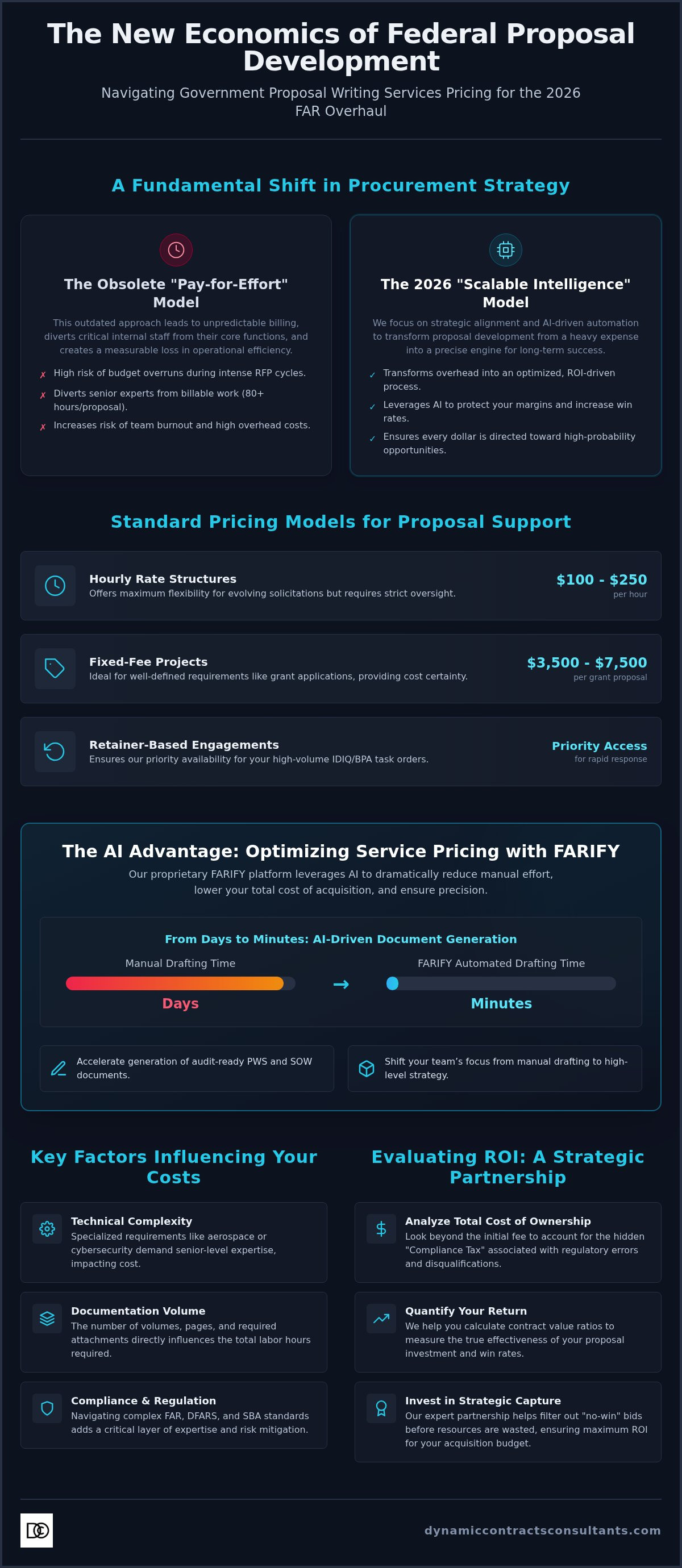
Strategic capture management reduces long-term expenses by filtering out "no-win" bids before resources are wasted. This proactive stance directly impacts government proposal writing services pricing by ensuring that every dollar spent is directed toward high-probability opportunities. By integrating AI-assisted response alignment through platforms like FARIFY, we've seen technical drafting times drop from days to minutes. This shift from manual drafting to AI-driven automation allows your team to focus on the high-level strategy that actually wins contracts. Our approach ensures that your acquisition budget is optimized for maximum ROI, protecting your margins while increasing your win rate in an increasingly competitive market.
Standard Pricing Models for Government Proposal Support
Selecting the appropriate financial structure for your procurement support is as critical as the technical response itself. The official definition of proposal costs clarifies that these are expenses incurred in preparing bids on potential government and non-government contracts. How you structure these payments, however, depends entirely on the complexity of the RFP and your internal capacity. In 2026, government proposal writing services pricing generally adheres to four primary structures:
- Hourly Rate Structures: Senior specialists for complex proposals command rates between $100 and $250 per hour. While this model offers maximum flexibility for evolving solicitations, it requires strict oversight to prevent budget overruns.
- Fixed-Fee Projects: This model is best for well-defined requirements like grant applications, which typically cost between $3,500 and $7,500. Research for grant opportunities can range from $250 to $1,500.
- Retainer-Based Engagements: We utilize retainers to ensure priority availability for high-volume IDIQ and BPA task orders where response windows are often narrower than 15 days.
- Hybrid Models: These combine a modest base fee with performance-based milestones, ensuring that government proposal writing services pricing remains aligned with your long-term win-rate objectives.
Hourly vs. Fixed-Fee: Which Aligns with Your Acquisition Strategy?
We recommend hourly structures for complex, evolving solicitations that involve multiple amendments or ambiguous requirements. Small businesses often prefer fixed-fee models for standardized GSA Schedule assistance or small business set-asides because they provide total budget predictability. You should select the model that minimizes your financial risk while maximizing the quality of the technical volume. Large contractors often find that retainer models offer the best balance for maintaining a consistent submission pipeline across multiple agencies.
The Ethics and Legality of Performance-Based Incentives
Industry forums occasionally suggest that contingency fees are a standard way to pay writers, but this is a dangerous misconception in federal contracting. The FAR contains strict restrictions on "contingent fees" for securing government contracts to prevent unethical lobbying. We focus on strategic capture management services to justify project-based fees through rigorous data analysis and bid-no-bid validation. You can legally structure performance incentives as long as they aren't a percentage of the contract value paid to an external party for "soliciting" the award. If you're unsure which model fits your compliance profile, we invite you to consult with our strategic team to design a compliant pricing strategy.
Factors That Influence Government Proposal Writing Costs
Determining the exact investment required for a winning bid involves a deep analysis of the underlying Federal Proposal Cost Structure. We've observed that government proposal writing services pricing is rarely static because it must respond to the specific technical and regulatory hurdles of each unique solicitation. A high-stakes aerospace requirement demands a different level of subject matter expertise than a standard administrative management contract. These variables ensure that your acquisition budget is allocated toward the areas that most significantly impact your evaluation score.
The sheer volume of documentation also plays a critical role in financial planning. Page-limited technical volumes, exhaustive compliance matrices, and the verification of past performance citations all contribute to the total labor hours. If your solicitation requires a rapid turnaround within 7 to 14 days, you'll likely encounter an "Urgency Premium." This premium accounts for the intensive, around-the-clock coordination required to meet federal deadlines without sacrificing the precision of your response. We focus on optimizing these factors to ensure your proposal is both competitive and cost-effective.
RFP Complexity and Technical Requirements
RFP complexity is often dictated by specialized NAICS codes, such as 541611 for administrative management or codes related to IT systems design. These designations determine whether we must engage subject matter experts (SMEs) to validate your technical approach. There's a fundamental cost difference between editing a pre-existing draft and ground-up proposal development. The primary labor driver in this phase is the rigorous alignment of Section L and Section M requirements. If your technical response doesn't mirror the agency's specific scoring rubric, even the most sophisticated writing will fail to secure the award. We ensure every technical volume is built to maximize points under the government's specific evaluation criteria.
The DCAA and FAR Compliance Burden
We integrate DCAA compliance consulting directly into the proposal phase to ensure your indirect rate justifications and accounting systems stand up to federal scrutiny. Generating FAR/DFARS-compliant subcontracting plans and flow-down clauses adds a necessary layer of complexity to government proposal writing services pricing. While this increases the initial investment, producing audit-ready documentation at the proposal stage is a visionary move. It prevents six-figure post-award losses that occur when a contractor's systems are found insufficient during an audit. Our focus on strategic compliance ensures that your documentation protects your firm's long-term financial health while meeting the strict demands of the 2026 procurement lifecycle.
The AI Advantage: Optimizing Service Pricing with FARIFY
Traditional procurement support often suffers from the inherent inefficiencies of manual technical drafting, which keeps government proposal writing services pricing high and turnaround times slow. We've integrated AI-driven automation through the FARIFY platform to disrupt this legacy model by reducing technical drafting time from days to minutes. This shift enables a more agile acquisition strategy that doesn't sacrifice precision for speed. Our platform generates audit-ready Performance Work Statements (PWS), Statements of Work (SOW), and Independent Government Cost Estimates (IGCE) with a level of accuracy that manual processes struggle to replicate. This isn't about replacing human expertise; it's about augmenting it with scalable intelligence to ensure your submission is compliant from the first draft.
Reducing Billable Hours with Automated Document Generation
Manual compliance matrix creation is a notorious labor sink that can consume dozens of billable hours in a single RFP cycle. FARIFY utilizes AI-powered extraction to identify requirements instantly, allowing our consultants to focus on high-level strategic alignment rather than administrative data entry. This efficiency directly impacts your bottom line by lowering the total labor hours required for a compliant submission. We've found that implementing AI for bid-no-bid analysis prevents wasted proposal spend by identifying low-probability opportunities before significant resources are committed. By automating the acquisition strategy documentation process, we help you redirect your budget toward high-impact capture activities that increase your overall win rate.
Improving Accuracy and Audit-Readiness
Human error in complex regulatory drafting for FAR, DFARS, or DOSAR can lead to immediate disqualification or costly post-award disputes. AI-driven templates ensure absolute consistency across multi-award contract vehicles and complex task orders. In competitive federal markets, the ability to generate a rapid response is a significant strategic advantage that traditional firms often lack. We maintain a human-in-the-loop assurance model where AI handles the heavy lifting of document generation while our senior specialists provide the final expert review. This combination represents the most cost-effective model in 2026. It balances the speed of automation with the nuanced judgment of experienced prime contractors who have worked with the DoD, State, and EPA.
Our approach ensures that your proposal writing efforts are both scalable and compliant with the latest 2026 federal regulations. By leveraging these advanced tools, we provide a level of operational efficiency that protects your margins and reduces the risk of post-award audits. If you're ready to optimize your acquisition budget with AI-enhanced precision, we encourage you to contact our strategic team to discuss your next RFP.
Evaluating ROI: Selecting a Strategic Proposal Partner
The final stage of optimizing your acquisition budget involves shifting your perspective from initial expenditure to long-term return on investment. While government proposal writing services pricing often represents a significant line item, it must be evaluated against the "Contract Value vs. Service Fee" ratio. We believe that a high-quality submission is not an expense but a strategic asset that secures your firm's future. To ensure you're partnering with a truly qualified firm, you should assess their credentials, specifically looking for NCMA certifications such as Certified Professional Contract Manager (CPCM), Certified Federal Contract Manager (CFCM), or Certified Commercial Contract Manager (CCCM). These designations guarantee a level of regulatory expertise that goes beyond simple technical writing.
The Value of a Professional Win-Rate
Your internal metrics should move from "cost per proposal" to "cost per awarded dollar." Professional capture management identifies high-probability opportunities, which prevents you from wasting your budget on bids where you have little chance of success. The ROI of leveraging specialized proposal writing services is found in scalable growth and the ability to pursue larger, more complex prime contracts with agencies like the DoD or EPA. By increasing your win-rate even by a small percentage, the service fee becomes a negligible fraction of the total contract award. We help you build a pipeline that is both sustainable and highly profitable in the 2026 federal market.
Structuring Your Engagement for Long-Term Success
A successful partnership balances our outsourced expertise with your internal subject matter knowledge. This synergy creates the most efficient response possible, ensuring that technical volumes are both visionary and grounded in practical reality. You should ensure your partner provides comprehensive support through the entire procurement lifecycle, including post-award contract administration. This ensures that the promises made during the proposal phase are executed flawlessly, protecting your reputation and past performance ratings. We invite you to leverage Dynamic Contracts Consultants' services to gain a decisive strategic advantage and ensure your firm remains compliant with the latest FAR overhaul requirements.
Before signing a proposal support agreement, we recommend using this final checklist to verify alignment:
- Does the provider have documented experience as a prime contractor for major federal agencies?
- Is their pricing model transparent and aligned with your specific RFP complexity?
- Do they utilize AI-driven tools like FARIFY to reduce manual labor and ensure audit-readiness?
- Can they provide DCAA-compliant documentation that stands up to federal scrutiny?
- Do they offer full lifecycle support, from capture to post-award compliance?
Strategic Alignment for Future Federal Success
The 2026 procurement environment demands a transition from reactive spending to proactive, intelligence-led investment. We've demonstrated that evaluating government proposal writing services pricing requires looking beyond surface-level costs to the long-term ROI of strategic compliance and expert capture management. By integrating AI-powered rapid document generation via FARIFY with our expert DCAA compliance monitoring, your firm can drastically reduce technical drafting time while ensuring every submission is audit-ready. This approach doesn't just save hours; it protects your margins and secures your reputation as a reliable prime contractor.
Our team provides national lifecycle support from initial acquisition planning through to final contract closeout, ensuring you have a dedicated partner at every stage of the procurement cycle. You don't have to navigate these complex RFP requirements alone or settle for "low-cost" writers who lack the specialized knowledge of FAR and DFARS regulations. We invite you to secure your next federal award with Dynamic Contracts Consultants’ expert proposal services. We're committed to helping you transform your acquisition strategy into an engine for scalable, visionary growth.
Frequently Asked Questions
What is the average hourly rate for government proposal writing services in 2026?
Senior proposal specialists for complex federal requirements typically command rates between $100 and $250 per hour. General technical writers often range from $35 to $60 per hour, depending on their experience with specific agency requirements. These rates reflect the specialized knowledge necessary to navigate the 2026 FAR overhaul and ensure your technical volumes meet the highest evaluative standards.
Are contingency fees or 'success fees' legal in federal proposal writing?
Contingency fees based on a percentage of the contract award are generally prohibited for external consultants under the Federal Acquisition Regulation (FAR). We structure our engagements through compliant fixed-fee or hourly models to maintain absolute procurement integrity. This approach ensures your firm avoids the severe legal and administrative penalties associated with non-compliant payment structures during a DCAA audit.
How does AI technology like FARIFY impact the total cost of proposal development?
AI technology like the FARIFY platform significantly optimizes government proposal writing services pricing by automating the labor-intensive stages of document generation. By reducing the time required for technical drafting and requirement extraction from days to minutes, we lower the total billable hours. This allows your acquisition budget to be redirected toward high-level strategic alignment and competitive capture management.
Is it more cost-effective to hire a freelancer or a specialized consulting firm?
Selecting a specialized consulting firm is typically more cost-effective for complex RFPs due to the collective expertise and infrastructure they provide. While freelancers may offer lower initial rates, they often lack the comprehensive DCAA compliance monitoring and "human-in-the-loop" AI tools necessary for high-stakes awards. We provide a full lifecycle support system that minimizes the risk of post-award audit failures and disqualifications.
What factors cause the price of a federal proposal to increase significantly?
Price increases are primarily driven by the technical complexity of the solicitation, such as specialized aerospace or IT requirements, and the total volume of required documentation. An "Urgency Premium" is also common for task orders with turnaround times of 7 to 14 days. These factors necessitate intensive coordination and the involvement of multiple subject matter experts to ensure a compliant and competitive submission.
How can small businesses afford professional proposal support for large contracts?
Small businesses can leverage customized proposal templates and AI-driven automation to access professional support without the overhead of a full-time internal team. We offer scalable solutions that allow smaller firms to compete for large contracts by focusing resources on high-probability opportunities identified through bid-no-bid analysis. This strategic approach ensures that your limited acquisition budget delivers the maximum possible impact.
Do proposal writing services include DCAA and FAR compliance reviews?
Our services integrate comprehensive DCAA and FAR compliance reviews to ensure your documentation is audit-ready from the proposal stage. We focus on strategic compliance, including the generation of FAR/DFARS-compliant subcontracting plans and indirect rate justifications. This proactive review process prevents costly post-award losses and administrative errors that could jeopardize your prime contractor status with the DoD, State, or EPA.
What is the typical ROI for hiring a professional government contract consultant?
The ROI of hiring a professional consultant is measured by the "Contract Value vs. Service Fee" ratio and the long-term stability of your awarded portfolio. An improved win rate on a multi-million dollar contract far outweighs the initial investment in professional writing. By securing high-value awards and maintaining flawless compliance, we help you achieve sustainable, scalable growth in the competitive federal marketplace.


