

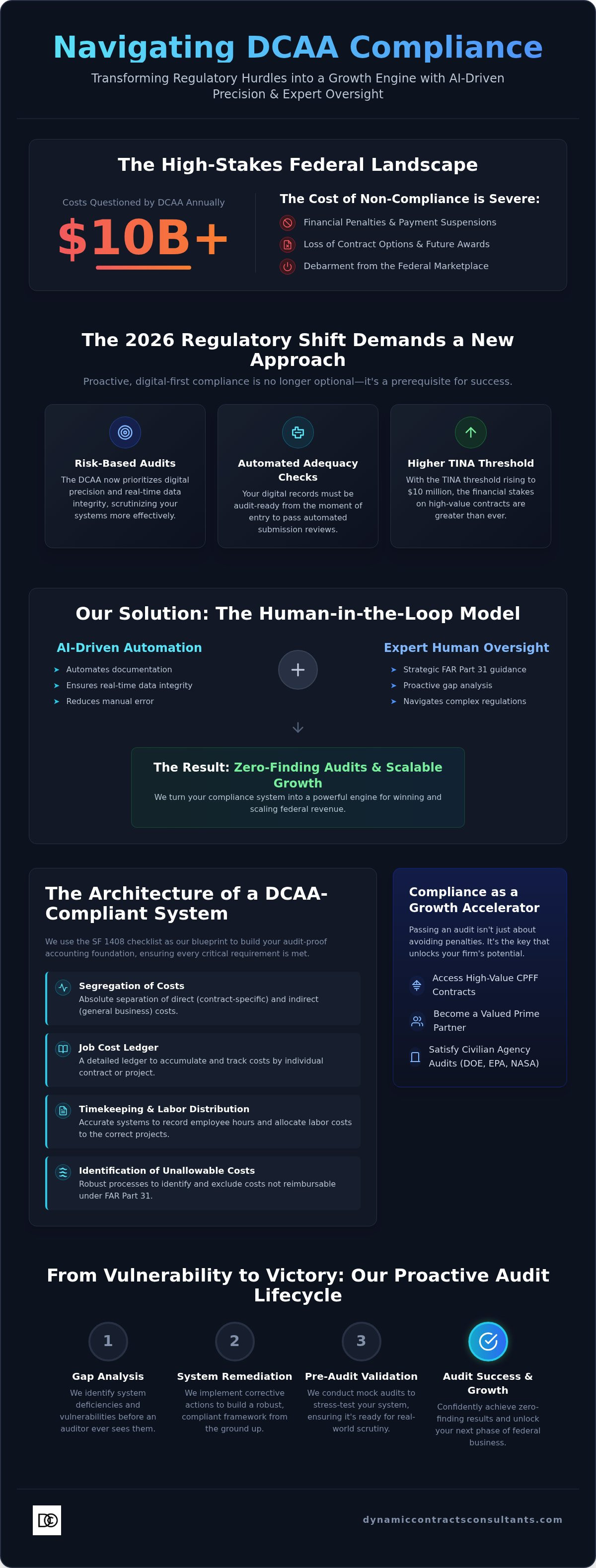
Did you know that the DCAA questioned over $10 billion in costs during the last fiscal year, and nearly half of those findings were ultimately upheld by contracting officers? We understand that for many federal contractors, the prospect of an audit feels less like a routine check and more like a high-stakes threat to your business's survival. The complexity of FAR Part 31 and the recent shift in thresholds, such as the 2026 TINA increase to $10 million, can make manual record-keeping feel like an impossible task. This is where strategic DCAA compliance consulting becomes a critical asset rather than just an administrative expense.
Our team is here to help you transform these regulatory requirements into a powerful engine for scaling your federal revenue through cost-plus contracts. We promise to show you how AI-driven precision and expert oversight can automate your documentation and ensure your accounting system is always audit-ready. We'll preview the 2026 regulatory landscape, the elimination of "trigger contracts," and the strategic framework you need to achieve zero-finding results in every audit.
Key Takeaways
- Understand how to navigate the 2026 regulatory landscape, where stringent digital oversight makes "audit-ready" documentation a prerequisite for high-value federal awards.
- Learn the technical requirements of the SF 1408 criteria to build an accounting system that effectively segregates direct and indirect costs.
- Discover the efficiency of a "Human-in-the-Loop" model, where DCAA compliance consulting leverages AI-driven automation alongside expert oversight to ensure precision.
- Follow a structured lifecycle to identify system deficiencies through gap analysis and proactive remediation before an auditor arrives.
- Transform compliance into a strategic tool that allows you to confidently pursue and scale revenue through complex cost-plus contracts.
The Strategic Importance of DCAA Compliance in 2026
DCAA compliance is more than an accounting checkbox; it's the foundation of your federal credibility. At its core, it requires strict adherence to the cost principles outlined in FAR Part 31 and the supplemental requirements of the DFARS. By engaging in professional Defense Contract Audit Agency (DCAA) oversight early, you ensure your business remains eligible for the most lucrative awards. We believe that true success in this sector starts with a fundamental shift in perspective. You shouldn't view these regulations as a hurdle, but as a framework for operational excellence.
In 2026, the federal government has pivoted toward a risk-based audit model that prioritizes digital precision and real-time data integrity. The DCAA now utilizes automated adequacy checks for incurred cost submissions, meaning your digital records must be audit-ready from the moment of entry. This shift transforms DCAA compliance consulting from a reactive defense into a proactive strategic advantage. When your systems are built with this level of foresight, you don't just survive audits; you use them to demonstrate your reliability to federal stakeholders.
The stakes of failing to maintain these standards are high. Non-compliance doesn't just lead to uncomfortable meetings or administrative delays. It results in direct financial penalties, including payment suspensions, the loss of contract options, or even debarment from the federal marketplace. In an environment where the DCAA questioned over $10 billion in costs last year, having a robust defense is non-negotiable for your long-term growth.
To better understand how these audits function within cost-reimbursable environments, watch this detailed guide:
Beyond the DoD: Why Civilian Agencies Adopt DCAA Standards
While the DCAA is technically a Department of Defense entity, its standards are the "universal language" of federal contracting. Civilian agencies like the EPA, DOE, and NASA increasingly utilize DCAA-style audits to ensure fiscal responsibility and regulatory oversight. Because FAR-compliant accounting is universal, a system built to satisfy the Pentagon serves as a gold standard across the entire federal landscape. We help you navigate these diverse agency portfolios by implementing a single, robust compliance framework that satisfies every auditor you'll encounter.
Compliance as a Growth Accelerator
Passing an initial accounting system audit is the key that unlocks cost-plus-fixed-fee (CPFF) contracts. These vehicles allow for greater flexibility and significantly reduced financial risk for your firm. Additionally, a compliant status makes you an attractive partner for prime contractors looking for reliable subcontractors for major teaming agreements. Integrating compliance with our Strategic Capture Management approach ensures you're not just following rules, but actively winning more business and scaling your revenue with confidence.
The Architecture of a DCAA-Compliant Accounting System
Establishing an accounting system that meets federal standards is a technical undertaking that requires more than just high-end software. Standard Form (SF) 1408 serves as the definitive blueprint for determining system adequacy. This checklist evaluates whether your system can track costs by contract, identify unallowable expenses, and support the accurate billing of the government. For many firms, this transition is the most significant hurdle in the procurement lifecycle. We view the SF 1408 not merely as a hurdle, but as a roadmap for achieving operational efficiency and financial transparency. You can find more foundational details in this comprehensive Guide for Government Contractors.
One of the most critical pillars of a compliant system is the absolute segregation of direct costs from indirect costs. Every dollar spent must be clearly identifiable as either belonging to a specific contract or being a general business expense. This distinction is vital because it prevents the government from being overcharged for overhead. Additionally, your system must utilize a logical and consistent cost allocation method. Auditors look for a "rational basis" for how you distribute shared costs across different projects. If your allocation methods fluctuate, it triggers red flags during an audit, potentially leading to questioned costs and payment delays.
Labor distribution remains the highest area of risk during a DCAA review. In 2026, manual spreadsheets are no longer sufficient to meet the "audit-ready" standard. Your system must be supported by automated timekeeping records that adhere to the principle of Total Time Accounting. This means every hour worked by every employee must be recorded and allocated to the correct project or indirect pool. We help you implement these digital safeguards to ensure that your labor data is contemporaneous, accurate, and ready for immediate inspection.
Mastering Indirect Rate Structures
Developing a sophisticated indirect rate structure is essential for recovering your full cost of doing business. This involves creating distinct pools for Fringe, Overhead, and General and Administrative (G&A) expenses. You must be able to calculate these rates precisely and defend them during a cost proposal review. For a deep dive into these complexities, we recommend reviewing our DCAA Cost Proposal Preparation guide. Mastering these rates allows you to maximize your margins while remaining fully compliant with FAR Part 31 cost principles.
Internal Controls and Policy Documentation
Written policies are just as important as the accounting software you choose. Even the most advanced ERP system can't compensate for a lack of documented internal controls. These manuals describe how your firm handles timekeeping, travel expenses, and procurement. Our DCAA compliance consulting services focus heavily on drafting these FAR-compliant policy manuals, ensuring they reflect your actual business practices. By maintaining continuous internal monitoring, you ensure that your "audit-ready" status is a permanent state rather than a temporary fix. If you're ready to modernize your internal controls, you can reach out to our expert team for a tailored assessment.
DCAA Compliance Consulting Models: Expertise vs. Automation
Selecting the right framework for your compliance journey is a decision that dictates your long-term scalability. While traditional CPA firms offer excellent general accounting support, they often lack the specialized knowledge of FAR and DFARS cost principles required for federal success. Specialized DCAA compliance consulting focuses on the unique intersection of accounting, law, and government strategy. We believe that a "Human-in-the-Loop" model is the only way to balance modern speed with regulatory rigor. AI provides the efficiency, but our experts provide the assurance that your systems will withstand a formal review.
A common question we hear is whether a standard tool like QuickBooks is sufficient for compliance. While QuickBooks is a capable general ledger, it's not natively built to handle the rigorous segregation of direct and indirect costs or the complex labor distribution requirements of a government audit. Without a layer of specialized policies and oversight, relying on it alone can lead to significant findings during a Preaward Accounting System Adequacy Checklist review. We don't just fix your software; we build a compliant environment around it that satisfies the most demanding auditors.
The cost-benefit of proactive consulting far outweighs the price of a reactive audit defense. Attempting to remediate a system after a "disapproved" status has been issued is both expensive and damaging to your reputation. By building a compliant architecture from day one, you avoid payment suspensions and protect your eligibility for future awards. We help you transition from a state of fear to a position of strategic strength.
The FARIFY Advantage: AI-Driven Precision
Our proprietary platform, FARIFY.ai, represents a significant shift in how contractors manage documentation. It allows you to generate compliant acquisition documents, such as a Performance Work Statement (PWS) or a Statement of Work (SOW), in mere minutes. This AI-driven automation drastically reduces the turnaround time for compliance matrices and ensures that RFP requirements are mapped with surgical precision. By minimizing human error in document generation, we help you maintain a state of constant readiness for any agency inquiry while significantly lowering your overhead costs.
Strategic Partnership vs. Transactional Support
Compliance shouldn't be a transactional event. Proactive support consistently yields better CPARS scores and stronger relationships with agency officials. Our Post-Award Compliance services ensure that your accounting system remains adequate as your contract portfolio grows. This long-term partnership approach combines the technological speed of FARIFY with the deep expertise of our certified professionals. It's a synergy that allows you to focus on mission delivery while we handle the complexities of the regulatory landscape.
Executing the DCAA Audit Lifecycle: A Step-by-Step Guide
Successfully managing the DCAA audit lifecycle requires a shift from viewing the audit as a singular event to understanding it as a continuous operational process. We've developed a structured methodology that ensures you're prepared for every interaction with federal auditors. This lifecycle approach begins long before an auditor ever sets foot in your office, focusing on systemic integrity and proactive risk management through specialized DCAA compliance consulting. By treating compliance as a constant state of readiness, you eliminate the panic often associated with government inquiries.
- Step 1: Conduct a gap analysis. We evaluate your current accounting infrastructure against SF 1408 requirements to identify specific vulnerabilities.
- Step 2: Remediate deficiencies. We update your policy manuals and refine workflows to ensure your internal controls are both FAR-compliant and functionally efficient.
- Step 3: Perform a "mock audit." Our team simulates DCAA scrutiny to stress-test your system, allowing us to resolve potential findings in a controlled environment.
- Step 4: Prepare the Incurred Cost Submission (ICS). We ensure 100% data integrity for your year-end submissions. In fiscal year 2025, the DCAA focused $300 billion of its audit activity on incurred costs, making this a high-stakes phase for your business.
- Step 5: Facilitate the entrance conference. We manage auditor requests and serve as your strategic liaison, ensuring the process remains professional and focused on your system's strengths.
Passing the Pre-Award Accounting System Survey
The pre-award survey is the first major hurdle for new contractors seeking cost-reimbursable work. You must understand the distinction between "Adequacy" and "Compliance." Adequacy refers to the design of your system, while compliance focuses on whether you're actually following your stated policies. To pass, you must demonstrate that your system can track and segregate costs by contract from day one. Utilizing a specialized DCAA Audit Checklist is an effective way to ensure your system design is ready for immediate government review.
Navigating Post-Award Audits and CPSRs
As you scale your federal revenue, you'll encounter more complex post-award reviews, such as the Contractor Procurement System Review (CPSR). These audits evaluate your purchasing processes and your ability to manage subcontractors effectively. A significant risk factor in these reviews is the implementation of flow-down clauses. You're responsible for ensuring that your subcontractors' compliance doesn't break your own system's adequacy. For deeper insights into managing these complex relationships, we recommend our guide on DCAA Compliance for Subcontractors.
If you're facing an upcoming audit or need to modernize your internal controls to meet 2026 standards, schedule a consultation with our expert team today.
Why Dynamic Contracts Consultants LLC is Your National DCAA Partner
Dynamic Contracts Consultants LLC stands as a premier national partner for organizations navigating the complexities of federal oversight. As a minority-owned small business founded in 2015, we bring the firsthand experience of a prime contractor to every engagement. We don't just provide theoretical advice; we deliver practical, "audit-ready" results rooted in a deep understanding of FAR, DFARS, ITAR, and EAR regulations. Our team, led by CPCM and CFCM certified professionals, bridges the gap between traditional accounting and strategic growth. We understand that your success depends on more than just passing an audit; it requires a partner who understands the high stakes of the federal marketplace.
By choosing our DCAA compliance consulting services, you gain access to the dual power of human expertise and proprietary technology. While many competitors rely solely on manual processes, Dynamic Contracts Consultants LLC utilizes our FARIFY AI platform to accelerate document generation without sacrificing precision. This "human-in-the-loop" assurance means your acquisition planning and compliance matrices are generated rapidly and then refined by experts who understand the nuances of your specific industry. We believe in providing simple solutions to complex problems, allowing you to focus on your core mission while we secure your administrative foundation.
Our capabilities extend across the entire procurement lifecycle. From the initial bid-no-bid analysis to post-award contract administration and final closeout, we provide a seamless thread of compliance. This holistic approach ensures that the data integrity established during the proposal phase remains consistent through every DCAA review and agency inquiry. We position your firm not just to win contracts, but to manage them profitably and with absolute regulatory confidence.
Customized Solutions for National Contractors
We recognize that a "one-size-fits-all" approach is insufficient in the federal marketplace. Dynamic Contracts Consultants LLC tailors compliance frameworks to meet the specific technical and regulatory needs of aerospace, engineering, and environmental firms. Whether you're working with the DoD, the Department of State, or the EPA, our national service model accounts for the subtle nuances in how different agencies interpret cost principles. To maximize your competitive edge, we invite you to explore our Proposal Writing services, where we integrate compliant cost structures directly into your winning bids.
Securing Your Future in Federal Contracting
Investing in a DCAA-compliant infrastructure today is an investment in your firm's long-term ROI. A robust accounting system doesn't just satisfy an auditor; it provides executives with the peace of mind that their revenue streams are protected from payment suspensions and questioned costs. Dynamic Contracts Consultants LLC provides the strategic oversight necessary to manage the entire procurement lifecycle, ensuring that your operational efficiency matches your technical excellence. As you look toward the challenges of 2026 and beyond, leverage our expertise for your business growth and transform compliance into your most significant competitive advantage.
Mastering the Federal Landscape with Audit-Ready Precision
The regulatory shifts of 2026 demand a more sophisticated approach to federal contracting than ever before. We've shown how transforming your accounting architecture from a reactive system into a proactive strategic asset allows you to pursue high-value cost-plus contracts with absolute confidence. By integrating the technical rigor of SF 1408 with modern operational efficiency, you don't just pass audits; you build a foundation for scalable intelligence and long-term revenue growth. Your compliance status is now a primary indicator of your firm's reliability and professional maturity.
Our DCAA compliance consulting combines the visionary speed of our AI-powered FARIFY platform with the deep expertise of our CPCM-certified professionals. As a minority-owned small business with proven prime contractor experience for the DoD, State Department, and EPA, we provide the "human-in-the-loop" assurance your firm needs to navigate complex procurement lifecycles. We're committed to delivering simple solutions to your most complex regulatory problems, ensuring your documentation is always contemporaneous and audit-ready.
It's time to stop fearing the auditor and start leveraging compliance as a competitive advantage. Schedule a DCAA Compliance Consultation with Dynamic Contracts Consultants today and secure your future in the federal marketplace. We look forward to helping your business reach its full potential through strategic precision and expert partnership.
Frequently Asked Questions
What is the primary goal of a DCAA compliance audit?
The primary objective of a DCAA audit is to verify that your financial practices adhere to the cost principles defined in FAR Part 31. Auditors ensure that every dollar billed to the government is allowable, allocable, and reasonable. This oversight protects taxpayer interests by identifying unallowable costs and ensuring that contractors maintain adequate internal controls throughout the procurement lifecycle.
Can a small business be DCAA compliant without expensive software?
You can achieve compliance without high-end ERP systems, provided your accounting practices meet the SF 1408 criteria. Many small businesses successfully utilize standard software by layering on specialized internal controls and automated timekeeping solutions. However, the manual overhead of maintaining these records often makes professional DCAA compliance consulting a more cost-effective strategy for long-term scalability and audit-ready precision.
What are the consequences of failing a DCAA accounting system survey?
Failing a pre-award accounting system survey renders your firm ineligible for cost-reimbursable or time-and-materials contracts. This "disapproved" status can lead to immediate payment suspensions on existing awards and severely damage your reputation with prime contractors. Because the DCAA questioned over $10 billion in costs last year, a failed survey signals to agencies that your firm represents a high financial risk.
How long does it typically take to become DCAA compliant?
The timeline for achieving a compliant state typically ranges from three to six months, depending on the complexity of your current infrastructure. This period includes conducting a thorough gap analysis, remediating accounting system deficiencies, and drafting FAR-compliant policy manuals. We recommend starting this process well before a contract award to ensure that your "audit-ready" documentation is fully established and tested through a mock audit.
Does DCAA compliance apply to firm-fixed-price contracts?
DCAA oversight is generally minimal for firm-fixed-price contracts unless they exceed specific thresholds for Truthful Cost or Pricing Data (TINA). As of June 30, 2026, the TINA threshold has increased to $10 million. If your FFP contract exceeds this amount, or if it's subject to Cost Accounting Standards (CAS), the DCAA may audit your cost or pricing data to ensure accuracy and completeness.
How does FARIFY AI assist in DCAA audit preparedness?
Our proprietary FARIFY AI platform accelerates audit preparedness by generating compliant acquisition and compliance documents in minutes. It reduces human error by automatically mapping RFP requirements to your accounting structures and generating precise Performance Work Statements (PWS). This technology ensures that your documentation remains consistent and contemporaneous, providing a scalable intelligence layer that supplements our expert-led DCAA compliance consulting services.
What is an Incurred Cost Submission (ICS) and who must file it?
An Incurred Cost Submission is an annual report that reconciles a contractor's claimed costs with their actual recorded expenses. It's required for any contractor holding cost-reimbursable or time-and-materials contracts. You must submit this package within six months of the end of your fiscal year. DCAA auditors use the ICS to determine the final indirect rates applicable to your government contracts.
Is DCAA compliance required for federal subcontractors?
Compliance requirements frequently flow down to subcontractors holding cost-reimbursable or time-and-materials subcontracts. Prime contractors are responsible for ensuring their subcontractors maintain adequate accounting systems to prevent finding risks during a Contractor Procurement System Review (CPSR). We help subcontractors implement the necessary internal controls to ensure their financial data integrity doesn't compromise the prime contractor's compliance status.


