

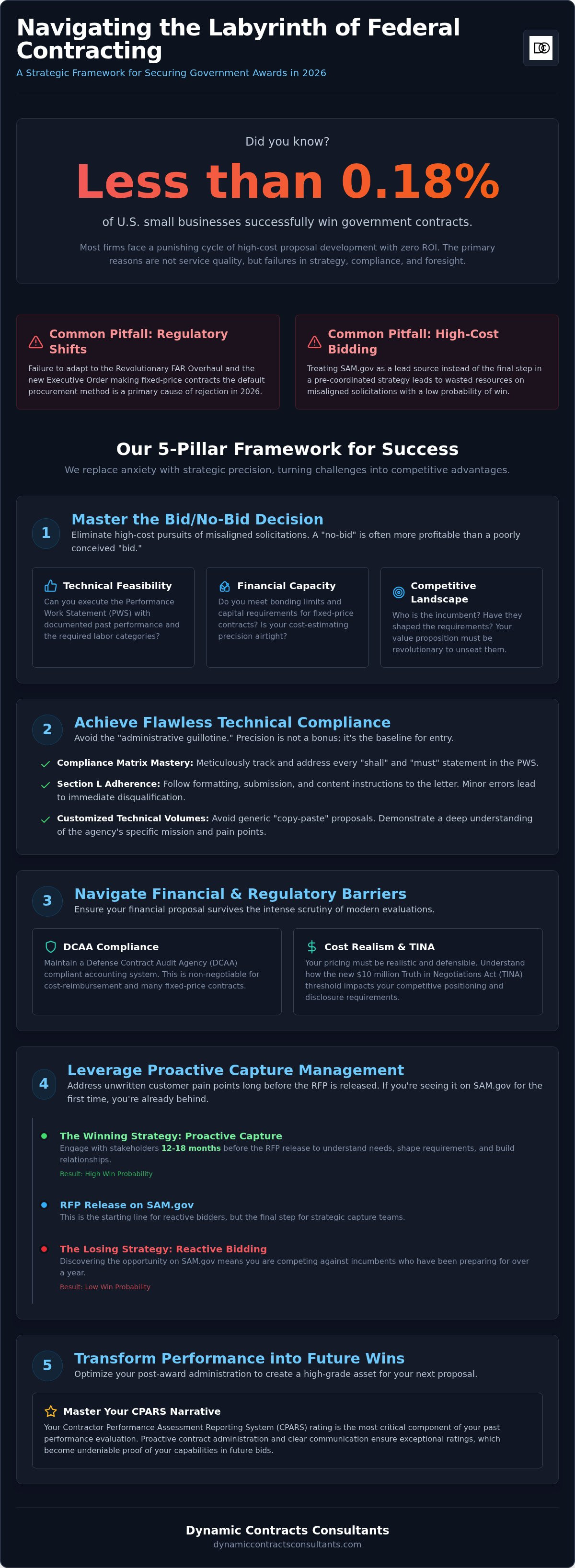
Did you know that less than 0.18% of small businesses in the U.S. successfully win government contracts? While federal obligations remain high, most firms face a cycle of high-cost proposal development with zero ROI. If your win rate has stalled, it's often not a reflection of your service quality. Instead, the primary reasons for losing federal contract bids in 2026 typically involve a failure to navigate the Revolutionary FAR Overhaul or the new Executive Order establishing fixed-price contracting as the default procurement method.
We understand the exhaustion that comes from navigating 'black box' evaluations and the constant pressure of maintaining DCAA compliance. Our goal is to replace that anxiety with strategic precision. In this analysis, we'll identify the critical technical and regulatory failures that jeopardize your federal win rate and show you how to rectify them. You'll gain a repeatable framework for bid/no-bid decisions and a clear understanding of how recent shifts, like the $10 million TINA threshold increase, impact your competitive positioning.
Key Takeaways
- Implement a rigorous bid/no-bid decision framework to eliminate the high costs associated with pursuing misaligned solicitations on SAM.gov.
- Identify the primary reasons for losing federal contract bids, ranging from minor technical formatting errors to a lack of strategic alignment with Section L instructions.
- Master the complexities of DCAA compliance and cost realism to ensure your financial proposal survives the "administrative guillotine" of modern evaluations.
- Leverage proactive capture management to address unwritten customer pain points 12–18 months before the Request for Proposal is officially released.
- Optimize your post-award contract administration and CPARS narratives to transform current performance into a high-grade asset for future win rates.
Strategic Alignment and the Bid/No-Bid Decision Framework
Reactive bidding on SAM.gov represents a fundamental misunderstanding of the federal procurement process. We've observed that many contractors treat the solicitation portal as a primary lead source rather than a final destination for a pre-coordinated strategy. This "scroll and bid" mentality is among the most common reasons for losing federal contract bids. When you pursue "near-match" solicitations without a pre-existing relationship or deep strategic alignment, you're entering a competition that's often already been decided in favor of more proactive firms.
Successful organizations evaluate their core competencies against Section M evaluation factors before a single word is written. They don't rely on optimism; they rely on data. Our approach utilizes AI for bid-no-bid analysis to strip away the emotional bias that often clouds executive judgment. This allows for a clinical assessment of whether a pursuit will yield a genuine return on investment or simply drain your proposal budget.
Establishing Your Bid/No-Bid Criteria
A disciplined framework is the only way to protect your resources. Identifying these gaps early prevents the most common reasons for losing federal contract bids before you commit a single dollar to the effort. We recommend a three-pillar evaluation:
- Technical Feasibility: You must determine if your team can realistically execute the Performance Work Statement (PWS). High-level similarities aren't enough; you need the specific labor categories and documented past performance to satisfy 2026's more stringent evaluation criteria.
- Financial Capacity: Ensure you meet bonding limits and capital requirements. The April 2026 Executive Order establishing fixed-price contracts as the default means your cash flow management and cost-estimating precision must be airtight.
- Competitive Landscape: Identifying the incumbent is vital. If they've shaped the requirements through "ghost" influence, your chances of unseating them without a revolutionary value proposition are slim.
The Opportunity Cost of Poor Targeting
Chasing every RFP that looks "close enough" carries a staggering price tag. The true cost of a failed proposal includes hundreds of hours of senior-level labor and potential consultant fees. Every hour spent on a losing effort is an hour stolen from a high-value target where you have a legitimate competitive advantage. We believe that a "no-bid" is often more profitable than a poorly conceived "bid."
Strategic market research acts as a critical pre-proposal requirement. It allows you to identify opportunities 12 to 18 months before they reach the public domain. By the time an RFP hits SAM.gov, the winning contractor has usually been engaged in capture management for over a year. If you're just seeing it now, you're already behind. Our proposal writing and acquisition planning services emphasize this alignment to ensure your efforts are focused where they will actually generate results.
Technical Non-Compliance: Why Precision in Proposal Development is Non-Negotiable
In the high-stakes environment of 2026 federal procurement, the "administrative guillotine" remains the swiftest way to end a pursuit. Evaluation committees often process hundreds of responses; they aren't just looking for the best solution, they're looking for reasons to disqualify firms to make their workload manageable. Minor formatting errors or clerical oversights are among the most frequent reasons for losing federal contract bids. Precision isn't a bonus. It's the baseline requirement for entry.
A common failure we observe is the neglect of the compliance matrix. When you overlook specific Section L instructions or fail to address every "shall" and "must" statement in the Performance Work Statement (PWS), you signal a lack of operational discipline. Similarly, submitting generic, "copy-paste" technical volumes tells the agency that you haven't invested the time to understand their specific mission. To avoid these pitfalls, many successful contractors leverage government proposal writing services to ensure every requirement is mapped with surgical accuracy.
Common Formatting and Submission Pitfalls
The technical evaluation process is often rigid and unforgiving. Even a revolutionary solution won't be read if it violates the basic rules of the solicitation. We've seen bids rejected for the following administrative lapses:
- Formatting Violations: Exceeding page counts, using unapproved font sizes, or failing to follow specific file naming conventions.
- Requirement Gaps: Missing a single "shall" statement in the PWS can lead to a "technically unacceptable" rating.
- Administrative Expirations: Submitting with an expired UEI or CAGE registration, or including outdated certifications that no longer meet the Revolutionary FAR Overhaul (RFO) standards.
Leveraging AI for Submission Readiness
Modern procurement demands modern tools. We utilize FARIFY.ai to extract RFP requirements with 100% accuracy, ensuring nothing is missed during the initial shred. This AI-driven automation allows our team to generate audit-ready compliance matrices in minutes, not days, significantly increasing your operational efficiency. However, we maintain a "human-in-the-loop" necessity. While AI provides scalable intelligence and speed, expert oversight ensures the technical narrative remains persuasive and aligned with the agency's nuanced goals. If you're concerned about your current submission readiness, you can consult with our strategic partners to review your compliance framework.
Strategic compliance is about more than just following rules; it's about demonstrating that your organization has the maturity to handle complex federal requirements. By integrating AI-powered speed with expert human analysis, we help you navigate the entire procurement lifecycle without falling victim to preventable administrative errors.
Financial and Regulatory Barriers: DCAA Compliance and Cost Realism
Financial viability is often the final hurdle where even the most technically superior proposals stumble. While many contractors focus heavily on the technical narrative, the Defense Contract Audit Agency (DCAA) serves as the primary gatekeeper for cost-reimbursable and complex awards. Inadequate accounting systems that fail to segregate direct and indirect costs are significant reasons for losing federal contract bids during the pre-award phase. If your accounting infrastructure doesn't meet the standards of a Pre-Award Accounting System Oversight (SF 1408), the agency will likely deem your firm a high-risk partner, regardless of your innovative solution.
The "Cost Realism" trap is another frequent failure point. In 2026, agencies are increasingly wary of "buy-in" bids where the price is artificially low. If your proposed costs don't align with your technical approach, evaluators will adjust your price upward for evaluation purposes or disqualify you entirely for a perceived lack of understanding. Establishing a robust financial foundation through DCAA compliance consulting ensures that your cost volume is both competitive and audit-ready from the outset.
Navigating Indirect Rates and Cost Structures
Developing defensible indirect rates is a precision exercise. You must ensure your fringe, overhead, and G&A pools withstand the scrutiny of forward pricing audits. With the TINA threshold increased to $10 million as of June 30, 2026, the administrative burden for some smaller contracts has shifted, yet the expectation for accounting accuracy remains absolute. We utilize FARIFY to help generate cost volumes that align with Independent Government Cost Estimates (IGCE), ensuring your labor distribution and timekeeping policies are fully compliant with the latest regulatory standards.
Audit-Ready Record Preparation
Compliance isn't a task reserved for the proposal phase; it's a permanent operational state. A "culture of compliance" must exist long before an RFP hits the street. DCAA's current focus on risk alignment means that your past performance rating is directly impacted by your history of audit adequacy and business system reliability. As your firm scales toward the new $35 million CAS threshold, preparing for Procurement System Reviews (CPSR) becomes essential. We help you establish the internal controls necessary to ensure your financial data is always ready for inspection, protecting both your current win rate and your long-term scalable growth.
Capture Management Failures: Missing the 'Hidden' Requirements
Winning a federal contract is rarely the result of a superior proposal alone; it's the result of a superior capture phase. If you're waiting for the RFP to appear on SAM.gov, you've already missed the most critical 12 to 18 months of the procurement lifecycle. One of the subtle reasons for losing federal contract bids is the absence of a "hidden" understanding of the agency's true pain points. These anxieties aren't always explicitly stated in the solicitation. They're uncovered through consistent engagement and strategic intelligence gathered long before the formal acquisition begins.
A government contract capture plan serves as the bridge between market research and your technical volume. It ensures that your response doesn't just meet the minimum requirements but speaks directly to the Program Manager's unwritten objectives. Without this foundation, your proposal will likely sound generic. It'll fail to resonate with the evaluators who are looking for a partner who understands their specific mission environment. We believe that your technical narrative should be a direct reflection of the intelligence gathered during this proactive phase.
Strategic Teaming and Subcontracting
Strategic partnerships allow you to fill capability gaps that might otherwise lead to a disqualification. We often see firms lose because they attempted to bid alone on a project requiring specialized niche expertise. By establishing teaming agreements early, you strengthen your past performance profile and diversify your technical approach. It's also vital to manage flow-down clauses effectively to maintain strategic compliance across your entire supply chain. Leveraging minority-owned small business status, a designation we also hold, can open doors to set-aside opportunities that are otherwise inaccessible to larger competitors.
Influencing the Requirement
The most successful contractors don't just react to requirements; they help shape them. Participating in pre-solicitation synopses and industry days provides a platform to offer feedback on draft RFPs. This engagement allows you to suggest evaluation criteria that favor your specific strengths and operational efficiencies. Building trust with Contracting Officers (COs) and Program Managers is a long-term investment. It positions your firm as a reliable strategic partner rather than just another faceless vendor. If your win rate is suffering, it may be time to re-evaluate your pre-proposal activities. You can connect with our capture management experts to refine your approach and address the underlying reasons for losing federal contract bids.
The Performance-Proposal Paradox: How Contract Administration Impacts Future Awards
We often observe contractors focusing so intently on the next RFP that they neglect the one they've already won. This is a critical strategic error. The "long tail" of past performance dictates that your current execution is the primary driver of your future win rate. In the 2026 procurement environment, a mediocre administrative record is one of the most common reasons for losing federal contract bids. Evaluators look at the Contractor Performance Assessment Reporting System (CPARS) not just to check a box, but to assess the inherent risk of your partnership. If your record shows inconsistency, your technical proposal's promises will ring hollow.
A "Satisfactory" rating is often a losing grade in today's competitive landscape. Agencies are under immense pressure to ensure operational efficiency, and they'll almost always choose a firm with "Exceptional" or "Very Good" ratings over one that simply met the minimum requirements. Integrating post-award contract administration into your broader growth strategy isn't just an administrative task; it's a prerequisite for long-term success. We believe that every project you execute is a live demonstration of your capability to handle the next one.
Managing CPARS and Past Performance Ratings
Proactively managing your performance record throughout the contract lifecycle is vital for maintaining a high win rate. You shouldn't wait for the annual review to discuss your performance with the agency. Regular check-ins with your Contracting Officer Representative (COR) ensure that expectations are aligned and any issues are mitigated before they reach your permanent record. If you receive an unfair evaluation, you have a limited window to rebut it with factual evidence. Protecting your record is protecting your future revenue. Our FARIFY platform assists in this process by generating audit-ready documentation and reporting, ensuring your post-award compliance is as precise as your initial bid.
Compliance as a Competitive Advantage
Modern federal agencies prioritize "low-risk" contractors over "low-cost" ones. A history of performance and delivery failures creates an immediate barrier to entry for high-value awards. You can significantly reduce this risk through comprehensive post-award compliance. This involves more than just meeting deadlines; it requires disciplined contract closeout procedures to ensure no administrative "dangling threads" remain. A clean federal record, backed by scalable intelligence and strategic precision, positions your firm as the most reliable choice in a sea of competitors who may lack your operational discipline.
Mastering the 2026 Federal Procurement Lifecycle
We've analyzed how the federal landscape is shifting toward default fixed-price models and higher regulatory thresholds. Success in this environment requires a synthesis of strategic compliance and operational efficiency. By implementing the decision frameworks and capture strategies discussed throughout this analysis, you move beyond the common reasons for losing federal contract bids and toward a sustainable, scalable win rate. It's no longer enough to be technically capable; you must be administratively and financially superior to your competitors.
As DCAA compliance experts with a proven prime contractor track record, we offer a dual-force approach through specialized consulting and our AI-powered FARIFY platform. Optimize Your Win-Rate with Dynamic Contracts Consultants LLC today to ensure your proposals meet the highest standards of precision and audit-readiness. Your growth in the federal sector depends on the strategic precision we provide, and we're ready to help you secure your next major award with confidence.
Frequently Asked Questions
What is the most common reason for losing a federal contract bid?
The most frequent failure point is administrative non-compliance, often referred to as the "administrative guillotine." Evaluators utilize minor formatting errors or missing "shall" statements to disqualify bids quickly during the initial screening. This oversight remains one of the primary reasons for losing federal contract bids despite the technical quality of the proposed solution.
How can AI improve my federal proposal win rate?
AI improves win rates by providing scalable intelligence and ensuring 100% accuracy in requirement extraction. Tools like our FARIFY platform generate audit-ready compliance matrices in minutes, allowing your team to focus on the persuasive technical narrative rather than manual administrative tasks. This technology removes emotional bias from your bid/no-bid decisions, ensuring you only pursue high-probability targets.
Does a low price guarantee a win in federal contracting?
A low price doesn't guarantee a win because federal agencies prioritize "Cost Realism" and risk mitigation over the absolute lowest bid. If your proposed costs are too low to realistically support your technical approach, you'll be disqualified for a perceived lack of understanding. The 2026 shift toward fixed-price contracting means agencies favor contractors who demonstrate operational efficiency and financial stability.
Why is DCAA compliance necessary before I even win a contract?
DCAA compliance is necessary because agencies use the SF 1408 pre-award survey to determine if your accounting system is capable of managing federal funds. Without a compliant system to segregate direct and indirect costs, you're viewed as a high-risk partner. This financial gatekeeping often prevents firms from winning cost-reimbursable contracts regardless of their technical merit.
What should I do if my federal bid is rejected for non-compliance?
You should immediately request a formal debrief to understand the specific administrative or technical gaps identified by the evaluation committee. Use this feedback to refine your compliance matrix and internal review processes for future submissions. Persistent non-compliance is one of the top reasons for losing federal contract bids, so implementing better "human-in-the-loop" AI oversight is a critical corrective action.
How does past performance affect my ability to win new federal bids?
Past performance functions as a long-term indicator of your organization's reliability and risk level. High CPARS ratings signal to evaluators that you're a low-risk choice, while a history of "Satisfactory" or lower grades can lead to disqualification in 2026's competitive environment. Agencies treat your execution on current contracts as a live demonstration of your capability to handle future work.
Can a small business compete against large incumbents in 2026?
Small businesses can compete effectively by leveraging set-aside opportunities and strategic teaming agreements. Using AI-driven automation allows smaller firms to match the proposal development speed and precision of large incumbents. Minority-owned status also provides a distinct competitive advantage in specific set-aside categories that large firms are ineligible to access.
What is a compliance matrix and why is it critical for proposals?
A compliance matrix is a cross-reference document that maps every solicitation requirement from Sections L and M to specific pages in your proposal. It's critical because it ensures no "must" or "shall" statement is overlooked during the writing process. This document serves as a roadmap for evaluators, significantly increasing the likelihood that your response is scored favorably and survives the initial administrative review.


