
A federal proposal template can accelerate drafting, but a generic one can leave gaps between your solution, the solicitation’s Section L instructions, and its Section M evaluation criteria. Customized federal proposal templates provide a stronger starting point: a structured framework that helps your team work efficiently while tailoring each response to the specific opportunity and its compliance requirements.
With tight submission deadlines, reusing language may seem practical, but boilerplate can weaken technical alignment or leave a required detail unaddressed. You need a process that supports speed without treating compliance as a final-stage check. A well-designed framework brings requirements, response planning, and documentation into the proposal workflow from the outset.
In this article, we explain how to adapt templates into opportunity-specific tools, align responses to evaluation criteria, and use AI-driven automation with expert review to support precise, audit-ready outputs. At Dynamic Contracts Consultants LLC, we combine proposal development expertise with AI-enabled document generation through our affiliate, FARIFY. Together, these capabilities simplify complex proposal development while keeping your team focused on the requirements that matter.
Key Takeaways
- Turn customized federal proposal templates into opportunity-specific frameworks that connect your response to solicitation requirements and evaluation criteria.
- Use a compliance matrix to organize requirements and guide proposal development from initial planning through final review.
- Balance repeatable processes with targeted customization so your team can work efficiently without relying on generic content.
- Apply AI-driven automation alongside expert review to accelerate document development and support audit-ready outputs.
- Connect proposal practices with post-award compliance across the contract lifecycle.
The Strategic Shift: From Static Templates to Customized Federal Frameworks
Customized federal proposal templates are strategic frameworks, not simply preformatted documents. They organize solicitation requirements, response ownership, evidence, and review around a specific opportunity. Your team can then produce a tailored submission without rebuilding its process from scratch.
That distinction matters in Section M evaluations, where a proposal must clearly address the stated criteria. Generic language may describe your capabilities, but it can leave evaluators without a clear connection between those capabilities and the agency’s needs. A useful framework keeps that connection visible while preserving a disciplined response structure.
The Federal Acquisition Regulation (FAR) provides the foundational framework for federal procurement, while individual solicitations define the requirements and evaluation approach for each opportunity. To see how requirement analysis can shape a structured response, watch this overview:
Why Generic Templates Increase Compliance Risk
Boilerplate can create risk when it carries assumptions from one procurement into another. In a technical volume, broad claims that are not tied to the current scope, deliverables, or evaluation criteria can obscure the substance of your solution. Copy-and-paste errors, such as retaining an outdated agency name or overlooking a changed instruction, can also leave a required response incomplete and make a proposal nonresponsive.
Agency context matters. A Department of Defense opportunity and an Environmental Protection Agency opportunity may involve different missions, technical priorities, and solicitation-specific instructions. We structure responses around the actual notice rather than assume that one agency’s approach transfers to another. The solicitation remains the controlling guide for what your proposal must address.
The ROI of Customization in Capture Management
Customization supports capture management by connecting opportunity analysis to proposal execution. The framework can carry forward the agency’s priorities, your differentiators, and the evidence needed to support your solution. This reduces avoidable rework and helps focus proposal resources on the requirements that shape the response. Our federal proposal writing service aligns structured development with opportunity-specific requirements.
Win-rate optimization depends on a disciplined response architecture that maps each requirement and evaluation criterion to a relevant, evidence-supported answer. In 2026, this discipline helps teams pursue speed without sacrificing precision: reusable structure supports operational efficiency, while expert customization keeps the proposal aligned with the agency’s mission and procurement goals.
Anatomy of a Compliant Federal Proposal Template
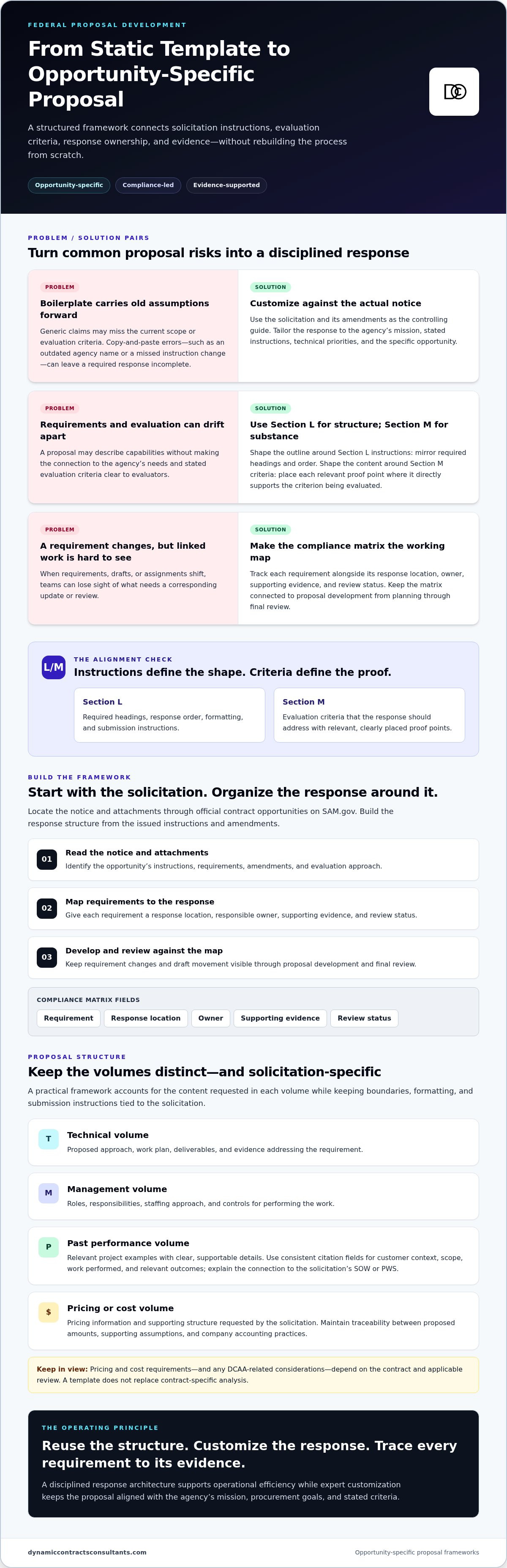
A compliant template gives your team a controlled way to translate solicitation instructions into a complete, evaluable response. Customized federal proposal templates should be built around the specific opportunity, with a compliance matrix connecting each requirement to its response location, owner, supporting evidence, and review status. Treat the matrix as the proposal’s north star: when a requirement changes or a draft moves, the team can see what else needs attention.
Start with the solicitation. Use the official contract opportunities on SAM.gov to locate the notice and its attachments, then build the response structure from the issued instructions and amendments. A practical framework typically accounts for:
- Technical volume: The proposed approach, work plan, deliverables, and evidence addressing the requirement.
- Management volume: Roles, responsibilities, staffing approach, and controls for performing the work.
- Past performance volume: Relevant project examples presented with clear, supportable details.
- Pricing or cost volume: The pricing information and supporting structure requested by the solicitation.
Keep volume boundaries, formatting, and submission instructions tied to the specific solicitation. For pricing and cost content, follow the stated submission requirements and maintain traceability between proposed amounts, supporting assumptions, and the company’s accounting practices. DCAA-related considerations depend on the contract and applicable review. Our DCAA compliance consulting helps contractors strengthen underlying documentation without treating one template as a substitute for contract-specific analysis.
Mapping to Section L and Section M
Section L instructions should shape the response outline. Mirror required headings and organize answers in the requested order, while confirming the solicitation’s actual directions. Section M evaluation criteria should shape the substance. Place each proof point where it directly supports the criterion being evaluated, rather than relying on evaluators to find it elsewhere. This structure makes it easier to trace requirements to answers and assess the offer against stated criteria.
Integrating Past Performance and Corporate Experience
Use modular citation fields to capture consistent information, such as customer context, scope, work performed, and relevant outcomes. Then select and tailor examples to demonstrate their relationship to the solicitation’s SOW or PWS. Relevance comes from explaining the connection, not simply repeating project descriptions. Our proposal writing services help maintain narrative consistency across volumes while preserving opportunity-specific detail.
We build templates to support strategic compliance and audit-ready documentation, with human review guiding the work. Our proposal framework information explains how we help connect requirements, evidence, and evaluation criteria.
Standardization vs. Customization: Balancing Efficiency and Precision
Standardization gives your proposal team a repeatable process for organizing content, assigning reviews, and tracking required inputs. Customization ensures the response reflects the opportunity rather than reading like a recycled submission. A practical 80/20 model can help: use roughly 80% of the framework for consistent structure and workflow, and reserve 20% for high-impact tailoring. Treat this as a planning heuristic, not a fixed formula. The solicitation determines how much adaptation each response needs.
Templates don’t have to make proposals robotic. The risk comes from treating reusable language as finished content. We use structure to reduce administrative friction, then tailor the response to show how your capabilities address the agency’s stated needs. Your unique value proposition should be evident in the evidence, methodology, and outcomes you present, not just in broad claims about your organization.
The Role of Technical Volume Tailoring
A technical volume needs to explain execution, not merely state “we will comply.” Use the framework to prompt specific details: the proposed method, responsible roles, work sequence, quality controls, and how the approach responds to the solicitation’s requirements. Technical responsiveness is the degree to which a proposal directly and clearly answers the solicitation’s technical requirements with a relevant, supportable approach.
Customized federal proposal templates can preserve these prompts across opportunities while leaving room for your team’s actual methods and differentiators. That balance helps reviewers understand not only that you recognize a requirement, but also how your solution addresses it.
Ensuring DCAA and FAR Compliance
Compliance is not established by a template alone. Review reusable content against applicable contract requirements and current FAR or DFARS provisions before using it, then validate the completed proposal against the solicitation. Stale clauses or assumptions can create inconsistencies between a submission and the requirements that govern the opportunity. Our DCAA compliance consulting supports disciplined processes and documentation, while human review helps ensure automation does not replace judgment.
Subcontracting templates also need deliberate clause management. Build in a controlled process for identifying and reviewing applicable flow-down clauses for each subcontract, rather than inserting the same clause set by default. The relevant terms depend on the contract and subcontract context, so the framework should make review and approval visible.
We combine repeatable structure with targeted human review to make complex requirements more manageable. Our compliance and proposal support information describes how we align proposal frameworks with compliance and execution needs.
Leveraging AI-Driven Automation for Rapid Template Customization
AI-driven automation can help move proposal development from manual document assembly toward a more structured cycle of analysis, drafting, and refinement. FARIFY, our affiliate’s AI-powered platform, supports rapid document generation, while our customized federal proposal templates provide a framework for shaping materials around the solicitation. The objective is not to remove expert judgment. It is to reduce repetitive work so your team can focus on technical alignment, evidence, and strategic differentiation.
AI can assist with organizing solicitation content, identifying requirements for review, and creating a draft compliance matrix. Validate these outputs against the source documents, including amendments, before using them to guide proposal decisions. An efficient first draft is useful only when the team confirms that requirements are accurately captured and addressed.
Automating the Compliance Matrix and RFP Extraction
A proposal team can use AI-assisted analysis to surface instructions, deliverables, evaluation criteria, and other requirements for structured review. Those items can then be mapped to response sections, owners, and evidence in a working matrix. This gives reviewers a clearer view of potential gaps and helps reduce manual transcription, while human review remains essential for interpreting context and confirming completeness. Our federal acquisition support connects proposal workflows with broader procurement lifecycle needs.
Ensuring Audit-Ready Outputs with FARIFY
FARIFY combines AI-enabled document generation with our team’s expertise in acquisition regulations, including FAR and DFARS. We use a human-in-the-loop approach to review generated content, check its relationship to source requirements, and help maintain clear, organized documentation. This supports audit readiness by making the development process more traceable, not by treating an AI-generated draft as automatically compliant.
The same discipline can support acquisition planning documents such as PWS or SOW drafts and IGCE materials, where source information and assumptions require careful review. AI assistance can help organize and prepare content, while knowledgeable reviewers verify that the result reflects the project context. It can also connect with bid-no-bid analysis: opportunity insights can inform which requirements, capabilities, and differentiators deserve emphasis if the team proceeds.
With customized federal proposal templates, AI can accelerate repeatable tasks while expert review guides the strategic refinement that makes each response specific. We bring these capabilities together to simplify complex proposal workflows and support precise, audit-ready outputs. Our AI-enabled proposal development information outlines how these services fit into a structured proposal process.
The Dynamic Contracts Advantage: Beyond the Template
A proposal framework creates value beyond submission when it becomes part of a disciplined procurement lifecycle. At Dynamic Contracts Consultants LLC, we connect capture management, proposal development, and post-award contract administration so your team can carry useful structure and documentation practices from opportunity planning into contract performance. Our approach has a practical aim: simple solutions to complex problems.
Comprehensive Lifecycle Support
Our support can extend from capture planning through post-award administration and closeout activities. As contract performance progresses, clear records and consistent communication help your team manage its responsibilities and prepare well-supported performance information, including CPARS narratives. We help organize documentation with audit readiness in mind, tailoring the work to your contract and operating context. Our post-award compliance support continues the work beyond proposal submission.
As a minority-owned small business, we recognize that supplier diversity can be relevant to agency small-business objectives. That context can be part of a contractor’s broader positioning, but it does not replace the need to demonstrate capability, meet solicitation requirements, and present a credible plan for performance.
Partnering for Scalable Growth
Well-governed customized federal proposal templates help your team reuse approved structures and organize evidence without treating prior responses as ready-made answers. Over time, an AI-enhanced proposal library can preserve useful content, capture lessons from completed bids, and make it easier to adapt materials to new opportunities. Review every reuse against the current solicitation and applicable requirements.
That foundation can support more efficient opportunity pursuit by reducing repetitive setup work and making roles, inputs, and review steps clearer. It also helps maintain consistency as your proposal pipeline grows, while leaving room for the opportunity-specific analysis that differentiates your response.
We combine acquisition expertise, AI-enabled document development, and human review to support precision, speed, and reliable documentation across your federal contracting work. Apply these capabilities to build a proposal process designed for your next stage of growth.
Build Your Next Proposal Framework for Growth
Federal proposal success depends on more than a reusable document. Customized federal proposal templates turn solicitation requirements into a structured, opportunity-specific response, helping your team balance operational efficiency with technical precision. A well-designed compliance matrix, clear volume organization, and targeted evidence make it easier to develop a proposal that speaks directly to evaluation criteria.
AI can accelerate repeatable work, but expert judgment remains essential. With FARIFY, we combine AI-powered document generation, which can produce drafts in minutes, with human review to support accurate, audit-ready outputs. Our DCAA compliance consulting adds a disciplined perspective to the documentation and processes behind your federal contracting work, while customized frameworks help carry strategic compliance beyond submission and into the broader procurement lifecycle.
Your next opportunity can be the starting point for a more scalable, reliable proposal process. Partner with Dynamic Contracts Consultants to build a customized proposal framework for your next opportunity.
Frequently Asked Questions
What is the difference between a generic and a customized federal proposal template?
A generic template provides a reusable document structure, while a customized federal proposal template is organized around the solicitation, agency context, and evaluation criteria for a specific opportunity. It can help map requirements to response sections, assign review responsibilities, and prompt relevant evidence. Your team still needs to tailor the content for each bid. Reusing a framework can support efficiency; copying prior answers without checking their relevance can weaken the response.
How do customized templates support compliance with FAR and DFARS?
Customized templates support compliance by prompting teams to identify applicable solicitation requirements and organize responses, clauses, and supporting documentation for review. They don’t establish compliance on their own or replace analysis of the current solicitation, contract terms, and applicable FAR or DFARS provisions. We combine acquisition expertise with human review to help keep generated materials aligned with source requirements and produce documentation designed with audit readiness in mind.
Can AI-generated proposal templates pass a DCAA audit?
An AI-generated template cannot, by itself, pass or guarantee the outcome of a DCAA audit. Audit readiness depends on the contractor’s records, processes, and the matters under review, not simply the tool used to prepare a document. FARIFY supports rapid document generation, and our human-in-the-loop process helps review outputs for accuracy and context. Treat AI-generated content as a draft that requires knowledgeable validation and supporting documentation.
How much time can I save by using customized federal proposal templates?
Time savings depend on the solicitation, source materials, review process, and how much content can be responsibly reused, so a universal estimate would be unreliable. Customized federal proposal templates can reduce repetitive setup by providing a prepared structure for requirements, response ownership, and evidence. FARIFY can generate documents in minutes rather than days, while your team still needs to verify the output, tailor the narrative, and complete appropriate reviews.
Do templates work for both prime and subcontracting opportunities?
Yes, templates can support both prime and subcontracting proposals when adapted to the opportunity and the parties’ respective requirements. A prime response may address the full scope and management approach, while a subcontractor’s contribution may focus on its assigned work, capabilities, and requested supporting information. For subcontracting, review applicable solicitation and contract terms, including relevant flow-down clauses, rather than assuming a prime proposal template can be reused unchanged.
How often should federal proposal templates be updated for regulatory changes?
Review templates before using them for each opportunity and whenever relevant solicitation amendments or official regulatory changes may affect their content. There is no single update interval that fits every framework, since templates differ in scope and may include different clauses, instructions, and references. Maintain version control, identify the source and review date for reusable material, and verify that each response reflects current opportunity documents instead of relying on an older saved draft.
What role do Section L and Section M play in template design?
Section L instructions guide how a proposal must be organized and submitted, while Section M describes the evaluation criteria for the offer. A strong template reflects Section L in its response structure and uses Section M to guide where the proposal presents its approach, evidence, and differentiators. Mapping both sections helps your team address instructions in a clear order and makes it easier for evaluators to locate relevant answers.


