

A rate can be mathematically correct and still be difficult to defend if its cost pool, allocation base, or assumptions are inconsistent. That’s why how to calculate indirect rates for government contracts involves more than dividing one number by another. The method must show how costs are grouped and distributed.
Contractors often know that fringe, overhead, and G&A costs need to be accounted for. The challenge is deciding which costs belong in each pool and which base best reflects their allocation. A repeatable approach makes rates easier to explain and connects proposal pricing with ongoing compliance.
In this guide, we explain how to define indirect cost pools, select allocation bases, calculate rates, and document assumptions consistently. We also distinguish planning and provisional billing rates from final rates calculated using actual costs, so you can understand how estimates are reconciled after the fiscal year ends. Our DCAA compliance consulting and cost and price analysis support a disciplined approach to rate structures and their documentation.
Key Takeaways
- Learn how to calculate indirect rates for government contracts by linking each cost pool to a clearly defined allocation base.
- Assess whether a single-rate or multiple-pool structure better reflects your cost model, accounting practices, and allocation rationale.
- Follow a consistent workflow: define the period, classify costs, total pools and bases, and check the results.
- Identify the records and assumptions that explain rate calculations and support proposal pricing.
- Recognize when changes in business conditions or cost patterns warrant a documented review of your rates.
What Indirect Rates Mean in Government Contract Pricing
An indirect rate is the proportion of a defined pool of indirect costs allocated over a corresponding base for a specific period. The basic calculation is indirect cost pool ÷ allocation base, expressed as a percentage by multiplying by 100. In our cost and price analysis work, we assess how the pool and base are defined and whether they fit your documented accounting approach. This is the starting point for understanding how to calculate indirect rates for government contracts.
Direct costs can be identified with a specific contract or other cost objective. Indirect costs support multiple activities and require an allocation method. Indirect costs offers a high-level overview of the concept; our analysis focuses on how your records and circumstances support a particular classification. A calculated rate is an allocation tool, not a determination that a cost is allowable or chargeable to a contract.
For additional context on rate structures, watch Building Government Contract Indirect Rates:
How Indirect Costs Differ from Direct Costs
We assess direct costs by their relationship to a specific contract or other cost objective. Indirect costs support multiple activities and need a rational allocation method. Classification depends on the circumstances and your consistent accounting practices, not on a cost’s label alone.
Hypothetical example: An employee’s labor recorded to one contract may be treated as direct labor. Office rent supporting staff who work across several projects might belong in an indirect pool and be allocated using an appropriate base. This illustrates possible treatment, not a universal classification. The facts and established accounting approach matter.
Why Government Contractors Track Indirect Rates
Rate assumptions connect cost estimates and proposal pricing to the way shared expenses are distributed across relevant work. Applying a documented method consistently supports financial planning and gives your team a clear basis for explaining its calculations. Our cost and price analysis, proposal financial analysis, and DCAA compliance consulting help align rate-structure reviews with pricing and supporting documentation.
Rates may also inform contract billing, but their application depends on the contract type, terms, and applicable requirements. Keep the arithmetic separate from the analysis of cost allowability, allocability, and contract-specific conditions. Before using a rate in an estimate or billing process, verify the relevant terms and treatment for that contract.
How to Define Indirect Cost Pools and Allocation Bases
Start by examining how your organization incurs shared costs and how its accounting practices classify them. A defensible rate structure connects each indirect cost pool to an allocation base that reflects a consistent rationale for distributing those costs. Fringe benefits, overhead, and general and administrative costs are common examples, not default categories for every contractor. We assess whether the structure fits your actual cost model.
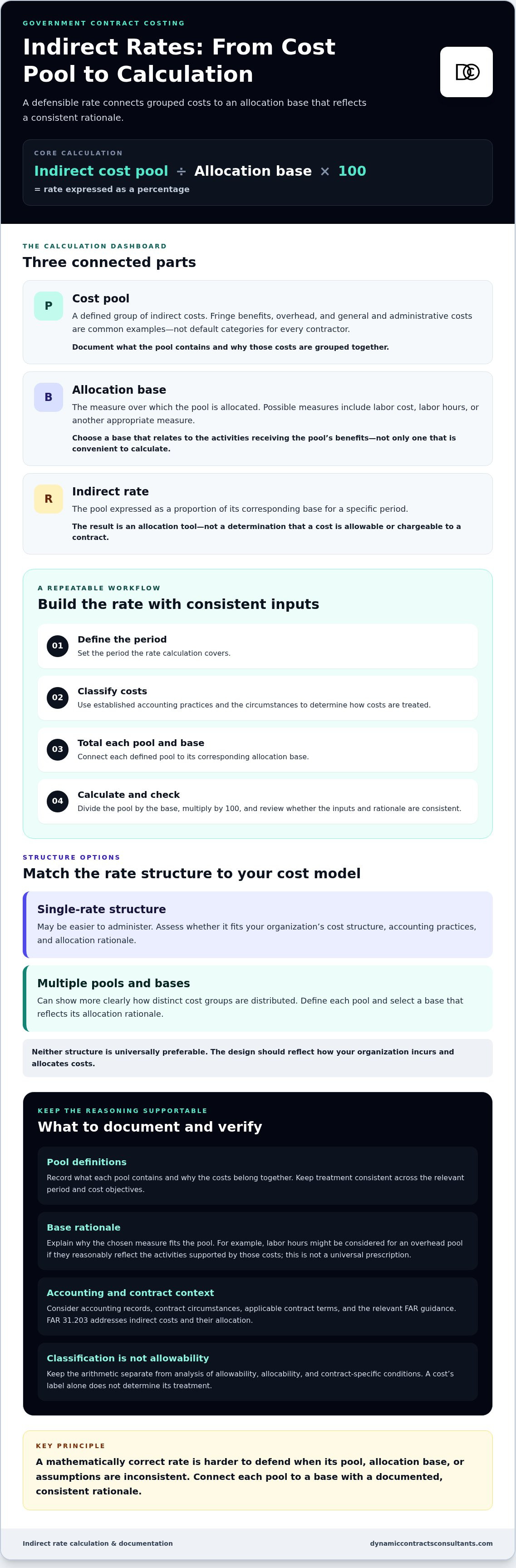
A pool groups indirect costs, a base measures how those costs are allocated, and the rate expresses the pool as a proportion of that base. The basic calculation is:
Indirect rate = (indirect cost pool ÷ allocation base) × 100
Organizing Costs into Indirect Cost Pools
We help organize related costs into pools for analysis and allocation, using your established accounting practices to guide consistent classification. The Federal Acquisition Regulation (FAR) 31.203 addresses indirect costs and their allocation. We consider that guidance alongside your accounting records and contract circumstances. Placing a cost in a pool does not, by itself, establish that the cost is allowable or chargeable.
For each pool, document what it contains and why the costs are grouped together. Make the rationale specific enough to support consistent treatment across the relevant period and cost objectives. We can review your rate structure and supporting documentation to help keep pool definitions connected to actual operations.
Selecting an Allocation Base That Fits the Pool
An allocation base may use labor cost, labor hours, or another appropriate measure. Choose a base based on how it relates to the activities receiving the pool’s benefits, rather than solely on how convenient it is to calculate. A base that does not reflect that relationship can make the resulting cost distribution harder to explain.
For example, labor hours might be considered for an overhead pool if they reasonably reflect the activities supported by those costs. This is an illustration, not a universal prescription. Document why the selected measure fits the pool and apply it consistently. Review the current FAR wording, its applicability, and relevant contract terms as part of your analysis.
These decisions shape how to calculate indirect rates for government contracts because changing a pool or its base can change the resulting rate. Our DCAA compliance consulting and cost analysis services support contractors reviewing rate structures and their documentation.
Which Indirect Rate Structure Fits Your Cost Model?
Evaluate rate structures against how your organization incurs and allocates costs rather than treating one design as a standard template. A single rate may be easier to administer, while multiple pools and bases can show more clearly how distinct cost groups are distributed. Neither approach is universally preferable. We consider your cost structure, accounting practices, and documented allocation rationale to identify a supportable design for your needs.
Single Rate or Multiple Rates: What Changes?
Combining costs under one rate may simplify estimating and application, but it can obscure differences in the activities driving separate costs. Multiple pools, each with its own base and rate, can make allocation more specific and transparent. They also require consistent classification and supporting analysis. We assess how each choice affects cost distribution and whether your records make the approach explainable.
| Context | Potential benefit | Review consideration |
|---|---|---|
| Cost patterns are relatively uniform across activities | A single rate may be simpler to calculate and apply. | We confirm whether one base reflects the relationship between the costs and the activities receiving benefit. |
| Distinct cost groups support different activities | Multiple rates can make allocation more specific and transparent. | We assess whether each pool and base is consistently defined and supported by records. |
| Operations or cost patterns change | A revised structure may better reflect current activity. | We document the reason for a change and evaluate its effect on estimates and rate application. |
The DCAA guide to calculating indirect rates provides additional context on calculations and allocation bases. When assessing how to calculate indirect rates for government contracts, distinguish the arithmetic from whether a rate is suitable for a particular contract or accounting use. Consider contract type, terms, and applicable cost treatment before applying a rate.
Estimated, Provisional, and Final Rates
Forward-looking estimates support planning and proposal pricing by projecting indirect costs and the related allocation base for a future period. Provisional billing rates are temporary rates based on estimates that may be used for billing during the year, subject to applicable contract terms and procedures. They may be adjusted as actual cost experience develops. Final rates use actual costs for a completed period and support reconciliation of provisional billings.
These rate types serve different purposes and arise at different points in the cost cycle. Before applying a specific procedure, review the current wording and applicability of FAR Part 42, including Subpart 42.7, and the relevant contract clauses. Our cost and price analysis can help connect rate assumptions to proposal estimates and subsequent financial review.
How to Calculate an Indirect Rate Step by Step
A consistent calculation starts with a defined accounting period and ends with a documented review of each result. The formula is straightforward, but accuracy depends on using matching pool and base definitions for the same period. Follow this workflow to calculate indirect rates consistently:
- Step 1: Define the period. Specify the time frame covered, such as a fiscal year or planning period. Use it consistently for pool costs and base activity.
- Step 2: Classify costs. Apply your established accounting practices to identify direct costs, indirect costs, and costs assigned to each pool. Record the rationale for classifications that require judgment.
- Step 3: Total each pool. Sum the costs assigned to each indirect pool for the defined period. Keep the supporting detail so the total can be traced to accounting records.
- Step 4: Determine each base. Calculate the total amount or activity measure used to allocate each pool for that same period. Define the denominator explicitly, including which costs, labor hours, or other units it contains.
- Step 5: Calculate each rate. Divide each pool’s total by its corresponding base total, then multiply by 100 to express the result as a percentage.
- Step 6: Review the results. Check the calculation, supporting records, classifications, and assumptions before applying the rate to estimates or other contract-related purposes.
Calculate Each Pool Against Its Matching Base
An indirect rate equals the total costs in a defined pool divided by the total amount in its matching allocation base, multiplied by 100. The formula is:
Rate = (indirect cost pool total ÷ matching allocation base total) × 100
Hypothetical example: Assume an illustrative indirect cost pool totals $300,000 and its defined allocation base totals $1,500,000 for the same period. The calculation is $300,000 ÷ $1,500,000 × 100 = 20%. These figures are illustrative only. They are not benchmarks and do not prescribe a standard rate, pool composition, or allocation base.
Apply the calculation separately to each pool and its corresponding base. Set a rounding convention, such as the number of decimal places to report, and use it consistently across calculations, schedules, and explanations. Retain adequate precision during the calculation before rounding the reported rate.
Review the Calculation Before Applying It
Reconcile pool and base totals to the accounting records for the period under review. Check for duplicated or omitted costs, inconsistent classifications across pools, and differences between source records and calculation schedules. Confirm that the numerator and denominator cover the intended period and follow the documented method. Correct arithmetic alone does not establish that a rate is suitable for every contract purpose, so consider the applicable terms and intended use.
Our indirect-rate analysis resources can help you structure a review of your rates and supporting documentation.
Document, Monitor, and Apply Indirect Rates with Control
A rate calculation is only as useful as the records and rationale behind it. Maintain a support file that connects each pool and allocation base to the accounting data for the period, explains the assumptions, and records subsequent revisions. This helps your team apply rates consistently in estimates, pricing analyses, and applicable billing processes.
Build a Clear Rate Support File
Organize the workpapers so a reviewer can trace the calculation from source records to reported rate. A structured file may include:
- Cost schedules showing which expenses make up each pool, with references to supporting accounting records.
- Allocation-base detail showing the source, period, and components of each denominator.
- Calculation workpapers identifying the formula, rate result, rounding method, and any period-specific adjustments.
- Written assumptions, approvals, and revision history explaining why the methodology was selected or changed.
Record the accounting period and preserve prior versions when rates or assumptions change. This creates traceability across planning estimates, provisional rates, and actual-cost calculations without treating them as interchangeable. A documented file can also support DCAA audit preparation by making the basis for your figures easier to follow.
Connect Rate Analysis to Pricing and Compliance Support
Rate assumptions affect how indirect costs appear in proposal cost analysis. Documenting those assumptions helps your team explain how estimates were developed and assess whether they remain appropriate as actual cost patterns change. Documentation does not guarantee a particular pricing outcome or determine how a rate applies under every contract. Apply rates consistently and in accordance with relevant contract terms and requirements.
Review the structure when business conditions shift, such as a change in the mix of work or in the activities driving shared costs. Assess whether the existing pools and bases still reflect the allocation rationale, document the analysis, and retain the decision. We connect rate analysis with proposal financial analysis and ongoing compliance support through our DCAA compliance consulting.
A disciplined process for how to calculate indirect rates for government contracts depends on sound calculations and controlled documentation. Our indirect-rate documentation resources can help you review your rate structure and workpapers.
Build Rate Confidence Into Your Contracting Strategy
Reliable indirect-rate management depends on more than the final percentage. Define pools and bases using a consistent allocation rationale, calculate each rate with period-specific figures, and preserve the records and assumptions that explain your method. These controls connect cost analysis to proposal pricing while keeping estimates, provisional billing rates, and final actual-cost rates distinct.
Understanding how to calculate indirect rates for government contracts gives your team a repeatable foundation. Applying a rate still requires attention to its purpose, supporting records, and relevant contract terms. A documented review can also help identify when changes in cost patterns call for reassessing the structure.
We support contractors through DCAA compliance consulting and audit-related support, cost and price analysis, and proposal financial analysis. Our team includes professionals with Certified Professional Contracts Manager and Certified Federal Contracts Manager credentials, bringing structured expertise to complex federal contracting requirements without promising a particular audit or pricing outcome.
For tailored support reviewing your rate structure and documentation, discuss your indirect-rate requirements with our team. With a consistent method and clear supporting records, you can make rate decisions with greater confidence throughout the contracting lifecycle.
Frequently Asked Questions
How do you calculate an indirect rate for a government contract?
To understand how to calculate indirect rates for government contracts, define the accounting period, classify costs consistently, total each indirect cost pool, and determine its matching allocation base for that same period. Divide the pool total by the base total, then multiply by 100 to express the rate as a percentage. Review the source records, assumptions, and contract terms before applying the rate to pricing or an applicable billing process.
What is the formula for an indirect cost rate?
The formula is indirect cost pool total ÷ matching allocation base total × 100. For example, if a hypothetical pool contains $300,000 and its corresponding base is $1,500,000, the calculation is 20%. These figures illustrate the arithmetic only; they are not standard rates or recommended bases. Use pool and base totals from the same defined period, and apply a consistent rounding convention when reporting the result.
What costs should be included in an indirect cost pool?
Include costs that your established accounting practices classify as indirect and that fit the pool’s documented allocation rationale. Fringe benefits, overhead, and general and administrative costs are common categories, but they are not automatic classifications for every contractor. The treatment of an individual cost depends on its relationship to contracts or other cost objectives and applicable requirements. Pool assignment does not, by itself, determine whether a cost is allowable or chargeable.
Can a government contractor use one indirect rate?
A contractor may use a single-rate structure when its cost model and allocation rationale support combining the relevant indirect costs and applying one base consistently. This can simplify administration, while multiple pools and bases may provide more detail when different cost groups support distinct activities. There is no universally preferable structure. Assess your accounting practices, cost patterns, and contract circumstances, and document why the selected approach reasonably allocates costs.
What is the difference between provisional and final indirect rates?
Provisional billing rates are temporary, estimate-based rates that may be used for billing during the year, subject to applicable contract terms and procedures. Final indirect rates use actual costs and allocation-base amounts for a completed period. The final calculation can differ from the provisional estimate, so billings may need to be reconciled according to the applicable process. Keep the rate purpose, period, and supporting records clear.
How often should indirect rates be reviewed?
Review rates regularly as part of your accounting and pricing processes, and reassess them when changes in business conditions or cost patterns may affect a pool, base, or allocation rationale. Examples include shifts in the mix of work or in the activities that drive shared costs. Document the review, its assumptions, and any decision to revise or retain the existing structure. The appropriate cadence depends on your circumstances and requirements.
Do indirect rates apply to every government contract?
Indirect costs may be relevant to estimates or pricing across government work, but a calculated rate does not automatically apply in the same way to every contract. Its use depends on the contract type, terms, applicable cost treatment, and purpose of the calculation. For example, a rate used to develop a proposal estimate is not necessarily a billing rate. Review the specific contract provisions and maintain a clear record of how each rate is applied.


