

Copying every prime-contract clause into every subcontract is not the same as managing flow-down risk. The contract flow down requirements that apply depend on the governing contract and your specific subcontract relationship. A blanket approach can obscure obligations just as an omission can leave them out. We help federal contractors treat flow-downs as decisions to analyze and document, rather than language to copy without review.
You need a disciplined way to determine which clauses apply, communicate the resulting obligations, and retain evidence of decisions and acknowledgements. That work can become difficult across multiple subcontractors and tiers, particularly when contract documents or requirements change during performance.
In this guide, we explain a repeatable process for analyzing applicable clauses, documenting the rationale, and translating requirements into clear subcontract language. We also cover how to maintain review records, monitor changes, and connect subcontract oversight to broader post-award contract administration. Our approach combines structured analysis with human review, helping you build traceable controls without treating clause copying or automation as a substitute for contract-specific judgment.
Key Takeaways
- Determine contract flow down requirements by reviewing the awarded contract, applicable modifications, clause language, and the subcontract’s scope and work.
- Use a clause matrix to link each decision to its source, rationale, subcontract location, reviewer, tier, communication status, acknowledgement, and supporting evidence.
- Translate applicable obligations into clear, subcontract-specific terms so teams and subcontractors understand the requirements relevant to their work.
- Monitor acknowledgement, deliverables, records, reporting, and other applicable performance evidence. Update flow-down controls when contract requirements change.
- Coordinate ownership across contracts, procurement, program, and compliance teams to make flow-down management a traceable part of post-award administration.
What Are Contract Flow-Down Requirements in Federal Subcontracts?
A flow-down is a prime-contract requirement incorporated into a subcontract when the governing terms and applicable rules make it relevant to that subcontract’s scope and circumstances. It does not mean every clause in a federal prime contract automatically applies to every subcontract or lower-tier supplier. Determining applicable contract flow down requirements requires reviewing the controlling contract documents alongside the work being subcontracted.
For background on the federal acquisition framework, see the Federal Acquisition Regulation (FAR). The specific requirements for a subcontract still depend on the contract language, applicable rules, scope of work, and transaction context.
The following video provides additional context on DFARS flow-down requirements:
How do flow-down clauses move from a prime contract to a subcontract?
The federal agency awards a contract to the prime contractor. The prime reviews the award, modifications, and applicable requirements, then identifies obligations relevant to a particular subcontract. Those obligations may need to be incorporated into the subcontract and, where required, may continue to a lower-tier supplier. Each tier needs its own review. Copying language forward without considering the scope can result in omissions or unnecessary terms.
Incorporation and communication are related but distinct. Incorporating a clause places contractual language in the subcontract, in full or through an appropriate reference. Communicating an operational requirement explains how the subcontractor’s work, records, reporting, or deliverables support performance. Effective administration addresses both. Internal policies or supplier instructions do not substitute for required contractual flow-down language.
Why do flow-down requirements matter after award?
Once performance begins, subcontract terms provide a shared basis for managing expectations. Clear, applicable language helps contract teams and subcontractors align on performance, reporting, and recordkeeping, while supporting oversight across subcontract tiers. An omitted clause, inaccurate incorporation, or instruction that conflicts with the subcontract can complicate administration and create compliance risk.
We treat clause mapping and subcontract oversight as connected elements of post-award contract administration. A traceable review helps your team understand why an obligation was included, where it appears, and how it will be monitored. This structured approach supports consistent execution without assuming a clause applies before the governing documents and subcontract context have been assessed.
How to Determine Which Contract Flow-Down Requirements Apply
We assess contract flow down requirements against the awarded contract and the specific subcontract, rather than relying on a generic clause checklist. Applicability is determined clause by clause, using the controlling contract language, governing requirements, and your subcontract’s actual scope. We document the basis for each decision so your team can trace why a clause was included, excluded, or referred for further review.
What contract documents should the reviewer examine?
We begin with the executed prime contract, its incorporated clauses, applicable modifications, and relevant attachments. We also review the solicitation context to understand the procurement, while distinguishing solicitation language from terms included in the final award. Compare the proposed subcontract and its statement of work with the prime contract’s requirements. Record each document’s source, revision or version, and review date so your team can identify the basis of the analysis later.
How should teams assess clause applicability?
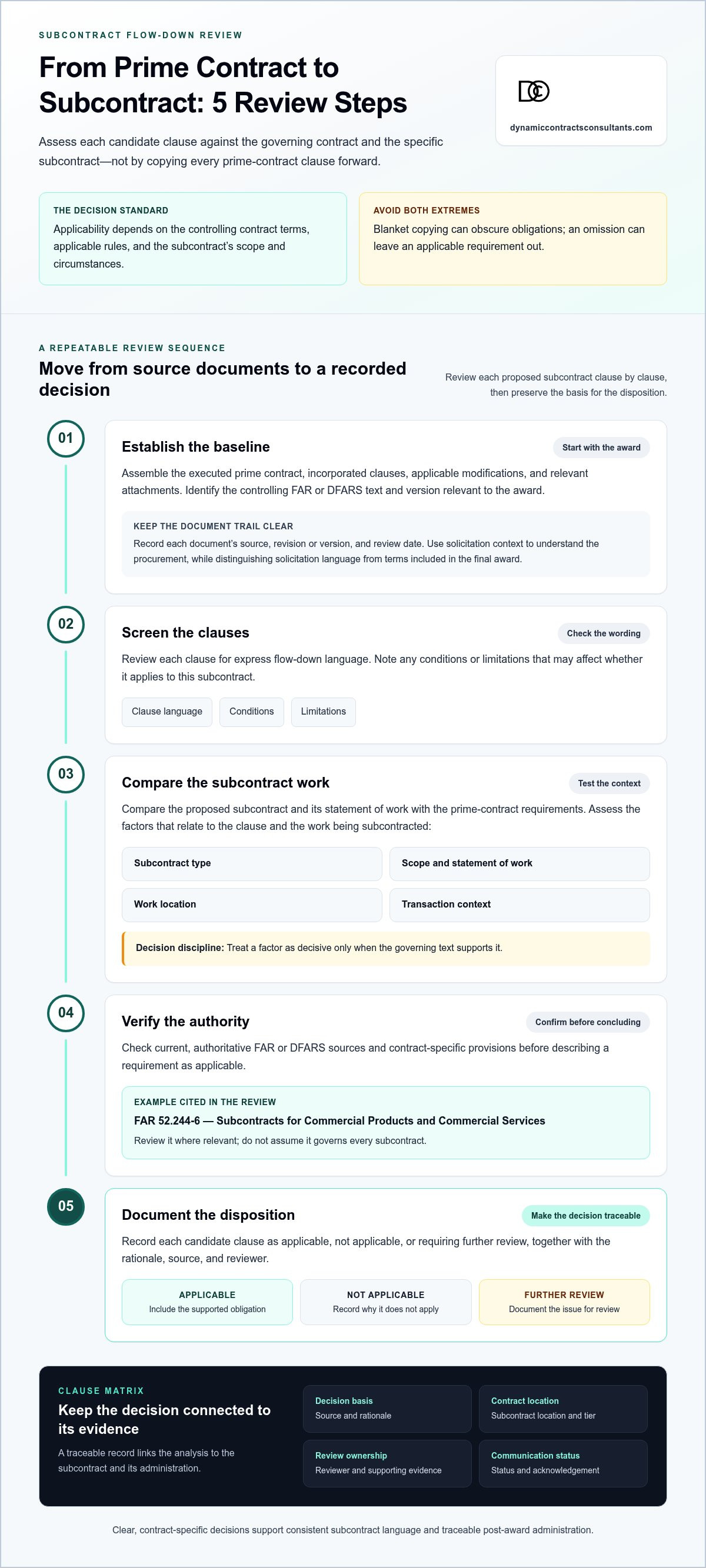
We use a consistent sequence for each proposed subcontract:
- Establish the baseline: Assemble the awarded contract and applicable modifications, then identify the controlling FAR or DFARS text and version relevant to the award.
- Screen the clauses: Review each clause for express flow-down language, including conditions or limitations that may affect its application to your subcontract.
- Compare the work: Assess the subcontract type, scope, statement of work, work location, and transaction context against the clause and relevant prime-contract terms. Treat a factor as decisive only when the governing text supports it.
- Verify the authority: Check current, authoritative FAR or DFARS sources and contract-specific provisions before describing a requirement as applicable. For example, where relevant, review FAR 52.244-6 Subcontracts for Commercial Products and Commercial Services without assuming it governs every subcontract.
- Document the disposition: Record each candidate clause as applicable, not applicable, or requiring further review, together with the rationale, source, and reviewer.
Express flow-down language gives your team a clear starting point, but the full clause and subcontract context still matter. Other requirements may need contract-specific interpretation. When language is ambiguous or conflicting, document the issue and route it for qualified review rather than resolving it by assumption. This creates a consistent record while keeping the analysis grounded in the governing documents.
Consider thresholds, subcontract characteristics, and performance details only when the controlling clause or contract makes them relevant. Do not infer applicability from a clause title alone or apply a threshold without confirming the governing text and context.
For a complex subcontract portfolio, discuss a structured flow-down review with us as part of your post-award compliance process.
How to Build a Traceable Flow-Down Clause Matrix
We use a clause matrix to turn flow-down analysis into a controlled record for your contract, procurement, program, and compliance teams to use throughout performance. It should connect each candidate clause to its source, applicability decision, rationale, and location in the subcontract. This makes contract flow down requirements easier to trace without treating the matrix as a substitute for reviewing the governing documents.
What fields belong in a flow-down clause matrix?
Design each record so reviewers can see what was assessed, who made the decision, and what action remains. Useful fields include:
- Clause identification: Clause number and title, source document, version or revision, and date reviewed.
- Applicability analysis: Decision, supporting rationale, unresolved interpretation, and any follow-up required.
- Subcontract mapping: Subcontract reference, supplier name or identifier, tier, and location of the related provision.
- Ownership and communication: Responsible reviewer or owner, communication status and date, subcontractor acknowledgement status, and evidence reference.
- Change tracking: Modification or updated source reference, review date, affected subcontracts, and disposition of the change.
Consistent decision labels help teams distinguish completed analysis from open work:
| Decision | What it records | Control action |
|---|---|---|
| Applicable | The review supports including the clause or requirement for this subcontract. | Map it to the subcontract language and track communication and acknowledgement. |
| Not applicable | The review supports excluding the candidate clause for this subcontract. | Retain the rationale and source documents supporting the decision. |
| Pending review | Applicability remains unresolved or requires further qualified review. | Assign an owner, record the open question, and track the follow-up to resolution. |
How should the matrix connect clauses to subcontract language?
For every applicable entry, identify the exact subcontract section or attachment where the obligation appears. The matrix should show whether the subcontract includes the full clause text, incorporates it by reference, or uses another authorized method. Compare the wording and method against the controlling contract and current requirements. A clause number in the matrix alone does not demonstrate that the subcontract contains the correct provision.
Maintain version control as well. When a prime-contract modification or source update prompts review, record the revised document version and date, identify affected clause records and subcontracts, and preserve the prior review history. This helps your team distinguish current decisions from superseded ones and document resulting subcontract updates. We integrate this traceability with post-award compliance support, connecting clause analysis, subcontract records, and ongoing administration.
How to Communicate, Monitor, and Update Flow-Down Obligations
Including an applicable clause in a subcontract is only one part of effective control. Contract teams must also explain what the obligation means for the subcontractor’s work, identify who owns each action, and retain evidence of performance. Copying every prime-contract clause into every subcontract is not a substitute for applicability analysis. It can make relevant obligations harder to identify and manage.
How can teams make flow-down obligations actionable?
For each applicable requirement, translate the subcontract language into clear, work-specific expectations. Identify the deliverable or record involved, any applicable reporting date, the subcontractor contact responsible for coordination, and the prime-side owner who will review performance. Keep the expectation aligned with the executed subcontract rather than relying on informal instructions that may be unclear or inconsistent.
Maintain controlled records showing what was communicated and acknowledged. Depending on the subcontract and obligation, the file may include the executed subcontract version, written acknowledgement, relevant correspondence, review decisions, and performance evidence. Set periodic reviews proportionate to contract risk and documented requirements. When evidence is missing, assign a follow-up owner and record the resolution rather than treating silence as confirmation.
What should happen when the prime contract changes?
Route each modification for an impact review against the clause matrix and identify potentially affected subcontract terms and tiers. Record the decision, reviewer, supporting rationale, approvals, and any revised language or communication. If a change affects a deliverable or reporting expectation, document how the subcontractor was informed and retain the related acknowledgement or other evidence.
A prime-contract modification does not automatically revise every lower-tier subcontract. Assess which subcontracts are affected, determine what action is supported by the governing terms, and use the appropriate contract process to make and communicate any required changes. Update the matrix and preserve prior versions so the decision history remains traceable.
These controls connect subcontract communication and performance evidence with broader post-award compliance management. Our structured approach helps you maintain visibility across decisions, records, and follow-up actions as requirements evolve.
Discuss post-award compliance support for your subcontract oversight process.
Integrate Flow-Down Management Into Post-Award Contract Administration
Flow-down controls are most effective when embedded in the post-award operating model, rather than treated as a one-time subcontract drafting task. A repeatable sequence connects contract review to subcontract performance and gives each team a clear role in maintaining strategic compliance.
- Review the award documents, applicable modifications, and subcontract scope.
- Decide which candidate clauses apply and document the rationale.
- Document the decision, source, reviewer, and evidence in a central clause matrix.
- Incorporate applicable obligations into the subcontract using an appropriate method.
- Communicate specific performance expectations to the subcontractor.
- Monitor applicable deliverables, records, reporting, and other performance evidence.
- Update clause records and affected subcontracts when changes warrant action.
How does flow-down management fit into the procurement lifecycle?
The process begins with award-document review and informs subcontract formation. During performance, teams use the clause matrix to connect obligations to subcontract provisions and track relevant evidence. Modifications prompt an impact review, while closeout provides an opportunity to confirm that required records and actions have been addressed. A central matrix helps teams apply consistent decision logic across subcontract files without assuming every subcontract carries identical terms.
Clear ownership supports execution. Contracts can coordinate interpretation and administration; procurement can align subcontract documents with approved decisions; program teams can monitor work and deliverables; and compliance teams can support process oversight and evidence management. Audit-ready records should show the source reviewed, the applicability rationale, the language incorporated, and how the requirement was communicated and monitored.
When can contract administration support improve the process?
Additional post-award administration may be useful when your organization manages multiple subcontract tiers, frequent prime-contract modifications, or records spread across disconnected files and teams. These conditions can make it harder to maintain a current view of contract flow down requirements, ownership, and follow-up. Dynamic Contracts Consultants LLC provides flow-down clause analysis, subcontract management, and post-award contract administration to support structured review and traceable records, with human review for AI-generated compliance documentation.
Explore our post-award compliance and contract administration support to see how these controls fit within broader lifecycle oversight.
Discuss flow-down clause management with Dynamic Contracts Consultants LLC to structure a practical approach for your subcontract relationships.
Make Flow-Down Oversight a Repeatable Part of Contract Performance
Effective flow-down management depends on disciplined decisions, not blanket clause copying. Review the governing contract and subcontract scope, document why each candidate clause applies or does not apply, and connect the decision to clear subcontract language and supporting records.
A traceable matrix helps your teams maintain that control as subcontracts move through performance and change. Assigning ownership across contracts, procurement, program, and compliance functions supports consistent communication, acknowledgement, and monitoring of applicable obligations. These practices make contract flow down requirements part of post-award oversight rather than a one-time drafting task.
Dynamic provides flow-down clause analysis and post-award compliance support, alongside contract administration and subcontract management across the contract lifecycle. We help organizations strengthen the processes and records that support ongoing subcontract oversight.
Discuss your flow-down clause management needs with our team. With a structured, contract-specific approach, you can build clearer obligations and more consistent oversight across your subcontract relationships.
Frequently Asked Questions
What are contract flow-down requirements?
Contract flow-down requirements are prime-contract obligations incorporated into a subcontract when the governing contract terms and applicable rules make them relevant. They connect federal contract requirements to subcontract performance and may extend to lower tiers when the applicable clause or contract terms require it. The prime contractor reviews the controlling documents and subcontract scope, then documents the applicability decision and communicates any obligations the subcontractor needs to perform.
Which FAR clauses must be flowed down to subcontractors?
There is no single list that applies to every subcontract. The clauses that must be flowed down depend on the current governing FAR or DFARS text, the prime contract’s terms, and the subcontract’s scope and context. Review each candidate clause’s flow-down language and conditions against the awarded contract and applicable modifications. Verify requirements using authoritative, current sources rather than relying on a generic checklist or clause title alone.
Do prime contractors have to flow down every clause in the prime contract?
No. A prime contractor should not assume that every clause in the prime contract applies to every subcontract. Some clauses may expressly require flow-down, while others may not apply based on their terms or the subcontract’s work. Assess each clause individually, document the reason for including or excluding it, and resolve uncertain or conflicting language through qualified review. Blanket copying can obscure relevant obligations and create mismatches.
How do I determine whether a clause applies to a subcontract?
Start with the awarded prime contract and applicable modifications, then review the clause text, stated flow-down provisions, and relevant contract terms. Compare those requirements with the subcontract’s scope, type, work performed, and other factors identified by the governing text. Record the decision as applicable, not applicable, or pending further review, with its source and rationale. Confirm the relevant FAR or DFARS version before finalizing the analysis.
How should flow-down clauses be documented?
Use a controlled clause matrix that connects each candidate clause to its source document, version, applicability decision, rationale, and location in the subcontract. Record the subcontract tier, reviewer, owner, communication status, acknowledgement, and evidence reference. Retain the executed subcontract and relevant correspondence, and track open questions or follow-up actions. Update records when a modification affects a clause or subcontract, preserving prior decisions so the review history remains traceable.
What happens if a required flow-down clause is omitted?
Omitting a clause that applies can create a gap between the prime contract’s requirements and the subcontract terms, complicating performance oversight and compliance administration. The appropriate response depends on the governing documents and circumstances. Identify the affected subcontract, document the issue, and route it for qualified review. If corrective action is appropriate, record the decision, any approved subcontract changes, communication, and acknowledgement, then update the clause matrix and supporting file.
Do flow-down requirements apply to lower-tier subcontractors?
They can apply to lower-tier subcontractors when the governing clause or contract terms require the obligation to continue through those tiers. Do not assume every requirement automatically extends to every supplier. Review the applicable language and each lower-tier subcontract’s scope and context, then document the resulting decision. Where a requirement applies, ensure it is reflected in the relevant subcontract terms and tracked through appropriate communication and performance records.


