

In fiscal year 2025, the federal government committed approximately $793 billion in contracts, yet the number of active small business contractors continues to decline as regulatory barriers intensify. You're likely feeling the weight of the February 1, 2026, FAR and DFARS overhaul, which demands a level of precision that can easily overwhelm even the most seasoned proposal teams. We understand that the fear of administrative disqualification often outweighs the excitement of a new solicitation. This guide provides a definitive strategic framework on how to respond to a government RFP with absolute technical and regulatory accuracy. We'll show you how to master the procurement lifecycle by integrating DCAA-compliant methodologies with AI-driven automation to ensure your submissions are audit-ready from the start. By following our expert-led process, you'll establish a repeatable framework that reduces your time-to-submission while significantly improving your win-rates in an increasingly competitive federal market.
Key Takeaways
- Learn to distinguish between SOW and PWS requirements to ensure your technical approach aligns perfectly with specific agency expectations.
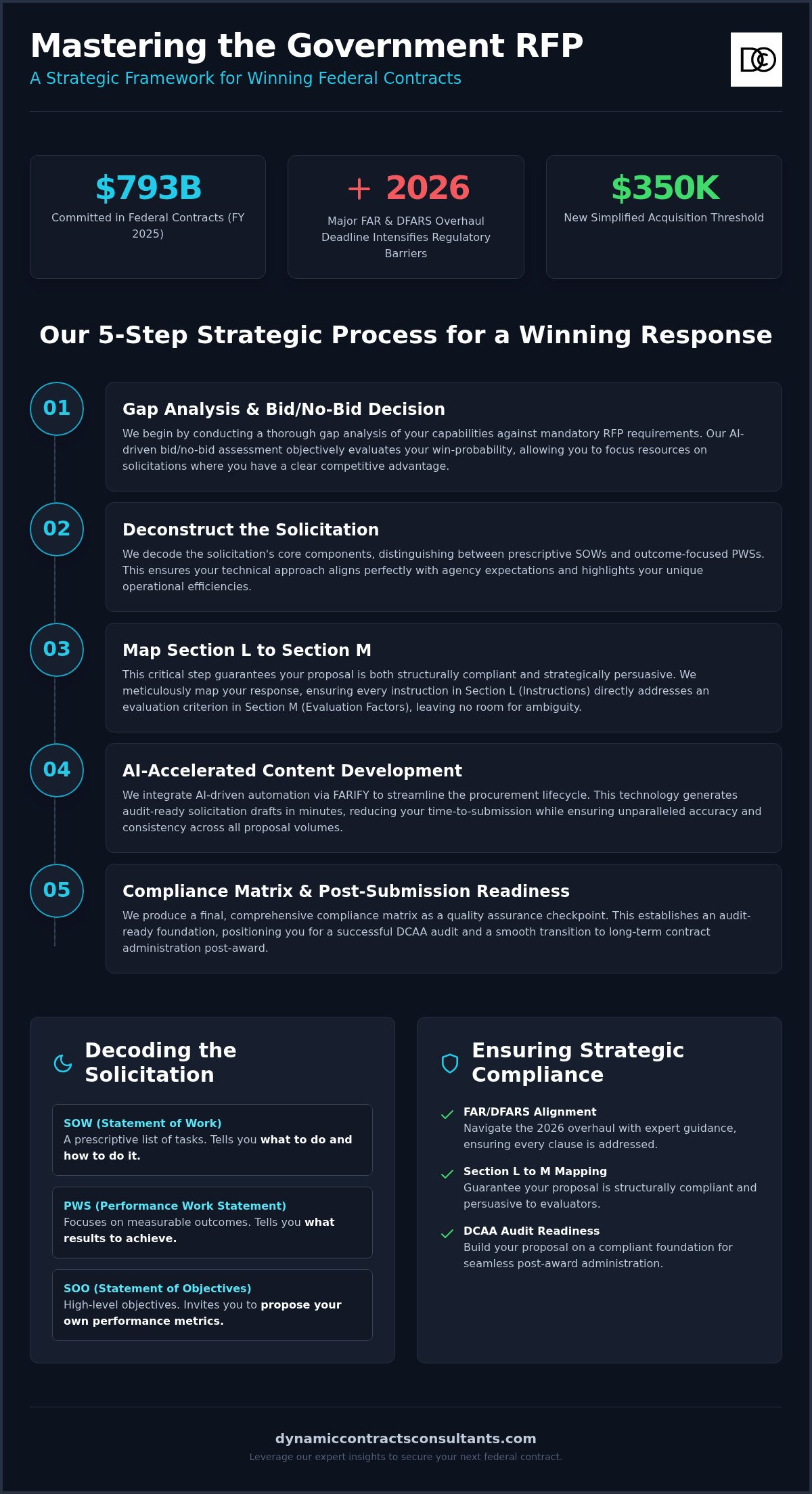
- Discover the definitive 5-step strategic framework on how to respond to a government RFP, from initial gap analysis to the final compliance matrix.
- Master the mapping of Section L instructions to Section M evaluation criteria to guarantee your proposal is both structurally compliant and strategically persuasive.
- Integrate AI-driven automation via FARIFY to streamline the procurement lifecycle and generate audit-ready solicitation drafts in minutes.
- Establish post-submission readiness by understanding the critical requirements for DCAA audits and the transition to long-term contract administration.
Decoding the Solicitation: The Critical Foundation of Your RFP Response
A Request for Proposal (RFP) serves as the formal gateway to federal contracting. It requires a response that is as much a legal document as it is a strategic asset. A government RFP response is a formal proposal demonstrating your technical, management, and cost capabilities to solve a specific agency need. Mastering how to respond to a government RFP in 2026 demands a strategic alignment with the recent FAR and DFARS overhauls. You're entering a landscape where the Simplified Acquisition Threshold has risen to $350,000, creating new pathways for agile firms that can demonstrate precision and compliance from the very first page.
Distinguishing between a Statement of Work (SOW) and a Performance Work Statement (PWS) is a vital first step. While an SOW provides a prescriptive list of tasks, a PWS focuses on measurable outcomes. This distinction allows you to highlight your unique operational efficiencies. When agencies issue a Statement of Objectives (SOO), they're inviting you to propose the performance metrics yourself. This is where we see innovative firms excel by proposing solution-driven metrics that exceed basic requirements. You must also track every solicitation amendment. In the fast-moving 2026 procurement cycle, submitting a response based on outdated specifications is a guaranteed path to a "non-responsive" determination.
To better understand the foundational steps of this process, watch this helpful guide:
The Strategic Bid/No-Bid Decision Framework
Evaluating resource allocation is the most critical step before drafting begins. You must determine if your firm is prepared for the significant administrative burden that federal compliance entails. We assess your win-probability by looking at technical alignment and past performance history. To remove emotional bias, we recommend utilizing AI for bid-no-bid analysis. This technology provides an objective assessment of your chances, allowing you to focus your proposal budget on the solicitations where you have a clear competitive advantage. Consider these factors during your assessment:
- Technical Alignment: Does your current capability set meet 100% of the mandatory requirements?
- Resource Capacity: Can your team handle the drafting cycle without compromising current contract performance?
- Strategic Fit: Does the contract align with your long-term growth and NAICS code targets?
Identifying Key Evaluation Factors
You'll find the roadmap to victory in Section M. This section details exactly how the government intends to score your proposal. Understanding how to respond to a government RFP also requires a deep dive into these evaluation factors to prioritize capability, cost, and technical approach based on the agency's specific weightings. It's essential to determine if the requirement is 'Best Value' or 'Lowest Price Technically Acceptable' (LPTA). In a Best Value scenario, the government may award the contract to a higher-priced offer if the technical benefits justify the cost. Your response strategy must mirror these priorities to ensure you're speaking the language of the evaluators.
The 5-Step Strategic Process for Developing a Winning Response
Success in federal contracting isn't accidental; it's the result of a methodical, repeatable workflow. Understanding how to respond to a government RFP means moving beyond simple drafting to a multi-layered strategic approach. According to the SBA contracting guide, businesses must meet stringent eligibility and performance standards before they're even considered for a contract award. This process ensures your response is not just technically sound but also administratively bulletproof.
- Step 1: Conduct a Thorough Gap Analysis. Before writing a single word, we perform a gap analysis. This identifies where your firm lacks specific capabilities or requires teaming partners to fulfill the Performance Work Statement (PWS).
- Step 2: Generate a Compliance Matrix. We create a comprehensive matrix that tracks every "shall," "must," and "will" in the solicitation. This prevents the administrative non-compliance that often leads to immediate disqualification.
- Step 3: Draft Technical and Management Volumes. We build these volumes around specific win-themes that resonate with the agency’s mission objectives and long-term goals.
- Step 4: Develop a Transparent Cost Volume. Your pricing must align with DCAA compliance standards. We ensure your cost volume is realistic, auditable, and competitive within the current market.
- Step 5: Perform Multi-Stage Color Team Reviews. We utilize Red, Gold, and White team reviews to refine the narrative, verify technical accuracy, and ensure final submission readiness.
Crafting a High-Impact Executive Summary
Your executive summary is the first thing evaluators read. It shouldn't be a generic "about us" section. Instead, focus on the agency’s specific pain points and how your solution mitigates their operational risks. We highlight your unique selling points, such as minority-owned small business status or specialized certifications, to set a tone of professional authority and technical precision from the start. This section must prove you understand the mission better than your competitors.
Developing the Technical and Management Volumes
Vague promises don't win contracts. You need concrete implementation plans that detail exactly how you'll execute the work and manage the contract lifecycle. We align management structures with federal oversight requirements, ensuring that your operational efficiency is clear to the evaluator. Many firms leverage government proposal writing services to maintain a professional narrative flow while focusing their internal teams on technical innovation. If you're unsure about your current framework, you can speak with our capture experts to refine your approach.
Ensuring Strategic Compliance with FAR/DFARS and Section L & M
The Federal Acquisition Regulation (FAR) acts as the constitutional framework for every federal solicitation. Your ability to navigate these regulations determines your eligibility before your technical solution is even evaluated. Mastering how to respond to a government RFP requires a meticulous alignment between Section L and Section M. While Section L provides the specific instructions for proposal structure, Section M contains the evaluation criteria that source selection boards use to grade your response. We recommend mirroring the language of Section M in your technical headers to simplify the scoring process for evaluators. This transparency reduces cognitive load for the reviewer and ensures every strength you claim is easily mapped to a requirement. Following strategic tips for government contracting, we prioritize strict adherence to these administrative guidelines to prevent early elimination.
Non-compliance with even a single flow-down clause can lead to immediate disqualification. These clauses, often buried in the fine print of a solicitation, dictate how your firm must manage subcontracts and regulatory reporting. We treat these requirements as mandatory hurdles. If your proposal fails to acknowledge or address these administrative mandates, the government perceives a lack of operational discipline. This level of precision is especially critical given the February 1, 2026, FAR overhaul, which introduced revised standards for telecommunications and foreign acquisition. Precision in these details isn't just a preference; it's a fundamental requirement for success in high-stakes acquisitions.
Mapping the Compliance Matrix
A robust compliance matrix is your primary defense against administrative rejection. Extracting every requirement from Sections C, F, H, L, and M creates a centralized tracking document that leaves nothing to chance. Every "shall," "must," and "will" statement is assigned to a specific owner within the proposal team. This ensures that no technical or administrative requirement is overlooked during the drafting cycle. Linking this matrix directly to our DCAA compliance consulting workflows verifies that cost-volume data remains consistent with the technical approach. This integrated strategy prevents common errors that arise when technical and financial teams work in silos.
Addressing Technical Excellence and Past Performance
Evaluators seek evidence of reliability and risk mitigation. Quantifying your past results using specific metrics proves your firm's capability to execute the current PWS. We draft CPARS-ready narratives that demonstrate your history of successful delivery and proactive problem-solving. This evidence-based approach is a core part of how to respond to a government RFP effectively. Utilizing government proposal review services identifies any lingering compliance gaps before final submission. These multi-stage reviews ensure that your narrative is not only persuasive but also perfectly aligned with the agency's scoring rubric.
Accelerating Response Development with AI-Driven Automation
Federal procurement is entering a phase of rapid digital transformation where speed and precision are no longer mutually exclusive. We utilize FARIFY.ai to generate solicitation drafts and SOW/PWS components in minutes, providing a significant edge in a market where solicitation volumes can fluctuate unexpectedly. This platform provides scalable intelligence designed specifically for the rigors of federal acquisitions. AI-driven automation streamlines the extraction of RFP requirements for the compliance matrix, ensuring that every mandatory "shall" statement is captured with surgical precision. By leveraging these technologies, you gain a massive competitive advantage in short-turnaround federal bids where the submission window is often narrow.
Maintaining audit-ready standards is our primary objective. Our AI models are trained specifically on acquisition regulations, including the complex 2026 FAR and DFARS overhaul updates. This ensures that the generated content remains compliant with the latest federal mandates, such as the new cybersecurity reporting requirements under CMMC. When you're learning how to respond to a government RFP in this modernized landscape, integrating these tools allows your capture team to shift their focus from administrative data entry to high-level strategic positioning. This shift directly impacts your operational efficiency and allows for a more scalable proposal department.
Integrating AI for Technical Volume Support
We use AI to draft initial technical responses by analyzing your firm’s historical performance data and previous winning proposals. This ensures a high level of consistency across multiple volumes of a large-scale federal response, which is often a challenge when multiple writers are involved. By reducing the drafting lifecycle from weeks to days, we provide your subject matter experts with more time to refine the technical nuances that evaluators prioritize. This accelerated workflow doesn't sacrifice quality; instead, it establishes a stronger foundation for your technical approach.
The 'Human-in-the-Loop' Assurance
While automation provides unprecedented speed, professional oversight remains mandatory for all compliance documentation. We don't advocate for unmonitored AI usage. Our process involves refining AI outputs to match the sophisticated, expert-led brand voice required to inspire confidence in federal evaluators. Every AI-assisted proposal undergoes a final human quality-control review to ensure that the narrative is persuasive and technically accurate. This approach balances cutting-edge efficiency with the deep strategic nuance that only an experienced consultant can provide. If you're ready to modernize your proposal department, contact our automation specialists to see how FARIFY.ai can transform your submission workflow.
Post-Submission Readiness: Positioning for Award and Compliance
Your responsibility doesn't end when you hit "submit." The documents you've prepared establish the legal and operational baseline for your entire performance period. Understanding how to respond to a government RFP involves more than just persuasion; it requires building an audit-ready record from the very first day of the solicitation phase. If the Defense Contract Audit Agency (DCAA) initiates a pre-award audit, your firm must be prepared to substantiate every cost estimate and technical claim made in your submission. This readiness ensures that your transition from proposal writer to post-award contract administration is seamless and risk-mitigated.
Your RFP response also serves as the definitive guide for managing flow-down clauses and subcontractor compliance. The commitments you make during the drafting phase dictate how you'll oversee your teaming partners and report on mandatory metrics. By establishing these internal controls early, you protect your firm from the administrative non-compliance that often leads to contract termination or poor performance ratings. This foresight is what separates successful prime contractors from those who struggle with the complexities of federal oversight.
Navigating Post-Award Compliance and Monitoring
During the response phase, we help you set up systems for deliverable and milestone tracking that will carry over into active performance. You must ensure your cost accounting system is robust enough for federal oversight before the contract award is finalized. Engaging in proactive post-award compliance is a strategic necessity to protect your firm’s reputation and secure a high CPARS rating. This long-term focus transforms a single contract win into a foundation for sustained growth and operational excellence.
Strategic Acquisition Planning for Future Growth
We view every RFP response as a sophisticated learning tool for future market research and capture management. Analyzing the feedback from evaluators allows you to refine your technical approach and better align with agency-specific preferences. Over time, you can leverage these successful submissions to build a library of customized federal proposal templates. This library reduces the administrative burden of future bids, allowing you to scale your federal footprint through repeatable, intelligent procurement strategies. Mastering how to respond to a government RFP is an iterative process that builds institutional knowledge and operational efficiency with every submission.
Securing Your Competitive Advantage in Federal Acquisitions
Winning in the 2026 federal landscape requires a synthesis of regulatory precision and technological agility. You've seen that success depends on a meticulous alignment between Section L instructions and Section M evaluation criteria. This ensures your response isn't just compliant but also strategically persuasive for evaluators. Integrating automated workflows allows your team to maintain audit-ready standards while drastically reducing the drafting lifecycle from weeks to days. Understanding how to respond to a government RFP is no longer just an administrative task; it's a strategic necessity for scalable growth in a market that demands absolute accuracy and operational efficiency.
At Dynamic Contracts Consultants LLC, we combine our proven prime contractor success with the deep technical knowledge of our DCAA compliance experts. By leveraging our AI-driven FARIFY integration, we provide the simple solutions to complex problems that your firm needs to thrive. We're ready to help you navigate the procurement lifecycle with confidence and precision. Partner with Dynamic Contracts Consultants LLC for expert proposal development and compliance to secure your next major award. Your path to a higher win-rate and long-term success starts with a commitment to a repeatable, intelligent framework.
Frequently Asked Questions
What is a compliance matrix in a government RFP response?
A compliance matrix is a structured cross-reference tool that maps every specific requirement in a solicitation to the exact page and paragraph in your proposal. It ensures that your firm addresses every "shall" and "must" statement found in Sections C, L, and M. By utilizing this matrix, we eliminate the risk of administrative oversight, providing a clear roadmap for evaluators to verify your technical and regulatory adherence.
How do I align my proposal with Section L and Section M?
You align your proposal by mirroring the organizational structure mandated in Section L while directly addressing the scoring criteria established in Section M. When learning how to respond to a government RFP, it's essential to use the exact headings and terminology found in the evaluation factors. This approach reduces cognitive load for the source selection board, making it easier for them to award your firm the maximum possible points.
Can AI be used to write a federal government proposal?
Yes, AI can be integrated into the drafting process using specialized platforms like FARIFY.ai that are trained on federal acquisition regulations. These tools accelerate the generation of solicitation drafts and requirement extractions while maintaining audit-ready standards. We always recommend a human-in-the-loop strategy to ensure that the final narrative reflects the sophisticated strategic nuance and brand authority required for high-stakes federal bids.
What is the difference between a SOW and a PWS in an RFP?
A Statement of Work (SOW) provides a prescriptive list of specific tasks and methods your firm must follow to complete the project. In contrast, a Performance Work Statement (PWS) is outcome-oriented, defining the required results and measurable performance standards without dictating the specific process. Understanding this distinction allows you to propose more innovative, efficient solutions when responding to a PWS or a Statement of Objectives.
How long does it typically take to respond to a government RFP?
The timeline for an RFP response typically spans 30 calendar days, though complex solicitations may offer longer windows or short-turnaround requirements of 15 days or less. Utilizing AI-driven automation can reduce the drafting lifecycle from weeks to days, allowing your team more time for strategic reviews and technical refinement. Efficient capture management ensures that you aren't starting from zero when the final solicitation is released.
What are the most common reasons for RFP response disqualification?
Most disqualifications result from administrative non-compliance, such as missing a mandatory flow-down clause, exceeding page counts, or failing to address a specific "shall" statement in the compliance matrix. We also see firms disqualified for submitting outdated information because they failed to sign up for solicitation amendments. Precision in the procurement lifecycle is mandatory, as even minor clerical errors can lead to a "non-responsive" determination by the contracting officer.
Do I need a DCAA-compliant accounting system before responding to an RFP?
You don't necessarily need a fully audited system to submit a proposal, but you must demonstrate that your accounting system is capable of being DCAA-compliant if you're pursuing cost-reimbursement contracts. Our DCAA compliance consulting ensures that your cost volume is realistic and auditable. Having these systems in place early protects your firm's reputation and prevents delays during the pre-award audit phase when the government verifies your financial readiness.
How does a 'Human-in-the-loop' AI process improve proposal quality?
A 'Human-in-the-loop' process improves quality by combining the rapid document generation of AI with the strategic oversight of experienced consultants. While AI handles the heavy lifting of requirement extraction and initial drafting, our experts refine the output to ensure technical accuracy and professional narrative flow. This synergy guarantees that your proposal is not only submitted quickly but also maintains the high-impact language and strategic compliance necessary to win.


