

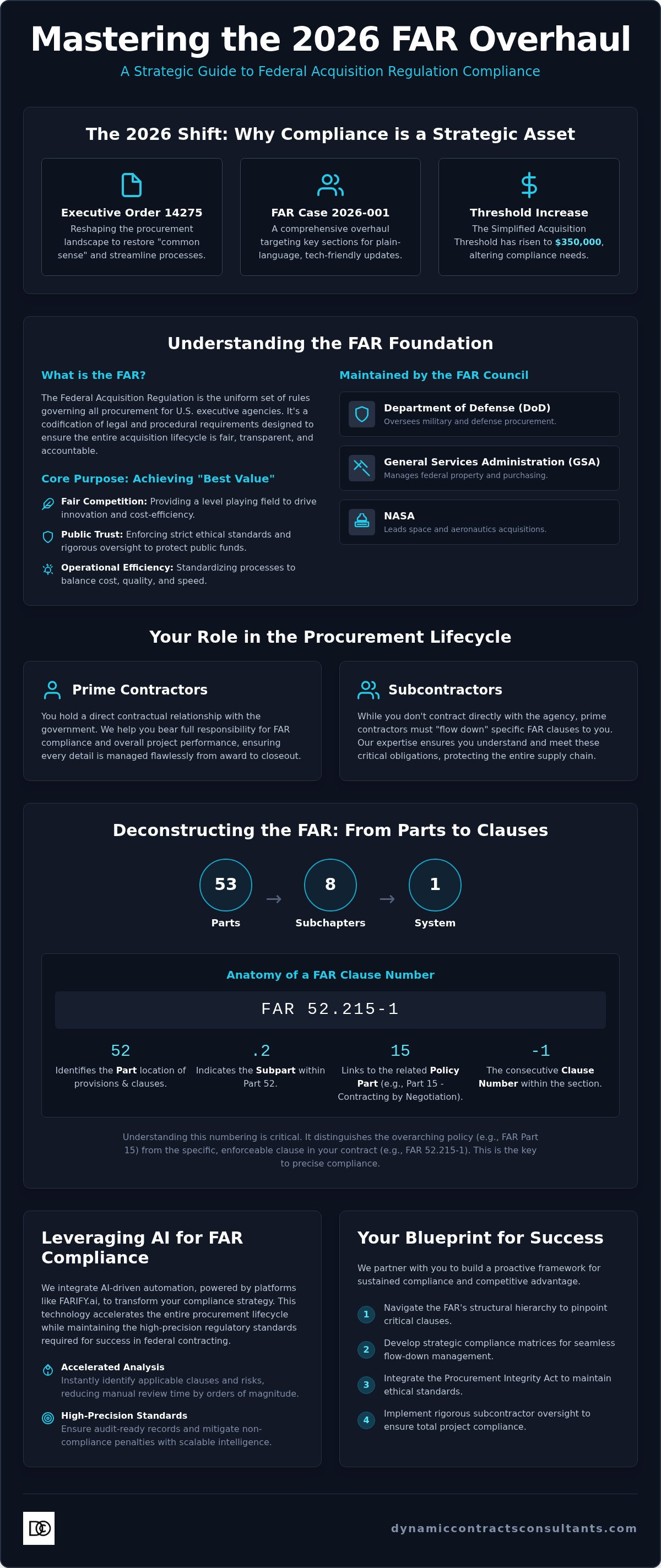
The 2026 Federal Acquisition Regulation overhaul represents the most significant shift in government procurement in decades, yet many contractors continue to treat compliance as a reactive burden rather than a strategic asset. We understand that the sheer volume of regulatory data can feel overwhelming, particularly as Executive Order 14275 reshapes the landscape. Developing a sophisticated approach to understanding federal acquisition regulation (FAR) is no longer optional if you intend to protect your margins and avoid the severe penalties associated with non-compliance.
We agree that identifying applicable clauses is increasingly difficult as thresholds shift, such as the Simplified Acquisition Threshold rising to $350,000. This article promises to help you master these complexities to ensure your organization achieves strategic compliance and secures high-value contracts. We'll provide a clear breakdown of the 2026 FAR structure, identify the most critical clauses for your operations, and outline a framework for maintaining audit-ready records through scalable intelligence and precise acquisition planning.
Key Takeaways
- Navigate the structural hierarchy of the FAR to identify critical clauses and numbering systems essential for effective contract management.
- Strengthen your organization’s baseline by understanding federal acquisition regulation (FAR) as the primary governing framework for executive agency procurement.
- Learn to develop strategic compliance matrices that ensure seamless flow-down clause management and rigorous subcontractor oversight.
- Integrate the Guiding Principles and the Procurement Integrity Act into your capture management strategy to maintain ethical and competitive standards.
- Discover how AI-driven automation and FARIFY.ai accelerate the procurement lifecycle while maintaining high-precision regulatory standards.
What is the Federal Acquisition Regulation (FAR)?
The Federal Acquisition Regulation serves as the primary, uniform set of rules governing all acquisitions by executive agencies within the United States federal government. It isn't merely a handbook; it's a formal codification of the legal and procedural requirements that ensure the procurement lifecycle remains fair, transparent, and accountable. This complex framework is jointly maintained and issued by the Department of Defense (DoD), the General Services Administration (GSA), and the National Aeronautics and Space Administration (NASA). These three bodies form the FAR Council, which works to ensure that the regulations stay current with evolving legislative mandates and executive priorities.
As we move through 2026, the environment has shifted significantly due to Executive Order 14275, "Restoring Common Sense to Federal Procurement." This initiative has triggered a comprehensive overhaul, notably through FAR Case 2026-001, which aims to streamline parts 1, 2, 4, and others. For your organization, understanding federal acquisition regulation (FAR) means recognizing that these rules are evolving toward a more plain-language, technology-friendly structure. The central mandate remains providing "best value" to the American taxpayer, a goal that requires balancing cost, quality, and administrative speed to achieve long-term success.
The Core Purpose of the FAR System
The FAR system exists to provide a level playing field for all potential contractors. It facilitates a transparent environment where competition drives innovation and cost-efficiency. We've seen that maintaining public trust is paramount, which is why the system enforces strict ethical standards and rigorous oversight. By standardizing the procurement process, the FAR ensures that whether you're bidding on a small service contract or a multi-billion dollar defense project, the underlying principles of integrity and accountability remain constant. It's about achieving operational efficiency without sacrificing the checks and balances that protect public funds.
Applicability: Who Must Follow These Rules?
Deepening your understanding federal acquisition regulation (FAR) requires a clear view of how these rules apply across different tiers of the procurement lifecycle. Most executive branch agencies must strictly adhere to the FAR, though some, like the FAA, operate under separate authorities. We categorize participants primarily into two groups:
- Prime Contractors: You're in a direct contractual relationship with the government and bear full responsibility for FAR compliance and performance.
- Subcontractors: While you don't have a direct contract with the agency, prime contractors are required to "flow down" specific FAR clauses to you to ensure total project compliance.
At Dynamic Contracts Consultants LLC, our expertise in post-award compliance helps you navigate these distinctions. We ensure that even if you're a third-tier supplier, you aren't caught off guard by regulatory obligations. Exceptions do exist, such as certain "Other Transaction Authority" (OTA) agreements or specific emergency procurements, but for the vast majority of federal work, the FAR remains the definitive rulebook for doing business with the government.
Navigating the Structure: Parts, Subparts, and Supplements
Gaining a comprehensive understanding federal acquisition regulation (FAR) requires more than a surface-level reading of the text; it demands a grasp of its architectural logic. The system is structured into 53 distinct parts, which are further organized into seven major subchapters. This hierarchy ensures that every regulation, from initial market research to final contract closeout, follows a predictable and manageable path. You can access the full, updated text via the Official Federal Acquisition Regulation (FAR) to see this structure in its entirety. This structural clarity is the first step toward understanding federal acquisition regulation (FAR) in a way that translates to lower risk and higher win rates for your organization.
A frequent source of confusion for contractors is the numbering system. It's vital to distinguish between a regulatory part and a specific contract clause. For example, FAR Part 15 outlines the policies for contracting by negotiation. However, the actual clause you'll see in your contract, such as FAR 52.215-1, resides in Part 52. The "52" identifies the location of provisions and clauses, while the "15" anchors the clause to the subject matter of Part 15. Utilizing the "Smart Matrix" on the acquisition.gov site allows you to filter these thousands of clauses based on your specific contract type and dollar threshold, significantly enhancing your operational efficiency during the proposal phase.
Major Subchapters of the FAR
The first three subchapters establish the foundation of the procurement lifecycle. Subchapter A focuses on general definitions and administration protocols, setting the ground rules for how agencies interact with the private sector. Subchapter B governs acquisition planning and market research requirements, which are critical for your capture management strategies. Subchapter C details contracting methods, such as sealed bidding and negotiations, providing the framework for how you'll eventually submit your proposals. We've found that mastery of these subchapters allows business leaders to predict agency behavior and align their internal processes accordingly.
Agency Supplements: DFARS, DOSAR, and Beyond
While the FAR provides the baseline, individual agencies often issue their own supplements to address unique mission requirements. The Department of Defense, for instance, utilizes the DFARS (Defense Federal Acquisition Regulation Supplement) to include specialized security and pricing rules that aren't found in the base regulation. These supplements can override or add layers to the standard rules, making them essential for strategic compliance. Failure to account for these nuances can complicate your financial reporting, particularly when seeking DCAA compliance consulting to ensure your accounting systems meet rigorous defense standards. If you're struggling to identify which agency-specific rules apply to your current portfolio, our team is ready to provide a specialized regulatory assessment tailored to your needs.
Principal Guidelines and Ethical Requirements
The Federal Acquisition System operates under a set of Guiding Principles designed to ensure that the government's needs are met with the highest level of integrity. At its core, the system aims to satisfy the customer in terms of cost, quality, and timeliness while minimizing administrative operating costs. For any contractor, understanding federal acquisition regulation (FAR) involves recognizing that these principles aren't just suggestions; they're the foundational expectations for every interaction. We see these guidelines as the moral compass of the procurement lifecycle, ensuring that public trust remains intact throughout the competitive process.
Central to this ethical framework is the Procurement Integrity Act, which prohibits the disclosure or acquisition of contractor bid or proposal information before the award of a federal agency procurement contract. Fair competition is the lifeblood of the system. Violating these rules results in severe consequences, ranging from the immediate cancellation of a procurement to the more permanent state of suspension or debarment. Debarment is final. It represents a total severance of the business relationship between your firm and the federal government, effectively ending your ability to secure future work. We emphasize that understanding federal acquisition regulation (FAR) requires a deep respect for these boundaries to protect your organization’s long-term viability.
The Best Value Deliverable Concept
The government doesn't always rely solely on the lowest price to make its selections. Instead, it utilizes the "Best Value" continuum, which allows for a balance between technical merit and total cost. In a Trade-off process, an agency might decide that a superior technical solution justifies paying a higher price. Conversely, for simpler requirements, they may use the Lowest Price Technically Acceptable (LPTA) method. We help our clients navigate this by leveraging professional government proposal writing to articulate value beyond just the bottom line. The Acquisition Team, including the Contracting Officer and technical evaluators, uses this data to determine which offer provides the most benefit to the taxpayer.
Conflict of Interest and Procurement Integrity
Organizational Conflicts of Interest (OCI) represent a significant hurdle in modern contracting. An OCI occurs when a firm’s other activities or relationships make it unable to render impartial assistance or give it an unfair competitive advantage. Identifying and mitigating these conflicts early is a hallmark of a sophisticated contractor. We recommend establishing robust internal ethics programs that go beyond mere compliance. These programs should include clear protocols for handling proprietary data and source selection information. By building a culture of transparency, you don't just avoid penalties; you position your firm as a trustworthy strategic partner in the eyes of federal agencies.
Strategic Compliance for Federal Contractors
Strategic compliance requires moving from theoretical knowledge to operational execution. While understanding federal acquisition regulation (FAR) provides the essential framework, your ability to implement that framework determines your long-term success in the federal marketplace. We view compliance as a competitive moat. It protects your organization from the severe risks of non-compliance while demonstrating to agencies that you're a disciplined, reliable partner. This process begins long before a contract is awarded and continues well after the final deliverable is submitted.
Developing a robust understanding federal acquisition regulation (FAR) allows you to anticipate regulatory shifts rather than merely reacting to them. In a landscape where oversight is increasing, your internal systems must be scalable and precise. We've seen that contractors who prioritize compliance as a core business function achieve higher operational efficiency and maintain better relationships with their Contracting Officers. It's about building a culture where precision is the standard and every clause is treated with the respect it deserves.
Building a Compliance Matrix
You can't achieve submission readiness without a methodical approach to solicitation requirements. We advocate for the creation of a comprehensive compliance matrix for every RFP response. This tool extracts specific instructions from Section L and evaluation criteria from Section M, cross-referencing them with your internal operational capabilities. By using standardized templates, you ensure that every requirement is addressed, every clause is accounted for, and every proposal is technically compliant. This level of precision is what differentiates high-performing contractors from the rest of the field. It's a foundational step that prevents costly administrative errors during the evaluation phase.
Post-Award Compliance and Audit Readiness
The award of a contract is merely the beginning of a new compliance phase. Maintaining audit-ready records is essential for satisfying oversight bodies like the DCAA. We emphasize that post-award compliance must be integrated into your daily operations. This involves managing the contract lifecycle from the initial award through to formal closeout. It's about more than just checking boxes; it's about ensuring that every financial transaction and operational decision is backed by the necessary documentation to survive a rigorous audit. Continuous monitoring allows you to identify and mitigate potential issues before they escalate into formal findings.
Managing flow-down clauses is another critical aspect of this phase. You're responsible for ensuring that your subcontractors adhere to the same FAR requirements that govern your prime contract. Establishing post-award contract administration as a core competency within your organization will significantly reduce your exposure to risk. If you're ready to elevate your internal compliance protocols, contact our expert consultants today to schedule a strategic review of your procurement systems.
Leveraging AI for FAR Compliance and Acquisition Planning
The digital transformation of federal procurement isn't a future concept; it's a present necessity for firms aiming to maintain a competitive edge. While manual research was once the standard, understanding federal acquisition regulation (FAR) in 2026 requires the integration of AI-driven automation to handle the increasing volume and complexity of regulatory data. We believe that technology should serve as an accelerator for your expertise, allowing your team to focus on high-level strategy while algorithms manage the granular details of clause extraction and compliance mapping. This shift toward scalable intelligence isn't just about speed; it's about achieving a level of precision that manual processes simply can't replicate.
Positioning your business as a tech-forward enterprise is a powerful differentiator when bidding on high-value contracts. Agencies are increasingly looking for partners who demonstrate operational efficiency and a commitment to modernizing the procurement lifecycle. By understanding federal acquisition regulation (FAR) through the lens of AI, you demonstrate a visionary approach to risk management. We utilize human-in-the-loop systems to ensure that while the AI provides the data, our seasoned experts provide the final layer of regulatory precision, ensuring every document is technically sound and strategically aligned.
AI-Driven Acquisition Planning and Proposal Development
AI is revolutionizing the earliest stages of the procurement lifecycle by enabling rapid generation of SOW, PWS, and SOO documents. Instead of spending weeks on market research, you can utilize AI-driven automation to analyze historical data and current trends in minutes. This technology also automates bid/no-bid analysis, providing a data-backed framework to focus your resources on the opportunities you're most likely to win. Integrating AI for grant writing into your broader strategy ensures that your organization remains agile across all federal funding streams, maximizing your capture potential without increasing administrative overhead.
FARIFY.ai: Precision Engineering for Federal Documents
FARIFY.ai represents the cutting edge of strategic compliance, designed to align perfectly with FAR, DFARS, and even complex state regulations. The platform generates audit-ready narratives and compliance documentation instantly, reducing what used to be days of document generation time to a matter of minutes. This isn't just about efficiency; it's about ensuring that every submission is backed by audit-ready records from day one. By partnering with Dynamic Contracts Consultants LLC and leveraging the FARIFY.ai platform, you gain access to a scalable intelligence model that grows with your business. We provide the expert-led guidance you need to navigate the most complex procurement environments, ensuring your organization is always prepared for the next high-value opportunity.
Securing Your Competitive Advantage in the 2026 Procurement Landscape
The 2026 regulatory overhaul signifies that a passive approach to compliance is no longer sustainable. Mastering the nuances of understanding federal acquisition regulation (FAR) serves as the foundation for protecting your margins and maintaining your organization's reputation. By implementing a structured compliance matrix and embracing digital transformation, you position your firm as a disciplined and visionary partner to federal agencies. Compliance isn't a hurdle to clear; it's a strategic moat that distinguishes elite contractors from the competition.
We provide the specialized tools and expertise necessary to navigate this complex environment with confidence. Our team offers expert DCAA compliance consulting and comprehensive post-award administration to ensure your operations remain audit-ready at every stage. Through the FARIFY.ai platform, we deliver AI-driven proposal development that combines unmatched speed with regulatory precision. Partner with us to navigate complex federal regulations and scale your business. Let's work together to ensure your organization achieves long-term success in the evolving federal marketplace.
Frequently Asked Questions
What is the difference between the FAR and DFARS?
The primary difference lies in the scope and agency authority. While the FAR provides the uniform baseline for all executive agencies, the DFARS (Defense Federal Acquisition Regulation Supplement) contains specialized requirements specific to the Department of Defense. These supplements often include more rigorous security standards and cost accounting protocols that aren't found in the base regulation, making them essential for contractors working within the defense industrial base.
How do I know which FAR clauses apply to my small business contract?
You can identify applicable clauses by reviewing the 'Smart Matrix' provided within the solicitation or on acquisition.gov. This tool filters clauses based on contract type, dollar value, and socioeconomic status. For a small business, it's vital to look for specific set-aside provisions and simplified acquisition procedures. We recommend cross-referencing these with Section I of your contract to ensure every obligation is accounted for correctly.
What is a flow-down clause in federal contracting?
A flow-down clause is a provision from a prime contract that must be included in subcontracts to ensure regulatory consistency throughout the supply chain. These clauses protect the government's interests by holding subcontractors to the same standards as the prime contractor. Managing this process is a critical component of understanding federal acquisition regulation (FAR), as prime contractors are ultimately responsible for subcontractor non-compliance and performance failures.
Can AI really ensure compliance with the Federal Acquisition Regulation?
AI-driven automation significantly enhances compliance by rapidly mapping clauses and generating audit-ready documentation through platforms like FARIFY.ai. While technology reduces the risk of administrative oversight, we utilize human-in-the-loop systems to provide the final layer of professional judgment. This combination ensures that your documentation is technically precise and strategically aligned with current 2026 mandates, effectively transforming compliance into a scalable business asset for your organization.
What are the penalties for failing to comply with FAR requirements?
Penalties for non-compliance range from financial offsets and contract termination for default to the more severe outcomes of suspension and debarment. Debarment effectively ends your ability to secure future federal contracts for a specified period. Beyond these legal actions, your firm may face significant reputational damage and negative past performance ratings. These ratings can hinder your ability to win high-value bids and secure long-term success in the federal marketplace.
What is the 'Best Value' determination in a federal solicitation?
Best Value is a procurement method where the government evaluates an offer based on a combination of price and non-price factors, such as technical merit and past performance. Unlike the lowest-price-only approach, this determination allows an agency to award a contract to a higher-priced bidder if the technical benefits justify the additional cost. Understanding federal acquisition regulation (FAR) protocols for best value helps you craft proposals that emphasize long-term operational efficiency.
How often is the FAR updated, and how can I stay current?
The FAR is updated continuously through Federal Acquisition Circulars (FACs) and proposed rules published in the Federal Register. In 2026, the overhaul driven by Executive Order 14275 has increased the frequency of these updates. You can stay current by subscribing to notifications from acquisition.gov or partnering with consultants who monitor regulatory shifts. Maintaining a proactive posture ensures your compliance framework remains current with the latest acquisition thresholds and security requirements.
Does the FAR apply to grants as well as contracts?
The FAR does not apply to federal grants; instead, grants are governed by Title 2 of the Code of Federal Regulations, specifically 2 CFR 200 (Uniform Guidance). While both systems emphasize transparency and accountability, their procedural requirements for procurement and financial management differ significantly. It's essential to distinguish between these frameworks to ensure your accounting and reporting systems are aligned with the specific funding instrument your organization has received from the government.


