

With 68% of proposal teams now utilizing generative AI to streamline their workflows, the decision between hiring a government proposal consultant vs in-house team is no longer just about headcount; it’s about strategic agility. We understand the frustration of maintaining high fixed overhead during dry procurement cycles or, worse, losing a high-value bid due to a minor compliance oversight. As the 2026 Federal Acquisition Regulation amendments prioritize fixed-price contracts, your organization must decide if its current structure can handle the increased financial risk and technical rigor required for success.
We've developed a definitive framework to help you evaluate whether a dedicated internal department or a specialized, AI-enhanced consultant is the most effective way to secure federal contracts. You'll discover how to minimize operational costs while ensuring every submission is audit-ready and technically superior. Our analysis explores the balance of scalable intelligence and human expertise, providing you with a clear roadmap to increase your win rates and achieve long-term success in this new era of procurement.
Key Takeaways
- Transition from a high-fixed-overhead staffing model to an agile, results-oriented structure to mitigate financial risk during procurement dry periods.
- Evaluate the critical trade-offs between institutional memory and specialized expertise when choosing between a government proposal consultant vs in-house team for high-stakes federal bids.
- Leverage AI-driven automation and scalable intelligence to significantly reduce response times while maintaining rigorous strategic compliance.
- Identify the key decision metrics—such as bid volume consistency and internal technical gaps—required to determine your organization's optimal proposal development model.
- Secure a competitive advantage in the 2026 regulatory environment by integrating "human-in-the-loop" AI assurance for audit-ready, compliant submissions.
The Federal Bidding Dilemma: Scaling Your Proposal Capabilities in 2026
Federal contracting is a high-stakes environment where a single prime contract win can define your company's trajectory for an entire decade. We've seen how the procurement lifecycle has evolved from a simple submission process into a complex, multi-stage marathon. It begins with intensive capture management and ends with a compliant, technically superior submission. In 2026, the bar for entry has moved higher. The federal government's shift toward fixed-price contracts as the default model means your technical and pricing accuracy must be flawless. You aren't just competing on capability; you are competing on your ability to manage financial risk through precision.
Many firms struggle with the government proposal consultant vs in-house team debate because the traditional staffing model is fundamentally rigid. If you rely solely on a fixed internal team, you face a dangerous binary. During procurement "dry" periods, high fixed overhead costs for salaries and benefits erode your profit margins. During peak "proposal season," your internal staff often becomes overwhelmed. This leads to the very compliance errors and slow turnaround times that disqualify otherwise excellent technical solutions. The status quo fails because it cannot scale at the speed of the modern federal market.
What is a Government Proposal Consultant?
A consultant is a strategic advisor who integrates into your acquisition planning to provide specialized expertise in strategic compliance and technical narrative development. Choosing between a government proposal consultant vs in-house team requires a deep understanding of your long-term capture strategy. We distinguish our role from simple staff augmentation by acting as strategic architects rather than just temporary labor. Our focus is on providing a proven methodology for navigating the entire procurement lifecycle. A specialized consultant provides the objective, expert-led perspective necessary to optimize your win-rate by ensuring every technical response is mapped directly to agency pain points and evaluative criteria.
The True Cost of a 'No-Bid' or 'Lost-Bid' Decision
The most hidden expense in federal contracting is the opportunity cost of the solicitations you never submit. When your internal team reaches its capacity, you're forced to pass on opportunities that align perfectly with your core competencies. This lack of scalability directly limits your growth potential. Beyond lost revenue, poor quality submissions or frequent compliance failures damage your professional reputation with contracting officers who value precision. We believe that implementing a rigorous bid/no-bid analysis is essential for effective resource allocation. It ensures you only commit your budget to opportunities where your probability of win is highest, protecting your reputation and your bottom line.
- Reputational Risk: Sloppy proposals signal a lack of operational discipline to the agency.
- Resource Depletion: Chasing low-probability wins drains the energy of your best technical staff.
- Market Stagnation: Inability to scale prevents entry into new agencies or contract vehicles.
The In-House Team: Institutional Memory vs. Fixed Overhead
Establishing an internal proposal department is often viewed as a commitment to long-term stability. The primary advantage of an in-house team lies in institutional memory. These professionals live and breathe your corporate culture, understand your past performance nuances, and speak your specific technical language. They don't need a briefing on your core values or internal hierarchies because they're part of the fabric of your organization. This deep-seated knowledge allows for a seamless integration between your technical experts and the proposal development process.
However, the government proposal consultant vs in-house team debate usually intensifies when you examine the financial burden of fixed overhead. Maintaining a full-time staff is expensive. According to March 2026 data, the average salary for a Proposal Manager ranges from $90,000 to $120,000, while senior managers in the defense sector frequently exceed $150,000. When you factor in benefits, payroll taxes, and ongoing training, the cost of a single senior hire can quickly surpass $200,000 annually. This remains a fixed cost even during "dry" procurement periods when no active RFPs are on your desk. This rigidity can drain your capital and limit your ability to pivot when market conditions shift.
Institutional Knowledge and Process Control
Direct access to Subject Matter Experts (SMEs) is a significant benefit of internal staffing. Your writers can walk down the hall to clarify a technical detail, which often leads to faster iterations on technical volumes. This proximity helps in maintaining a consistent government contract capture plan across multiple fiscal years. You retain total control over the workflow and security protocols. Yet, there's a latent risk of "stale thinking." Internal teams can become echo chambers, repeating the same narrative structures and missing the innovative strategies that outside experts bring from across the industry.
The Hidden Costs of Recruitment and Retention
Finding a single individual who masters technical writing, complex pricing intelligence, and DCAA compliance is nearly impossible. Most firms end up hiring multiple specialists, which compounds the overhead issue. The federal market for cleared proposal talent is incredibly competitive; staff turnover can derail a multi-year acquisition strategy overnight. Beyond recruitment, you must invest heavily in training to keep staff updated on the "Revolutionary FAR Overhaul" and evolving DCAA audit requirements. If you find your internal team is struggling to keep pace with these regulatory shifts, it might be time to re-evaluate your staffing model to ensure your submissions remain audit-ready and compliant.
The gap between winning a contract and successfully managing it is often where internal teams falter. While they focus on the immediate "win," they may lack the specialized foresight to integrate post-award compliance requirements into the initial proposal. This oversight can lead to significant audit risks once the contract is active, turning a hard-won victory into a financial liability.
The Consultant Advantage: Specialized Expertise and AI Agility
The primary differentiator in the government proposal consultant vs in-house team evaluation is the transition from a fixed-cost burden to an agile, performance-based partnership. While internal teams struggle with the "dry" periods discussed previously, a specialized consultant provides on-demand scalability. You can ramp up your proposal capabilities for peak "proposal season" without the long-term commitment of permanent hires. This model allows you to access a multi-disciplinary team of writers, price analysts, and compliance auditors only when the procurement lifecycle demands it, ensuring your resources are always allocated toward high-probability wins.
A significant advantage of the consultant model is the ability to conduct an objective gap analysis. Internal teams often suffer from "tunnel vision," overlooking strategic weaknesses because they are too close to the project. We act as a surrogate evaluator, identifying flaws in your past performance narratives or technical approach before the government's selection board sees them. This proactive scrutiny is essential in an era where the Department of Defense and civilian agencies are prioritizing fixed-price contracts, leaving no room for pricing errors or technical ambiguity.
Strategic Compliance and Audit-Ready Submissions
Winning a federal contract requires more than a compelling narrative; it demands absolute adherence to Section L and M requirements. We ensure that every technical volume is mapped precisely to the government's evaluation criteria, leaving nothing to chance. Integrating DCAA compliance consulting into the pre-award phase protects your firm from post-award audit failures. Our "human-in-the-loop" AI assurance model ensures that while technology accelerates the drafting process, expert consultants verify every detail for absolute regulatory precision. This blend of scalable intelligence and human expertise guarantees that your submission is not only persuasive but also fully compliant with the latest FAR requirements.
Leveraging AI for Operational Efficiency
The AI revolution has fundamentally altered the cost-benefit analysis of the government proposal consultant vs in-house team. Platforms like FARIFY.ai have reduced the time required for document generation from days to mere minutes, allowing us to maintain a high tempo without sacrificing quality. This AI-driven automation streamlines market research and solicitation drafting, significantly reducing the burn rate typically associated with complex proposal development. By utilizing tech-forward workflows, we help you maintain high-impact language and technical precision across every volume. This operational efficiency means you can pursue more opportunities simultaneously, maximizing your growth potential in a competitive $700 billion federal marketplace.
- Rapid Document Generation: Move from solicitation to first draft in record time using FARIFY.ai.
- Enhanced Market Intelligence: Leverage AI to analyze competitor pricing and agency spending patterns.
- Reduced Resource Drain: Minimize the impact on your internal technical staff by automating administrative proposal tasks.
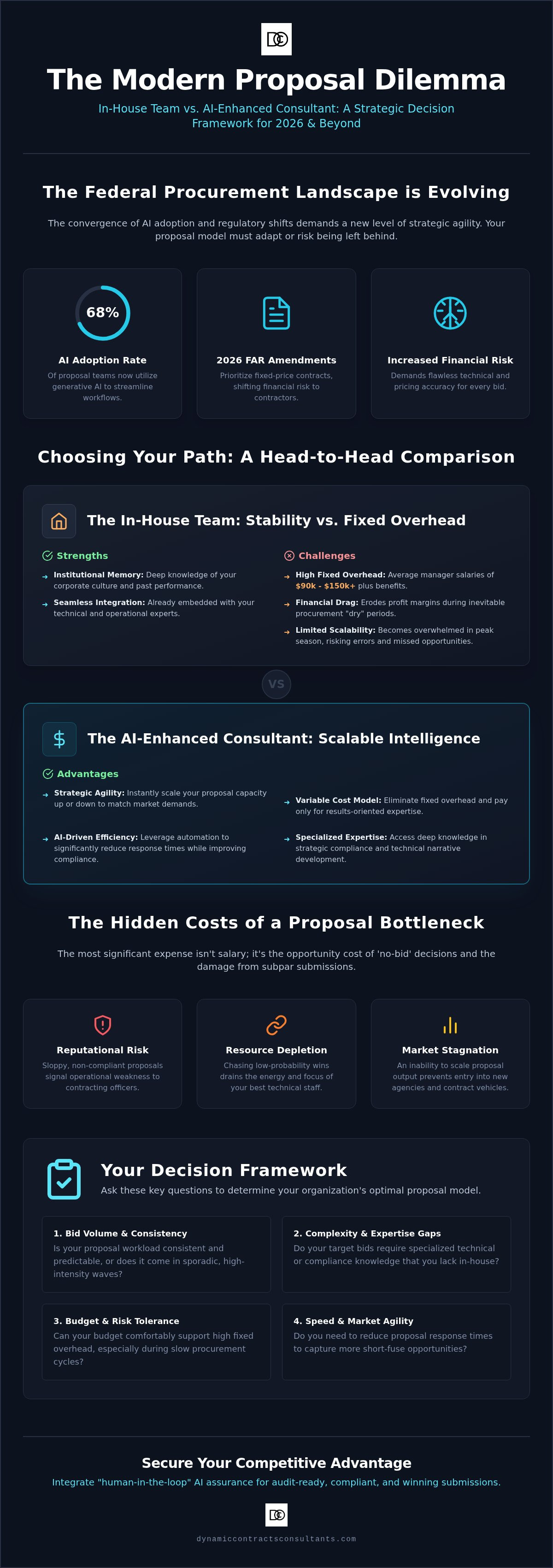
Decision Framework: Selecting the Optimal Model for Your Business
Evaluating the government proposal consultant vs in-house team dynamic requires a rigorous analysis of your Total Cost of Ownership (TCO). You cannot simply compare a consultant's invoice against a manager's base salary. A true TCO assessment includes recruitment fees, benefits, software licenses, and the significant cost of idle time during slow procurement cycles. If your bid volume is cyclical, maintaining a large internal staff creates a permanent drag on your profit margins. Conversely, a steady stream of repetitive task orders might justify a permanent, lean internal presence. Your pipeline dictates your structure; it's that simple.
The 2026 gold standard for high-growth contractors is the Hybrid Model. We've observed that the most successful firms maintain a small internal core focused on capture management and Subject Matter Expert (SME) coordination while leveraging external strategic consultants for technical writing, pricing intelligence, and compliance. This approach offers the best of both worlds: deep institutional knowledge paired with the scalable intelligence and objective scrutiny of an outside partner. It allows you to maintain operational efficiency without sacrificing the surge capacity required for complex, high-value solicitations.
When to Keep it In-House
There are specific scenarios where an internal team remains the most logical choice. If your firm deals with highly proprietary technology or classified intellectual property that requires constant, on-site security oversight, keeping the proposal process within your walls is often necessary. Small-scale bidding on repetitive GSA Schedule task orders also favors an in-house approach, as the technical narratives rarely change between submissions. In these cases, a dedicated internal coordinator can manage the workflow effectively without needing the deep strategic intervention of a consultant.
When to Outsource to a Strategic Partner
Outsourcing becomes essential during rapid growth phases or when facing "must-win" recompetes. Complacency is the primary reason incumbents lose contracts; an external consultant brings a fresh, critical perspective that identifies weaknesses in your past performance narratives. Complex solicitations often require specialized post-award compliance foresight that internal teams may lack. If you're entering a new agency market or dealing with tightened DCAA requirements, the risk of a compliance error is too high to manage without expert-led support. A strategic partner ensures your submission is technically superior and audit-ready from day one.
If you're ready to transition from a fixed-cost burden to a results-oriented partnership, contact us today for a strategic consultation to evaluate your current proposal infrastructure.
The Dynamic Contracts Difference: Your Partner in Scalable Intelligence
Choosing between a government proposal consultant vs in-house team often feels like a compromise between deep institutional knowledge and high-speed agility. At Dynamic Contracts Consultants LLC, we've eliminated that trade-off by positioning ourselves as strategic architects rather than mere document preparers. We provide simple solutions to complex problems by integrating our FARIFY.ai platform directly into the acquisition lifecycle. This approach allows your organization to leverage AI-driven speed while maintaining the human-in-the-loop assurance that federal evaluators demand. Our goal isn't just to help you submit; it's to ensure your submission is technically flawless and contractually sound.
Our partnership extends far beyond the drafting phase. We recognize that the procurement lifecycle is a continuous loop, starting with rigorous bid/no-bid analysis and continuing through post-award contract administration. By providing this comprehensive support, we reduce the operational friction that typically slows down large-scale federal projects. You don't just get a writer; you get a strategic partner committed to your long-term scalable growth and operational efficiency. We bridge the gap between initial capture and final execution, protecting your profit margins at every stage.
Full-Lifecycle Acquisition Support
Our proposal writing services are built on a foundation of strategic compliance. We ensure every technical volume is mapped to the specific requirements of the solicitation, but we also look ahead to post-award realities. This foresight prevents the common pitfalls where a winning bid becomes a compliance nightmare during performance. Supporting your team from the initial solicitation drafting through final contract closeout ensures that your technical approach remains aligned with FAR, DFAR, and DCAA standards throughout the entire journey, providing you with peace of mind during agency audits.
Why Trust and Innovation Matter in 2026
Trust is earned through performance, not just promises. Since our founding in 2015, Dynamic Contracts Consultants LLC has established a track record as a minority-owned small business with prime contractor experience for the DoD, State Department, and EPA. We balance this formal B2B professionalism with cutting-edge AI automation to give you a competitive edge that isolated internal teams simply can't match. This unique combination allows us to offer the specialized expertise of a government proposal consultant vs in-house team limitations. We encourage you to start a direct dialogue with our experts to see how our scalable intelligence can transform your capture strategy.
- Expert-Led Strategy: Benefit from over a decade of experience in high-stakes federal procurement.
- AI-Powered Speed: Accelerate your response times without sacrificing technical precision via FARIFY.ai.
- Audit-Ready Results: Ensure every submission is compliant with the most recent FAR and DCAA standards.
Securing Your Competitive Advantage in the 2026 Procurement Landscape
The decision between a government proposal consultant vs in-house team isn't just a matter of headcount; it's a strategic choice about how your organization scales in a volatile market. We've demonstrated how institutional memory must be balanced with the agility of AI-driven automation to ensure your firm remains competitive as Federal Acquisition Regulation requirements tighten. By adopting a hybrid approach, you can maintain a lean internal core while leveraging specialized experts to handle high-stakes technical volumes and complex pricing intelligence. This model provides the surge capacity required for "proposal season" without the burden of permanent fixed overhead.
Our commitment to providing simple solutions to complex problems is backed by expert DCAA compliance consulting and our innovative FARIFY integration for rapid drafting. We bring proven prime contractor experience with major federal agencies to every engagement, ensuring your submissions are technically superior and audit-ready. Don't let compliance errors or high overhead stall your growth. We're here to help you navigate the procurement lifecycle with precision and visionary intelligence.
Optimize your win rate with our strategic proposal development services.
We look forward to partnering with you to achieve scalable growth and long-term success in the federal marketplace.
Frequently Asked Questions
How do I know if I need a government proposal consultant or an in-house team?
You should evaluate your bid volume and technical complexity to determine the most efficient path forward. If your win rate is below 30% or your team spends over 20 hours per proposal on administrative formatting, a consultant is recommended. Choosing between a government proposal consultant vs in-house team depends on whether your pipeline is steady or cyclical. High-value recompetes often require the objective scrutiny of an external partner to avoid incumbent complacency.
What is the typical ROI of hiring a government proposal consultant?
The ROI is measured through increased win rates and significantly reduced overhead costs during non-bidding periods. By shifting from a fixed-salary model to a performance-based partnership, you eliminate the expense of idle staff. Successful contractors often see a higher return by winning larger prime contracts that they previously lacked the bandwidth to pursue. This effectively pays for the consultancy through a single high-value win that defines the company's decade.
Can a consultant help with DCAA compliance during the proposal phase?
Yes, a specialized consultant ensures your pricing and technical volumes are audit-ready before submission. We integrate DCAA compliance consulting into the pre-award phase to protect you from post-award audit failures. This proactive approach ensures that your cost accounting systems and labor categories align with federal standards. It prevents financial liability once the contract is active and performance begins, ensuring your victory doesn't become a liability.
How does AI-driven proposal writing improve my win rate?
AI-driven proposal writing improves win rates by accelerating document generation while maintaining absolute regulatory precision. Our FARIFY platform reduces the time spent on administrative drafting, allowing our experts to focus on high-impact technical narratives. This "human-in-the-loop" model ensures your submission is technically superior and fully compliant with Section L and M requirements. It gives you a competitive edge in the 2026 regulatory environment.
What should I look for in a federal proposal consulting firm?
You should prioritize firms with proven prime contractor experience and deep expertise in FAR and DCAA regulations. Look for a partner that combines traditional strategic consulting with modern AI-driven automation. A reliable firm acts as a strategic architect, offering full-lifecycle support from initial capture management to post-award administration. They should provide simple solutions to complex problems rather than just temporary staff augmentation for writing tasks.
Is a hybrid proposal team model more expensive than a fully in-house team?
A hybrid model is generally more cost-effective because it reduces the Total Cost of Ownership associated with large internal departments. You maintain a lean internal core for institutional knowledge while leveraging a government proposal consultant vs in-house team for specialized surge capacity. This prevents the financial drain of paying high salaries during dry periods. It ensures you have expert support for complex solicitations without the burden of permanent fixed overhead.
How long does it take to integrate a consultant into our bidding process?
Integration can occur within days, depending on the complexity of your current capture plan and internal systems. Strategic partners are designed to plug into existing workflows immediately, bringing their own templates and AI tools like FARIFY. This rapid onboarding allows you to respond to urgent RFPs that your internal team might otherwise have to "no-bid" due to bandwidth constraints. It provides immediate scalability for your procurement efforts.
Do consultants handle technical volumes or just administrative compliance?
Professional consultants manage the entire proposal development lifecycle, including complex technical volumes and pricing intelligence. We work closely with your Subject Matter Experts to translate raw technical data into persuasive, compliant narratives. Our role is to ensure that every section of your submission meets the highest standards of professional excellence. From the executive summary to the detailed technical approach, we ensure your response is contractually sound and technically superior.


