
A "non-responsive" determination often stems from a fundamental misunderstanding: the internal federal proposal review process isn't a final proofreading exercise, it's a strategic simulation of agency evaluation. Most contractors lose high-value awards not because their solution is inferior, but because their internal review cycles fail to mirror the rigid merit criteria used by government source selection boards. We understand the frustration of seeing months of capture work dismissed due to a single overlooked requirement in Section L or M. It’s a costly drain on resources that prevents your business from achieving its full growth potential.
If you're tired of high rejection rates and inefficient review loops that miss critical compliance gaps, it's time to shift your perspective. We'll help you master the complexities of how federal agencies score bids and provide the internal methodologies needed to secure audit-ready submissions every time. By integrating AI-driven automation and disciplined Color Team structures, we ensure your proposals are both technically superior and strategically compliant. In this article, we'll walk you through a comprehensive framework for 2026 that streamlines your procurement lifecycle and increases your win-rates through scalable intelligence and precision-engineered workflows.
Key Takeaways
- Understand the critical distinction between Technical Merit and Cost/Price factors to align your bid with the specific scoring priorities of the Source Selection Authority.
- Implement a structured Color Team framework that mirrors the federal proposal review process to identify and resolve compliance gaps before the final submission deadline.
- Master the art of technical responsiveness by using a comprehensive compliance matrix to track every mandatory requirement within the RFP's Section L and M.
- Leverage AI-powered automation via FARIFY.ai to reduce manual review times by 70% while ensuring your documentation remains audit-ready and precise.
- Establish a DCAA-compliant infrastructure to support the transition from a winning proposal to successful post-award contract administration and long-term growth.
Decoding the Federal Proposal Review Process: How Agencies Score Your Bid
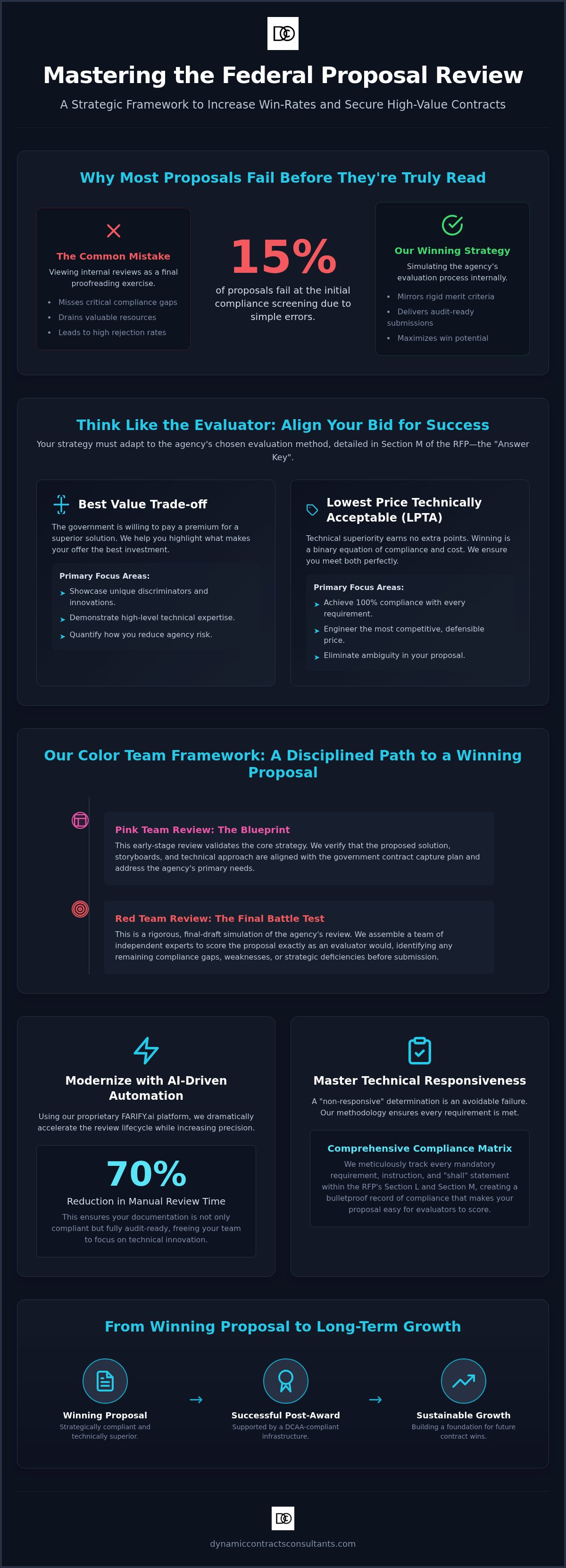
The federal proposal review process is the systematic evaluation of a contractor's capability, compliance, and cost-effectiveness against agency requirements. To win in this environment, you must view your submission through the lens of the evaluators. We've seen that the most successful contractors don't just write to the statement of work; they write specifically to Section M of the solicitation. Section M is the agency's "answer key," detailing the exact evaluation factors for award. It dictates the relative importance of technical merit versus cost and price, providing the roadmap our team uses to ensure your bid aligns with the government’s specific priorities.
Understanding the hierarchy of the review team is equally vital. The Technical Evaluation Board (TEB) consists of subject matter experts who dissect your technical volume to identify strengths, weaknesses, and deficiencies. Their findings are then passed to the Source Selection Authority (SSA), the individual responsible for making the final award decision. The SSA balances the TEB’s technical findings against the cost analysis to determine which offer provides the best value. Our proposal writing methodology focuses on making the TEB’s job easier by providing clear, compliant, and easy-to-score narratives that resonate with these specialized reviewers.
The Agency Evaluation Lifecycle
The evaluation doesn't begin with your innovative solutions; it starts with a cold, binary compliance screening. Industry data suggests that approximately 15% of proposals fail at this initial stage before a technical expert even reads a single page. This happens because of missing signatures, incorrect margins, or failure to address a "shall" statement. Once you pass this gate, the TEB scores your technical volume based on the criteria in Section M. Simultaneously, the agency conducts a past performance and cost realism assessment. They aren't just looking for the lowest price; they're assessing the risk that your proposed solution cannot be executed at the price you've quoted. We help you mitigate this risk by developing "audit-ready" documentation that stands up to the most rigorous scrutiny.
Best Value vs. Lowest Price Technically Acceptable (LPTA)
You must adapt your internal review strategy based on the agency’s chosen evaluation method. In a Best Value Trade-off scenario, the government is willing to pay a premium for technical superiority or reduced risk. Here, we emphasize your unique discriminators and high-level expertise. Conversely, under Lowest Price Technically Acceptable (LPTA) rules, technical superiority earns you no extra points. In these cases, compliance and the lowest price are the only metrics that matter. We work with you to strategically position your proposal, ensuring your internal review cycles are calibrated to the specific procurement model the agency is using to ensure maximum operational efficiency and higher win-rates.
The Color Team Framework: A Strategic Internal Review Methodology
Winning a high-value government contract requires more than just meeting technical specifications; it requires a disciplined internal review cycle that anticipates the scrutiny of a federal evaluation board. We implement the Color Team framework to ensure every submission is battle-tested before it reaches the contracting officer’s desk. The federal proposal review process is unforgiving. If your internal methodology doesn't mirror the agency’s evaluation criteria, you're essentially gambling with your firm’s resources. This structured approach prevents review fatigue by assigning specific, measurable objectives to each phase, allowing your subject matter experts, compliance officers, and strategic leads to focus on their unique areas of expertise without overlapping efforts.
Pink Team and Red Team: From Concept to Compliance
The Pink Team review occurs early in the procurement lifecycle. Its primary goal is to validate the initial storyboards and technical approach against the government contract capture plan. We verify that the proposed solution actually solves the agency's underlying problem before the writing becomes too rigid to change. Moving forward, the Red Team serves as the most critical hurdle in your internal federal proposal review process. This 'near-final' review focuses on total technical responsiveness and strict adherence to FAR/DFARS regulations. It’s here that we ensure the Section L instructions have been followed to the letter, leaving no room for administrative rejection or negative scoring from the Technical Evaluation Board.
Gold Team and White Hat: Final Polish and Price Realism
Once the technical narrative is solidified, the Gold Team takes over. This phase involves senior management and strategic leads who ensure the proposal reflects your corporate win themes and meets the highest standards of professional authority. Simultaneously, we conduct a White Hat review. This acts as a final 'cold-eye' check for formatting, grammar, and overall submission readiness to ensure the document is flawless. Crucially, this stage includes a deep dive into the cost volume. We verify that all pricing is backed by a DCAA-compliant accounting infrastructure, ensuring your financial data is as robust as your technical solution. If you find your internal review cycles are missing these critical checkpoints, you can leverage our expert insights to audit and refine your current workflow.
By maintaining this level of rigor, we help you transform your proposal from a simple response into a visionary strategic document. Every review phase must result in actionable feedback that directly improves the alignment with the agency’s requirements. This commitment to precision is what separates successful prime contractors from those who struggle with high rejection rates. Our goal is to ensure that by the time your proposal is submitted, it has already passed a review more stringent than the one it will face from the government.
Bridging the Gap Between Compliance and Technical Responsiveness
A proposal can be entirely compliant and still fail to secure an award. While compliance ensures you aren't disqualified, responsiveness is what actually wins the contract. The federal proposal review process evaluates both, yet many contractors confuse the two. Compliance is binary; it's the strict adherence to the font sizes, margin requirements, and administrative forms dictated in Section L. Responsiveness, however, is your ability to address the agency's underlying pain points and operational challenges. We focus on bridging this gap by ensuring your technical narrative doesn't just follow the rules but provides a visionary solution that evaluators find compelling and low-risk.
To succeed, you must integrate Section L instructions and Section M evaluation criteria into a single, unified roadmap. This alignment ensures that every paragraph you write serves a dual purpose: meeting a mandatory requirement and earning the highest possible score from the Technical Evaluation Board. If your team treats these sections as separate hurdles, you'll likely miss the subtle nuances that define technical superiority. Utilizing professional government proposal review services allows you to identify hidden regulatory risks and technical gaps that internal teams often overlook during the heat of a bid cycle.
Building the Compliance Matrix
The foundation of a winning bid is a comprehensive compliance matrix. This document isn't just a checklist; it's a living strategic tool that tracks every "shall," "must," and "will" statement found within the Statement of Work (SOW) or Performance Work Statement (PWS). We extract these requirements and map them directly to specific paragraphs in your technical volume. This ensures that during Pink and Red Team reviews, evaluators can quickly verify that no requirement has been missed. By maintaining this matrix throughout the procurement lifecycle, you create a transparent audit trail that guarantees your submission is 100% compliant before it ever reaches the agency.
Addressing the 'Unwritten' Evaluation Criteria
Experienced contractors know that the most critical evaluation criteria aren't always explicitly stated in the solicitation. Agencies have specific pain points, historical frustrations, and long-term goals that only surface through disciplined capture management. We use this intelligence to influence the focus of your internal reviews. By addressing these "unwritten" needs, your proposal doesn't just meet the bar set by the RFP; it sets a new standard that competitors will struggle to match. This proactive approach transforms your proposal from a standard response into a strategic asset that emphasizes operational efficiency and scalable intelligence.
Modernizing Proposal Reviews with AI-Driven Automation
The traditional federal proposal review process often suffers from the bottleneck of manual data entry and human error. In a high-stakes environment where a single missing certification can lead to immediate disqualification, relying solely on manual oversight is a significant risk. We help you mitigate this by integrating AI-driven automation into your procurement lifecycle. By leveraging advanced requirement extraction, we've seen contractors reduce their manual review time by 70%. This shift allows your strategic leads to focus on high-level win themes rather than getting bogged down in the administrative minutiae of cross-referencing thousands of pages of regulatory text.
Central to this modernization is the use of FARIFY.ai, which allows us to generate audit-ready compliance matrices in minutes rather than days. These matrices provide a real-time roadmap for your technical writers, ensuring that every "shall" and "must" statement is addressed from the very first draft. When combined with our customized federal proposal templates, your team can maintain structural compliance throughout the entire writing process. This isn't about replacing human expertise; it's about providing your experts with scalable intelligence that ensures every submission meets the highest standards of precision and authority.
AI-Powered Gap Analysis
One of the most valuable applications of automation is the ability to perform a comprehensive gap analysis across multiple volumes. Our AI-driven tools scan your technical and cost drafts to identify missing technical requirements, expired certifications, or inconsistencies in terminology. This automated cross-referencing ensures that your response to the Statement of Work (SOW) perfectly mirrors the agency's expectations. For those pursuing a broader range of funding, our AI for grant writing guide provides additional insights into how these modern strategies are reshaping federal funding success in 2026.
Accelerating the Review Timeline
Federal agencies often issue RFPs with tight 30-day submission windows, leaving very little room for multiple Color Team iterations. Automation streamlines the feedback loop between your technical writers and compliance experts, allowing for more frequent, bite-sized reviews rather than a single, overwhelming Red Team event. This agile approach ensures that errors are caught early, reducing the stress of the final Gold Team polish. By achieving this level of operational efficiency, your firm can manage multiple concurrent bids without sacrificing the quality or compliance of any single submission. If you're ready to modernize your internal workflows, you can contact our strategic consultants to implement these AI-driven solutions today.
We maintain a strict "human-in-the-loop" assurance protocol to verify that all AI-generated insights align with the latest FAR and DFARS standards. Our CPCM and CFCM certified experts oversee the automated outputs, providing the professional judgment necessary to navigate complex business environments. This hybrid approach ensures that your proposals are both technologically advanced and legally robust, positioning you as a visionary partner in the federal marketplace.
Securing Contract Awards through Expert-Led Strategic Compliance
The federal proposal review process concludes with a final determination of responsibility and cost realism. While previous chapters of this framework focused on the creation and automation of the bid, this final stage requires a transition toward total operational readiness. We ensure that your proposal isn't just a winning document but a legally binding roadmap for long-term performance. By engaging Dynamic Contracts Consultants LLC for a final pre-submission audit, you leverage the expertise of Certified Professional Contracts Managers (CPCM) who verify that every technical promise is backed by a verifiable management infrastructure. This meticulous oversight positions your firm as a low-risk partner, which is a critical discriminator during the Source Selection Authority's final deliberations.
Our experts provide the professional judgment necessary to navigate the nuances of strategic compliance. While AI identifies technical gaps, our team interprets the regulatory intent behind complex solicitations. We verify that your executive summary, technical approach, and cost volume speak with a unified voice of authority. This comprehensive final check ensures your submission is flawless and reflects the sophisticated business environment in which you operate. It's this balance of cutting-edge technology and veteran expertise that allows our partners to submit bids with absolute confidence.
From Proposal Win to Post-Award Success
The review cycle must account for the long-term implications of flow-down clauses and subcontracting plans. These administrative details are often finalized in the late stages of a bid, yet they carry significant risk if they aren't reviewed against the initial RFP requirements. We help you prepare for post-award audits during the submission phase, ensuring that your internal systems are ready for the rigorous oversight that follows a contract award. You can transition smoothly into post-award contract administration by building these considerations into your initial review framework. To see how we support the entire procurement lifecycle, explore our full suite of proposal writing and compliance services.
The Dynamic Advantage in Federal Acquisitions
Our "simple solutions to complex problems" philosophy is what drives consistent results for our clients. A vital part of this advantage is the role of DCAA compliance consulting in validating your financial data. When your cost volume is supported by a DCAA-compliant accounting system, you eliminate the risk of a "non-realistic" cost rating. This level of preparation demonstrates to evaluators that your firm possesses the scalable intelligence and operational efficiency required for high-value prime contracts. Partner with Dynamic Contracts Consultants LLC to transform your review process into a strategic engine for growth and secure your place as a leader in the 2026 federal marketplace.
Scaling Your Success in the 2026 Federal Marketplace
Mastering the federal proposal review process requires a sophisticated blend of technical precision and scalable intelligence. We've explored how a structured Color Team methodology and AI-driven requirement extraction can reduce manual workloads while significantly increasing your win-rates. By aligning your internal reviews with the agency's specific merit criteria, you transform your proposals from administrative responses into visionary strategic assets that clearly communicate your firm's value and low-risk profile.
Our team brings the authority of Certified Professional Contracts Managers (CPCM) and a proven track record as a prime contractor for the DoD and State Department. We provide the critical oversight necessary to verify that every insight generated by FARIFY.ai meets the most stringent FAR standards. It's time to move beyond the fear of rejection and embrace a framework built for long-term success and operational efficiency. Every bid you submit should be a reflection of your firm's highest standards and strategic intent.
Leverage our expert proposal writing and review services for your next federal bid and secure the high-value contracts your business deserves. We're ready to help you navigate the complexities of the upcoming fiscal year with confidence and precision. Your path to sustainable government growth starts with a disciplined, expert-led review strategy.
Frequently Asked Questions
What is the primary goal of the federal proposal review process?
The primary goal is to ensure the government selects the contractor providing the best value while minimizing performance and financial risk. This systematic evaluation determines if your firm is technically capable and fully compliant with the solicitation's unique requirements. It establishes a transparent framework where agencies can compare competing bids objectively against the established merit criteria.
How long does a typical federal agency take to review a proposal?
Review timelines vary significantly based on the procurement's complexity and the agency's internal workload. While simplified acquisitions may conclude in 60 days, larger multi-year contracts often require six to twelve months for a final award decision. We help you manage these timelines by ensuring your submission is audit-ready from the initial filing.
What are the most common reasons for proposal disqualification during review?
Disqualification most frequently occurs due to administrative non-compliance, such as missing signatures or late submissions. Failure to address every "shall" statement in the SOW or exceeding page count limits in Section L will also lead to an immediate rejection during the federal proposal review process. Maintaining a rigorous compliance matrix is the best defense against these avoidable errors.
How can AI improve my internal proposal review process in 2026?
In 2026, AI-driven automation via tools like FARIFY.ai allows you to reduce manual review time by approximately 70%. It accelerates the extraction of technical requirements and automates gap analysis, ensuring your team identifies compliance risks much earlier in the procurement lifecycle. This scalable intelligence helps you maintain high win-rates even when managing multiple concurrent bid cycles.
What is the difference between a Pink Team and a Red Team review?
A Pink Team review focuses on the initial technical approach and storyboards to ensure alignment with your capture plan and win themes. In contrast, the Red Team is a near-final review that subjects the complete draft to the same level of scrutiny as a government contracting officer. Both phases are essential for identifying technical gaps before the final Gold Team polish.
Does the government provide feedback if my proposal is not selected?
Yes, you're entitled to a formal debriefing if you request it within three days of receiving a notification of non-selection. These sessions provide valuable insights into your proposal's perceived strengths and weaknesses according to the evaluation board. We use this feedback to help you refine your technical narratives and improve your competitive positioning for future opportunities.
How do I ensure my proposal is compliant with FAR and DFARS requirements?
We recommend developing a comprehensive compliance matrix that maps every RFP requirement directly to your technical narrative. Utilizing CPCM and CFCM certified experts ensures your documentation adheres to the latest FAR and DFARS standards, providing professional assurance for every submission. This meticulous approach prevents regulatory oversights that could lead to negative past performance ratings.
What role does past performance play in the federal evaluation process?
Past performance acts as a critical risk assessment metric within the federal proposal review process. Evaluators analyze the relevancy and quality of your previous work to determine the likelihood that you'll successfully fulfill the current contract's objectives. We help you curate and present your project history to highlight operational efficiency and a proven record of success as a prime contractor.


