

A "Satisfactory" CPARS rating is no longer a safe middle ground. In the post-2026 regulatory environment, it's a signal to agencies that your firm is a baseline commodity rather than a strategic asset. We recognize that the recent Revolutionary FAR Overhaul (RFO) has transformed federal contract performance management from a retroactive check-the-box exercise into a continuous, data-driven lifecycle. You're likely feeling the weight of the new FAR Part 42 requirements and the Department of Defense's shift toward negative-event reporting. The pressure to maintain pristine ratings while navigating the complex divide between CO and COR responsibilities is higher than ever.
We've designed this guide to help you master the complexities of post-award administration so you can protect your ratings and secure your next federal win. You'll gain a clear framework for managing compliance and reducing the risk of DCAA audit findings through proactive documentation. We'll walk you through the essential strategies for 2026, from leveraging AI-driven oversight to understanding how the renumbered FAR Subpart 42.11 impacts your daily operations. By the end of this article, you'll have the insights needed to turn your past performance into a powerful engine for scalable growth.
Key Takeaways
- Learn how to transform federal contract performance management from a reactive compliance task into a proactive strategy that secures your firm's competitive advantage in 2026.
- Understand the critical updates to FAR Subpart 42.15 and how the shift toward negative-event reporting impacts your long-term CPARS ratings.
- Master the distinct roles within the government administrative team to ensure clear communication and alignment between your operations and the Contracting Officer.
- Discover how to leverage scalable intelligence and AI-driven documentation to maintain an audit-ready digital trail that protects your interests.
- Implement a framework for end-to-end post-award administration that minimizes risk while maximizing your probability of future contract wins.
The Strategic Stakes of Federal Contract Performance Management
Federal contract performance management is the systematic oversight of technical, schedule, and cost requirements throughout the life of a government agreement. It's a disciplined approach that ensures every deliverable aligns with the Statement of Work while maintaining strict fiscal and temporal boundaries. While many organizations treat the contract award as the finish line, we view it as the commencement of a high-stakes strategic phase. Effective execution is the foundation of your firm's past performance record, which serves as your most valuable intangible asset in the federal marketplace. By prioritizing federal contract performance management, you ensure that every operational milestone contributes to a narrative of reliability and excellence.
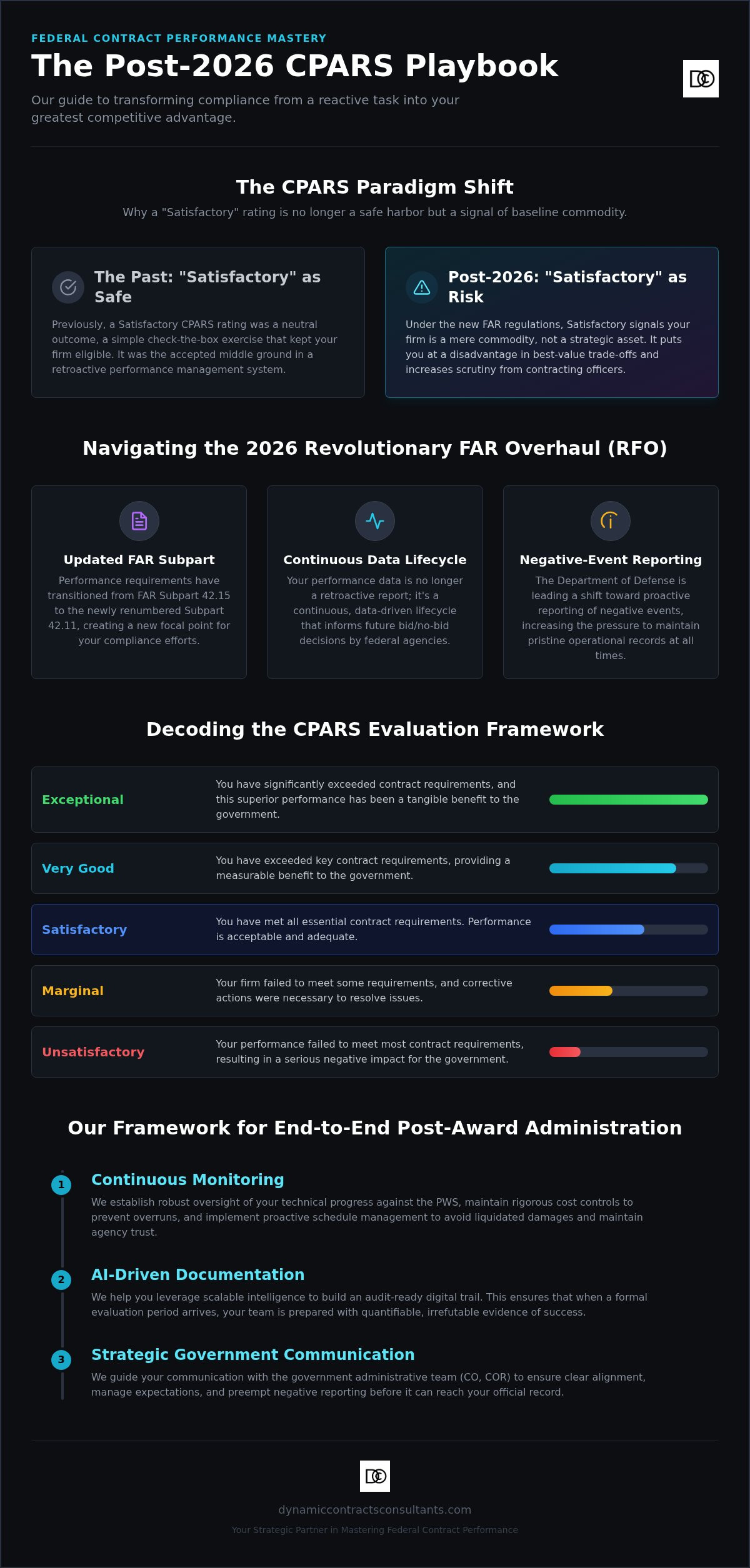
The shift from award-centric thinking to an execution-centric strategy is no longer optional. Under the 2026 Revolutionary FAR Overhaul (RFO), agencies now use performance data across the entire acquisition lifecycle, making your current output the primary driver for future bid/no-bid analysis. If your performance metrics aren't audit-ready, you're essentially gambling with your firm's future eligibility. We see this transition as a move toward professionalized contract stewardship where your operational data speaks louder than your marketing materials.
Beyond Compliance: Performance as a Competitive Asset
High CPARS ratings act as a force multiplier in competitive solicitations, often tipping the scales in best-value trade-off decisions. We've seen that firms with consistent "Exceptional" ratings can command higher margins because they lower the government's perceived risk. Conversely, the cost of poor performance is devastating. Cure notices, show-cause letters, and the looming threat of debarment can paralyze a business. Performance-based contracting requires a shift in mindset where you don't just meet requirements but actively document your mission impact. Performance management is a strategic bridge between current execution and future growth.
Understanding the Post-Award Lifecycle
The journey begins at the kick-off meeting and extends through the final contract closeout, encompassing every modification and option year decision in between. Throughout this lifecycle, the government identifies critical milestones where your performance is formally measured and recorded in CPARS. To navigate this successfully, you need a robust framework for post-award contract administration to mitigate risk and ensure compliance. This involves:
- Continuous monitoring of technical progress against the Performance Work Statement (PWS).
- Rigorous cost control and reporting for cost-reimbursement vehicles to prevent overruns.
- Proactive schedule management to avoid liquidated damages and maintain agency trust.
- Strategic communication with the government administrative team to preempt negative reporting before it reaches the official record.
Managing these milestones requires precision. We focus on establishing a digital trail of performance data early in the process, ensuring that when the formal evaluation period arrives, your team is prepared with quantifiable evidence of success.
Deciphering FAR Subpart 42.15 and the CPARS Framework
The regulatory architecture of federal contract performance management is built upon the standards established in the Federal Acquisition Regulation. While the industry historically focused on FAR Subpart 42.15, the Revolutionary FAR Overhaul of 2026 has transitioned these requirements to FAR Subpart 42.11. Regardless of the numbering, the mandate remains clear: agencies must document contractor performance for every contract exceeding the simplified acquisition threshold, which currently sits at $250,000 for most service and supply requirements. The Contractor Performance Assessment Reporting System (CPARS) serves as the official repository for this data, creating a permanent digital record that follows your firm throughout its entire lifecycle.
We believe that understanding the five-point rating scale is essential for maintaining a competitive edge. Evaluations range from "Exceptional," where you've significantly exceeded contract requirements to the government's benefit, down to "Unsatisfactory," which indicates a failure to meet basic obligations. In the 2026 landscape, a "Satisfactory" rating is no longer a goal; it's the bare minimum. To secure future work, we help you aim for "Very Good" or "Exceptional" scores by providing quantifiable mission impacts that justify higher adjectival ratings.
The Evaluation Criteria: What Agencies Actually Track
Agencies assess your performance through four primary lenses. Technical Quality focuses on your ability to meet Statement of Work (SOW) requirements with precision, ensuring that deliverables are functional and compliant. Schedule management tracks your adherence to milestones; even a single late report can jeopardize a rating. Cost Control is critical for cost-reimbursement contracts, where we focus on your ability to manage budgets and avoid unauthorized overruns. Finally, Management and Small Business Subcontracting evaluates your operational coordination and your success in ensuring flow-down compliance with your partners.
The CPARS Workflow: Your Rights and Timelines
When an Assessing Official (AO) submits an evaluation, the clock starts on a critical 14-day window. You have exactly two weeks to review the government's comments and provide your own perspective. We don't recommend simply agreeing with every assessment. If you disagree with a rating, you must draft a professional, evidence-based rebuttal that addresses specific facts rather than emotional grievances. If a resolution isn't reached with the AO, the Reviewing Official (RO) steps in as the final authority to resolve the dispute. If you're facing a complex performance dispute that threatens your past performance record, you can reach out to our team for strategic guidance on drafting high-impact rebuttals.
Aligning with the Government Administrative Team
Successful federal contract performance management isn't a solo endeavor; it's a collaborative process that requires precise synchronization with the government’s oversight personnel. We define the 'Administrative Team' as the collective of federal officials responsible for ensuring contract compliance and mission success. This team is anchored by the Contracting Officer (CO) and the Contracting Officer’s Representative (COR). Establishing a proactive communication cadence with these individuals is the only way to prevent 'surprises' during the annual evaluation cycle. When you treat these relationships as a strategic partnership, you move from reactive compliance to proactive excellence.
The foundation of this partnership is the Quality Assurance Surveillance Plan (QASP). This document defines exactly how the government will measure your success, outlining the specific metrics and methods for oversight. We recommend reviewing the QASP during your internal kick-off meetings to ensure every team member understands the thresholds for performance. By aligning your internal reporting with the QASP, you create a shared language of success that makes it easier for the government to document your achievements in the official record.
Roles and Responsibilities of the CO and COR
You must maintain a clear distinction between technical guidance and administrative authority. Only the CO possesses the legal power to change contract terms, funding, or schedules. While the COR serves as the technical eyes and ears of the government, they cannot authorize work outside the original scope. If you receive technical direction from a COR that conflicts with your administrative requirements, seek immediate clarification from the CO. The CPARS official guide outlines these business rules, emphasizing that evaluations are a reflection of your ability to navigate these specific authorities. Understanding these boundaries protects you from unauthorized performance that could lead to negative ratings or cost overruns.
Establishing a Quality Assurance Protocol
We believe that your internal quality control should be more rigorous than the government's surveillance. By implementing robust government contract performance monitoring, you can identify potential technical or schedule slippages before they reach the COR’s desk. This proactive approach allows you to address issues internally and present the government with solutions rather than problems. It also provides a platform to document 'above and beyond' efforts. When you deliver a project ahead of schedule or implement a cost-saving innovation, record it immediately. These documented successes are the evidence we use to justify 'Exceptional' ratings, transforming your performance from a baseline service into a high-value competitive asset.
Proactive Monitoring and AI-Driven Documentation
The traditional methods of manual oversight are no longer sufficient for the high-velocity demands of 2026. We've entered an era where federal contract performance management must rely on scalable intelligence to maintain a competitive advantage. This shift requires building an audit-ready digital trail that captures every performance data point in real-time. By transitioning from reactive reporting to predictive performance management, you can identify potential schedule slips or cost variances before they impact your official record. This level of oversight is especially critical when managing contract flow-down requirements for subcontractors, as their performance directly influences your prime contractor ratings.
Predictive management allows you to move beyond simply documenting what happened. It enables you to forecast trends in technical execution and resource allocation. When you maintain a continuous stream of performance data, you eliminate the end-of-year rush to justify your ratings. We focus on creating a transparent environment where data serves as the objective arbiter of success, ensuring that your firm remains resilient against shifting agency priorities or personnel changes within the government administrative team.
Leveraging AI for CPARS Narrative Support
AI-driven automation allows us to analyze technical deliverables against complex Statement of Work (SOW) requirements with surgical precision. Instead of relying on memory during the evaluation period, you can use these tools to draft data-backed self-assessments that make the COR's job easier. Providing a well-documented narrative reduces the administrative burden on the government and increases the likelihood of your accomplishments being accurately recorded. FARIFY accelerates the generation of audit-ready performance records by synthesizing thousands of data points into compliant, high-impact narratives.
Managing Risk through Continuous Internal Audits
While AI provides the speed, we always advocate for a 'Human-in-the-Loop' review process to ensure every report meets our rigorous standards for accuracy. This dual-layered approach is vital when preparing for DCAA compliance consulting, as it ensures your technical performance is perfectly mirrored by your real-time cost data. We recommend a five-step monthly performance self-audit:
- Verify all technical milestones against the QASP benchmarks.
- Review subcontractor compliance with mandatory flow-down clauses.
- Reconcile labor hours and material costs against the project budget.
- Identify any 'above and beyond' contributions for the monthly status report.
- Update the digital performance repository with validated evidence.
This structured approach ensures that you're never caught off guard during a formal review. If you're ready to modernize your oversight processes and protect your past performance record, contact our consultants today to discuss a tailored implementation strategy.
Optimizing Outcomes with Dynamic Contracts Consultants LLC
We provide a strategic partnership that extends beyond simple oversight to maximize your organization's standing in the US federal sector. Our approach to federal contract performance management integrates deep regulatory expertise with forward-thinking technology to ensure your operations remain resilient under scrutiny. Dynamic Contracts Consultants LLC understands that your past performance record is a critical business asset, and we treat every evaluation period as an opportunity to strengthen your firm's market position. By partnering with us, you gain access to a team that manages the nuances of post-award administration while you focus on technical execution.
Effective performance management requires a shift from passive observation to active stewardship. By maintaining a high-fidelity record of your achievements, we help you build a narrative of reliability that resonates with future source selection boards. This proactive stance ensures that your firm isn't just surviving the contract lifecycle but is actively positioning itself for scalable growth. We ensure your current data serves as the objective arbiter of your firm's success.
Expert Post-Award Administration and Oversight
Managing the complexities of the post-award environment requires a meticulous eye for detail and a thorough understanding of evolving standards. Dynamic Contracts Consultants LLC handles the intensive administrative workload, including rigorous flow-down clause management and subcontractor compliance monitoring to prevent pass-through liability. If you encounter a performance dispute, we lead the development of evidence-based CPARS rebuttals to protect your ratings. We ensure every deliverable aligns with FAR/DFARS standards, reducing administrative friction and protecting your interests at every milestone.
FARIFY: Accelerating Compliance and Precision
We've revolutionized the procurement lifecycle by integrating FARIFY.ai into our daily operational workflow. This AI-driven platform allows us to generate complex documents like PWS, SOW, and IGCE in minutes rather than days, ensuring surgical precision. By combining our human-in-the-loop assurance with AI-powered speed, we provide a level of documentation accuracy that stands up to the most rigorous government scrutiny. This scalable intelligence is trained specifically on the federal landscape to provide audit-ready outputs.
Your performance on current contracts is the best marketing tool for your next federal proposal development effort. High ratings today simplify the bid/no-bid analysis of tomorrow, giving you the confidence to pursue high-value opportunities. We invite you to leverage our expert insights and technological advantages to secure your position as a top-tier contractor. Let's build a performance record that speaks for itself and secures your long-term success.
Mastering the New Standard of Federal Performance
Mastering federal contract performance management is the definitive factor that separates industry leaders from those merely surviving the 2026 regulatory landscape. You've learned that success requires a transition from reactive compliance to proactive, data-driven stewardship. By maintaining a rigorous digital trail and aligning your internal quality protocols with government expectations, you transform your past performance record into a formidable competitive asset. Every deliverable is no longer just a task; it's a strategic building block for your next major win.
Our team of Certified Professional Contracts Managers (CPCM) brings the precision and authority required to protect your interests in complex business environments. Dynamic Contracts Consultants LLC provides expert DCAA compliance consulting and leverages AI-powered document generation via FARIFY to ensure every milestone is captured with surgical accuracy. This strategic integration of human expertise and scalable intelligence guarantees that your firm remains audit-ready and resilient against shifting agency priorities. We don't just manage contracts; we secure your firm's reputation in the federal marketplace.
Don't leave your reputation to the discretion of a single annual review. Secure your contract performance with Dynamic Contracts Consultants LLC today and position your organization for sustainable growth. We're committed to ensuring your technical excellence is perfectly reflected in the official record.
Frequently Asked Questions
What is the difference between CPARS and past performance?
CPARS is the official government database used to record and store contractor evaluations, while past performance is the resulting historical record of your firm's execution. We view CPARS as the mechanism and past performance as the asset. Source selection boards review these records to determine your firm's technical capability and level of risk during future solicitations.
How often is contractor performance evaluated in federal contracts?
Agencies generally conduct evaluations annually and upon contract completion. For requirements exceeding one year, the government must generate an interim report every 12 months to track progress. A final report is mandatory once the period of performance ends or the contract is closed out, ensuring a complete record of your execution history.
Can I appeal a negative CPARS rating?
You have a legal right to submit a factual rebuttal within 14 days of receiving an evaluation. While this isn't a judicial appeal, your response becomes a permanent part of the record. If the Assessing Official maintains the negative rating, the Reviewing Official provides a final, higher-level determination to resolve the performance dispute.
What are the most common performance management pitfalls for new contractors?
The primary failures we observe are insufficient documentation and poor communication with the COR. Many firms wait until the evaluation period to gather evidence, which often results in missed opportunities to justify higher ratings. Failing to align internal quality control with the specific metrics in the Quality Assurance Surveillance Plan is another critical error for new entrants.
How does the COR influence my performance evaluation?
The COR serves as the government's primary technical lead and provides the detailed observations used to justify your ratings. While the Contracting Officer typically signs the evaluation, they rely almost exclusively on the COR’s narrative and data. Maintaining a transparent, proactive relationship with your COR is essential for successful federal contract performance management.
What role does AI play in federal contract compliance?
AI transforms federal contract performance management by automating the synthesis of technical data into audit-ready narratives. We use platforms like FARIFY to analyze deliverables against SOW requirements, ensuring your self-assessments are precise and data-backed. This technology reduces administrative errors and ensures your documentation remains compliant with the latest FAR standards.
What happens if I receive a Cure Notice during performance?
A Cure Notice is a formal notification that the government intends to terminate your contract for default unless you correct a specific performance failure. You typically have 10 days to provide a solution. Ignoring this notice or failing to "cure" the defect will result in a permanent "Unsatisfactory" rating and severe damage to your reputation.
How do flow-down clauses affect performance management for subcontractors?
Flow-down clauses require subcontractors to meet the same technical and administrative standards as the prime contractor. You are legally responsible for their performance failures, which can directly lower your own CPARS ratings. We help you implement rigorous subcontractor oversight to ensure their execution aligns with the prime contract’s compliance and quality requirements.


