

Is your firm inadvertently subsidizing federal projects through uncompensated constructive changes? In the wake of the 2026 Executive Order establishing fixed-price contracting as the default procurement method, the financial stakes of managing government contract modifications have never been higher. We understand the administrative burden of tracking FAR Part 43 requirements while attempting to avoid the DCAA audit triggers that often accompany modification negotiations. It's a delicate balance between maintaining a positive relationship with your Contracting Officer and ensuring your organization receives the equitable adjustments it's legally entitled to.
We've developed this framework to help you master the complexities of both unilateral and bilateral changes while protecting your bottom line. By integrating AI-driven analysis with deep regulatory expertise, we'll guide you through the process of generating seamless, audit-ready documentation that stands up to the most rigorous scrutiny. This article provides a comprehensive overview of strategic modification management, from initial notification to the successful negotiation of final terms.
Key Takeaways
- Understand how even minor administrative errors in modification processing can negatively impact your CPARS rating and future eligibility.
- Master the critical distinction between unilateral and bilateral changes to ensure you are effectively managing government contract modifications without compromising your legal rights.
- Identify the "silent killers" of profitability by recognizing constructive changes early and formalizing them through strategic equitable adjustment requests.
- Leverage AI-driven automation tools like FARIFY to accelerate requirement extraction and perform immediate impact assessments on proposed scope changes.
- Discover how integrating CPCM-certified expertise into your post-award administration transforms modification management from a risk factor into a driver of scalable growth.
The Anatomy of Federal Contract Modifications: Why Precision Matters
A contract modification is formally defined as any written change to the terms, scope, or conditions of an existing federal agreement. While this definition appears straightforward, managing government contract modifications is a high-stakes endeavor where administrative precision is mandatory. In the current regulatory environment, even minor errors or missed deadlines during the modification process can lead to significant Contractor Performance Assessment Reporting System (CPARS) issues. These negative ratings don't just affect your current project; they jeopardize your eligibility for future awards across the entire federal marketplace. We view modification management as a core component of strategic compliance that must be integrated across the entire procurement lifecycle to protect your organization's margins and long-term reputation.
To better understand the mechanics of these changes, watch this helpful overview:
Effective post-award compliance requires a nuanced understanding of the Federal Acquisition Regulation (FAR). While modern AI-driven automation provides incredible speed in identifying requirement shifts, we maintain that a human-in-the-loop is essential for complex regulatory changes. Expert analysis ensures that multifaceted legal nuances are correctly interpreted. This prevents the costly missteps that fully automated systems might overlook when dealing with the specificities of agency-level supplements or evolving case law.
Drivers of Modification: From Funding to Technology
Federal requirements are rarely static. As mission priorities evolve, agencies often find that the original Performance Work Statement (PWS) no longer reflects current operational needs or security standards. Budgetary realignments also frequently necessitate incremental funding modifications, which require meticulous tracking to avoid unauthorized performance gaps. Furthermore, rapid technological advancements drive scope changes as agencies seek to incorporate the latest innovations into ongoing projects. We help you anticipate these shifts to ensure your contract remains aligned with agency goals while maintaining operational efficiency.
The Role of the Contracting Officer (CO) vs. Contractor
It's vital to remember that the Contracting Officer (CO) possesses the exclusive legal authority to bind the government. No other agency official, including Technical Representatives or Program Managers, can authorize changes that impact contract cost, schedule, or quality. Your responsibility as a contractor involves providing timely notification of any perceived changes and submitting accurate, data-driven proposals for equitable adjustments. Establishing a formal, collaborative communication channel with the CO ensures that all modifications are properly documented and authorized, which is the only way to maintain the legal integrity of the agreement.
Navigating FAR Part 43: Unilateral vs. Bilateral Modifications
Success in federal contracting depends on your ability to categorize and respond to changes within the strict boundaries of FAR Part 43. This regulation establishes a binary framework for modifications, forcing a choice between unilateral and bilateral actions. Managing government contract modifications effectively starts with identifying whether a change is merely administrative or truly substantive. While administrative changes might seem trivial, substantive modifications impact your scope, cost, and schedule, requiring a sophisticated strategic response to protect your margins.
Managing government contract modifications requires a proactive stance on the legal concept of "consideration." In the context of government contracting, any material change to the contract must involve a mutual exchange of value. If the government requires additional services, you're entitled to an equitable adjustment in price or performance time. Ensuring that every modification is supported by adequate consideration is a critical step in maintaining a balanced and enforceable agreement that reflects the true value of your work.
Unilateral Modifications: Managing the Change Order
Unilateral modifications are signed only by the Contracting Officer. These are typically reserved for administrative updates that don't materially affect the substance of the contract, such as correcting an accounting code or updating a paying office. However, they're also the vehicle for issuing change orders and termination notices. Under the standard Change Clause (FAR 52.243), you have a mandatory duty to proceed with the changed work even if the final price hasn't been negotiated. This creates a significant financial risk if you don't have a robust system for tracking the costs associated with these directed changes.
Bilateral Modifications: The Art of the Supplemental Agreement
Bilateral modifications, known as Supplemental Agreements, are the primary tool for negotiating significant shifts in the contract's lifecycle. These require the signature of both the Contracting Officer and your authorized representative to become legally binding. We specialize in helping you navigate these negotiations, ensuring that changes in scope, delivery schedules, and pricing are fair and sustainable. Learn more about our Post-Award Compliance services to understand how we leverage data to strengthen your position during these critical discussions.
The transition from a unilateral change order to a bilateral supplemental agreement is where many contractors lose their leverage. By maintaining precise documentation and utilizing AI-driven analysis, you can transform a government-directed change into a strategic opportunity for contract growth. If your team is struggling with a complex modification, reach out to our consultants for expert-led guidance that ensures your compliance remains unshakeable.
Mitigating Risk: Constructive Changes and Equitable Adjustments
Constructive changes occur when the government's actions or inactions effectively change the contract scope without a formal written modification. These are often described as the silent killer of contractor profitability because they result in uncompensated work performed outside the original agreement. For a deeper understanding of the legal theories behind these events, we recommend reviewing this analysis of Constructive Changes and Equitable Adjustments. Effectively managing government contract modifications requires a vigilant team capable of identifying when an informal instruction from a Technical Representative or Program Manager crosses the line into a directed change.
The most common pitfall for contractors is the failure to provide timely notice. Most Change Clauses require you to notify the Contracting Officer within 30 days of perceiving a change. If you miss this window, you risk waiving your right to recover costs. We emphasize that a verbal suggestion on a job site can have the same legal weight as a written order if the government receives the benefit of the extra work, but only if you document and report it immediately. Our strategy focuses on early identification to ensure every hour of performance is accounted for and compensated.
The Request for Equitable Adjustment (REA) Framework
When a change occurs, we help you prepare a Request for Equitable Adjustment (REA) to recover the true costs of performance. This calculation goes beyond direct labor; it must include applicable overhead, general and administrative (G&A) expenses, and a reasonable profit. Unlike a formal Contract Claim under the Disputes Act, an REA is a collaborative negotiation tool. It allows for a more flexible resolution process while avoiding the adversarial nature of litigation. We utilize detailed cost and price analysis to ensure your adjustment proposal is mathematically sound and regulatory compliant, even when navigating the increased TINA thresholds established in 2026.
Audit-Ready Record Preparation for DCAA Scrutiny
Maintaining a contemporaneous record is the only way to survive a post-award audit. You must link every modification-related cost to specific Contract Line Item Numbers (CLINs) to ensure transparency. This level of detail is critical for DCAA Compliance Consulting: A Strategic Framework for 2026, as auditors will look for a clear nexus between the directed change and the incurred expense. We also ensure that all relevant flow-down clauses are properly integrated into your subcontracts, protecting the entire supply chain from compliance gaps. Our approach guarantees that your documentation is always audit-ready, even during high-pressure negotiations where the government seeks to minimize price adjustments.
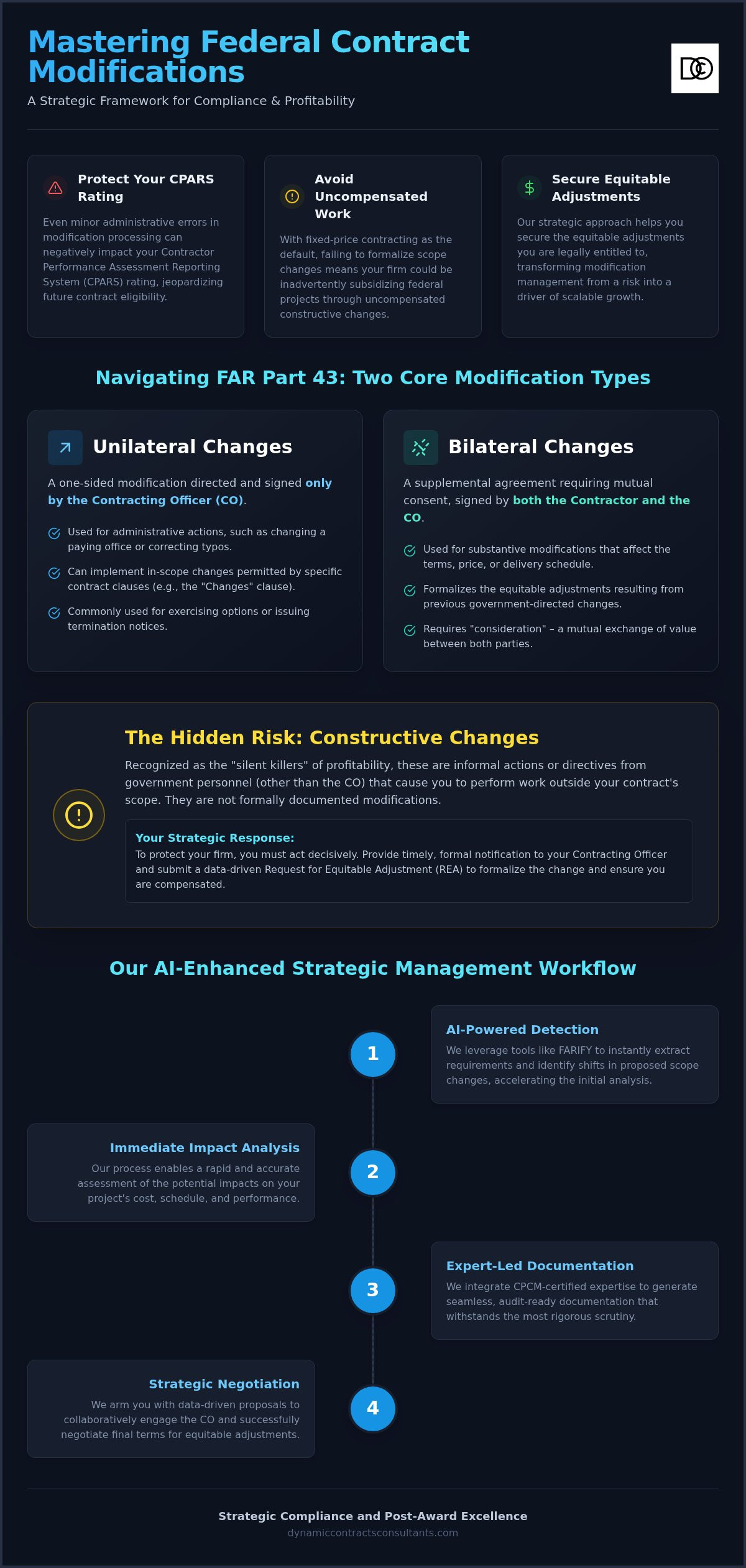
Strategic Management Workflow: Efficiency through AI and Expertise
Managing government contract modifications in 2026 requires more than just a deep understanding of the FAR; it demands an operational workflow that prioritizes speed without sacrificing precision. We've shifted away from the slow, manual document reviews of the past toward a streamlined process powered by AI-driven automation. This modern approach ensures that every proposed change is analyzed against the current regulatory landscape, including the updated TINA thresholds of $10 million and the significantly higher CAS applicability limits that took effect earlier this year. By treating modifications as a data-driven strategic function, we help you protect your margins while maintaining a high level of operational efficiency.
We've built a four-step framework to ensure every modification proposal is both technically superior and regulatory compliant. This systematic approach eliminates the guesswork often associated with complex scope changes:
- Step 1: Immediate Impact Assessment. We utilize FARIFY’s requirement extraction to identify every hidden obligation or risk in a proposed change within seconds.
- Step 2: Gap Analysis. Our team aligns the modification with the specific instructions found in Section L and the evaluation criteria in Section M to ensure your response is exactly what the government expects.
- Step 3: Technical Volume Generation. We draft a compelling technical response that justifies the resources required to execute the new scope of work.
- Step 4: Compliance Matrix Generation. We create a comprehensive matrix to verify that no flow-down clauses or administrative requirements are overlooked before submission.
Leveraging FARIFY for Rapid Document Generation
AI-driven automation has transformed the way we handle the procurement lifecycle. By using FARIFY, we reduce the turnaround time for generating updated Performance Work Statements (PWS) or Statements of Work (SOW) from days to minutes. This speed allows your team to respond to government requests with unprecedented agility. We maintain a human-in-the-loop validation process to ensure that every AI-generated output is audit-ready and reflects the specific nuances of your contract. Discover our AI-driven Proposal Writing services to see how we integrate these tools into your broader business strategy.
Strategic Capture Management for Contract Growth
We view modifications as a primary vehicle for contract expansion and upselling. A well-managed change order isn't just a hurdle; it's an opportunity to demonstrate additional value to your agency partners. By aligning your modification responses with a long-term capture strategy, you can turn a simple scope adjustment into a multi-year growth opportunity. For more insights on scaling your operations, see our Comprehensive Guide to Post-Award Contract Administration. This strategic focus ensures that managing government contract modifications becomes a driver of scalable intelligence rather than an administrative burden.
If you're ready to modernize your approach to contract changes and secure your organization's financial future, contact our expert consultants today to begin your digital transformation.
Partnering for Success: How We Optimize Your Post-Award Performance
Dynamic Contracts Consultants LLC serves as your dedicated, outsourced contract administration department. We recognize that the complexities of the federal procurement environment require a blend of deep regulatory knowledge and technological agility. By leveraging our CPCM-certified expertise, you gain access to seasoned strategists who understand the nuances of high-stakes federal negotiations. We focus on delivering simple solutions to complex problems, ensuring that the administrative burden of managing government contract modifications doesn't impede your operational momentum. Our team acts as an extension of your organization, providing the fegyelmezettség (discipline) necessary to maintain compliance in a rapidly shifting marketplace.
Our commitment to scalable intelligence means that we don't just react to changes; we anticipate them. We ensure your organization remains compliant with the evolving 2026 standards, including the shift toward fixed-price contracting as the default procurement method. This forward-thinking approach transforms contract administration from a back-office function into a core competitive advantage. When you partner with us, you're not just buying a service; you're investing in a strategic framework designed for long-term success and audit-ready results.
Lifecycle Support: From Award to Closeout
The impact of a modification extends far beyond the immediate scope change. We manage the complexity of CPARS narratives to ensure your performance is documented accurately, which is essential for securing future wins. Throughout the modification process, we maintain strict adherence to the Procurement Integrity Act, protecting your firm from even the appearance of impropriety. As modifications occur, we simultaneously prepare the necessary contract closeout documentation. This proactive stance ensures that when the period of performance ends, your closeout is seamless and free of the administrative hurdles that often delay final payments.
Scalable Growth through Strategic Compliance
Correctly managing government contract modifications is a fundamental building block of agency trust. When you deliver precise, data-backed modification proposals, you demonstrate a level of professional maturity that federal agencies value. This precision directly correlates with higher past performance ratings, which are the lifeblood of a growing federal practice. We help you use strategic compliance as a lever for scalable growth, ensuring every change order strengthens your position in the marketplace rather than weakening your margins. Our goal is to ensure that your compliance posture supports your business objectives at every stage of the procurement lifecycle.
If you're looking to enhance your post-award performance and protect your organization's reputation, consult with our experts on your contract administration needs to build a more resilient and profitable federal business.
Strategic Resilience in the 2026 Federal Marketplace
The 2026 federal landscape demands a decisive shift from reactive administration to strategic resilience. Successfully managing government contract modifications now requires a sophisticated synthesis of rigorous FAR Part 43 compliance and the rapid processing power of AI-driven automation. We've examined how early identification of constructive changes and the maintenance of audit-ready documentation are essential for protecting your organization's margins. By integrating tools like FARIFY with the oversight of CPCM and CFCM certified experts, you transform administrative burdens into scalable intelligence that supports long-term contract growth.
Our team leverages deep prime contractor experience with agencies such as the DoD and EPA to ensure your post-award performance remains unshakeable. We combine high-level regulatory precision with visionary technology to provide simple solutions to the most complex procurement challenges. Don't leave your CPARS ratings or profitability to chance in this increasingly high-stakes environment. We're ready to help you navigate the procurement lifecycle with confidence and precision.
Secure your contract margins with expert administration services and position your business for sustained success in the evolving federal marketplace.
Frequently Asked Questions
What is the difference between a change order and a contract modification?
A change order is a specific type of unilateral modification issued under the contract’s Change Clause. In contrast, a contract modification is a broader term that encompasses any written change to the contract’s terms; these can be either unilateral or bilateral. All change orders are modifications, but not all modifications are change orders. Precision in these definitions is critical for maintaining your legal standing during performance disputes.
Can a contractor refuse a unilateral modification under FAR Part 43?
Generally, you cannot refuse to perform under a unilateral modification. Standard Change Clauses, such as FAR 52.243-1, mandate that contractors proceed with the directed work even if the price hasn't been finalized. While you must perform, you retain the legal right to seek an equitable adjustment. We help you document these directed changes to ensure your organization is fully compensated for the additional effort.
How do I calculate an equitable adjustment for a contract change?
To calculate an equitable adjustment, you must determine the delta between the cost of the original work and the cost of the modified scope. This calculation includes direct labor, materials, overhead, and G&A, plus a reasonable profit. Accuracy is paramount here. Managing government contract modifications effectively requires a data-driven approach to ensure every dollar of increased performance cost is justified and recoverable during negotiations.
What are the risks of performing work before a modification is signed?
Performing work before a modification is signed carries the risk of non-payment for unauthorized activities. The government isn't legally bound to pay for work encouraged by Technical Representatives who lack Contracting Officer authority. This practice leads to uncompensated constructive changes that diminish your margins. We advise waiting for formal authorization or a written change order to protect your organization’s financial health and legal interests.
How does FARIFY AI assist in managing contract modifications?
FARIFY AI assists in managing government contract modifications by automating the extraction of new requirements from complex documents. It identifies clause changes and performs rapid impact assessments, allowing your team to understand the technical and financial implications of a change within minutes. This scalable intelligence reduces administrative overhead and ensures your modification proposals are both timely and regulatory compliant; giving you a competitive edge.
What documentation is required for a DCAA-compliant contract modification?
DCAA-compliant documentation requires a contemporaneous trail linking specific costs to the directed change. You must provide detailed cost proposals supported by timecards, material invoices, and evidence of the Contracting Officer’s direction. This level of detail establishes the necessary nexus between the government’s action and your increased expenses. Our consultants ensure your records are audit-ready, preventing costly disallowances during post-award reviews or future performance audits.
When should a contractor file a formal claim instead of an REA?
You should file a formal claim when REA negotiations reach a deadlock or when the Contracting Officer refuses to issue a final decision. While an REA is a collaborative negotiation tool, a claim is a formal demand under the Contract Disputes Act. Claims trigger the accrual of interest but are inherently more adversarial. We typically recommend exhausting the REA process first to preserve your agency relationship and achieve a faster resolution.
How do flow-down clauses change when a prime contract is modified?
When your prime contract is modified, you must identify which new requirements or FAR clauses must be flowed down to your subcontractors. If the modification changes the scope or compliance standards, your subcontracts must be updated to reflect these new obligations. Neglecting this step creates a liability gap between your prime agreement and your supply chain. We assist in ensuring all modifications are properly synchronized across all tiers of performance.


