

By 2026, the margin for error in federal procurement will effectively disappear as agencies transition toward real-time compliance monitoring and AI-augmented evaluation cycles. You likely recognize that the traditional path to winning awards is becoming increasingly obstructed by complex DCAA standards and the rigid requirements of the Federal Acquisition Regulation. It's frustrating to manage manual proposal workflows when you know a single oversight in your financial systems could disqualify you from a high-value opportunity.
We've developed this comprehensive government contract readiness checklist to transform that operational anxiety into a distinct competitive advantage. Our expert-led framework ensures your organization is strategically positioned for success with audit-ready precision. You'll gain a clear roadmap to federal eligibility and learn how to implement scalable intelligence that accelerates your proposal development. This guide previews the essential benchmarks for the 2026 fiscal year, covering everything from DCAA-compliant infrastructure to the integration of AI-driven tools like FARIFY for rapid acquisition planning. We'll show you how to move beyond basic eligibility toward a sophisticated capture strategy that wins.
Key Takeaways
- Identify the critical shifts in the 2026 federal procurement landscape that make strategic compliance the primary differentiator for winning high-value awards.
- Navigate mandatory administrative requirements by using our government contract readiness checklist to secure your UEI and optimize your SAM.gov registration for maximum visibility.
- Establish an audit-ready financial infrastructure by integrating DCAA-compliant accounting systems and mastering FAR Part 31 cost principles from the outset.
- Leverage AI-driven automation through FARIFY.ai to reduce document turnaround times from days to minutes while maintaining strict regulatory precision.
- Enhance your capture management through a formal bid/no-bid analysis framework that ensures your resources are focused on the most viable opportunities.
Why Government Contract Readiness is Your Strategic Foundation in 2026
Entering the federal market in 2026 requires more than a standard registration. It demands a holistic approach to strategic compliance. The federal marketplace, valued at over $700 billion, offers immense growth potential, but the barrier to entry has shifted from simple participation to rigorous operational maturity. We've developed a comprehensive government contract readiness checklist to help you move beyond basic administrative eligibility toward a position of strategic dominance. If you're not fully prepared, the cost of non-readiness is more than just a missed award. It's the wasted investment in proposal development and the loss of institutional credibility. We align your internal processes with agency expectations to ensure your organization achieves prompt project completion while maintaining cost-effective operational relationships.
The 2026 Federal Landscape and Regulatory Evolution
Recent updates to the Federal Acquisition Regulation (FAR) and Defense Federal Acquisition Regulation Supplement (DFARS) have intensified the requirements for new entrants. Cybersecurity is no longer an optional add-on. The Cybersecurity Maturity Model Certification (CMMC) is now a central component of any effective government contract readiness checklist. Federal agencies now prioritize audit-ready contractors from the initial solicitation phase. They lack the resources to wait for a vendor to achieve compliance after the award. If your financial and operational systems aren't compliant on day one, you're effectively excluded from high-value opportunities with the DoD, EPA, or Department of State.
Defining the Three Pillars of Total Readiness
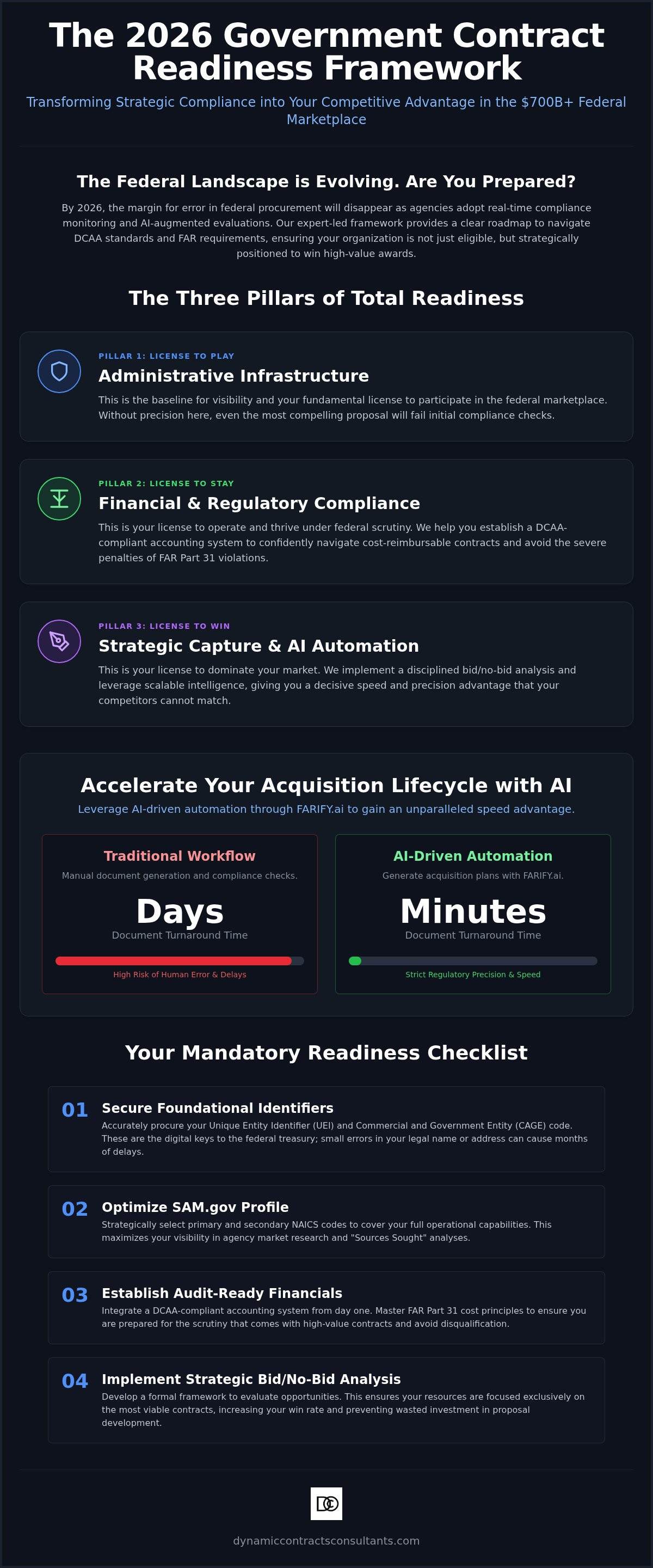
We define readiness through three distinct pillars that dictate your success throughout the procurement lifecycle. These pillars ensure you aren't just eligible to bid, but equipped to execute and scale.
- Administrative Infrastructure: This represents your license to play. It encompasses your Unique Entity Identifier (UEI), CAGE code, and an optimized SAM.gov profile. It's the baseline for visibility.
- Financial Compliance: This is your license to stay. Establishing a DCAA-compliant accounting system ensures you can navigate the scrutiny of cost-reimbursable contracts. We specialize in DCAA compliance consulting to protect your organization from the penalties of FAR Part 31 violations.
- Strategic Capture: This is your license to win. It involves a disciplined bid/no-bid analysis and the use of scalable intelligence. By leveraging AI-driven automation through FARIFY.ai, we help you generate acquisition plans and compliance documents in minutes, giving you a speed advantage your competitors can't match.
Administrative Infrastructure: The Mandatory Registration Checklist
Administrative infrastructure represents the baseline of your eligibility. Without precision in this phase, even the most innovative proposal will fail the initial compliance check. Your government contract readiness checklist must begin with the accurate procurement of your Unique Entity Identifier (UEI) and Commercial and Government Entity (CAGE) code. These aren't merely administrative numbers. They are the digital keys to the federal treasury. The UEI has functioned as the primary federal identifier since 2022. While the registration process seems straightforward, small errors in your legal business name or physical address can lead to months of validation delays.
Optimization of your SAM.gov profile requires a strategic approach to North American Industry Classification System (NAICS) codes. Many contractors make the mistake of selecting a single, broad code. You should identify a primary NAICS code that reflects your core revenue driver, supplemented by secondary codes that cover the full spectrum of your operational capabilities. This ensures your firm appears in market research queries when agencies are conducting "Sources Sought" analyses. Validating these codes against your past performance and current service offerings is essential to maintain credibility during the evaluation process.
Navigating the SAM.gov Ecosystem in 2026
Entity validation has become more rigorous. In 2026, the Federal Service Desk requires verifiable proof of your entity's physical location and legal start date. Common pitfalls include using P.O. boxes or failing to match SAM data exactly with IRS records. A single character discrepancy can trigger a manual review, stalling your ability to bid. We recommend initiating your annual renewal at least 90 days before expiration to avoid any lapse in active status. If your registration expires, you're ineligible for award and your existing payments may be frozen.
Socio-Economic Certifications as Competitive Differentiators
Certifications such as 8(a), Woman-Owned Small Business (WOSB), and Service-Disabled Veteran-Owned Small Business (SDVOSB) are not just labels. They are strategic tools that allow agencies to meet mandatory spending goals. By securing these certifications, you effectively reduce your competitive pool from thousands of firms to a handful of qualified peers. As a minority-owned firm, we've seen firsthand how these set-asides create pathways to sole-source awards and simplified acquisition thresholds. Success in this area requires aligning your certifications with your strategic capture management strategy. You can speak with our consultants to determine which certifications will provide the highest return on investment for your specific industry.
Financial and Regulatory Compliance: Preparing for DCAA Scrutiny
Financial eligibility is often the most significant hurdle for firms transitioning from commercial work to federal contracting. While administrative registration gets you into the system, your financial infrastructure determines if you can stay there. A robust government contract readiness checklist must prioritize the establishment of an accounting system that satisfies the Defense Contract Audit Agency (DCAA). This isn't just about balancing books; it's about the precise segregation of direct costs, indirect costs, and unallowable expenses as defined by FAR Part 31. Many contractors fail to realize that the government won't award cost-reimbursable contracts unless your system is deemed adequate by an auditor.
We focus on protecting your margins through expert indirect rate consulting. By accurately calculating your overhead, fringe, and G&A rates, we ensure you don't leave money on the table or risk disqualification due to "unrealistic" pricing. If you're targeting large-scale prime contracts, you'll eventually face a Contractor Procurement System Review (CPSR). Preparing for these audits early prevents the operational paralysis that occurs when an agency flags your quality-control processes as insufficient. Scalable intelligence in your financial reporting is the difference between a one-time award and a sustainable federal practice.
The DCAA Compliance Framework
The standard for financial readiness is the Standard Form (SF) 1408 pre-award survey. To pass, your system must demonstrate audit-ready timekeeping and labor distribution. Every hour must be recorded against a specific contract or indirect pool, with no room for manual estimates that fail DCAA scrutiny. We provide DCAA compliance consulting to help you implement these rigorous controls before the auditors arrive. This proactive approach transforms compliance from a burden into a strategic asset that supports your long-term growth.
Post-Award Administration and Flow-Down Clauses
Readiness doesn't end when the contract is signed. Effective post-award compliance involves managing the intricate web of flow-down clauses that you're legally required to pass to your subcontractors. Failure to monitor your subs can lead to prime contractor liability and negative CPARS ratings. We help you integrate audit-ready record-keeping into your daily operations, ensuring you have the data needed to support a positive performance narrative. Maintaining this level of operational efficiency is critical for securing bridge contracts and follow-on awards in the 2026 fiscal cycle.
Operational and Strategic Readiness: From Capture to Submission
Winning federal awards in 2026 isn't a matter of volume; it's a matter of selection. A critical component of your government contract readiness checklist is the implementation of a formal Bid/No-Bid analysis decision framework. Unlike basic bid-matching services that merely identify opportunities based on keywords, a strategic framework forces you to evaluate your probability of win (PWin) based on specific criteria. You must assess past performance relevance, resource availability, and competitive intelligence before committing valuable proposal assets. We've seen firms exhaust their annual budgets on low-probability bids simply because they lacked the discipline to disqualify an opportunity early.
To ensure 100% RFP adherence, we recommend building a compliance matrix at the start of every proposal cycle. This matrix cross-references Section L (Instructions) and Section M (Evaluation Criteria) to guarantee that every government requirement is explicitly addressed in your narrative. Missing a single sub-factor in Section L can lead to a "technically unacceptable" rating, regardless of your actual expertise. By utilizing market research to identify high-probability teaming agreements, you can fill technical gaps and present a more robust solution to the agency, positioning your firm as a low-risk choice for contracting officers.
The Capture Management Lifecycle
Effective strategic capture management requires moving from reactive bidding to proactive engagement. You shouldn't wait for the solicitation to drop on SAM.gov to begin your work. Conduct a thorough gap analysis six to twelve months before the anticipated release date. This proactive window allows you to identify key acquisition professionals and contracting officers early in the procurement lifecycle. Establishing these professional relationships provides insights into the agency’s specific pain points, which allows you to tailor your eventual response to their operational reality.
Professional Proposal Development Standards
Drafting a technical volume is a delicate balance of technical precision and persuasive writing. Your response must mirror the government’s specific language while demonstrating your unique value proposition. We emphasize the necessity of independent government proposal review services to catch logical gaps that internal teams often overlook. These reviews ensure your submission remains compliant with the Procurement Integrity Act, protecting your firm from legal risks during the evaluation. Precision in the final submission is the definitive step in our government contract readiness checklist, ensuring your operational readiness translates into high-value awards.
If you're ready to refine your capture strategy and increase your win rate, contact our capture management experts today to begin your strategic evaluation.
Leveraging AI and Expert Consulting to Accelerate Your Acquisition Lifecycle
The 2026 procurement landscape demands a level of agility that manual processes simply cannot sustain. A modern government contract readiness checklist is incomplete without a strategy for AI-driven automation. By integrating FARIFY.ai into your workflow, we help you transition from slow, document-heavy cycles to a model of scalable intelligence. Our AI-powered platform reduces the turnaround time for critical acquisition documents, such as the Performance Work Statement (PWS), Statement of Objectives (SOO), and Independent Government Cost Estimate (IGCE), from several days to mere minutes. This speed doesn't come at the cost of quality. Instead, it provides the baseline for more sophisticated human analysis, allowing your team to focus on strategic compliance rather than clerical tasks.
We believe in a "Human-in-the-Loop" philosophy. While AI handles the heavy lifting of data extraction and initial drafting, our expert consultants provide the necessary oversight to ensure every output is audit-ready. This synergy ensures that your technical volumes and compliance matrices meet the highest standards of the FAR and DFARS. Beyond traditional procurement, you can scale your organizational intelligence by utilizing AI for grant writing to diversify your federal funding streams and secure non-dilutive capital for technical innovation.
The Future of AI-Driven Proposal Development
FARIFY technology allows for rapid compliance matrix generation, a task that historically required hours of painstaking manual cross-referencing. Our platform automates RFP requirement extraction, identifying every "shall" and "must" statement with surgical precision. This automation improves your win-rates by allowing your team to focus on the persuasive, high-value aspects of the narrative rather than administrative box-checking. We ensure your documentation remains audit-ready throughout the entire lifecycle, providing a clear trail for DCAA or agency reviewers. This level of operational efficiency is what separates modern contractors from those still relying on legacy proposal methods.
Partnering with Dynamic Contracts Consultants LLC
Our collective expertise at Dynamic Contracts Consultants LLC simplifies the most complex federal requirements, transforming them into manageable strategic steps. We don't offer generic templates. Instead, we provide customized proposal writing services tailored to your specific industry and technical niche. Whether you're a tech-forward enterprise or a traditional service provider, our goal is to ensure your government contract readiness checklist leads directly to successful awards and long-term growth. We invite you to leverage our scalable intelligence to dominate the 2026 federal marketplace. Contact us today to discuss how we can integrate these advanced tools into your federal capture strategy and procurement lifecycle.
Secure Your Competitive Advantage in the 2026 Federal Market
Achieving total readiness is no longer a linear task; it's a strategic imperative that requires balancing rigid regulatory compliance with modern operational efficiency. By implementing this government contract readiness checklist, you've established the foundation necessary to compete for high-value awards across the DoD, State Department, and NOAA. Our approach, led by industry veteran Khalil Memon, combines decades of prime contractor experience with the cutting-edge precision of AI-powered document generation. We ensure your organization isn't just eligible to bid, but strategically positioned to win and execute with audit-ready confidence.
The complexities of the 2026 fiscal cycle demand a partner that understands the intersection of FAR compliance and scalable intelligence. We invite you to move beyond manual proposal bottlenecks and embrace a framework designed for long-term growth. Accelerate your federal success with our expert proposal and compliance services. We're ready to help you transform these complex requirements into your firm's greatest competitive strength. Your path to a sustainable federal practice starts with the right strategic alignment.
Frequently Asked Questions
What are the first steps to becoming a government contractor in 2026?
The initial steps involve legal entity validation and securing a Unique Entity Identifier (UEI) through the SAM.gov portal. You must also identify your primary and secondary NAICS codes to align with federal spending categories. Our government contract readiness checklist emphasizes that these administrative foundations are the prerequisite for any agency interaction. Once registered, you should focus on your CAGE code and socio-economic certifications to define your competitive position in the 2026 procurement landscape.
How long does it typically take to become 'contract ready'?
Achieving baseline administrative eligibility typically requires two to four weeks, provided your entity validation documentation is accurate. However, reaching full operational readiness, including DCAA-compliant accounting systems, often takes three to six months. This timeline depends on the complexity of your existing infrastructure and the specific requirements of your target agencies. We recommend starting the process well before a high-priority solicitation drops to ensure your systems are fully audit-ready for the evaluation.
Is DCAA compliance mandatory for all small business contractors?
DCAA compliance isn't mandatory for every contract type, but it's essential if you intend to bid on cost-reimbursable or time-and-materials awards. While fixed-price contracts have lower financial barriers, many high-value federal opportunities require a pre-award survey of your accounting system. Establishing these standards early allows you to pursue a wider range of opportunities. We help you implement these systems so you don't have to decline lucrative bids due to financial non-compliance.
What is a CAGE code and why does my business need one?
A Commercial and Government Entity (CAGE) code is a five-character identifier assigned by the Defense Logistics Agency. It's mandatory for any business seeking to work with the Department of Defense or obtain a facility security clearance. This code is used for administrative tasks, including payments and tracking government property. Without an active CAGE code, your firm cannot receive federal funds, making it a non-negotiable item on your government contract readiness checklist.
How can AI-driven automation improve my proposal win-rate?
AI-driven automation through platforms like FARIFY.ai significantly increases your win-rate by ensuring 100% compliance with RFP instructions. It allows you to generate complex compliance matrices and acquisition plans in minutes, freeing your team to focus on technical innovation and persuasive narrative development. This scalable intelligence reduces the risk of administrative disqualification. By automating the extraction of Section L and M requirements, you ensure your proposal is precisely aligned with the government's evaluation criteria.
What happens if my business fails a DCAA audit?
Failing a DCAA audit can lead to the immediate suspension of progress payments or the loss of a pending contract award. The government will typically issue a report detailing the deficiencies and require a formal corrective action plan. If the issues aren't resolved, your firm could be deemed "non-responsible," which effectively bars you from future prime contracts. We provide the expert oversight needed to identify these gaps before an official auditor arrives at your facility.
Can Dynamic Contracts Consultants LLC help with both pre-award and post-award compliance?
We provide comprehensive support throughout the entire procurement lifecycle, covering both pre-award strategy and post-award administration. Our team at Dynamic Contracts Consultants LLC handles initial capture management and proposal writing as well as the complex task of managing flow-down clauses and DCAA audits after the award. This end-to-end partnership ensures that your organizational systems remain compliant as you scale. We act as your strategic partner to simplify the transition from winning a bid to successful project execution.
What industries benefit most from a formal readiness checklist?
While all sectors benefit from structured preparation, professional services, information technology, and construction firms see the most significant ROI from a formal readiness framework. These industries often face complex labor distribution requirements and rigorous cybersecurity standards like CMMC. A standardized checklist ensures that businesses in these high-stakes sectors don't overlook critical FAR requirements. It provides a repeatable process for navigating the administrative and financial hurdles that often stall growth in the federal marketplace.


