

Could your next AI-generated proposal survive a DCAA audit under the new 2026 federal oversight mandates? We recognize the intense pressure you face in this shifting landscape. With the Federal Simplified Acquisition Threshold now at $350,000 and the Uniform Guidance overhaul finalized as of October 1, 2026, the complexity of RFP requirements has reached an unprecedented peak. You're likely balancing the urgent need for speed against the fear that AI inaccuracies might trigger catastrophic compliance failures or audit flags.
We'll show you how to leverage strategic AI grant writing assistance to transform this regulatory burden into a distinct competitive advantage. You'll discover how our approach ensures 100% FAR and DFARS compliance while significantly reducing manual proposal development costs. This guide explores the integration of scalable intelligence and audit-ready documentation to secure your position as a top-tier federal contractor. We'll examine how to navigate OMB Memorandum M-25-22 requirements while maintaining the precision necessary for high-stakes submissions. By aligning modern automation with rigorous regulatory standards, we help you improve win-rates and streamline the entire procurement lifecycle.
Key Takeaways
- Understand why 2026 marks the critical shift from experimental tools to mission-critical acquisition automation for federal contractors.
- Learn how specialized AI grant writing assistance ensures 100% compliance with FAR and DFARS while aligning with complex Section L and M requirements.
- Discover the limitations of general-purpose AI models and why a "Human-in-the-Loop" approach is essential for maintaining audit-ready documentation.
- Implement a structured framework for RFP requirement extraction and automated gap analysis to significantly reduce proposal turnaround times.
- Leverage the strategic partnership between FARIFY’s rapid document generation and our deep regulatory expertise to improve your win-rates.
The Strategic Shift to AI Grant Writing Assistance in 2026
AI grant writing assistance has evolved into a sophisticated ecosystem of machine learning and regulatory intelligence. It's no longer just about generating text; it's about ensuring every sentence aligns with the complex framework of federal acquisition. As we move through 2026, we see a fundamental transition. AI has shifted from an experimental tool used by early adopters to a mission-critical component of acquisition automation. This change is driven by the recent overhaul of 2 C.F.R. Part 200, which became a binding regulation on October 1, 2026. These rules demand a level of precision that manual drafting can't consistently achieve.
While the basic grant writing process remains the same for many, federal contractors face far more rigorous standards than typical nonprofit seekers. You aren't just asking for funds; you're entering a high-stakes contractual environment where scalable intelligence is necessary to manage the entire procurement lifecycle. We position our solutions to bridge this gap, providing the technological edge required for rapid, compliant document generation.
The Evolution of Proposal Development
Proposal development has moved far beyond simple draft generation. Modern systems now handle complex requirement extraction, identifying subtle nuances in Section L and M that human eyes might overlook during high-volume periods. Implementing specialized AI grant writing assistance allows your team to focus on strategy while the system handles the heavy lifting of compliance mapping. We use these tools to maintain a consistent organizational voice across hundreds of pages of technical volumes. If your team still relies on manual-only processes, you're facing a significant competitive disadvantage. The speed and precision required to meet 2026 submission windows simply don't allow for old-school drafting methods.
Federal vs. Private Sector AI Requirements
The gap between private sector AI and federal needs is widening. In the federal market, FAR and DFARS alignment isn't optional. It's the foundation of your bid. Generic generative AI tools often fail federal audit-readiness tests because they lack the specific training on these regulations. You must also consider security. Protecting sensitive acquisition strategies requires an AI environment that prioritizes data privacy and adheres to OMB Memorandum M-25-22. We ensure that your data stays secure while our models produce content that's ready for DCAA scrutiny. Our approach prioritizes U.S.-developed AI solutions, ensuring you remain compliant with the latest federal acquisition policies and risk management mandates.
Navigating Federal Complexity with AI-Driven Regulatory Intelligence
Federal contracting is a labyrinth of technicalities where a single oversight can lead to disqualification. Generic AI models often struggle with the strict hierarchy of federal regulations, frequently hallucinating or missing the nuances of specific clauses. We utilize specialized AI models trained exclusively on the Federal Acquisition Regulation (FAR) and agency-specific supplements to provide reliable AI grant writing assistance. This ensures your submissions aren't just linguistically polished, but legally and technically compliant with the most current standards of 2026.
The alignment of Section L and Section M is the structural backbone of a winning proposal. Section L dictates the instructions for submission, while Section M details exactly how the agency will score your response. Our AI-driven automation extracts these requirements with precision to generate a comprehensive compliance matrix that acts as a roadmap for your technical writers. This system integrates market research and teaming agreements directly into the AI workflow, ensuring that every subcontractor's role is clearly defined and mapped to a specific RFP requirement. This level of scalable intelligence prevents the common pitfall of missing an obscure clause that could lead to a non-responsive determination.
Ensuring Audit-Ready Submissions
Pre-award compliance starts with a thorough gap analysis that identifies where your current capabilities meet or fall short of solicitation requirements. Our FARIFY technology accelerates the creation of Performance Work Statements (PWS), Statements of Work (SOW), and Statements of Objectives (SOO) in minutes rather than days. Researching an AI solution for grant language demonstrates that specialized tools are necessary to navigate policy-heavy environments effectively. AI-driven automation ensures every record generated is structured for federal scrutiny, providing a transparent trail for DCAA auditors. This systematic approach guarantees that your documentation is robust enough to withstand the most rigorous post-award reviews.
Strategic Capture and Bid/No-Bid Analysis
Strategic growth requires a disciplined approach to the bid lifecycle. We leverage AI for rapid solicitation drafting and comprehensive market research to identify trends and competitor positioning before the final RFP is even released. By utilizing AI-generated acquisition planning, we provide the data necessary to inform a rigorous bid/no-bid decision framework. This allows you to focus your proposal development budget on the contracts where you have the highest probability of success. You can optimize your win-rate with our strategic capture management services, ensuring your capture management is data-driven and strategically sound. If you're looking to scale your federal footprint, you might find it beneficial to reach out for a strategic assessment of your current procurement processes.
Beyond Text Generation: Evaluating Specialized AI Grant Writing Platforms
You shouldn't trust general-purpose models with high-stakes federal submissions. While tools like ChatGPT or Claude offer impressive linguistic capabilities, they lack the specialized regulatory training essential for the federal sector. These platforms are built on generic web data, making them prone to hallucinations when asked to interpret specific FAR clauses or DCAA requirements. In contrast, our AI grant writing assistance utilizes models specifically engineered for the procurement lifecycle, ensuring every response is grounded in current law and the 2026 Uniform Guidance standards.
General AI vs. Specialized Acquisition AI
The difference lies in the training sets. Generic models struggle with technical volume drafting because they don't understand the strict compliance tracking required by Section L. By integrating specialized AI grant writing assistance into your workflow, you transition from reactive drafting to proactive compliance management. Specialized platforms like FARIFY produce audit-ready output rather than mere draft-quality text. We ensure our platform generates Independent Government Cost Estimates (IGCEs) and contract modification analyses in minutes rather than days. This level of precision is unattainable for tools trained on open-source internet content, which lacks the depth of DFARS or ITAR regulations.
Many contractors worry that AI-generated content sounds robotic or lacks the persuasive edge needed to win. We address this through advanced tone customization that mirrors your organizational voice while maintaining the formal rigidity expected by federal reviewers. It's about blending sophisticated automation with strategic compliance. This allows you to produce high-volume submissions without sacrificing the unique value proposition of your firm.
The Value of Human Expertise in AI Workflows
We advocate for the "Human-in-the-Loop" model as the gold standard for 2026. Professional proposal editing remains essential for identifying strategic capture opportunities that even the best AI might overlook. Dynamic Contracts Consultants LLC provides the critical oversight needed for all AI-generated documentation, acting as a final safeguard against regulatory drift. This hybrid approach ensures that while you benefit from AI-driven automation, a human expert validates every line for regulatory alignment. You can learn more about the strategic necessity of government proposal review services to see why this oversight is non-negotiable for high-value contracts.
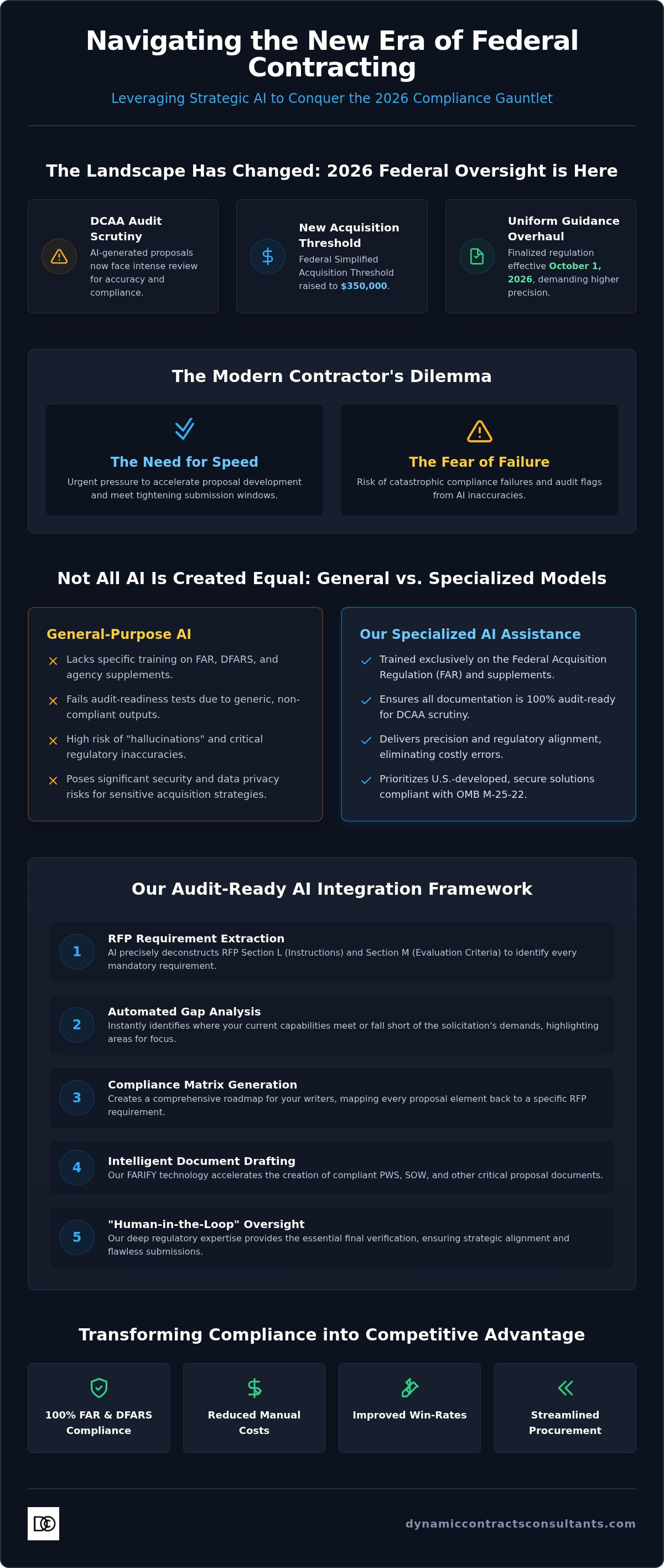
A Framework for Integrating AI Assistance into Your Proposal Lifecycle
Implementing a structured framework is the only way to ensure that AI-driven automation translates into successful contract awards. We've developed a five-step methodology that balances the rapid processing speed of FARIFY with the deep regulatory expertise of our senior consultants. This process begins with RFP requirement extraction and an automated gap analysis. Our system identifies every mandatory deliverable and technical specification within the solicitation, highlighting where your capabilities meet the agency's needs and where you might need strategic teaming partners. This initial phase ensures that your bid starts on a foundation of absolute compliance.
Once the requirements are mapped, we move into technical volume drafting. During this stage, our AI grant writing assistance provides real-time compliance monitoring, ensuring that every sentence adheres to the instructions in Section L. We then integrate cost and price analysis through AI-powered IGCE preparation. This allows you to forecast competitive labor rates and material costs with a level of precision that manual spreadsheets cannot match. Human expert review follows to ensure strategic alignment, followed by a final post-award document transition to set up your compliance infrastructure.
Optimizing the Pre-Award Phase
The speed of the federal market in 2026 demands rapid responses without sacrificing accuracy. We utilize AI to generate comprehensive compliance matrices in minutes, ensuring no obscure clause or reporting requirement is overlooked. By using customized templates, we help you build a scalable proposal development process that maintains a consistent organizational voice. This systematic approach allows your team to handle a higher volume of solicitations while maintaining the quality expected by federal reviewers. You can explore our professional proposal writing and template services to see how we streamline these critical early stages.
Connecting Proposals to Post-Award Success
A winning proposal is only the beginning of your contractual obligations. We ensure that your AI-assisted writing simplifies the management of flow-down clauses, which are essential for maintaining compliance across your entire supply chain. Our framework also prepares you for CPARS narrative support during the proposal phase, ensuring your technical approach is documented for future performance evaluations. This foresight is critical given the more stringent regulations finalized on October 1, 2026. For a deeper look at the next steps, read our comprehensive guide to post-award contract administration. To discuss how this framework can be tailored to your specific acquisition goals, contact our strategic consultants today.
Optimizing Federal Funding Success with FARIFY and Dynamic Contracts Consultants LLC
The integration of FARIFY LLC and Dynamic Contracts Consultants LLC provides a comprehensive answer to the complexities of the 2026 federal acquisition landscape. We focus on delivering simple solutions to complex problems, ensuring that the administrative weight of federal compliance doesn't hinder your operational growth. As a minority-owned small business founded in 2015, we offer more than just technology; we provide the strategic insight necessary to leverage set-aside opportunities and maintain prime contractor status with agencies such as the DoD and the EPA. Our approach ensures that your firm remains agile while adhering to the most rigorous regulatory standards.
Why a Strategic Partnership Trumps Standalone Software
While standalone tools offer speed, they often lack the contextual oversight required for high-stakes bidding. By choosing the integrated model offered by Dynamic Contracts Consultants LLC, you gain the support of Certified Professional Contracts Managers (CPCM) and Certified Federal Contracts Managers (CFCM) who understand how to validate AI outputs against current FAR standards. Our team provides end-to-end acquisition support, from the initial bid/no-bid analysis to final contract closeout. We've successfully served as a prime contractor for the DoD, State Department, and EPA, bringing a level of practical experience that generic software providers can't replicate. Our AI grant writing assistance ensures that your submissions are rooted in this deep institutional knowledge, moving beyond simple text generation to true strategic capture.
Securing Your Competitive Advantage in 2026
Building a long-term competitive advantage requires a shift toward scalable intelligence across your entire procurement team. We help business leaders navigate this digital transformation by implementing AI-driven automation that enhances, rather than replaces, human expertise. This visionary approach allows you to scale your federal footprint while maintaining the highest standards of precision and compliance. To ensure your success continues long after the initial award, we provide specialized oversight for the entire contract lifecycle. You can ensure your post-award compliance with our expert consulting to maintain audit-readiness throughout the duration of your contract. Partnering with Dynamic Contracts Consultants LLC means securing a strategic ally committed to your growth in an increasingly complex federal marketplace.
Securing Your Competitive Edge in the 2026 Federal Marketplace
The transition toward mission-critical acquisition automation is no longer a future projection but a present reality. You've seen how integrating specialized AI grant writing assistance into your procurement lifecycle allows for rapid document generation without sacrificing the precision required by FAR and DFARS standards. By balancing FARIFY’s technological speed with our senior consultants' strategic oversight, we ensure your proposals are both visionary and audit-ready.
Our team at Dynamic Contracts Consultants LLC brings the authority of Certified Professional Contracts Managers (CPCM) and a proven track record as a prime contractor for the DoD and NASA. As a minority-owned small business, we provide the unique perspective and technical edge necessary to dominate in a complex regulatory environment. We invite you to leverage our expert AI grant writing assistance for your next federal submission to streamline your operations and improve your win-rates. We're ready to help you turn these complex requirements into your greatest strategic advantage.
Frequently Asked Questions
How does AI grant writing assistance ensure FAR and DFARS compliance?
AI grant writing assistance ensures compliance by utilizing specialized models trained on the complete Federal Acquisition Regulation (FAR) and agency-specific DFARS supplements. These systems perform real-time cross-referencing between your proposal text and mandatory regulatory clauses. By identifying potential conflicts or missing requirements during the drafting phase, we help you maintain 100% alignment with federal standards, reducing the risk of non-responsiveness or post-award audit failures during the procurement lifecycle.
Can AI generate audit-ready Independent Government Cost Estimates (IGCEs)?
Yes, specialized AI platforms generate audit-ready IGCEs by integrating historical procurement data with current labor rates and material costs. Our system automates the complex calculations required for price analysis, ensuring that your financial projections are both competitive and defensible. This automation eliminates manual spreadsheet errors and provides a transparent methodology that DCAA auditors can easily verify, significantly improving your financial compliance and operational efficiency during the bid process.
What is the role of "human-in-the-loop" in AI-driven federal proposal development?
The "human-in-the-loop" model ensures that strategic capture management and nuanced decision-making guide the AI's output. While AI handles requirement extraction and initial drafting, our Certified Professional Contracts Managers (CPCM) review every document for strategic alignment and Section L/M compliance. This hybrid approach combines machine speed with human expert judgment, ensuring that your proposal isn't just compliant, but also highly persuasive and strategically sound for high-value federal opportunities.
How secure is our acquisition data when using AI platforms like FARIFY?
We prioritize data security by adhering to strict federal standards, including the mandates of OMB Memorandum M-25-22. Our AI environment implements robust data-use restrictions and privacy safeguards to protect your sensitive acquisition strategies. Unlike generic tools, our platform ensures your proprietary information is never used to train open-source models, maintaining the confidentiality required for complex government contracting and protecting your firm's unique intellectual property and scalable intelligence.
Can AI help with post-award compliance and CPARS narrative support?
AI-driven automation extends into the post-award phase by simplifying the management of flow-down clauses and contract administration. Our system helps generate accurate CPARS narratives by cross-referencing performance data with original contract objectives. This ensures that your past performance record is documented precisely, supporting long-term success and improving your visibility for future prime contract renewals. This foresight is critical given the more stringent regulations finalized on October 1, 2026.
Does using AI for grant writing affect my eligibility for small business set-asides?
Utilizing AI grant writing assistance does not impact your eligibility for small business set-asides. Instead, it enhances your capability to compete for these opportunities by reducing the overhead costs associated with manual proposal development. As a minority-owned small business ourselves, we understand that these tools allow smaller firms to maintain the technical precision usually reserved for larger prime contractors, leveling the federal playing field while ensuring 100% regulatory compliance.
How quickly can FARIFY generate a compliant PWS or SOW?
FARIFY generates compliant Performance Work Statements (PWS) and Statements of Work (SOW) in minutes rather than the days required for manual drafting. By automating the extraction of technical requirements from solicitations, the platform produces structured, audit-ready documentation almost instantly. This rapid turnaround allows your team to focus on refining technical solutions and strategic teaming, significantly increasing your capacity to respond to multiple high-stakes solicitations without sacrificing quality or accuracy.
What is the difference between generic AI and specialized acquisition AI?
Generic AI relies on broad internet data and lacks the specialized knowledge required for federal procurement. Specialized acquisition AI is trained on specific regulatory frameworks like FAR, DFARS, and DCAA guidelines. This specialization ensures that the output is audit-ready and technically compliant rather than just grammatically correct. Our platform avoids the hallucinations common in general-purpose models, providing the precision necessary for high-stakes government submissions and long-term success in the federal market.


