

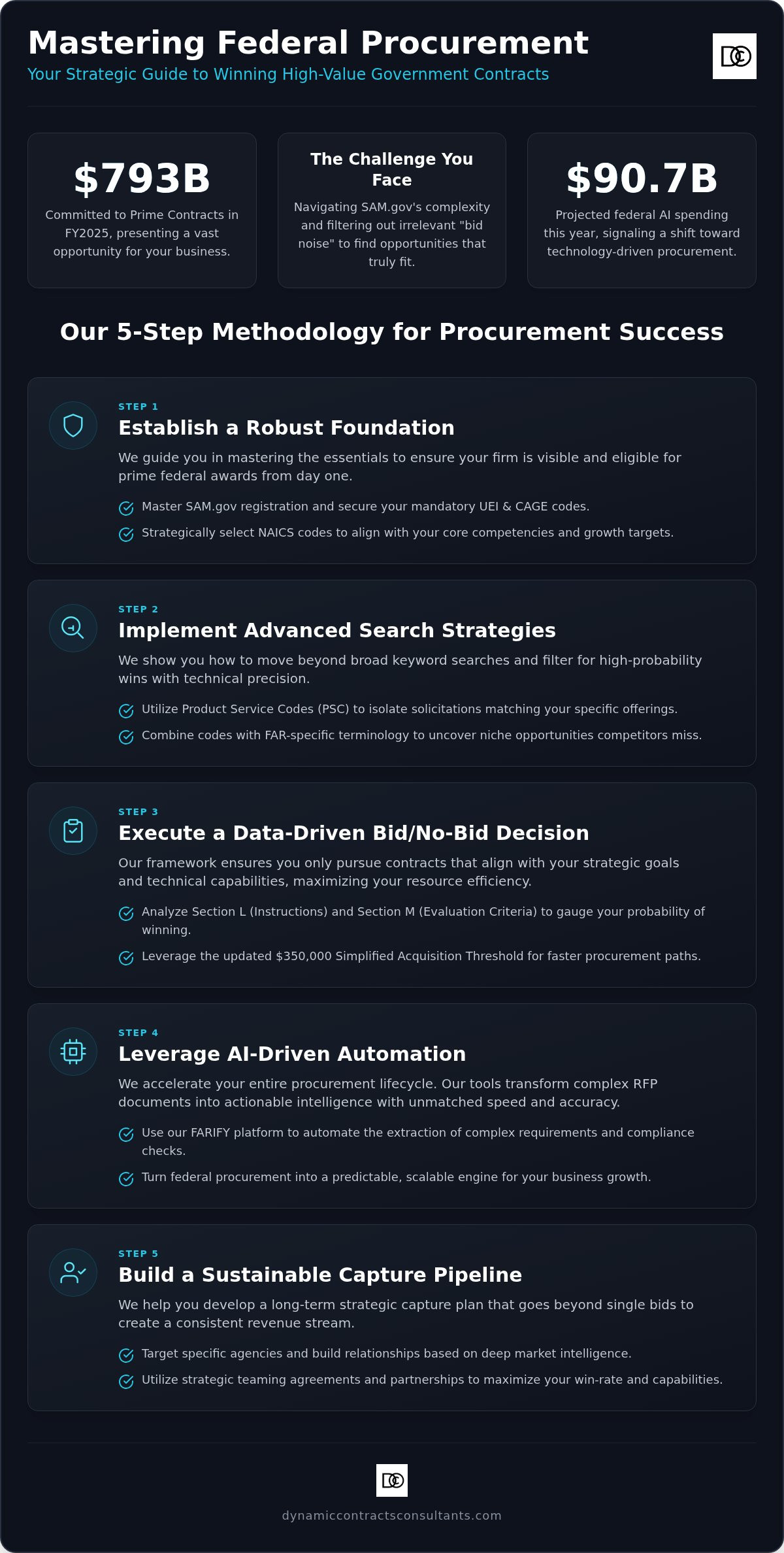
Did you know that the federal government committed approximately $793 billion to prime contracts in fiscal year 2025, yet many firms still struggle with how to find government contract opportunities that actually align with their core competencies? We understand the frustration of monitoring SAM.gov only to find a sea of irrelevant noise. It's difficult to manage the complexities of FAR/DFARS while fearing you'll bid on a contract that's a poor strategic fit. You need a methodology that moves beyond manual searching into the realm of predictive intelligence.
This 2026 guide will transform your approach, showing you exactly how to master the procurement landscape using advanced search methodologies and AI-driven analysis to secure high-value awards. We promise to help you leverage the updated $350,000 Simplified Acquisition Threshold and navigate the current suspension of CMMC Phase II requirements. We'll preview a streamlined process for finding relevant bids, achieving higher win-rates through better targeting, and maintaining audit-ready compliance using our FARIFY platform. With federal AI spending projected to hit $90.7 billion this year, we'll show you how to turn federal procurement into a scalable engine for your business growth.
Key Takeaways
- We show you how to establish a robust foundation by mastering SAM.gov and ensuring your UEI and CAGE codes are properly registered for prime federal awards.
- Discover how to find government contract opportunities by optimizing your search methodology with Product Service Codes (PSC) and FAR-specific terminology to isolate high-probability wins.
- Implement our recommended bid/no-bid decision framework by analyzing Section L and Section M to ensure a solicitation aligns with your technical capabilities.
- Leverage our AI-driven automation tools to accelerate your procurement lifecycle, allowing you to extract complex RFP requirements with increased speed and accuracy.
- Build a sustainable revenue pipeline by developing a strategic capture plan that targets specific agencies and utilizes teaming agreements to maximize your win-rate.
Navigating the Federal Marketplace: The Official Portals for Discovery
SAM.gov serves as the definitive source of truth for federal solicitations exceeding $25,000. Understanding the framework of government procurement requires you to treat this portal as your primary intelligence hub. It's where agencies post formal Request for Proposals (RFPs) and Request for Quotes (RFQs). Beyond simple listings, you must monitor pre-solicitation notices. These offer early insights into upcoming requirements before the formal bidding window opens. Award notices provide critical data on your competitors, while sole-source justifications reveal where agencies lack a competitive pool. If you're looking for a more streamlined path, GSA Schedules act as a pre-vetted marketplace where agencies can bypass some of the standard bidding friction through pre-negotiated pricing.
To participate in this marketplace, you must secure a Unique Entity ID (UEI) and a Commercial and Government Entity (CAGE) code. These identifiers are mandatory for all federal contractors. Without them, your firm is invisible to the system and ineligible for award. We view these registrations not just as administrative hurdles, but as the foundation of your digital identity in the federal sector. Mastering how to find government contract opportunities starts with a clean, validated presence in these core databases.
Essential Registrations for Federal Visibility
Registration in the System for Award Management (SAM) is a methodical process that demands absolute precision. Your chosen North American Industry Classification System (NAICS) codes are critical because they define your search parameters. They also determine which small business set-aside opportunities you qualify for. We recommend a strategic selection of codes that reflect both your current capabilities and your growth targets. You should also optimize your business profile in the Dynamic Small Business Search (DSBS). This is the specific tool contracting officers use during market research to find qualified small businesses. A sparse profile often leads to missed opportunities during the early acquisition phase.
Secondary Sources: Aggregators and Grant Portals
While SAM.gov is central, it's not exhaustive for every type of federal funding. Grants.gov serves as the primary portal for federal assistance and funding outside of traditional procurement. For state and local opportunities, regional aggregators like BidNet Direct provide essential coverage that SAM.gov ignores. We integrate these varied sources into our comprehensive acquisition planning services to ensure you don't miss high-value prospects. Effectively learning how to find government contract opportunities involves monitoring these secondary channels to build a diversified and resilient pipeline. This multi-layered approach ensures your capture strategy accounts for the full spectrum of available public sector spend.
Advanced Search Strategies: Filtering for High-Probability Wins
Identifying a solicitation is only the first step; the true challenge lies in determining which leads represent a viable path to award. While SAM.gov is the official federal marketplace, searching it without a structured methodology often results in "bid noise." We've found that high-performing contractors prioritize technical filters over broad keywords to isolate high-probability wins. Learning how to find government contract opportunities effectively means shifting your focus from volume to strategic alignment.
We recommend using Product Service Codes (PSC) to define specific technical requirements. While NAICS codes describe your industry, PSCs describe the actual product or service the agency is buying. By combining these with keyword search strings that include FAR-specific terminology, you can locate niche solicitations that competitors might overlook. This level of precision ensures your team doesn't waste resources on opportunities that are a poor strategic fit.
Decoding NAICS and PSC Codes
NAICS codes act as the primary filter for federal opportunity matching. However, selecting an incorrect code can inadvertently exclude your firm from relevant small business set-asides. We advise you to leverage historical award data to identify which codes your target agencies historically use for your specific offerings. This data-driven approach ensures your search parameters align with actual agency buying habits rather than theoretical industry categories.
Leveraging Small Business Set-Asides
The federal government maintains a statutory goal to award at least 23% of prime contracting dollars to small businesses, creating a significant competitive advantage for qualified firms. In 2026, sub-goals for Small Disadvantaged Businesses (SDB) and Women-Owned Small Businesses (WOSB) remain at 5% each, while the goal for HUBZone businesses is 3%. You should specifically monitor for "Rule of Two" opportunities, where the contracting officer restricts competition to small businesses if at least two capable firms are expected to respond. With the Simplified Acquisition Threshold (SAT) currently set at $350,000, many of these opportunities are processed with reduced administrative friction, allowing for faster award cycles.
Navigating these specialized programs requires strategic compliance, especially with the SBA's August 2026 proposed rule to restructure nearly 1,000 industry standards into 338. Beyond active solicitations, you must track agency procurement forecasts. This allows you to identify upcoming needs months before an RFP is released, giving you the lead time necessary for effective capture planning. If you're ready to move beyond manual searching, speak with our capture management experts to build a data-backed pipeline.
Evaluating Solicitations: The Bid/No-Bid Decision Framework
Once you've mastered the mechanics of how to find government contract opportunities, your focus must shift toward rigorous evaluation. A common pitfall for emerging contractors is the "shotgun approach," where firms bid on every solicitation that loosely matches their NAICS codes. We advocate for a more disciplined methodology. You must dissect Section L (Instructions to Offerors) and Section M (Evaluation Factors for Award) with clinical precision. Section L dictates the format and required documentation, while Section M reveals exactly how the agency will score your proposal. If your technical capabilities don't align with the highest-weighted factors in Section M, the probability of award is negligible.
We recommend conducting a thorough gap analysis for every potential bid. This process identifies missing technical certifications or past performance requirements that may necessitate teaming agreements with established prime contractors. Simultaneously, you must assess the "Price to Win." This isn't just your internal cost; it's an analysis based on historical award data and Independent Government Cost Estimates (IGCE). Balancing your operational costs against the competitive ceiling is essential for maintaining long-term profitability.
The Strategic Bid/No-Bid Matrix
A structured scoring system provides the objectivity needed for scalable growth. We utilize a weighted matrix that evaluates technical, financial, and strategic alignment. In many cases, deciding not to bid is the most profitable choice for your firm, as it preserves resources for opportunities where you have a clear competitive advantage. You can leverage our AI-driven bid/no-bid analysis to accelerate this decision-making process and ensure your pipeline remains focused on high-probability wins. This disciplined approach aligns with the broader SBA contracting guide recommendations for strategic market positioning.
Assessing Compliance and Risk
Regulatory risks represent a significant barrier to post-award success. You must identify "killer clauses" within the RFP, such as complex flow-down requirements or specific cybersecurity standards, that could disrupt your operational efficiency. For contracts involving cost-reimbursable components, determining if you need DCAA compliance consulting is a critical pre-award step. Ensuring your accounting system is ready for federal audit scrutiny isn't just about winning the contract; it's about protecting your business from the financial penalties associated with non-compliance. While learning how to find government contract opportunities is vital, securing your infrastructure for audit-readiness is what guarantees long-term viability.
Leveraging AI and Automation in Opportunity Discovery
Manual search processes on SAM.gov are inherently slow and susceptible to human error. In 2026, we see a paradigm shift where AI-driven automation becomes the core operating model for successful procurement. By integrating FARIFY.ai into your workflow, you can extract complex RFP requirements in seconds rather than hours. This speed allows your team to focus on strategic capture rather than administrative data entry. Understanding how to find government contract opportunities now requires a technological edge to filter through the projected $793 billion in annual federal spend. We've designed our tools to provide a competitive advantage by identifying opportunities before they become saturated with bidders.
Our platform enables you to automate market research, identifying agency spending patterns and incumbent contractors with precision. We assist you in generating audit-ready compliance matrices that ensure 100% response alignment with the solicitation's requirements. This automated approach also streamlines the drafting of Performance Work Statements (PWS) and Statements of Work (SOW), reducing the risk of technical non-compliance. By removing the manual burden of document synthesis, we empower your subject matter experts to focus on the technical nuances that actually win contracts. This level of operational efficiency is no longer optional in a market where federal AI spending is projected to reach $90.7 billion in 2026.
AI-Driven Market Intelligence
Scalable intelligence allows small firms to compete effectively with large-scale capture teams by processing vast amounts of historical data. We use AI to analyze Contractor Performance Assessment Reporting System (CPARS) narratives and past performance requirements to predict which agencies are most likely to award to your specific profile. FARIFY's AI model is trained specifically on acquisition regulations for precision. This deep learning approach ensures that your market intelligence isn't just broad, but strategically actionable. We help you identify which agencies have a high propensity for your NAICS codes, ensuring your efforts regarding how to find government contract opportunities are concentrated on the most fertile ground.
Rapid Proposal Development
Meeting tight deadlines is a constant pressure in federal contracting. We help you integrate AI for grant writing and proposals to accelerate your submission timeline. While automation handles the initial generation, we maintain a human-in-the-loop assurance for final submission readiness. This synergy reduces the procurement lifecycle from weeks to days, allowing you to respond to more solicitations without increasing overhead. Our proposal writing services utilize these automated document generation tools to ensure every submission is linguistically precise and regulatory-compliant. If you're ready to transform your capture process into a high-speed engine, contact our team to deploy FARIFY.ai.
Building a Sustainable Capture Pipeline for 2026
Success in federal procurement isn't defined by winning a single solicitation; it's the result of a disciplined, multi-year strategy. While we've discussed the technical aspects of how to find government contract opportunities, you must transition from a reactive bidding posture to a proactive capture methodology. We help you develop a comprehensive government contract capture plan that targets specific agencies long before an RFP is ever published. This long-term view allows you to align your resources with upcoming agency needs, ensuring your firm is the obvious choice when the formal procurement window opens.
Strategic capture involves pre-solicitation collaboration with contracting officers and program managers. By engaging during the market research phase, you can provide technical insights that influence the eventual requirement drafting. This isn't about unfair advantage; it's about ensuring the government understands the state of the industry and the technical possibilities your firm offers. We also emphasize the importance of teaming agreements. Establishing partnerships with established prime contractors allows you to leverage their past performance while building your own technical footprint within a new agency.
Strategic Relationship Management
Building a pipeline requires you to identify and engage key stakeholders within specific agencies like the Department of Defense, the State Department, and the EPA. We recommend attending Industry Days and Small Business events to network directly with agency leads and Small Business Specialists. These interactions provide intelligence that databases cannot capture. If you're an emerging contractor, treat subcontracting as a critical gateway. Serving as a subcontractor on a high-visibility project is often the most effective way to secure the past performance metrics required for future prime contract awards.
Ensuring Post-Award Excellence
Your ability to win future contracts depends heavily on your current performance. We implement rigorous post-award contract administration to mitigate performance risks and protect your reputation. A stellar Contractor Performance Assessment Reporting System (CPARS) rating is your most valuable asset in the federal marketplace. Consistent delivery and proactive management of flow-down clauses ensure you remain in good standing with both the government and your subcontractors. This operational excellence often leads to "sole-source" opportunities and contract renewals, transforming your initial win into a sustainable revenue stream. By focusing on the full procurement lifecycle, we ensure your business achieves scalable growth and long-term success in the federal sector.
Strategic Growth in the 2026 Federal Marketplace
Success in the federal sector requires you to move beyond basic database searches. You've learned that mastering how to find government contract opportunities involves a sophisticated blend of AI-driven market intelligence and a disciplined bid/no-bid framework. By leveraging our AI-powered FARIFY document generation and expert DCAA compliance consulting, you can transform complex FAR/DFARS requirements into a distinct competitive advantage. Our proven track record with agencies like the DoD, NASA, and the EPA ensures that your strategic compliance is managed by professionals who understand the high stakes of federal procurement.
Building a sustainable pipeline is about more than the initial award; it's about establishing a legacy of post-award excellence and strategic relationship management. We're here to serve as your partner in this journey, providing the scalable intelligence and human-in-the-loop assurance needed to navigate the evolving landscape. Scale your federal acquisition success with Dynamic Contracts Consultants LLC and explore our expert services today. We look forward to helping you secure your firm's future in the public sector marketplace.
Frequently Asked Questions
Is there a cost to search for government contract opportunities on SAM.gov?
No, accessing the official federal marketplace is entirely free of charge for all registered entities. You should exercise caution when encountering third-party platforms that demand payment for access to public solicitations. We recommend using the official portal to ensure you're viewing the most current and authoritative data. While the search is free, the strategic intelligence required to filter these results effectively often necessitates professional capture management expertise.
How long does it typically take to register a business for federal contracting?
The registration process for the System for Award Management typically requires 10 to 14 business days for completion. However, this timeline can extend significantly if your entity validation requires additional documentation or if there are discrepancies in your IRS tax identification data. We advise you to begin this process well in advance of any specific bid deadlines to ensure your UEI and CAGE code are fully active and verified before submission.
What are NAICS codes and why are they critical for finding contracts?
NAICS codes are numerical identifiers used by federal agencies to classify business establishments based on their primary economic activity. They're critical because contracting officers use these codes to set aside specific opportunities for small businesses. Selecting the correct codes is a foundational step in learning how to find government contract opportunities that align with your capabilities. Incorrect classification can lead to technical disqualification or the loss of eligibility for specialized set-aside programs.
Can a new business without past performance win a government contract?
Yes, a new business can secure awards by utilizing strategic teaming agreements or serving as a subcontractor to an established prime. Agencies often look at the individual experience of key personnel if the company itself lacks a robust corporate history. You might also target micro-purchases below the $15,000 threshold, which are often awarded with less emphasis on formal past performance, allowing you to build the necessary record for larger prime solicitations.
How do minority-owned small business set-asides work in 2026?
In 2026, minority-owned firms qualify for Small Disadvantaged Business (SDB) set-asides, with the federal government maintaining a statutory goal of awarding 5% of prime contracts to these entities. Programs like the SBA 8(a) Business Development program provide a structured path for social and economically disadvantaged firms to receive sole-source contracts. We assist you in navigating these regulations to ensure your strategic compliance maximizes your visibility to contracting officers seeking to meet these diversity requirements.
What is the difference between a prime contractor and a subcontractor?
A prime contractor holds a direct legal relationship with the federal government and is responsible for overall project execution and compliance. In contrast, a subcontractor is hired by the prime to perform specific tasks and has no direct contractual privity with the agency. For firms still learning how to find government contract opportunities, starting as a subcontractor is an excellent way to gain agency-specific experience and build a performance record without the full administrative burden of prime contract management.
How can AI tools like FARIFY help in the bidding process?
AI tools like FARIFY.ai revolutionize the procurement lifecycle by automating the extraction of complex RFP requirements. Our platform generates audit-ready compliance matrices in minutes, ensuring your proposal is 100% aligned with Section L and M instructions. This scalable intelligence allows your team to maintain a higher volume of submissions while ensuring the technical precision required for high-value awards. It effectively removes the manual burden of document synthesis, allowing for more strategic bid-no-bid analysis.
What happens if my business is not DCAA compliant after winning a bid?
If your business is awarded a cost-reimbursable contract but fails to maintain a DCAA-compliant accounting system, the government may withhold payments or terminate the contract for default. Non-compliance poses a severe financial risk, as it can lead to the disallowance of costs and negative CPARS ratings that jeopardize future wins. We provide expert DCAA compliance consulting to ensure your systems meet federal audit standards before you encounter the scrutiny of a post-award audit.


