

What if the lowest price you offer is actually the reason you lose your next federal award? In the 2026 procurement environment, the shift toward the Best Value continuum means that traditional price-cutting is a race to the bottom that compromises your margins and your mission. We understand that the pressure to remain competitive while facing strict DCAA audits and shrinking profit windows feels like an impossible balancing act. By implementing sophisticated government contract negotiation strategies, you can move beyond defensive bidding and start dictating terms that protect your bottom line.
We've designed this guide to help you master the complexities of FAR Part 15 and leverage data-driven insights to secure high-value federal awards. You'll learn how to transform your proposal-to-award timeline while ensuring 100% audit-readiness through strategic compliance. We'll explore how advanced analytics and AI-driven preparation allow you to negotiate from a position of strength, ensuring your next contract is won on your terms, not just the agency's minimum requirements.
Key Takeaways
- Understand the regulatory framework of FAR Part 15 to effectively transition from sealed bidding to complex negotiated acquisitions.
- Develop sophisticated government contract negotiation strategies that leverage the Best Value Trade-Off process to justify higher price points through technical excellence.
- Protect your profit margins and ensure long-term audit-readiness by defending indirect rates through rigorous cost realism analysis and DCAA compliance.
- Master the critical competitive range phase to refine your final proposal revisions and navigate post-award debriefings with strategic precision.
- Enhance operational efficiency by integrating AI-driven automation into your procurement lifecycle for faster, more accurate solicitation drafting and market research.
Mastering the Fundamentals of FAR Part 15 Negotiation
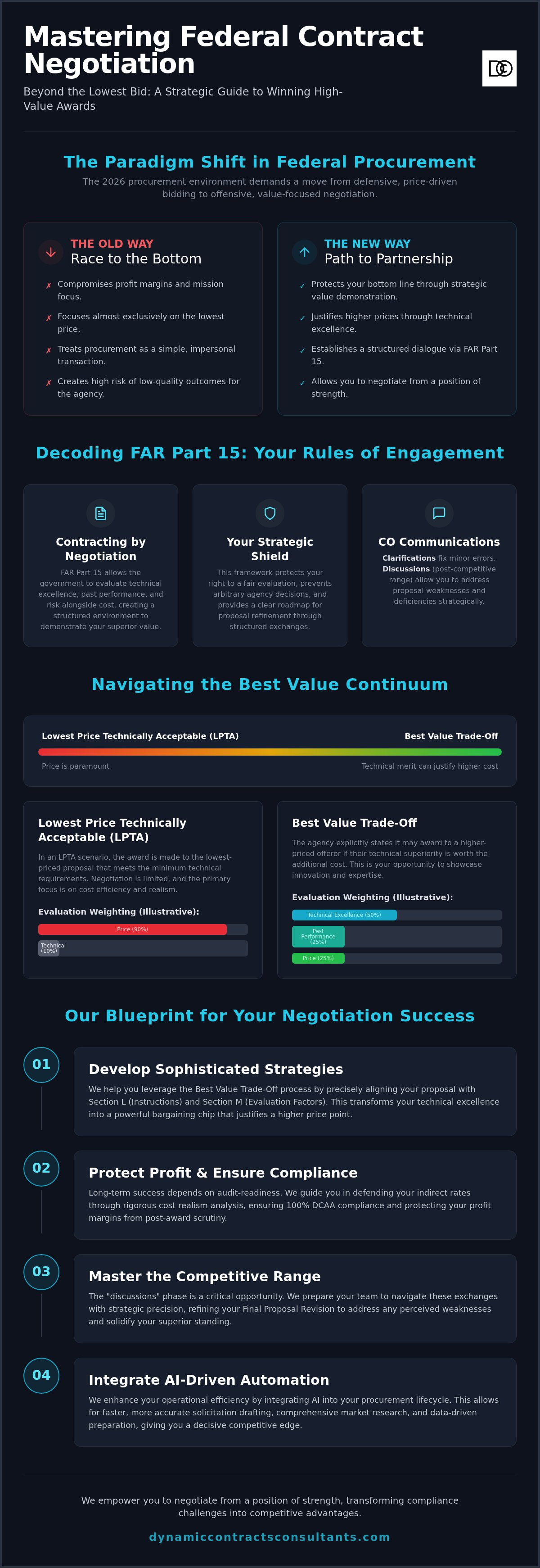
Federal procurement isn't a simple transaction; it's a highly regulated dialogue governed by FAR Part 15. While FAR Part 14 sealed bidding focuses almost exclusively on the lowest price, FAR Part 15 "Contracting by Negotiation" allows the government to evaluate technical excellence, past performance, and risk alongside cost. This framework serves as the definitive rules of engagement for both parties. It creates a structured environment where you can demonstrate why your solution offers the best value to the taxpayer. We specialize in helping you interpret these complex solicitation requirements to identify where you have the most leverage. Effective government contract negotiation strategies start with a deep technical understanding of how these rules protect your right to a fair evaluation.
The government procurement process relies on these regulations to ensure transparency and competition. For contractors, FAR Part 15 is your shield. It prevents agencies from making arbitrary decisions and provides a roadmap for how you can refine your proposal through exchanges. We don't just look at the surface requirements; we analyze the underlying evaluation criteria to find the strategic gaps where your specific expertise can be used as a bargaining chip during the acquisition lifecycle.
The Role of the Contracting Officer (CO) in Negotiations
The Contracting Officer (CO) holds the legal authority to bind the government to a contract, but their power isn't absolute. They operate within strict limitations to ensure fairness. It's vital to recognize the difference between "clarifications" and "discussions" during the exchange phase. Clarifications are limited to resolving minor irregularities or clerical errors. Discussions, however, are more comprehensive. They occur after the competitive range is established and allow you to address deficiencies or weaknesses in your proposal. We help you manage these communications so you can provide the necessary data without compromising your proprietary methods or pricing integrity.
Key Regulatory Frameworks: FAR, DFARS, and Agency-Specific Supplements
In 2026, the regulatory environment is more layered than ever. While the FAR provides the baseline, agency-specific supplements like the DFARS for defense or the GSAM for the General Services Administration introduce unique requirements that can significantly alter your approach. These supplements often dictate specific cost accounting standards or technical reporting obligations that you must account for during negotiations. The Procurement Integrity Act strictly prohibits the disclosure of contractor bid or proposal information, ensuring that your strategic data remains protected during these critical exchanges. We ensure your team is prepared to navigate these hierarchies while maintaining 100% audit-readiness.
Navigating the Best Value Continuum and Source Selection
Success in the federal market depends on recognizing that the government's purchasing decisions exist on a spectrum. The Best Value Continuum is the framework agencies use to decide whether to prioritize the lowest price or the highest technical performance. We work with you to analyze the specific source selection method chosen for a solicitation, as this dictates your entire approach to government contract negotiation strategies. If an agency utilizes a trade-off process, they're explicitly stating that technical superiority can justify a higher price point. This is your opportunity to demonstrate that the value you provide far outweighs the cost delta.
A historical GAO review of best-value contracts highlights how agencies have long balanced these factors to avoid the risks associated with low-cost, low-quality providers. In 2026, data-driven source selection is the standard. You must treat Section L (Instructions) and Section M (Evaluation Factors) as your primary negotiation documents. By aligning your response perfectly with these sections, you're essentially pre-negotiating the government's acceptance of your technical volume. We help you identify the specific discriminators that turn a "technically acceptable" proposal into a "superior" one.
Lowest Price Technically Acceptable (LPTA) vs. Trade-Off
LPTA is often a race to the bottom where profit margins are razor-thin. If you're competing in this space, your negotiation strategy focuses on cost realism and extreme operational efficiency. However, most high-value federal awards in technology and professional services utilize the Trade-Off method. We leverage strategic capture management services to ensure you're pursuing the right opportunities where your technical premium is seen as a risk-mitigation asset rather than a cost burden. This positioning is vital for maintaining margins in a competitive landscape.
Source Selection Evaluation Criteria
Decoding the weights assigned to technical factors, past performance, and cost is critical for your success. If technical merit is "significantly more important than cost," you have substantial room to negotiate terms that protect your margins. Our approach ensures you don't leave money on the table by underestimating your own value.
- Develop a detailed compliance matrix to map every RFP requirement to your response, ensuring your proposal is "un-rejectable."
- Prepare for oral presentations as a high-stakes negotiation of your firm's capability and cultural fit.
- Use past performance as a non-price bargaining chip to justify your indirect rates and labor categories.
If you want to ensure your proposal survives the initial screening and reaches the competitive range, you can reach out to our team for a detailed analysis of your source selection strategy.
Strategic Pricing and Cost Realism in Federal Negotiations
Pricing in the federal sector is an exercise in strategic transparency. When you submit a proposal for a cost-reimbursement or certain fixed-price incentive contracts, the government doesn't just look at the final number. They perform a rigorous Cost Realism Analysis to determine if your proposed costs are realistic for the work, reflect a clear understanding of the requirements, and are consistent with your technical proposal. If your price is too low, the agency may see it as a performance risk; if it's too high, you're eliminated from the competitive range. Mastering government contract negotiation strategies requires you to defend every dollar with data-backed evidence.
We help you bridge the gap between your internal financial goals and the government's budgetary constraints. By leveraging AI-driven automation, we can help you generate an Independent Government Cost Estimate (IGCE) that mirrors the agency's own internal projections. This allows you to identify potential pricing friction points before you even enter the negotiation room. Negotiating your profit or fee also requires a delicate touch, as you must remain within statutory limits, such as the 15% cap for experimental or R&D work and 10% for other cost-plus-fixed-fee contracts.
Cost and Price Analysis Methodologies
The government utilizes two primary methods to evaluate your financial submission. Price analysis compares your total price against market trends or previous contracts, while cost analysis dives into the specific elements of your bid, such as labor, materials, and indirects. You must be prepared for "Certified Cost or Pricing Data" disclosures under the Truth in Negotiations Act (TINA). As of 2026, the threshold for requiring certified cost or pricing data remains at $2 million for most federal prime contracts. We ensure your documentation is audit-ready, preventing the government from claiming "defective pricing" during post-award reviews.
Managing Indirect Rates and Flow-Down Clauses
Your indirect rates, including fringe, overhead, and G&A, are often the most contested parts of a negotiation. Defending these rates is impossible without a robust accounting system. We provide DCAA compliance consulting to ensure your rates are calculated correctly and can withstand the scrutiny of a federal auditor. Additionally, you must strategically manage flow-down clauses for your subcontractors. Negotiating these clauses ensures that the risks you've accepted from the government are appropriately shared with your partners, protecting your company's long-term operational efficiency and financial stability.
If your accounting system isn't currently meeting federal standards, it's vital to address these gaps before the negotiation phase begins. We work with you to establish a framework that ensures your business remains 100% audit-ready while maintaining healthy margins.
Pre-Award and Post-Award Negotiation Tactics for 2026
Negotiations don't end once the proposal is submitted. In fact, the most critical phase often begins when you enter the "Competitive Range." This is your opportunity to address the government's concerns and refine your technical approach through Final Proposal Revisions (FPR). We guide you through these high-pressure exchanges, ensuring that every adjustment you make strengthens your position without eroding your profitability. Our government contract negotiation strategies focus on maintaining the integrity of your solution while aligning with the Contracting Officer's specific objectives. We don't just help you respond; we help you lead the conversation.
Once the contract is active, the focus shifts to maintaining operational efficiency and preventing scope creep. This is where post-award contract administration becomes your most valuable tool. We help you establish a baseline that allows for clear communication with the agency, ensuring that any work performed outside the original Statement of Work is properly documented and compensated. Effective management at this stage ensures that your profit margins remain protected throughout the entire procurement lifecycle.
The Art of the Debriefing
Whether you win or lose, you should always request a formal debriefing. It's not just a procedural formality; it's a strategic intelligence-gathering session. We help you analyze the feedback to understand how the source selection board viewed your technical volume compared to your competitors. If the debriefing reveals that the government failed to follow its own evaluation criteria, it may provide the necessary grounds for a GAO protest. This analysis is a vital part of your long-term success, as it informs your future government contract negotiation strategies and capture plans.
Negotiating Contract Modifications (Change Orders)
Contracts are rarely static. Changes in funding, schedule, or agency requirements often necessitate modifications. We assist you in drafting and negotiating Requests for Equitable Adjustment (REA) to ensure you're fairly compensated for these changes. By handling these modifications collaboratively, you protect your margins while building a positive narrative for your Contractor Performance Assessment Reporting System (CPARS) ratings. A strong CPARS score is a non-price asset that gives you significant leverage in future negotiations. We ensure your team is prepared to handle these shifts without compromising project delivery or financial health.
If you're currently facing a complex modification or preparing for a critical debriefing, contact our expert consultants today to ensure your interests are protected and your growth remains scalable.
Leveraging AI and Expert Consulting for Negotiation Success
In 2026, the speed of federal procurement demands a shift from legacy manual drafting to sophisticated AI proposal development. We've seen how traditional processes often lead to missed deadlines or non-compliant submissions that fail at the first hurdle. By integrating FARIFY.ai into your workflow, you can generate compliant documentation in minutes rather than weeks. This technological edge directly supports your government contract negotiation strategies by providing the data-driven insights needed to defend your pricing and technical approach with absolute precision. It's not just about speed; it's about the intelligence that informs every bargaining point.
Our approach doesn't replace human expertise with algorithms. Instead, we utilize a "human-in-the-loop" model that combines the rapid processing power of AI with the strategic oversight of our senior consultants. This ensures that every document, from market research to final proposal revisions, aligns with the specific nuances of the solicitation while maintaining 100% audit-readiness. You'll enter every negotiation with a comprehensive understanding of the competitive landscape, backed by documentation that meets the highest federal standards.
AI-Driven Acquisition Planning
FARIFY.ai allows you to automate the most time-intensive aspects of the procurement lifecycle. You can generate audit-ready Performance Work Statements (PWS), Statements of Work (SOW), and Independent Government Cost Estimates (IGCE) with unprecedented speed. This efficiency enables your team to focus on the high-level strategy required to win. Additionally, the platform provides advanced bid/no-bid analysis, helping you allocate resources only to the opportunities where you have the highest probability of success. We've designed these tools to reduce the turnaround time from RFP extraction to submission-readiness, giving you a distinct advantage in tight response windows.
Ensuring Long-Term Success through Strategic Compliance
Expert negotiation is meaningless if it leads to a contract that fails a post-award audit. We bridge the gap between the initial award and long-term compliance by ensuring your negotiation records are robust and transparent. This is especially critical in high-scrutiny sectors like the DOD, State Department, and EPA, where regulatory shifts can impact your operational efficiency. Our specialized consulting mitigates these risks by building compliance into the very foundation of your proposal.
- Mitigate risk through real-time compliance monitoring and automated document generation that reflects current FAR and DFARS requirements.
- Establish a "Gold Standard" for your accounting and reporting systems before the first audit notification arrives.
- Scale your federal footprint by leveraging our collective expertise in acquisition planning and post-award contract administration.
You don't have to navigate these complexities alone. Explore our full suite of services to see how we can transform your federal acquisition strategy into a scalable engine for growth and long-term success.
Advancing Your Federal Acquisition Strategy for 2026
Success in the 2026 federal marketplace requires a transition from reactive bidding to proactive, data-informed engagement. We've explored how mastering FAR Part 15 and the Best Value continuum allows you to justify technical premiums while protecting your margins. By integrating government contract negotiation strategies that prioritize both cost realism and technical excellence, you position your firm as a low-risk, high-value partner for any agency.
Our approach combines the specialized knowledge of DCAA compliance experts with the operational speed of our AI-driven FARIFY platform. Whether you're operating as a prime or a subcontractor, our national reach and deep experience ensure your business remains audit-ready and competitive. We're here to help you scale your operational efficiency through every phase of the procurement lifecycle.
Secure your next federal award with our expert negotiation and proposal services. We're ready to help you achieve sustainable growth and strategic success in the years ahead.
Frequently Asked Questions
What are the most effective government contract negotiation strategies for small businesses?
The most effective approach for small businesses is to leverage technical excellence and socio-economic status as risk-mitigation tools. You should focus on demonstrating how your specific expertise reduces the agency's operational burden, which allows you to negotiate from a position of value rather than just price. We recommend using data-driven insights to justify your technical premiums during the discussion phase.
How does FAR Part 15 differ from other types of federal procurement?
FAR Part 15 governs "Contracting by Negotiation," which is distinct from the rigid, price-only focus of FAR Part 14 sealed bidding. It allows for a structured dialogue between you and the government, covering technical merit, past performance, and cost realism. This framework provides the legal basis for discussions, clarifications, and the establishment of a competitive range before the final award decision is made.
Can I negotiate price after a government contract has been awarded?
Price negotiations post-award typically occur through contract modifications or Requests for Equitable Adjustment (REA). While the base award price is generally set, any changes in the Statement of Work, project schedule, or funding levels open a new window for negotiation. We help you manage these modifications to ensure that any scope creep is properly documented and compensated to protect your profit margins.
What is the 'Competitive Range' and how do I ensure my firm stays in it?
The competitive range includes only the most highly rated proposals that have a realistic chance of winning the award. To ensure you stay in this group, your proposal must be technically superior and 100% compliant with the instructions in Section L and the evaluation criteria in Section M. We utilize detailed compliance matrices to identify and resolve potential weaknesses before your proposal reaches the source selection board.
How does DCAA compliance affect my ability to negotiate indirect rates?
DCAA compliance provides the verified financial framework necessary to defend your fringe, overhead, and G&A rates during negotiations. If your accounting system isn't audit-ready, the Contracting Officer may use lower, arbitrary rates that erode your profitability. Our specialized consulting ensures your indirect rate agreements are backed by accurate data, giving you the leverage needed to protect your firm's financial health.
What role does AI play in federal contract negotiation in 2026?
AI transforms the negotiation process by providing rapid, data-driven insights into solicitation requirements and market trends. In 2026, tools like FARIFY.ai allow you to generate compliant acquisition documents and cost estimates in minutes. This speed lets your team focus on high-level government contract negotiation strategies rather than manual document drafting, ensuring you're better prepared for every exchange with the government.
What is a 'Best Value' trade-off and how does it impact my bid strategy?
A Best Value trade-off is a source selection process where the government decides that a superior technical solution justifies a higher price. Your bid strategy must shift away from being the lowest-cost provider toward proving that your technical excellence offers the best long-term value. We help you position your technical volume to show that the extra cost is actually a strategic investment in risk reduction.
How do I handle a 'take it or leave it' offer from a federal contracting officer?
You should respond by presenting a cost realism analysis that demonstrates the risks associated with a lower price point. Show the Contracting Officer that further reductions would compromise mission success or the quality of the deliverables. We help you maintain a collaborative, professional dialogue while using hard data to explain why your proposed price is necessary for successful contract performance.


