

A single oversight in your 2 CFR 200 record-keeping isn't just a clerical error; it's a direct threat to your organization’s future funding and reputation. As we approach 2026, the margin for error in federal grant financial management has effectively vanished, replaced by a landscape where auditors demand real-time transparency and absolute precision. You likely feel the mounting pressure as federal oversight intensifies and manual spreadsheets fail to keep pace with evolving reporting requirements. The fear of a failed DCAA audit or a revoked award is a heavy burden for any leadership team to carry.
We understand that navigating the complexities of the Uniform Guidance can feel like an endless cycle of administrative hurdles. That’s why we’ve designed a framework to help you master these complexities and ensure total compliance. In this article, we’ll provide a clear roadmap to achieving seamless audit experiences and implementing scalable financial intelligence. You'll discover how our expert-led strategies and modern technology can turn your compliance obligations into a foundation for long-term growth and operational excellence.
Key Takeaways
- Learn to distinguish federal stewardship from commercial accounting to build a compliant foundation for your organization’s awards.
- Prepare for the 2026 Uniform Guidance updates by understanding how these regulatory shifts impact your strategic compliance strategy.
- Adopt a proactive "audit-ready" mindset. Real-time documentation helps you mitigate risks and simplify future DCAA interactions.
- Utilize our framework for internal controls to transform compliance requirements into an engine for operational efficiency.
- Discover how AI-driven automation and scalable intelligence compress your procurement lifecycle while ensuring precision in your federal grant financial management.
Understanding the Foundations of Federal Grant Financial Management
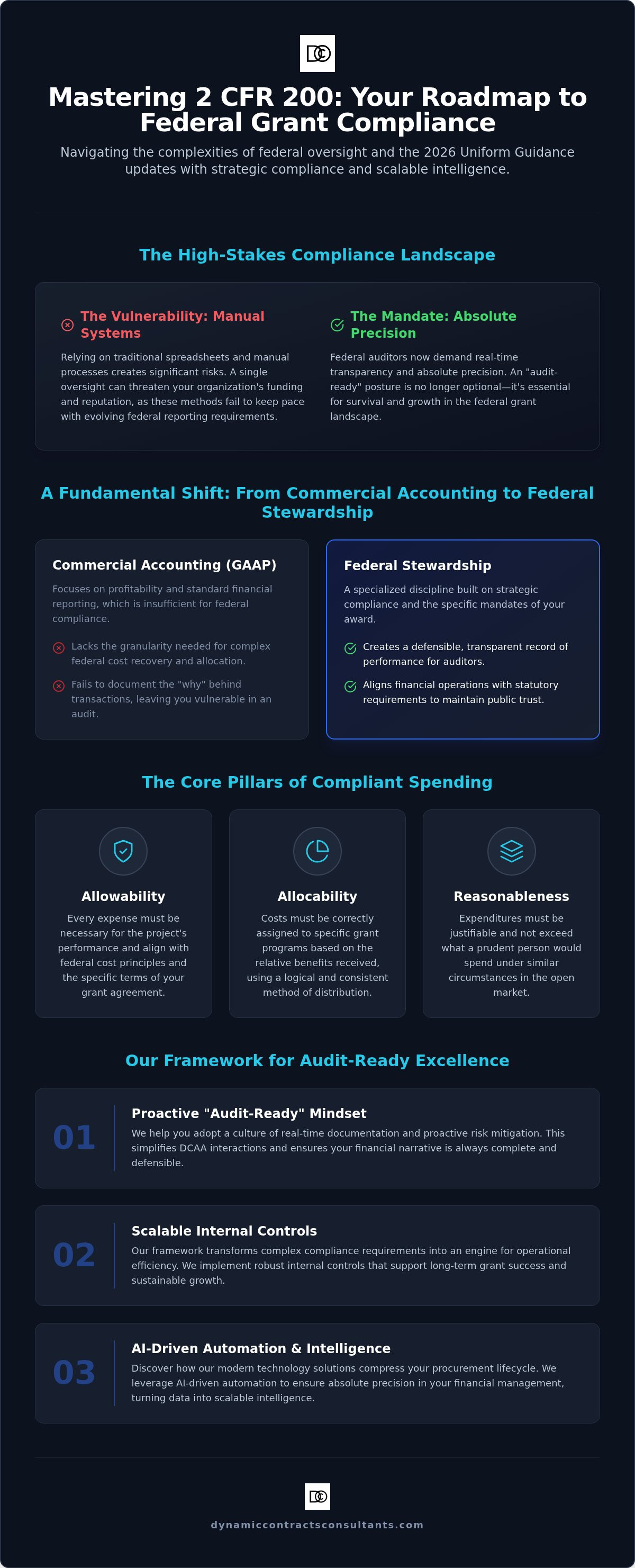
Effective federal grant financial management represents the systematic oversight of awarded funds to ensure absolute adherence to statutory requirements. It's a discipline of stewardship that extends far beyond basic bookkeeping. We define it as the alignment of financial operations with the specific mandates of your award. This process is essential for maintaining public trust. Transparent financial reporting proves to the Office of Management and Budget (OMB) and the public that resources are utilized effectively. We view this not as a set of restrictions, but as "strategic compliance." When you master these foundations, you create a framework for sustainable organizational growth and scalable intelligence.
The Core Pillars of Federal Stewardship
To succeed in the federal landscape, your financial systems must support three critical pillars of cost integrity. These principles dictate how every dollar is spent and recorded.
- Allowability: Every expense must align with federal cost principles and the specific terms of your grant agreement. If a cost isn't necessary for the project's performance, it's unallowable.
- Allocability: You must correctly assign costs to specific grant programs based on the relative benefits received. This requires a logical, consistent method of distribution.
- Reasonableness: Expenditures must be justifiable within the context of market rates. A cost is reasonable if it doesn't exceed what a prudent person would spend under similar circumstances.
Why Traditional Accounting Falls Short
Standard commercial accounting follows GAAP to measure profitability. Federal stewardship, however, demands a specialized focus on cost recovery and regulatory narratives. Traditional systems often fail to provide the granularity needed for federal grant financial management. They don't naturally handle the complexities of indirect rate calculations or the rigorous time-tracking required for labor distribution. We bridge the gap between your raw financial data and the strict requirements of federal auditors. Our approach to post-award compliance ensures your data translates into a defensible record of performance. Relying on standard accounting alone leaves you vulnerable during a DCAA audit. You need a system that documents the "why" behind every transaction, not just the "how much."
Navigating 2 CFR 200: The Uniform Guidance Compliance Framework
2 CFR 200, commonly known as the Uniform Guidance, serves as the definitive architecture for federal grant financial management. It consolidates administrative requirements, cost principles, and audit standards into a single, comprehensive regulatory framework. As we approach 2026, the updates to these guidelines emphasize increased transparency and a shift toward performance-based outcomes. While these changes aim to reduce administrative burden, they actually heighten the expectation for digital accuracy and real-time reporting. You must align your internal policies with these evolving federal standards to avoid the compliance gaps that frequently lead to adverse audit findings. We prioritize the integration of these regulations into your daily operations, ensuring your financial narrative remains beyond reproach.
Standardizing Administrative Requirements
Establishing a unified approach to procurement, property management, and record retention is vital for long-term success. Your organization’s ability to maintain documentation must be consistent across all departments to withstand federal scrutiny. This consistency is particularly critical when managing sub-recipient oversight. You’re responsible for ensuring that all federal compliance clauses flow down to your partners and sub-grantees. Failure to monitor these entities can result in disallowed costs that your organization may be forced to repay. This level of meticulous detail is a core component of effective post-award contract administration. We recommend reviewing HHS Grants Policies to see how agency-specific interpretations can influence your internal control environment.
Cost Principles and Indirect Rate Negotiation
Negotiating a Negotiated Indirect Cost Rate Agreement (NICRA) is a strategic milestone for any organization. It allows you to recover legitimate overhead and fringe benefit costs that are essential for sustaining your operations. We help our partners capture these costs accurately, ensuring that your financial data reflects the true cost of project execution. A well-documented acquisition strategy is also mandatory for complex grants. This includes performing thorough market research to justify every procurement decision. You can't rely on historical pricing alone; auditors expect to see a competitive analysis or a clear justification for sole-source selections. By documenting these decisions in real-time, you build a defensible record of reasonableness and necessity. If you’re ready to refine your organization’s approach to these complex requirements, contact our advisory team today for a strategic consultation.
Proactive Risk Mitigation: Addressing DCAA Scrutiny and Audit Vulnerabilities
DCAA scrutiny is often the most significant source of anxiety for organizations managing federal awards. These audits are typically triggered by inconsistencies in labor distribution or a lack of real-time documentation. We advocate for an "audit-ready" mindset. This means you shouldn't wait for an audit notice to organize your files. Instead, you must document every financial decision the moment it happens. Retrospective documentation is often viewed with suspicion by auditors and rarely captures the full context of a transaction. When records are created months after the fact, they lack the precision required to withstand federal oversight.
Effective federal grant financial management also requires a deep understanding of the Procurement Integrity Act. This legislation impacts how you manage sensitive financial data and interact with government officials during the procurement lifecycle. Violations can lead to severe penalties, including debarment from future awards. Many leaders view these requirements as an administrative burden. However, we see strategic compliance as a powerful asset. It demonstrates to federal agencies that your organization is a reliable partner, capable of managing complex funds with absolute precision. High-impact federal grant financial management relies on this proactive approach to mitigate risk before it escalates into a revoked award or a failed audit.
Preparing for DCAA Financial System Reviews
A DCAA-compliant accounting system isn't just about software; it's about the policies that govern its use. Your system must demonstrate that labor costs are charged directly to the correct project and that indirect costs are pooled consistently. Proving the adequacy of your timekeeping and labor distribution systems is essential for passing these reviews. Auditors look for daily entries and supervisor approvals as evidence of internal control. If your system lacks these features, you face a high risk of audit failure. Our DCAA compliance consulting provides the framework you need to pass these rigorous reviews with confidence.
Mitigating Post-Award Compliance Risks
Managing the lifecycle of a grant requires constant vigilance from award to closeout. It's not enough to simply spend the money; you must prove that the spending achieved the intended project outcomes. This performance data feeds directly into your CPARS narrative. A strong CPARS rating is your most valuable tool for securing future federal opportunities. It tells the government that you don't just follow the rules, but you deliver results. Our post-award compliance services help you manage these risks, ensuring your reporting is both accurate and persuasive. We transform the closeout process into a strategic opportunity for growth rather than a final administrative hurdle.
Implementing Scalable Internal Controls for Long-Term Grant Success
Internal controls serve as the operational efficiency engine of any successful organization managing federal awards. They aren't merely administrative hurdles; they're the primary defense against financial mismanagement and reputational damage. Within the context of federal grant financial management, these controls ensure that your organization remains compliant while scaling its operations. We utilize a framework that prioritizes the prevention of fraud, waste, and abuse through the strict separation of duties. By ensuring that no single individual has total control over a financial transaction, you create a system of checks and balances that satisfies both internal stakeholders and federal auditors. This structure is essential for maintaining the integrity of public funds.
The Five-Step Internal Control Implementation
We implement internal controls using the COSO framework, tailored specifically for the rigorous demands of federal stewardship. This approach transforms abstract regulations into actionable daily procedures that protect your funding. It's about building a resilient system that can withstand the highest levels of scrutiny.
- Step 1: Control Environment: We help you establish a culture of compliance where accountability starts at the leadership level and permeates the entire organization.
- Step 2: Risk Assessment: You must identify financial and operational vulnerabilities before they result in disallowed costs or compliance gaps.
- Step 3: Control Activities: These are the specific policies, such as multi-level procurement approvals and time-tracking verifications, that manage daily risk.
- Step 4: Information & Communication: Accurate data must flow seamlessly to the right stakeholders to ensure timely and transparent decision-making.
- Step 5: Monitoring: Continuous oversight and regular self-auditing allow you to correct errors before an agency auditor discovers them.
Strategic Reporting and Data Integrity
Automation is the key to removing the human error factor that often plagues manual financial reporting. We focus on automating the generation of the SF-425 (Federal Financial Report) and other mandatory filings to ensure your data is always consistent and timely. This digital precision creates a centralized repository of audit-ready records, allowing you to respond to inquiries in minutes rather than days. Beyond simple compliance, these real-time financial insights provide the scalable intelligence needed for informed bid/no-bid decisions. When you have a clear view of your current grant performance and indirect rate recovery, you can pursue new opportunities with total confidence. If you're ready to build a more resilient and automated financial infrastructure, reach out to our strategic consultants today for a specialized evaluation.
Strategic Partnership: Enhancing Financial Management with AI-Driven Precision
The synergy between Dynamic Contracts Consultants and our affiliate, FARIFY LLC, represents a paradigm shift in how organizations approach federal grant financial management. We combine decades of regulatory expertise with cutting-edge AI-driven automation to solve the most persistent bottlenecks in the procurement lifecycle. While traditional methods rely on manual document drafting and oversight, our integrated approach compresses timelines from days to minutes. This isn't just about speed; it's about the precision required to maintain a competitive edge in a marketplace that demands both agility and absolute compliance. By leveraging scalable intelligence, you can focus your resources on project execution rather than administrative backlog.
The FARIFY Advantage in Grant Management
FARIFY.ai serves as a force multiplier for your compliance team. It specializes in the rapid generation of complex documents such as Performance Work Statements (PWS), Statements of Work (SOW), and Statements of Objectives (SOO). These documents are essential when managing sub-grantees or drafting solicitations that must align with strict federal standards. Our platform also produces detailed compliance matrices and gap analysis reports, identifying potential vulnerabilities before they become audit liabilities. This level of automation is particularly valuable when you're adapting to the 2026 Uniform Guidance updates. To understand the broader impact of these technologies, we recommend reading our guide on AI for grant writing.
Your Strategic Partner in Federal Compliance
Technology alone isn't enough to guarantee success in high-stakes government environments. We maintain a "human-in-the-loop" assurance model to ensure every AI-generated document is audit-ready and contextually accurate. Our professional consultants review the outputs of FARIFY.ai, applying nuanced strategic insights that AI cannot replicate. This partnership provides you with customized templates and strategic capture management that significantly improve your win-rates. We don't just provide tools; we provide a comprehensive framework for scalable growth. Our goal is to ensure your federal grant financial management system is a driver of success, not a source of risk. We invite you to explore our comprehensive federal services to see how we can transform your organization’s compliance posture.
Securing Your Competitive Advantage in the 2026 Federal Landscape
Mastering federal grant financial management requires more than just meeting administrative requirements; it demands a shift toward scalable intelligence and proactive stewardship. By integrating the five components of the COSO framework and leveraging AI-driven automation through FARIFY, you transform compliance from a burden into a strategic asset. Our framework ensures that your organization remains audit-ready in the face of evolving 2026 Uniform Guidance updates, protecting your current funding while positioning you for future awards.
As a minority-owned small business, we bring a level of precision that ensures your financial systems meet the highest standards of federal oversight. We provide the human-in-the-loop assurance necessary to validate AI-generated documentation, giving you total confidence during DCAA reviews. The path to long-term success in government contracting is built on a foundation of transparency and operational efficiency. We've proven our track record as a prime contractor, and we're ready to apply that expertise to your specific mission needs.
If you're ready to modernize your financial infrastructure and eliminate the risk of non-compliance, we are here to guide your digital transformation. Partner with our experts to secure your federal grant compliance and build a resilient, scalable future for your organization. Your mission deserves the support of a partner who understands every detail of the federal marketplace.
Frequently Asked Questions
What are the primary financial management requirements under 2 CFR 200?
The primary requirements include establishing robust internal controls, maintaining transparent financial reporting, and adhering to strict cost principles. Under 2 CFR 200, organizations must prove that every expenditure is allowable, allocable, and reasonable. These standards also mandate granular record-keeping for labor distribution and indirect cost recovery. Adhering to these systematic oversight rules is essential for maintaining federal grant financial management integrity and passing mandatory agency audits during the 2026 cycle.
How does a DCAA audit differ for grant recipients compared to contract prime contractors?
DCAA audits for grant recipients focus on compliance with 2 CFR 200 and agency-specific mandates, whereas contract audits primarily follow the Federal Acquisition Regulation (FAR). For grant holders, auditors place a higher emphasis on the relationship between expenditures and project outcomes. We ensure that your systems are prepared for this scrutiny by aligning your financial data with the performance narratives required for federal grant financial management success and long-term funding viability.
Can we use AI to manage federal grant financial reporting and documentation?
You can utilize AI-driven automation to transform the generation of complex compliance documents and financial reports. Our FARIFY.ai platform generates audit-ready solicitation drafts, PWS, and compliance matrices in minutes. We maintain a human-in-the-loop assurance model where our consultants verify all AI-produced outputs. This approach combines technological speed with professional expertise to ensure every document meets the highest regulatory standards for federal stewardship without sacrificing accuracy or precision.
What is the role of "internal controls" in federal grant financial management?
Internal controls act as the operational efficiency engine that prevents fraud, waste, and abuse within your organization. They provide a structured framework of checks and balances, such as the separation of duties, to ensure financial integrity. By implementing the five components of the COSO framework, you create a resilient system that satisfies federal auditors. These controls are vital for maintaining public trust and ensuring that federal grant financial management remains a strategic asset for growth.
How do we determine if a cost is "allowable" under federal grant guidelines?
A cost is considered allowable if it's necessary and reasonable for the performance of the federal award. It must also be allocable to the specific project and consistent with your organization’s internal policies and federal cost principles. We help you verify these factors by documenting the justification for every expense in real-time. This proactive approach ensures that your expenditures remain beyond reproach during any subsequent financial review or rigorous DCAA audit.
What happens if our organization is found non-compliant during a federal financial audit?
Non-compliance can lead to severe consequences, including the revocation of current funding and the requirement to repay disallowed costs. Your organization may also face damage to its CPARS narrative, which negatively impacts your ability to secure future federal opportunities. In extreme cases, repeated failures can lead to debarment from the federal marketplace. We mitigate these risks by establishing a culture of strategic compliance and audit-readiness across your entire grant lifecycle to protect your reputation.
How often should federal grant financial reports be submitted?
Reporting frequencies are typically defined in the specific terms of your award agreement, often requiring quarterly or semi-annual submissions. The SF-425 Federal Financial Report is a standard requirement for most agencies. We recommend utilizing automation to ensure these filings are always timely and accurate. Maintaining a consistent reporting rhythm is essential for demonstrating transparency and keeping your project in good standing with the awarding agency throughout the period of performance.
What is a NICRA and why is it essential for federal grant financial management?
A Negotiated Indirect Cost Rate Agreement (NICRA) is a formal document that establishes the rates your organization uses to recover indirect costs, such as overhead and fringe benefits. It's essential because it allows you to capture the true cost of project execution beyond direct labor. Without a NICRA, you may be limited to a de minimis rate that doesn't fully cover your operational expenses. We assist in the strategic negotiation of these agreements to optimize your federal grant financial management.


