

Scaling a federal portfolio is often viewed as a project management milestone, yet for most firms, it's actually a high-stakes compliance crisis in disguise. As you transition from a single prime award to a diverse array of obligations, the administrative burden doesn't just grow; it compounds. Understanding how to manage multiple government contracts requires more than just additional staff. It demands a shift from reactive document handling to a centralized, AI-enhanced framework that anticipates the rigors of a DCAA audit before they occur.
You've likely felt the mounting pressure of tracking disparate flow-down clauses for subcontractors while manual record-keeping slows your next bid cycle to a crawl. We understand that fragmented administration is the primary barrier to sustainable growth in the 2026 federal market. This guide provides a comprehensive roadmap for mastering your multi-contract portfolio through strategic compliance and automated document generation. We'll examine how to integrate human-in-the-loop AI models to ensure your entire operation remains audit-ready, allowing you to focus on execution rather than paperwork.
Key Takeaways
- Identify why transitioning to a multi-contract portfolio introduces exponential administrative complexity rather than a simple linear increase in operational workload.
- Master how to manage multiple government contracts by implementing a centralized compliance matrix that ensures audit readiness across diverse agency requirements.
- Leverage human-in-the-loop AI integration to accelerate the generation of Performance Work Statements and other critical administrative documentation without sacrificing precision.
- Establish rigorous internal controls for flow-down clause compliance to mitigate the operational risks inherent in managing multiple subcontractors simultaneously.
- Recognize the strategic indicators for transitioning to specialized post-award administration to maintain a robust proposal pipeline during periods of rapid scaling.
The Exponential Complexity of Multi-Contract Portfolio Management
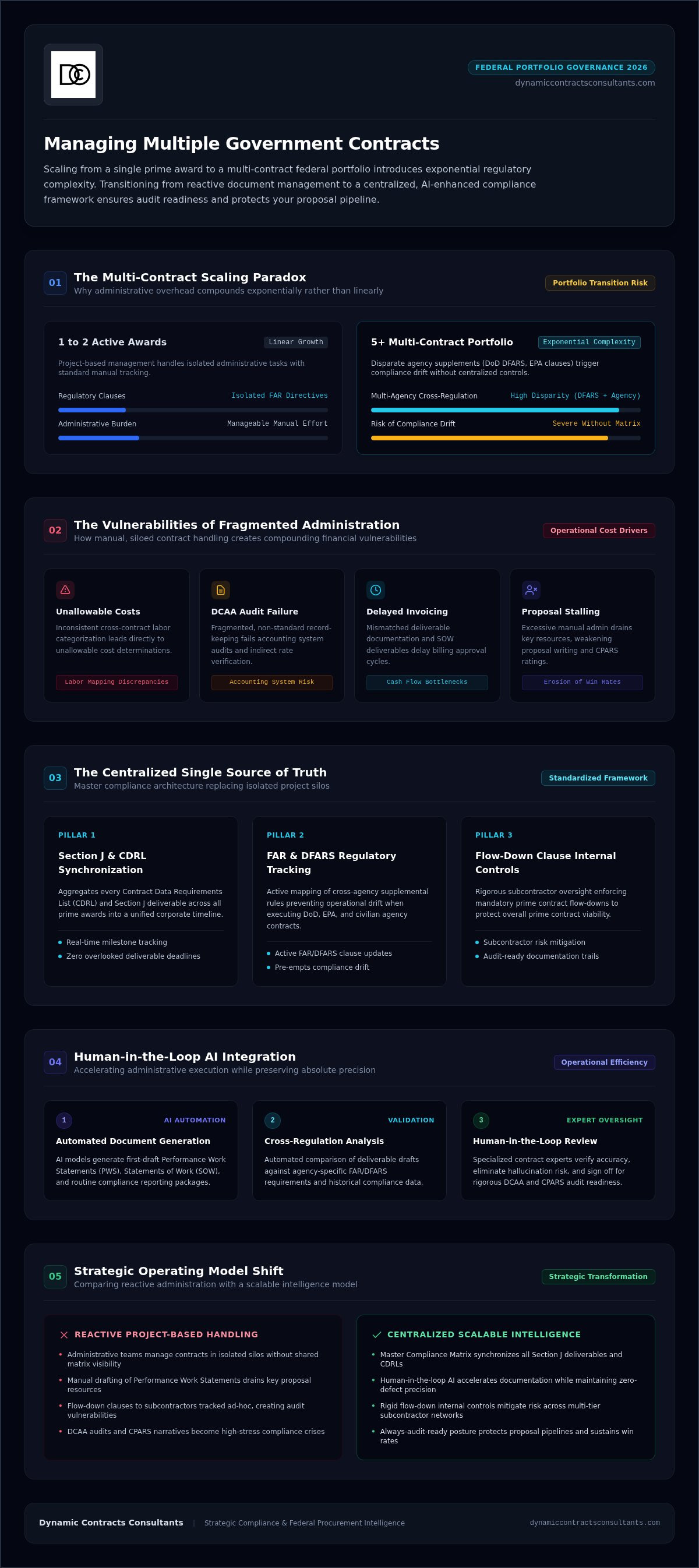
Scaling a federal contracting business often creates a deceptive sense of progress. While securing a second or third award suggests growth, the administrative burden doesn't follow a linear path. Instead, it expands exponentially. Transitioning from a single project to a portfolio of five or more contracts introduces a multidimensional layer of regulatory oversight that can quickly overwhelm a firm's internal controls. Learning how to manage multiple government contracts effectively requires a transition from isolated project management to a holistic, framework-based approach. Without this shift, the very success of winning new work becomes the primary risk factor for operational failure.
Understanding Compliance Drift in Federal Acquisitions
The regulatory landscape of government procurement in the United States isn't a monolith. Different agencies, such as the Department of Defense (DoD) and the Environmental Protection Agency (EPA), operate under distinct supplemental regulations like the DFARS or agency-specific clauses. These variations often lead to operational silos where teams fail to communicate cross-contract requirements. Compliance drift is the gradual divergence from FAR standards due to administrative overload. This phenomenon often manifests when a firm attempts to apply a one-size-fits-all administrative process to varied contract types. These inconsistencies prevent the standardization of timekeeping and reporting, leading to fragmented Statement of Work (SOW) tracking and missed deliverables.
The Financial Risks of Fragmented Oversight
Fragmented administration carries severe financial implications that extend beyond immediate audit findings. Poorly managed portfolios often result in negative Contractor Performance Assessment Reporting System (CPARS) narratives, which directly jeopardize future win rates. When administrative teams spend excessive time on manual document generation, they lose the capacity to maintain a competitive proposal writing pipeline. The hidden costs of manual oversight include:
- Inconsistent labor categorization leading to unallowable costs.
- Fragmented record-keeping that fails DCAA accounting system audits.
- Delayed invoice processing due to mismatched deliverable documentation.
- Increased overhead from redundant administrative personnel.
Establishing a centralized Single Source of Truth isn't optional in 2026. It's the only method to ensure that growth doesn't erode the foundational compliance required to remain a viable prime contractor. Firms must move away from reactive, project-based tracking and toward a scalable framework that treats compliance as a centralized corporate function rather than a contract-specific task.
Developing a Centralized Compliance and Administration Framework
Managing a single federal award is a project; managing a portfolio is a system. Successful firms recognize that the secret to how to manage multiple government contracts lies in the transition from decentralized oversight to a rigid, centralized framework. This shift requires standardizing internal controls to meet DCAA accounting system requirements and implementing a systematic document retention policy that ensures every deliverable remains audit-ready. Without a centralized approach, the administrative load creates friction that eventually halts growth.
The Master Compliance Matrix: Your Portfolio Roadmap
The master compliance matrix serves as the primary operational roadmap for the entire corporate portfolio. It involves mapping every Section J deliverable across all active awards into a single, synchronized timeline. This process allows leadership to track milestone deadlines and reporting requirements in real-time, ensuring that no Contract Data Requirements List (CDRL) is overlooked during periods of high activity. By integrating daily updates from the Federal Acquisition Regulation (FAR) and agency-specific DFARS clauses, contractors maintain a proactive stance against regulatory changes. This centralized view prevents the operational silos that typically occur when individual project managers handle compliance in isolation.
Audit-Ready Accounting and Indirect Rate Management
When juggling multiple agencies, maintaining indirect rate consistency is vital for long-term financial stability. DCAA scrutiny increases as the volume of work grows, requiring rigorous timekeeping and precise cost allocation across all cost centers. Small discrepancies in how labor is billed to a DoD contract versus a civilian agency award can trigger significant audit findings. Utilizing specialized DCAA compliance consulting helps establish the necessary guardrails for indirect rate management. It's about ensuring that your accounting system is not only compliant but also optimized for the varied overhead structures inherent in a diverse portfolio.
Effective post-award contract administration ensures that these frameworks aren't just theoretical; they're embedded in daily workflows. It's about creating a repeatable process that scales as the business wins more work. If your current administrative burden is slowing your growth, you might consider how a professional compliance assessment can streamline your operations and reduce the risk of audit failure.
Leveraging AI for Rapid Document Generation and Monitoring
Managing a scaling portfolio requires a departure from traditional, manual oversight. The administrative friction of drafting Performance Work Statements (PWS) and Statements of Work (SOW) often becomes the bottleneck for firms trying to understand how to manage multiple government contracts without ballooning overhead. AI-driven automation serves as the necessary force multiplier. By utilizing technology to extract RFP requirements and generate compliance matrices in minutes, contractors can shift their focus from clerical document generation to strategic execution. This technological integration ensures that the centralized framework remains dynamic and responsive to the fast-paced federal environment.
Accelerating the Acquisition Lifecycle with FARIFY
The FARIFY platform represents a paradigm shift in document precision. It enables the generation of solicitation drafts and Independent Government Cost Estimates (IGCEs) at a scale previously unattainable for small to mid-sized firms. It's not just about speed; it's about accuracy. AI analyzes contract modifications to identify hidden risks that human reviewers might overlook during high-pressure cycles. This reduces the turnaround time for compliant documentation from several days to mere minutes. Following the federal contracting guide for small businesses is significantly easier when your administrative foundation is automated.
AI-Enhanced Risk Assessment and Bid/No-Bid Analysis
Scaling requires discipline in opportunity selection. AI allows for a more rigorous AI for bid-no-bid analysis by evaluating new solicitations against current portfolio capacity and past performance data. It automates the gap analysis process for technical volumes, highlighting where a firm's current capabilities align with agency needs. This ensures that every new bid is a strategic fit rather than an administrative burden. The "Human-in-the-Loop" model remains essential here; AI provides the data-driven foundation while human experts verify the final outputs to ensure they're audit-ready.
Transitioning from manual tracking to automated milestone alerts removes the risk of human error in deliverable management. Instead of relying on static spreadsheets, leadership receives real-time notifications regarding upcoming deadlines and reporting windows. This ensures that compliance is maintained consistently across the entire portfolio, preventing the missed deliverables that often plague rapidly growing contractors.
Managing Subcontractors and Flow-Down Clause Compliance
Prime contractors often underestimate the ripple effect of subcontractor performance on their own corporate standing. When analyzing how to manage multiple government contracts, the oversight of third-party partners becomes a critical pillar of risk management. A single failure by a subcontractor to adhere to labor standards or security protocols can trigger a negative CPARS rating that impacts the prime's entire portfolio. This isn't just about one project. It's about protecting the reputation of the entire organization. Utilizing specialized post-award compliance services provides the rigorous third-party oversight necessary to maintain performance standards across diverse teams and varied agency requirements.
Navigating Flow-Down Clause Requirements
The complexity of flow-down clauses increases with every new agency added to your portfolio. Prime contractors must distinguish between mandatory clauses, which are required by law or regulation, and discretionary clauses, which are included to mitigate the prime's specific risks. Adherence to the FAR and the Procurement Integrity Act must be explicitly mirrored in every subcontract agreement to ensure total alignment. The legal necessity of flow-down clause accuracy is paramount to avoid prime contractor liability for subcontractor non-compliance. Failure to correctly flow down requirements regarding cybersecurity or small business participation can result in breach of contract or even suspension and debarment.
Strategic Teaming and Subcontractor Risk Mitigation
Rapid scaling requires a standardized approach to teaming. Developing robust templates for teaming agreements and subcontracts allows a firm to onboard partners without reinventing the administrative wheel for every bid. Regular quality-control reviews of subcontractor deliverables ensure that the final work product meets agency expectations before it reaches the Contracting Officer. This discipline is essential for firms preparing for a Contractor Purchasing System Review (CPSR). A successful CPSR validates that your subcontract management protocols are sufficient for large-scale federal operations. It demonstrates to the government that your firm has the internal controls necessary to manage public funds responsibly.
Maintaining clear boundaries and rigorous documentation is the only way to protect your firm from the mistakes of others. If your current subcontractor management processes are fragmented, it's time to consult with our compliance experts to establish a more resilient oversight framework that scales with your ambition.
Optimizing Your Contract Lifecycle with Strategic Advisory
The transition from managing a single award to overseeing a diverse portfolio often reveals the limitations of in-house administrative staff. While internal teams are sufficient for project-level tasks, they frequently lack the specialized regulatory depth required for high-level strategic scaling. Recognizing when to move from in-house management to specialized advisory services is a pivotal decision for executive leadership. It's the difference between merely maintaining operations and actively expanding market share. Understanding how to manage multiple government contracts involves more than administrative diligence; it requires a sophisticated advisory layer that aligns current performance with future acquisition goals. Compliance is the foundation.
The Value of Strategic Capture Management
Strategic capture management ensures that your acquisition strategy remains synchronized with long-term business growth objectives. Expert advisory services identify high-value opportunities that specifically fit your existing compliance framework, reducing the operational strain of entering unfamiliar agency environments. This proactive approach prevents the common pitfall of winning work that the firm cannot administratively support. Integrating The Strategic Necessity of Government Proposal Review Services into your capture process provides an objective evaluation of your technical and cost volumes before they reach the government. This ensures that every bid is not only competitive but also executable within your current resource constraints.
Ensuring Long-Term Success through Professional Oversight
Maintaining a healthy pipeline requires a dedicated focus on proposal writing even during periods of intense post-award activity. Many firms find that their business development efforts stall because key personnel are consumed by the complexities of multi-contract administration. Leveraging your minority-owned status or strategic certifications, such as 8(a) or HUBZone, becomes significantly more effective when backed by professional oversight that guarantees audit-ready performance. This oversight extends through the entire lifecycle, including the critical closeout phase. Closing the loop from administration to successful closeout ensures that all final indirect rate adjustments are settled and CPARS entries are finalized.
A "simple solution" approach to complex federal regulations allows leadership to focus on mission success rather than regulatory minutiae. By offloading the burden of compliance monitoring and document generation to specialized strategists, you ensure that your firm remains agile. Professional advisory services provide the rendering of complex FAR requirements into actionable corporate policies. To secure your firm's position in the 2026 federal market, Consult with our experts for your business growth and establish a framework that supports sustainable, compliant scaling.
Securing Your Federal Growth Through Strategic Compliance Frameworks
Mastering the transition from a single award to a complex portfolio is the defining challenge for growing federal contractors. Success in 2026 requires a shift from reactive administration to a proactive, framework-based approach that centralizes compliance across all active awards. By implementing a master compliance matrix and leveraging AI-powered document generation via FARIFY, your organization can maintain audit-ready status without exhausting internal resources. This guide has detailed how to manage multiple government contracts by integrating specialized advisory with technical automation to ensure seamless operational scaling.
Protecting your corporate reputation across multiple agencies demands rigorous subcontractor oversight and a deep understanding of DCAA compliance. Our proven prime contractor track record with agencies like the DoD and EPA ensures that your scaling strategy is built on a foundation of regulatory precision. We provide the strategic depth necessary to navigate complex flow-down requirements while keeping your proposal pipeline active. It's time to move beyond manual oversight and adopt a scalable model for long-term growth. Contact our expert consultants to scale your federal portfolio securely to ensure your firm remains competitive and compliant in an increasingly complex acquisition environment.
Frequently Asked Questions
What is the most effective way to track multiple contract deadlines?
The most effective method involves implementing a centralized master compliance matrix synchronized with automated milestone alerts. This framework allows leadership to monitor Section J deliverables across the entire portfolio in real-time. Moving away from static spreadsheets is essential when learning how to manage multiple government contracts effectively. Automated systems reduce the risk of human error; they ensure that every Contract Data Requirements List (CDRL) is submitted within the specified performance window.
How do flow-down clauses change when I have multiple subcontractors?
Managing multiple subcontractors requires a more rigorous distinction between mandatory and discretionary flow-down clauses. Mandatory clauses, such as those regarding the Procurement Integrity Act, must be mirrored exactly in every agreement. Discretionary clauses are added to mitigate the prime's specific risks. Accuracy in these documents is paramount, as the prime contractor remains liable to the government for any subcontractor non-compliance or failure to meet federal security standards.
Can AI really help with DCAA compliance and audit preparation?
Specialized AI platforms like FARIFY significantly enhance DCAA compliance by generating audit-ready records and analyzing contract modifications for hidden risks. These tools extract RFP requirements and produce compliance matrices in minutes rather than days. A human-in-the-loop model ensures that the AI's output meets strict regulatory standards. This combination allows firms to maintain a lean administrative team while ensuring their accounting and documentation systems remain ready for rigorous federal scrutiny.
What is the difference between contract administration and contract management?
Contract administration primarily focuses on post-award execution, including deliverable tracking, invoice processing, and compliance monitoring. In contrast, contract management is a broader lifecycle term that encompasses pre-award capture, proposal development, and high-level relationship oversight with the Contracting Officer. For firms scaling their portfolios, specialized post-award administration is the specific function that prevents operational silos and ensures that performance requirements are met across all active federal awards.
How often should I conduct internal compliance audits on my portfolio?
Internal compliance audits should occur at least quarterly to identify potential compliance drift before formal agency reviews. For high-risk or complex cost-reimbursable contracts, monthly reviews of timekeeping and cost allocation are often necessary. These internal checks ensure that all documentation remains audit-ready and that subcontractor performance aligns with the prime's CPARS goals. Regular oversight prevents the accumulation of administrative errors that could jeopardize the firm's standing as a reliable prime contractor.
What are the risks of using generic templates for government contract documents?
Generic templates often fail to account for agency-specific supplements, such as the DFARS or DOSAR, which can lead to significant compliance gaps. Using non-specific documents increases the risk of negative CPARS narratives or audit failures because they don't reflect current FAR requirements or unique solicitation clauses. Customized templates, especially those generated through specialized AI tools, ensure that every document is tailored to the specific regulatory environment of the individual contract.
How does managing multiple contracts affect my indirect cost rates?
Expanding your portfolio complicates indirect cost allocation because you must maintain rate consistency across different agencies and contract types. Managing multiple awards requires a sophisticated accounting system that can precisely allocate overhead and general and administrative (G&A) expenses. Inconsistencies in how these rates are applied can trigger DCAA audit findings. Establishing a centralized framework helps ensure that your indirect rates remain compliant with federal cost principles regardless of the portfolio's diversity.


