

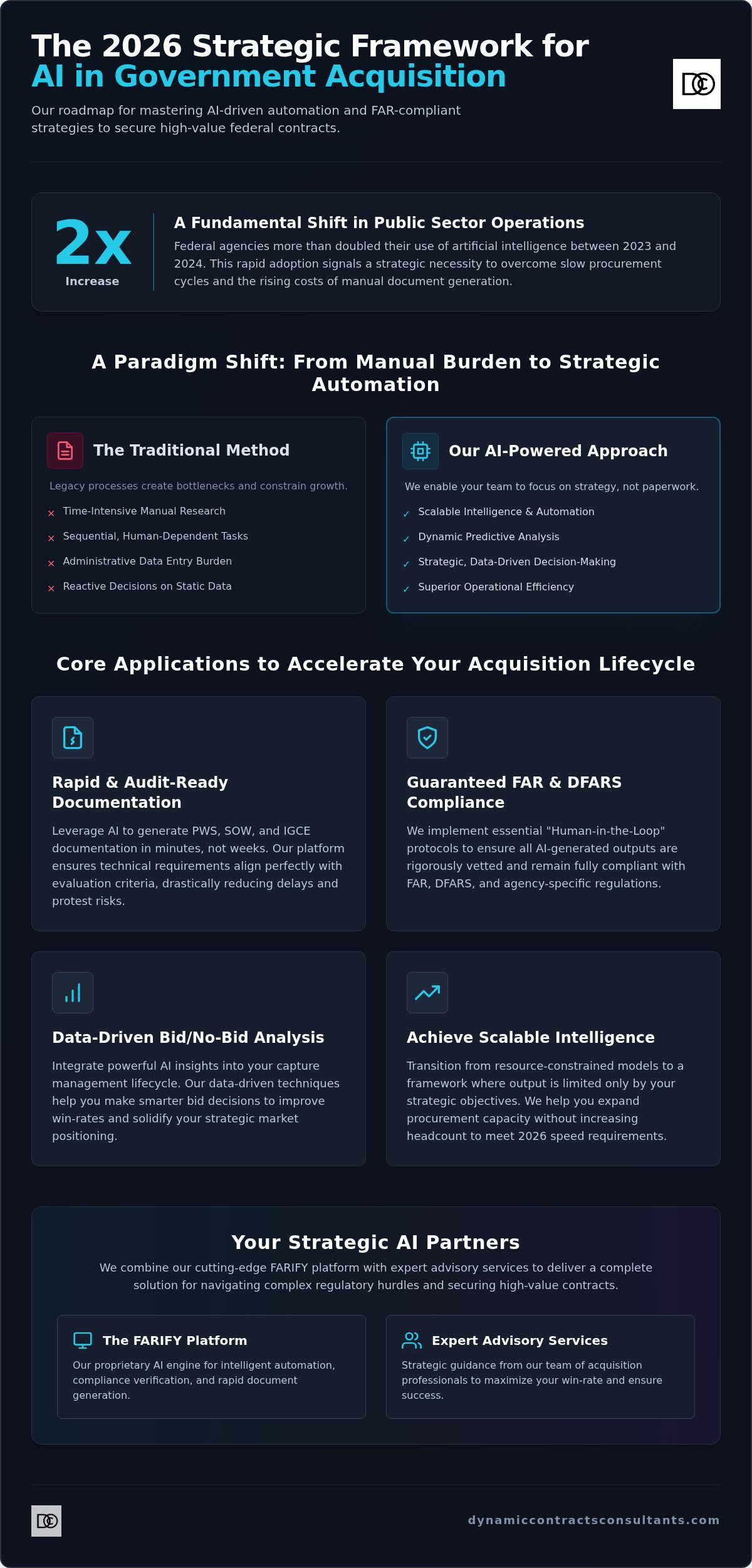
Federal agencies more than doubled their use of artificial intelligence between 2023 and 2024, according to the GAO's April 2026 report. This rapid adoption signals a fundamental shift in how the public sector operates. As a contractor or acquisition professional, you're likely facing the dual challenge of keeping pace with this technological surge while managing the intense complexity of FAR and DFARS regulations. Integrating AI for government acquisition planning is no longer a luxury; it's a strategic necessity to overcome slow procurement cycles and the rising costs of manual document generation.
We understand that your primary goal is to maintain compliance while increasing operational efficiency. Led by CEO Khalil Memon and headquartered at 54 Sugar Creek Center Blvd in Sugar Land, TX, our team developed this 2026 Strategic Framework to provide the roadmap you need to master AI-driven automation and FAR-compliant strategies. By reading this guide, you'll learn how to accelerate your acquisition lifecycle and secure high-value federal contracts with precision. We'll explore how to achieve audit-ready documentation and faster solicitation drafting through scalable intelligence. Our analysis covers everything from the new $350,000 Simplified Acquisition Threshold to the latest OMB mandates, ensuring your capture management remains data-driven and results-oriented.
Key Takeaways
- Learn how to transition from manual, time-intensive research to scalable intelligence to meet the rigorous procurement speed requirements of the 2026 federal market.
- Discover how to leverage AI for government acquisition planning to generate audit-ready PWS, SOW, and IGCE documentation with unprecedented precision and speed.
- Understand the essential "Human-in-the-Loop" protocols required to ensure all AI-generated outputs remain fully compliant with FAR, DFARS, and agency-specific regulations.
- Master data-driven bid/no-bid analysis techniques that integrate AI insights into your capture management lifecycle to improve win-rates and strategic positioning.
- Explore the operational advantages of using the FARIFY platform alongside expert advisory services to manage complex regulatory hurdles and secure high-value contracts.
The Evolution of Federal Acquisition Planning in the AI Era
The federal landscape has reached a tipping point where traditional methods can no longer sustain the pace of modern mission requirements. According to the April 2026 GAO report, federal agencies more than doubled their use of artificial intelligence in just one year. This surge isn't just about adopting new tools; it's a fundamental transformation in how we approach the entire procurement lifecycle. The shift toward AI for government acquisition planning represents a move away from the labor-intensive, manual data collection that has historically slowed down contract awards. By replacing legacy processes with automated workflows, we enable your team to focus on strategic decision-making rather than administrative data entry.
From Manual Research to Scalable Intelligence
In the past, market research involved weeks of scouring static databases and manually vetting vendor capabilities. Today, AI-driven automation processes vast sets of vendor data in a fraction of that time, allowing your team to move from reactive research to dynamic predictive analysis. This evolution is central to the broader application of AI in government, where data-driven insights replace anecdotal evidence. Scalable intelligence is the ability to expand procurement capacity without increasing headcount. By leveraging these technologies, we help you transition from a resource-constrained model to one where your output is limited only by your strategic objectives, not your administrative bandwidth. This shift allows for a more granular understanding of market trends, ensuring that your acquisition strategies are grounded in real-time data rather than historical assumptions.
The Strategic Necessity of Modernization
Agencies like the Department of Defense are prioritizing faster acquisition cycles to maintain a competitive edge in a rapidly changing global environment. Traditional planning fails to meet 2026 speed requirements because it relies on sequential, human-dependent tasks that create bottlenecks in solicitation drafting and synopsis support. We recognize that while you must innovate, you also have a legal obligation to maintain the highest standards of fairness. Balancing technological innovation with the Procurement Integrity Act requires a disciplined approach to how data is handled and how AI outputs are vetted. Solutions like our FARIFY platform are designed to generate compliant documents in minutes rather than days, ensuring that your documentation is both rapid and audit-ready. For a deeper look at these frameworks, you can explore our insights on Strategic Methodologies in Federal Proposal Development. This modernization isn't optional; it's the only way to navigate the complex regulatory hurdles of the 2026 fiscal environment while improving your win-rates through superior operational efficiency.
Core Applications of AI for Government Acquisition Planning
The practical application of AI for government acquisition planning moves beyond theoretical efficiency into the realm of high-precision document engineering. While we previously addressed the broad evolution of the sector, your focus must now turn to the specific outputs that determine the success of a procurement cycle. We utilize AI-driven automation to transform the administrative burden of document generation into a streamlined, strategic workflow that ensures every solicitation component is technically sound and fully compliant.
Rapid Document Generation: PWS, SOW, and SOO
Drafting technical volumes like a Performance Work Statement (PWS), Statement of Work (SOW), or Statement of Objectives (SOO) traditionally consumes weeks of subject matter expert time. AI platforms like FARIFY allow us to create these documents in minutes, maintaining strict consistency across complex solicitation structures. This technology ensures that your technical requirements align perfectly with the evaluation criteria found in Sections L and M. By automating this alignment, we significantly reduce the risk of internal contradictions that often lead to costly delays or pre-award protests. Our approach focuses on creating audit-ready documentation that stands up to the most rigorous regulatory scrutiny.
Data-Driven Market Research and IGCE
Preparing an Independent Government Cost Estimate (IGCE) requires a comprehensive analysis of historical pricing and vendor performance. Machine learning algorithms now allow us to process thousands of past contract actions to project accurate cost ranges with minimal margin for error. This process generates market research reports that provide contracting officers with the data-driven confidence required for high-value acquisitions. As detailed in the GAO Report on AI Acquisitions, the ability to systematically analyze lessons learned is a critical gap in current federal processes. AI-enhanced market research directly addresses this by providing a scalable way to vet vendor capabilities and pricing models against current market conditions.
Beyond initial drafting, we use AI to extract complex RFP requirements for the creation of compliance matrices. These tools identify every "shall" or "must" statement within a solicitation, ensuring that your response is 100% compliant and technically responsive. This level of precision is essential for maintaining your competitive edge in an environment where the micro-purchase threshold has risen to $15,000 and the simplified acquisition threshold stands at $350,000. If you're ready to modernize your procurement workflow, you can connect with our strategic advisors to discuss a tailored implementation plan for your organization.
Navigating FAR/DFARS Compliance in an AI Environment
Speed without precision is a liability in federal contracting. While we've established how automation accelerates the procurement lifecycle, you must remember that AI is a force multiplier, not a substitute for legal accountability. Integrating AI for government acquisition planning requires a sophisticated understanding of the Federal Acquisition Regulation (FAR) and agency-specific supplements. Strategic compliance is the proactive alignment of technology with federal law. Without this alignment, the risk of "hallucinations" or outdated regulatory references can compromise your proposal's integrity and lead to costly non-compliance issues during post-award audits.
The Human-in-the-Loop Assurance Framework
A "Human-in-the-Loop" (HITL) approach is non-negotiable for generating audit-ready documentation. AI can draft a Performance Work Statement in minutes, but only a subject matter expert can verify that the technical requirements don't inadvertently violate the Procurement Integrity Act or create organizational conflicts of interest. Dynamic Contracts Consultants LLC bridges the gap between AI and expertise by ensuring that every AI-generated output undergoes rigorous professional vetting to meet DCAA standards. Expert review is particularly critical for complex cost accounting and certified pricing data requirements. To understand how we integrate these expert-led reviews into a broader compliance strategy, explore our guide on DCAA Compliance Consulting: A Strategic Framework. This synergy between AI-driven automation and human expertise ensures your documentation is both rapid and defensible.
Regulatory Alignment: FAR and DFARS
The regulatory environment in 2026 is exceptionally dynamic. For instance, the FY2026 National Defense Authorization Act increased the Truth in Negotiations Act (TINA) threshold for DoD contracts to $10 million effective June 30, 2026. Because there is often a gap between statutory changes and FAR updates, we train our models to prioritize current law over lagging regulatory text. We focus on several critical areas to maintain compliance:
- OMB Memorandum M-25-22: We ensure your AI acquisitions include required clauses for data privacy, IP protection, and the prevention of vendor lock-in.
- Threshold Accuracy: Our systems are calibrated to the $15,000 micro-purchase and $350,000 simplified acquisition thresholds established in October 2025.
- Responsible AI Mandates: We align all outputs with OMB Memo M-26-04, ensuring that procured AI adheres to principles of truth-seeking and ideological neutrality as required by the March 11, 2026, deadline.
Maintaining procurement integrity also means protecting your proprietary data. We utilize secure, siloed environments to prevent your sensitive capture strategies from leaking into public training sets. This level of data security is fundamental to our partnership, allowing you to leverage cutting-edge automation without sacrificing the confidentiality of your high-value federal contracts.
Implementation Strategy for Contractors and Agencies
Successful implementation of AI for government acquisition planning requires more than just deploying new software; it demands a fundamental shift in how your organization evaluates opportunities and manages the procurement lifecycle. We see many firms struggle because they treat AI as a standalone tool rather than a core component of their strategic framework. By integrating automation into the earliest stages of planning, you can transform your capture management from a reactive process into a predictive, data-driven engine for growth.
Optimizing the Capture Management Lifecycle
Your capture strategy must evolve to handle the massive influx of data in the 2026 marketplace. AI-driven insights allow us to identify high-value opportunities by analyzing agency spending trends and historical award patterns far more efficiently than manual research. A critical step in this optimization is the AI for Bid-No-Bid Analysis, which evaluates your technical capabilities against solicitation requirements in seconds. This is especially vital given the SBA's August 20, 2026, proposal to restructure size standards. If finalized, the increase for NAICS 541611 from $24.5 million to $295 million would fundamentally alter the competitive landscape, making predictive modeling essential for determining which set-asides remain viable for your firm.
Preparing for Post-Award Success
Audit-readiness is not something you achieve after a contract is awarded; it's something you build during the planning phase. Dynamic Contracts Consultants LLC emphasizes that every AI-generated document must be structured to facilitate seamless Post-Award Compliance. This includes the automated identification and management of flow-down clauses that must be passed to subcontractors to ensure total program integrity. When you use AI to draft your initial acquisition plans, our system ensures that every record is indexed and ready for DCAA or agency-specific audits.
We focus on creating customized proposal templates for recurring solicitations, which doesn't just save time but ensures that your "audit-ready" standard is applied consistently across your entire portfolio. This proactive approach reduces the administrative burden of contract administration and protects your long-term profitability by minimizing the risk of post-award disputes. Transitioning to an AI-enhanced procurement model requires a partner who understands the intersection of technology and the FAR. If you're looking to scale your operations and improve your win-rates through sophisticated automation, contact our expert team today to begin developing your customized implementation roadmap.
FARIFY and Dynamic Contracts: Your Strategic AI Partners
Achieving excellence in the federal sector requires a synergy between sophisticated technology and seasoned strategic insight. At Dynamic Contracts Consultants LLC and our affiliate FARIFY LLC, we specialize in providing simple solutions to complex problems. By integrating AI for government acquisition planning into your organizational workflow, we empower you to navigate the 2026 regulatory environment with a level of precision that manual processes cannot replicate. Our partnership model combines the rapid, automated generation of the FARIFY platform with the high-level advisory of our consulting team, ensuring your business remains competitive and fully compliant.
The Power of FARIFY: Speed Meets Precision
The FARIFY platform is engineered to eliminate the most significant administrative burdens in the procurement lifecycle. While traditional methods for drafting technical volumes often consume weeks of subject matter expert time, our technology generates solicitation drafts and technical requirements in minutes. We also automate the creation of compliance matrices, which are essential for ensuring your technical responses align perfectly with Section L and M requirements. This application of AI for government acquisition planning reduces the operational costs of capture management while maintaining an "audit-ready" standard for every deliverable. By delegating administrative generation to our secure environment, your team can focus on the high-level strategy needed to secure high-value federal contracts.
Expert Consulting for Long-Term Success
Technological tools are most effective when guided by expert leadership. CEO Khalil Memon, a CPCM and CFCM expert, leads our team with a vision that bridges the gap between traditional contracting and modern digital transformation. Based at our headquarters at 54 Sugar Creek Center Blvd, Suite 200, Sugar Land, TX 77478, we provide comprehensive lifecycle support to clients across the nation. As a minority-owned small business, we understand the nuances of the federal ecosystem and bring prime contractor experience with agencies such as the DoD, EPA, and NOAA to every engagement. Our Proposal Writing Services are built on this foundation of proven expertise and regulatory mastery.
We invite you to take the first step toward modernization by scheduling an AI-driven acquisition audit. We'll evaluate your current procurement workflows and identify specific areas where automation can improve your audit-readiness and win-rates. Whether you're preparing for the proposed SBA size standard changes or managing complex flow-down clauses, we serve as your strategic partner in achieving scalable, long-term success. Our goal is to ensure that every document you produce is technically responsive and strategically positioned for victory.
Securing Your Competitive Edge in the 2026 Federal Market
The transition to AI for government acquisition planning is a fundamental shift that rewards precision and speed. We've explored how scalable intelligence replaces manual research, allowing your organization to generate audit-ready PWS and IGCE documentation in minutes instead of days. By aligning these technological advances with rigorous FAR and DFARS compliance, you ensure that your procurement lifecycle is both rapid and defensible. Our framework provides the strategic roadmap necessary to manage complex regulatory hurdles, from the new $350,000 simplified acquisition threshold to the $10 million TINA requirements for the DoD.
We're committed to your long-term success through expert DCAA compliance consulting and a proven track record with agencies like the DoD and NASA. Our team provides the simple solutions needed to solve complex federal contracting problems. Don't let administrative bottlenecks limit your growth in this transformative era. Optimize your acquisition lifecycle with Dynamic Contracts Consultants and leverage our visionary expertise to secure high-value contracts. We look forward to partnering with you to build a more efficient, compliant, and profitable future.
Frequently Asked Questions
How does AI improve government acquisition planning?
AI improves government acquisition planning by transforming labor-intensive manual research into scalable intelligence. It allows for the rapid generation of solicitation documents and market research reports by processing vast datasets to identify vendor capabilities and historical pricing trends. By automating these administrative tasks, agencies and contractors can focus on strategic decision-making while maintaining a consistent standard of precision throughout the entire procurement lifecycle. This technological integration ensures your acquisition strategy is data-driven and results-oriented.
Can AI-generated documents pass a DCAA audit?
Yes, AI-generated documents produced through our FARIFY platform are specifically designed to be audit-ready. We ensure that every output, from Independent Government Cost Estimates to Performance Work Statements, is structured to meet rigorous DCAA financial and operational standards. By combining AI-driven speed with expert oversight, we provide documentation that is technically sound and fully defensible during federal audits. This approach protects your firm from compliance risks and the high cost of manual document generation.
What is the role of human-in-the-loop in AI contracting?
The human-in-the-loop requirement serves as a critical assurance framework to verify that AI-generated outputs align with complex federal regulations. While AI provides the speed to draft documents in minutes, our subject matter experts perform the final review to ensure every clause is accurate and compliant with current laws. This collaborative approach mitigates the risk of AI hallucinations and ensures that high-stakes contracting decisions are grounded in both cutting-edge technology and professional judgment.
Is FARIFY compliant with FAR and DFARS regulations?
FARIFY is fully compliant with FAR and DFARS regulations because its AI model is trained specifically on specialized acquisition laws rather than generic data. The platform generates documentation that adheres to current federal standards, including agency-specific supplements like DOSAR or ARRARS. We continuously update the system to reflect statutory changes, such as the new $350,000 simplified acquisition threshold, ensuring your acquisition planning remains proactive and legally sound in a dynamic regulatory environment.
How much time can AI save in the solicitation drafting process?
AI-driven automation through FARIFY can generate compliant solicitation drafts, including PWS, SOW, and SOO documents, in minutes rather than days. This represents a significant reduction in the procurement lead time compared to traditional manual drafting. By accelerating the generation of technical volumes and compliance matrices, your team can drastically lower the cost of capture management and respond to high-value federal opportunities with unprecedented speed and precision, improving your overall win-rates.
Does AI help with bid/no-bid analysis for government contractors?
AI significantly enhances bid/no-bid analysis by utilizing predictive modeling to evaluate your technical capabilities against complex RFP requirements. By extracting "shall" and "must" statements automatically, our system provides data-driven insights into your probability of success. This allows you to identify high-value opportunities based on agency spending trends and historical award patterns. It ensures your capture management resources are focused on the contracts with the highest strategic value and scalable intelligence.
What agencies have Dynamic Contracts Consultants served as a prime contractor for?
Dynamic Contracts Consultants has successfully served as a prime contractor for several major federal agencies, including the Department of Defense, the Department of State, the Environmental Protection Agency, and the Department of Commerce. We've also provided expert support to high-profile organizations such as NASA and AIRBUS. This extensive experience as a prime contractor allows us to provide audit-ready solutions that reflect a deep understanding of the complex administrative systems in federal procurement.
How does AI ensure procurement integrity during market research?
AI ensures procurement integrity by providing a transparent, data-driven methodology for market research that eliminates anecdotal bias. It systematically analyzes vendor performance and historical pricing in a secure, siloed environment, which prevents the leakage of proprietary capture strategies. By utilizing machine learning to vet vendor capabilities against current market conditions, we help agencies and contractors adhere to the Procurement Integrity Act while achieving greater operational efficiency and audit-ready documentation.


