

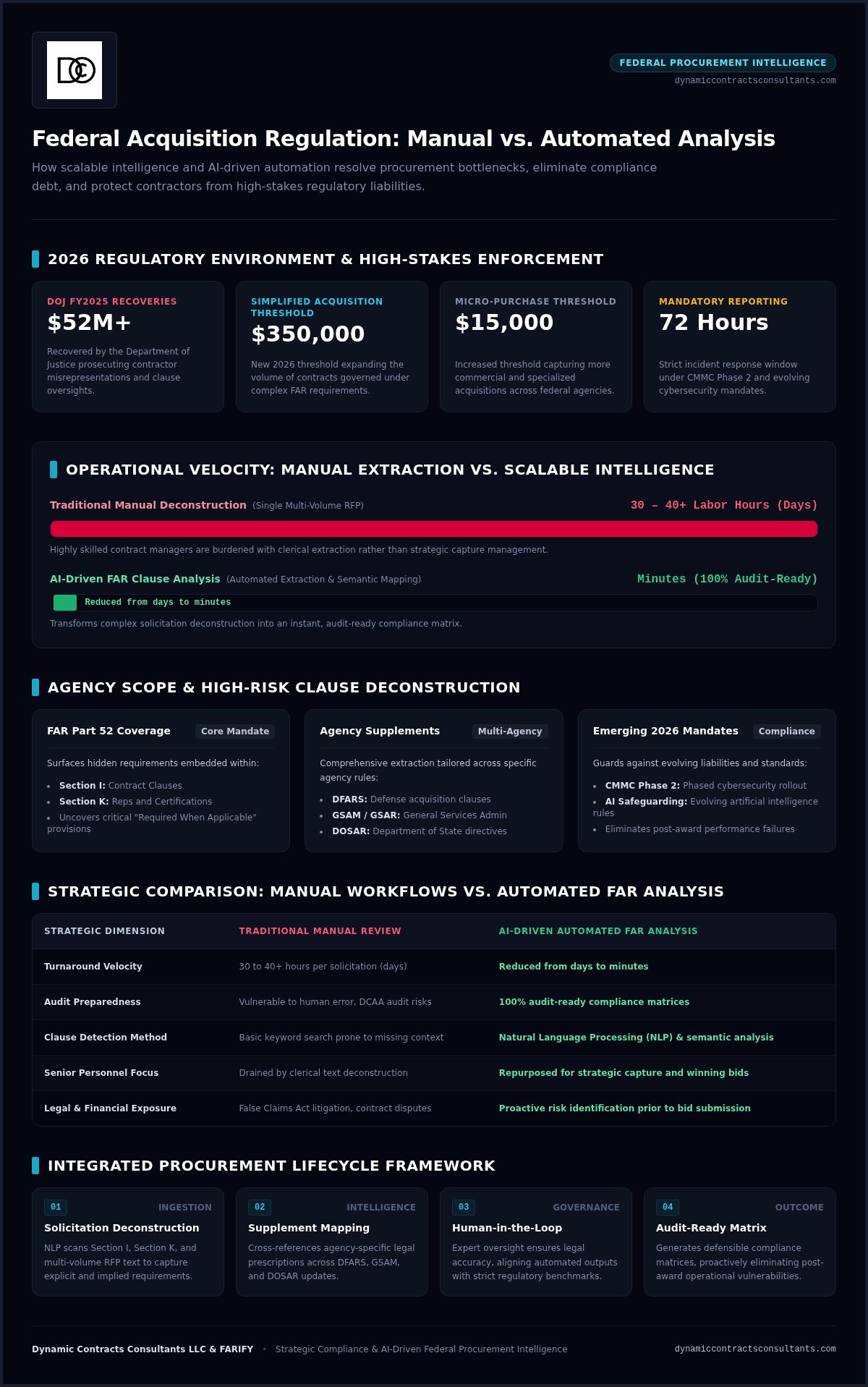
Senior contract managers traditionally sacrifice over 40 manual labor hours to deconstruct a single multi-volume RFP, yet the Department of Justice recovered over $52 million in FY2025 by prosecuting contractor misrepresentations. We recognize that manual review isn't just slow. It's a high-stakes liability that leaves your firm vulnerable to human error and DCAA audit risks. As federal thresholds like the Simplified Acquisition Threshold climb to $350,000 in 2026, the volume of complex requirements only intensifies.
You don't have to choose between speed and safety. By automating FAR clause analysis, you can transform a traditional compliance bottleneck into a powerful strategic advantage. We'll show you how AI-driven automation reduces document review time from days to minutes while ensuring 100% audit-ready compliance matrices. This article provides a strategic framework for leveraging scalable intelligence to identify high-risk clauses and manage the procurement lifecycle with precision. You'll discover how to integrate human-in-the-loop oversight to maintain operational efficiency and secure long-term success in an increasingly automated federal marketplace.
Key Takeaways
- Identify the critical limitations of manual regulatory reviews and learn how to eliminate the "Compliance Debt" that often leads to post-award performance failures.
- Discover the strategic benefits of automating FAR clause analysis to transform complex solicitation deconstruction into a streamlined, minute-long process.
- Compare the accuracy and efficiency of AI-driven extraction against traditional methods to ensure your compliance matrices remain 100% audit-ready.
- Implement a practical framework for integrating scalable intelligence into your federal proposal development process to proactively mitigate high-risk clauses.
- Leverage the synergy between FARIFY’s automated platform and our expert oversight to maintain a visionary edge in the 2026 federal procurement landscape.
The Evolution of Federal Procurement: Why Manual FAR Analysis is Failing
The regulatory landscape of 2026 demands a level of precision that manual workflows simply can't sustain. With the Simplified Acquisition Threshold now set at $350,000 and the Micro-Purchase Threshold increased to $15,000, more contracts than ever fall under the complex web of the Federal Acquisition Regulation (FAR). We've observed that the sheer volume of updates, including the phased rollout of CMMC Phase 2 and evolving AI safeguarding clauses, creates a "Compliance Debt" that contractors can't easily repay. Automating FAR clause analysis is no longer a luxury; it's a strategic necessity for firms that want to avoid the pitfalls of manual deconstruction. When you rely on traditional legal reviews, you're often operating in a reactive state, struggling to keep pace with modern solicitation timelines.
To better understand the foundational structure of these regulations, watch this helpful video:
The High Cost of Human Error in Clause Extraction
Manual oversight during the federal proposal development process carries significant financial and operational risks. A single missed "Required When Applicable" clause can lead to post-award disasters, including unfavorable DCAA audit findings and potential False Claims Act litigation. The Department of Justice recovered over $52 million in FY2025 by prosecuting misrepresentations, many of which stemmed from simple clause oversights. We've seen how these errors drain senior personnel resources, forcing highly skilled contract managers to spend 30 to 40 hours on clerical extraction rather than strategic capture management. This inefficiency isn't just a bottleneck; it's a direct threat to your profitability and long-term success.
Bridging the Gap Between Speed and Regulatory Precision
The shift toward automating FAR clause analysis represents a necessary evolution in procurement. You need scalable intelligence that goes beyond simple keyword matching to grasp the nuanced requirements of DFARS, GSAR, and agency-specific supplements. While generic AI models often fail to recognize the specific legal prescriptions of federal contracting, specialized platforms like FARIFY.ai provide the domain-specific accuracy required for an "Audit-Ready" standard. We combine this technology with expert oversight to ensure every output meets the highest regulatory standards. By integrating these tools, we help you transition from a reactive compliance posture to a proactive strategy that identifies high-risk clauses before you even submit your bid. This approach ensures that your team remains focused on winning contracts while our technology handles the heavy lifting of regulatory deconstruction.
What is Automated FAR Clause Analysis?
We define automating FAR clause analysis as a sophisticated methodology utilizing Natural Language Processing (NLP) and machine learning to deconstruct complex solicitations. Unlike basic keyword searching, which often misses the context of FAR Part 52 solicitation provisions and contract clauses, semantic analysis identifies the legal intent behind the text. This approach ensures that "hidden" requirements buried within Section I (Contract Clauses) or Section K (Representations and Certifications) are extracted with precision. It's about moving from a search-based workflow to an intelligence-based framework.
Our platform integrates agency-specific supplements like DFARS, DOSAR, and the GSAM, providing a comprehensive view of the regulatory landscape. By mapping these requirements to your specific operational capabilities, we move beyond data extraction into the sphere of scalable intelligence. This ensures your bid remains compliant with the latest 2026 standards, such as the 72-hour mandatory incident reporting thresholds and updated cybersecurity mandates.
Core Technologies: NLP and Machine Learning in Contracting
NLP allows our systems to interpret the nuanced language of federal contracting, distinguishing between "shall" and "may" within a thousand-page document. Machine learning identifies patterns across historical solicitations, predicting potential compliance bottlenecks before they impact your performance. Automated FAR analysis is a strategic tool for rapid requirement extraction and compliance mapping that eliminates manual fatigue. It doesn't just find text; it understands the obligation.
Automating Flow-Down Clause Identification
Identifying mandatory flow-down clauses is a critical strategic necessity for prime contractors managing extensive supply chains. Manually tracking these requirements is prone to error, especially when ensuring compliance with FFATA or FCPA mandates. By utilizing automation in post-award contract administration, you can generate accurate flow-down matrices in minutes. This proactive mapping reduces your liability and ensures your subcontractors meet the same "Audit-Ready" standards as your prime organization. If you're ready to modernize your compliance framework, reach out to our team of experts to discuss a tailored solution.
Manual vs. Automated FAR Analysis: A Strategic Comparison
We've found that the traditional approach to solicitation review often creates a significant drag on the procurement lifecycle. While some firms continue to rely on senior contract managers to manually parse documents, this method typically extends the proposal development phase by weeks. In contrast, automating FAR clause analysis allows your team to generate comprehensive results in minutes. This shift in time-to-output is essential for maintaining a visionary edge in 2026, where the GSA Federal Acquisition Regulation overview highlights the increasing speed and complexity of federal rulemaking.
Efficiency Metrics and Resource Allocation
When you evaluate the labor hours required for a 200-page RFP compliance matrix, the disparity becomes clear. A manual review typically consumes 30 to 40 hours of senior-level time, whereas AI-driven automation completes the same extraction in under ten minutes. This efficiency allows your contracting officers to pivot from clerical deconstruction to high-value negotiation and strategy. It also accelerates your "Bid/No-Bid" decision speed, ensuring you don't waste resources on solicitations that carry unmanageable risk or low win probability. By shifting your budget from administrative labor to strategic capture planning, you can handle multiple simultaneous RFPs without needing to increase your headcount.
Risk Mitigation and Audit Preparedness
Human fatigue is a reality in lengthy solicitation reviews, often leading to missed clauses that trigger performance failures. Automated systems eliminate this "fatigue factor" by applying the same rigorous standards to page 500 as they do to page one. These tools create a transparent digital audit trail that is essential for DCAA compliance. Standardizing the review process also reduces the likelihood of Procurement Integrity Act violations by ensuring every clause is handled with objective precision. While manual review processes are often subject to an average error rate of 10% to 15% due to cognitive load, AI-driven clause extraction maintains near-perfect consistency across complex datasets. This scalable intelligence ensures that your compliance matrices are always audit-ready, allowing you to focus on growth rather than remediation.
Implementing Automation in Your Procurement Lifecycle
Transitioning to an automated framework requires a methodical approach to ensure your organization captures the full benefits of scalable intelligence. We recommend a five-step integration process. First, you must audit your current federal proposal development process to identify where manual deconstruction creates the most significant delays. Second, select a platform like FARIFY.ai, which is purpose-built for the regulatory nuances of federal contracting. Third, establish Human-in-the-Loop protocols to verify findings against complex prescriptions. Fourth, integrate these automated outputs into your existing contract management system to maintain a single source of truth. Finally, train your acquisition team to interpret AI-driven risk assessments, moving them from clerical tasks to strategic decision-making roles.
Selecting the Right Scalable Intelligence Platform
Generic large language models are insufficient for federal regulatory analysis because they lack the specific training required for high-stakes deconstruction. They often hallucinate or fail to account for the hierarchical prescriptions found in agency supplements. In the 2026 environment, your platform must meet the "Audit-Ready" standard. This includes SOC 2 compliance, robust data encryption, and specific coverage of DFARS and GSAR updates. Additionally, the FY2026 NDAA Section 1532 restricts the use of AI technologies from foreign adversaries. This makes domestic, domain-specific tools a mandatory requirement for contractors performing work for the DoD or State Department. We prioritize these security standards to protect your sensitive procurement data.
The Human-in-the-Loop Assurance Model
While automating FAR clause analysis delivers unprecedented speed, professional expertise remains the final safeguard. We utilize a dual-force approach where our consultants validate every compliance matrix generated by the AI. This ensures that even the most complex "gray area" regulations are interpreted with the seasoned judgment of CPCM or CFCM certified experts. This model is particularly critical for maintaining post-award compliance, where misinterpreting a single flow-down obligation can lead to significant financial penalties or audit failures. We provide the strategic oversight necessary to ensure your outputs aren't just fast; they're legally sound and audit-ready. If you want to modernize your workflow with this level of precision, schedule a strategic consultation with our experts today.
Future-Proofing Compliance with FARIFY and Dynamic Contracts Consultants LLC
The 2026 federal landscape rewards contractors who balance technological agility with regulatory depth. We've developed a dual-force approach that pairs the speed of FARIFY with the veteran oversight of Dynamic Contracts Consultants LLC. While our AI platform handles the exhaustive task of automating FAR clause analysis, our consultants provide the strategic layer necessary for high-stakes competition. This combination ensures you don't just keep up with the volume of solicitations; you dominate the field with precision. By leveraging our scalable intelligence, your organization can increase proposal volume without compromising the "Audit-Ready" standard that federal agencies demand.
AI-Driven Innovation Meets Strategic Compliance
We utilize FARIFY to accelerate every stage of the procurement lifecycle, from initial deconstruction to the generation of compliant Performance Work Statements (PWS) and Statements of Work (SOW). Integrating AI in bid-no-bid analysis allows your firm to allocate resources only to the most viable opportunities, significantly improving your win-rates. By adopting these tools, you position your organization as a tech-forward leader. Contracting officers value partners who demonstrate operational efficiency and a commitment to error-free compliance. This proactive stance is essential for maintaining a visionary edge in an environment where regulatory requirements shift almost weekly.
Your Partner in the Full Acquisition Lifecycle
Our expertise extends far beyond simple automation. As a minority-owned small business led by Khalil "Kal" Memon, who holds CPCM, CFCM, and CCCM certifications, Dynamic Contracts Consultants LLC understands the nuances of the federal system. We provide a comprehensive suite of federal contracting services, supporting prime contractors for the DoD, State Department, EPA, and NOAA. From market research to contract closeout, our strategic methodologies ensure long-term success. We don't just offer tools; we offer a partnership rooted in precision and intelligence.
We've built our reputation on the "Audit-Ready" standard, ensuring that every document we produce meets the most stringent federal requirements. While automating FAR clause analysis is the foundation of our modern workflow, our human-in-the-loop assurance is what guarantees your organization remains compliant during post-award compliance reviews and DCAA audits. We invite you to leverage our expert insights and scalable intelligence to secure your firm’s growth in 2026 and beyond. Reach out to our team today to discuss your digital transformation.
Securing Your Competitive Edge in the 2026 Federal Marketplace
The strategic framework for 2026 requires a shift from reactive compliance to proactive capture management. By automating FAR clause analysis, you move beyond the limitations of manual review, effectively neutralizing the risks associated with increasing regulatory complexity. We've outlined how this transition optimizes resource allocation and safeguards your firm against the high cost of human error. It's about turning a compliance bottleneck into a strategic advantage that drives higher win-rates.
At Dynamic Contracts Consultants LLC, we integrate these technological advancements with the accredited expertise of our CPCM and CFCM certified specialists. This synergy produces audit-ready outputs in minutes, providing a robust foundation for your work with agencies like the DoD and EPA. You gain the scalability needed to pursue larger contracts without compromising the precision of your compliance matrices. This ensures your compliance standing is never in question during post-award audits.
We're committed to your success throughout the full acquisition lifecycle. Partner with Dynamic Contracts Consultants LLC today to transform your procurement operations into a center of excellence. Let's secure your competitive advantage together and build a more profitable future for your organization.
Frequently Asked Questions
Can AI truly understand the nuances of the Federal Acquisition Regulation (FAR)?
Our AI model is trained specifically on acquisition regulations rather than generic datasets, allowing it to interpret the complex prescriptions found in the FAR. While generic LLMs often struggle with legal intent, our platform recognizes the hierarchy of clauses and the nuances of "shall" versus "may." We combine this scalable intelligence with expert oversight to ensure every deconstruction is accurate. This specialized training allows for a level of precision that manual reviews often miss.
How does automating FAR clause analysis improve our DCAA audit readiness?
Automating FAR clause analysis improves your DCAA audit readiness by standardizing the solicitation review process and creating a transparent digital audit trail. We ensure that every extracted requirement is mapped directly to its regulatory source, eliminating the inconsistencies common in manual spreadsheets. This structured approach provides the audit-ready documentation required for financial and operational standards. By reducing human error in the pre-award phase, you protect your organization from unfavorable findings during post-award performance audits.
Is automated clause extraction secure enough for sensitive government contracts?
We prioritize data security by utilizing domestic, domain-trained AI systems that comply with the FY2026 NDAA Section 1532 restrictions on foreign technologies. Your sensitive procurement data is protected through robust encryption and SOC 2 compliant protocols, ensuring that Federal Contract Information remains secure. Unlike public AI tools that risk data spillage, our platform is designed for the high-security requirements of agencies like the DoD and State Department. This allows you to leverage automation without compromising your cybersecurity posture.
What is the "Human-in-the-Loop" model in automated contracting?
The Human-in-the-Loop model is our strategic framework that pairs AI-driven speed with the seasoned judgment of our acquisition specialists. While FARIFY extracts and categorizes clauses in minutes, our CPCM and CFCM certified consultants perform a final review to validate the findings. This ensures that "gray area" regulations are interpreted correctly and that every deliverable meets our rigorous regulatory standards. You benefit from the efficiency of automation while maintaining the safety net of professional expertise.
How much time can we actually save by automating our compliance matrices?
You can typically reduce the time spent on compliance matrix generation from several days to just a few minutes. While senior contract managers often spend 30 to 40 hours manually deconstructing a 200-page RFP, our platform completes the extraction and mapping process almost instantly. This massive reduction in administrative labor hours allows your team to focus on strategic capture management and negotiation. It’s a shift that directly improves your operational efficiency and bid submission speed.
Does FARIFY support agency-specific supplements like DFARS or DOSAR?
Yes, our platform provides comprehensive support for the DFARS, DOSAR, GSAM, and other major agency-specific supplements. We recognize that federal contracting often requires looking beyond the basic FAR to understand specialized requirements for defense or state department projects. Our AI is trained to identify and map these supplemental clauses with the same precision as standard regulations. This ensures that your compliance matrices are complete regardless of which agency issued the solicitation.
How does automation help with identifying mandatory flow-down clauses?
Automation simplifies the identification of mandatory flow-down clauses by automatically mapping prime contract requirements to subcontractor obligations. We use semantic analysis to flag clauses that must be included in subcontracts, such as those related to CMMC or Buy American mandates. This reduces your liability as a prime contractor and ensures your entire supply chain remains compliant. By generating accurate flow-down matrices in minutes, you eliminate the risk of missing critical post-award administrative duties.
What are the first steps to integrating AI into our existing procurement team?
The first step is auditing your current procurement lifecycle to identify bottlenecks where manual deconstruction delays your bid submission. Once you identify these gaps, you can select a domain-specific platform like FARIFY and establish human-in-the-loop protocols for final verification. We recommend starting with a single solicitation to demonstrate the efficiency gains to your team. Training your acquisition professionals on AI-driven risk assessment ensures they can effectively leverage these new tools for strategic growth.


