

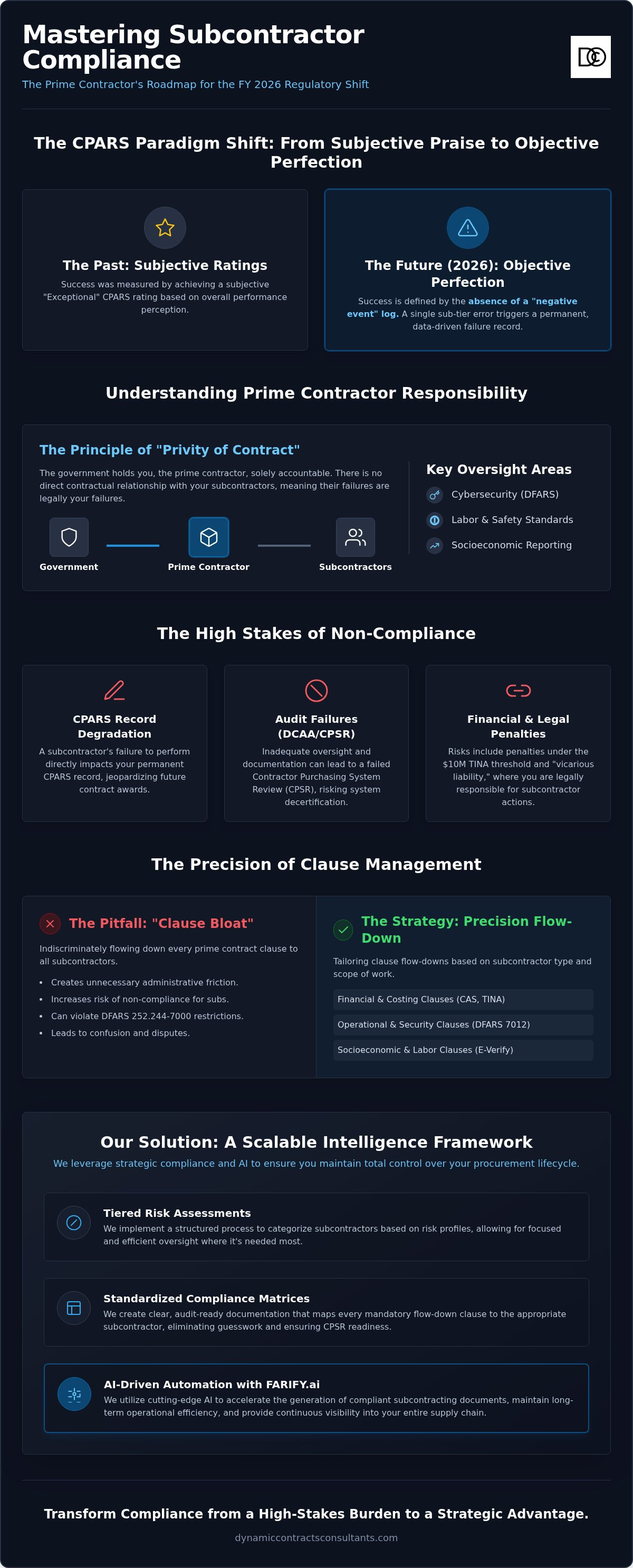
What if your next CPARS rating wasn't a score of "Exceptional," but simply the absence of a "negative event" log? Under the FY 2026 National Defense Authorization Act, the baseline for success has shifted from subjective praise to objective, data-driven perfection. We understand that managing prime contractor responsibility for subcontractor compliance has never been more high-stakes, especially when a single sub-tier error now triggers a permanent failure record. The burden of monitoring thousands of mandatory flow-down clauses can feel overwhelming when manual processes are no longer enough to satisfy DCAA or CPSR auditors.
You've likely realized that traditional oversight methods can't keep pace with the $10 million TINA thresholds or the complex DFARS 252.244-7000 restrictions on commercial item flow-downs. We're here to help you master these complexities by implementing a scalable, AI-enhanced oversight framework. This article provides a comprehensive roadmap to protecting your reputation and ensuring your documentation is audit-ready for the 2026 regulatory environment. We'll examine the specific mechanics of the new CPARS model, the precision required in clause management, and how to leverage FARIFY to maintain total control over your procurement lifecycle.
Key Takeaways
- Understand how the government enforces prime contractor responsibility for subcontractor compliance through the "Privity of Contract" principle, making you directly accountable for all sub-tier actions.
- Learn to navigate the procurement lifecycle by distinguishing between mandatory financial, operational, and socioeconomic flow-down clauses while avoiding the risks associated with "clause bloat."
- Protect your performance record from the 2026 CPARS "negative event" model by implementing rigorous oversight that prevents subcontractor errors from degrading your ratings.
- Establish a scalable intelligence framework that utilizes tiered risk assessments and standardized compliance matrices to ensure audit-ready documentation for DCAA or CPSR reviews.
- Discover how we leverage AI-driven automation and FARIFY.ai to accelerate the generation of compliant subcontracting documents and maintain long-term operational efficiency.
Understanding the Prime Contractor’s Liability for Subcontractor Compliance
The legal foundation of federal procurement rests on a singular point of accountability. When you enter into a prime contract with a federal agency, you accept total responsibility for the entire supply chain's performance. This concept, known as prime contractor responsibility for subcontractor compliance, ensures the government has a single entity to hold liable for delays, defects, or regulatory breaches. By Understanding Subcontractor Roles within this framework, we can see that the government maintains a "hands-off" approach to subs, leaving the burden of management entirely on your shoulders. We recognize that this creates a high-pressure environment where your reputation depends on the actions of third parties.
To better understand this concept, watch this helpful video:
The "Privity of Contract" principle is the core of this relationship. Since the government doesn't have a direct contractual agreement with your subcontractors, it won't resolve disputes between you and your sub-tier partners. However, it will hold you accountable for their failures. If a sub misses a deadline or violates a cybersecurity protocol, it's your CPARS rating that suffers. The Contracting Officer (CO) acts as the gatekeeper, monitoring your post-award compliance through your ability to manage these relationships effectively. Managing prime contractor responsibility for subcontractor compliance requires a proactive stance that goes beyond simple contract signing.
The Scope of Prime Contractor Oversight
Modern oversight isn't just about checking technical milestones. We've seen that primes are most vulnerable in areas like cybersecurity, labor standards, and socioeconomic reporting. Administrative oversight involves verifying that your subs have the right systems in place, while technical monitoring ensures the work meets contract specs. A "set it and forget it" approach is a recipe for failure in 2026. With the new CPARS "negative event" model, you need continuous, data-driven visibility into every sub-tier action throughout the procurement lifecycle.
Legal and Regulatory Foundations
FAR Part 44 provides the roadmap for subcontracting policies, requiring you to have an approved purchasing system if you exceed certain thresholds. We also must consider the Procurement Integrity Act, which dictates how you select subcontractors to ensure fair competition and ethical conduct. In federal contracting, vicarious liability means that you are legally responsible for the actions or omissions of your subcontractors as if you had performed the work yourself. This underscores why we prioritize strategic compliance and AI-driven automation to mitigate these inherent risks and ensure your long-term success.
Navigating FAR and DFARS Flow-Down Clause Requirements
Effective flow-down management serves as the technical backbone of your post-award operations. It represents the most direct execution of prime contractor responsibility for subcontractor compliance within the procurement lifecycle. We often see organizations struggle with "clause bloat," the practice of indiscriminately flowing down every clause from the prime contract to every sub-tier partner. While this might seem like a safe default, it frequently creates unnecessary administrative friction and can even violate DFARS 252.244-7000, which restricts flowing down excessive clauses to commercial item subcontractors. Conversely, missing a single mandatory requirement can lead to severe audit findings during a Contractor Purchasing System Review (CPSR).
According to the SBA contracting guide, primes must distinguish between clauses that are mandatory by text and those that are self-executing. We categorize these requirements into three primary streams: financial, such as the $10 million TINA threshold for DoD contracts; operational, including quality control and reporting; and socioeconomic, which covers compliance with small business participation plans. When subcontractors object to specific requirements, your role is to determine if the clause is a regulatory mandate or a discretionary risk-mitigation tool that can be negotiated. Maintaining this balance is essential for scalable growth and operational efficiency.
Mandatory Flow-Downs for Commercial Items
For subcontracts involving commercial products or services, the regulatory burden is theoretically lighter but requires much higher precision. FAR 52.244-6 explicitly limits the number of clauses you can flow down to your suppliers. You must ensure that critical requirements like E-Verify, Equal Opportunity, and Combating Trafficking in Persons are correctly integrated into your subcontracts. We provide specialized post-award compliance management to help you identify exactly which clauses apply to your commercial vendors, preventing the legal exposure of improper flow-downs.
Complex DFARS and Cybersecurity Flow-Downs
The 2026 framework places immense pressure on cybersecurity posture across the entire supply chain. You're now held directly accountable for ensuring your subcontractors meet NIST SP 800-171 and CMMC 2.0 standards. It's no longer sufficient to accept a subcontractor's self-assessment at face value. You must verify that your partners have logged their scores in the Supplier Performance Risk System (SPRS) and are adhering to Counterfeit Avoidance Acceptance Program (CAAP) requirements. If you need assistance refining your compliance matrix to meet these rigorous standards, you can consult with our strategic partners for a tailored review of your flow-down procedures.
The High Cost of Oversight Failures: CPARS, Audits, and Financial Risk
The consequences of inadequate oversight extend far beyond administrative friction. In the current 2026 regulatory environment, the government's shift toward a data-driven "negative event" model in CPARS means that compliance is no longer a sliding scale; it's a binary record of success or failure. Under the Federal Acquisition Regulation (FAR) on subcontractor responsibility, you're the primary point of failure if a sub-tier partner misses a milestone or violates a labor standard. We've observed that the U.S. General Services Administration (GSA) identified over $13 billion in suspected fraud since March 2026, leading to an unprecedented level of scrutiny regarding prime contractor responsibility for subcontractor compliance.
Financial exposure manifests in several high-impact ways. Contracting Officers (COs) increasingly utilize their authority to withhold progress payments or assess liquidated damages when subcontractor performance falters. A single sub-tier error can trigger a Contractor Purchasing System Review (CPSR), where a "disapproved" status effectively bars you from receiving certain types of future contracts. Beyond the immediate loss of revenue, the reputational damage within the federal acquisition community can be irreparable. News of a failed audit or a major compliance breach travels quickly, often impacting your ability to form strategic partnerships for future large-scale captures.
CPARS and Future Award Eligibility
Your Past Performance score is your most valuable asset in the federal marketplace. Under the 2026 framework, compliant performance is the expected baseline and isn't rated. Instead, specific failures by your subcontractors are logged as negative events. These entries create a permanent narrative that can disqualify you from high-value solicitations before the technical evaluation even begins. We recommend documenting every corrective action plan issued to a subcontractor. This proactive documentation serves as evidence of your robust oversight and can mitigate the severity of a negative event entry by demonstrating your "human-in-the-loop" management approach.
Audit Scrutiny: DCAA and CPSR Preparedness
Auditors from the DCAA are now focusing heavily on how primes conduct cost and price analysis for their subs, especially with the Truthful Cost or Pricing Data (TINA) threshold sitting at $10 million for DoD contracts. If your subcontractor's accounting system fails an audit, the ripple effect can jeopardize your own billing privileges. We provide specialized DCAA compliance consulting to help you build an audit-ready framework that monitors sub-tier financial health in real-time. Protecting your reputation requires a strategic partnership that anticipates these pitfalls before they reach the auditor's desk.
Implementing a Scalable Subcontractor Monitoring and Compliance Program
We believe that shifting from reactive management to a proactive, scalable framework is the only way to safeguard your organization in the 2026 environment. Effective execution of prime contractor responsibility for subcontractor compliance requires more than just high-level intent; it demands a structured methodology that integrates with your existing procurement lifecycle. By establishing a tiered risk assessment, you'll be able to allocate oversight resources where they're most needed, focusing your primary attention on high-risk technical areas or complex cost-reimbursement subcontracts. This strategic allocation of effort prevents administrative bottlenecks while maintaining the high standards required for federal work.
The 5-Step Strategic Oversight Framework
We've developed a rigorous five-step process to ensure total lifecycle compliance and operational excellence:
- Pre-award vetting: Verify a subcontractor's financial capability and past performance record long before the final bid is submitted.
- Precise clause flow-down: Negotiate specific FAR and DFARS requirements tailored to the subcontract type to avoid the pitfalls of clause bloat.
- Continuous monitoring: Implement a monthly cadence for deliverable tracking and technical milestone verification to catch slippage early.
- Risk mitigation: Use human-in-the-loop analysis to issue formal corrective action plans at the first sign of a sub-tier compliance failure.
- Final closeout: Consolidate all performance data to draft a defensible CPARS narrative that highlights your successful management of the supply chain.
This framework ensures that prime contractor responsibility for subcontractor compliance is treated as a core performance metric rather than a back-office administrative task. For contracts exceeding the $900,000 threshold, our system automatically triggers a subcontracting plan compliance module to ensure you meet your socioeconomic obligations without manual errors.
Documenting Compliance for Audit Readiness
Maintaining a centralized repository for subcontractor certifications is a non-negotiable requirement for passing a Contractor Purchasing System Review (CPSR). You must create a chronological paper trail of every oversight activity, including meeting minutes, site visit reports, and email correspondence regarding quality issues. In 2026, the ability to generate audit-ready documentation instantaneously is the difference between a clean performance record and a significant audit finding. We utilize the FARIFY platform and AI-driven automation to monitor subcontracting plan compliance in real-time, ensuring that you're always prepared for sudden Contracting Officer inquiries or DCAA reviews. If you're ready to modernize your oversight processes and protect your reputation, contact our strategic compliance team for a professional evaluation of your current program.
Leveraging Strategic Compliance and AI for Post-Award Excellence
We recognize that the administrative burden of managing prime contractor responsibility for subcontractor compliance can stifle your firm's growth. In a regulatory environment where oversight expectations are higher than ever, manual processes are no longer a viable strategy for high-performing primes. We help you transition from traditional, labor-intensive methods to a model of scalable intelligence. By integrating AI-driven automation into your procurement lifecycle, we ensure that compliance becomes a source of competitive advantage rather than a drain on your internal resources. Our goal is to provide you with the sophisticated tools necessary to maintain a flawless performance record while you focus on technical delivery.
AI-Powered Flow-Down Analysis
Our proprietary FARIFY.ai platform revolutionizes how you handle complex solicitations. Instead of spending days manually reviewing thousands of pages, our technology extracts RFP requirements and maps them to specific subcontractors in minutes. This precision eliminates the risk of "clause bloat" while ensuring that every mandatory DFARS and cybersecurity requirement is present in your sub-tier agreements. Utilizing this technology for post-award contract administration allows your team to focus on technical execution while we handle the data-heavy compliance mapping. It's a method that significantly reduces manual errors in compliance matrix creation, protecting your firm from the negative event logs that now define CPARS ratings.
Strategic Partnership for Long-Term Growth
Technology alone isn't a silver bullet; it requires the human-in-the-loop advantage that our experts provide. By combining the speed of AI with our experience serving as a prime contractor for the DoD, EPA, and NOAA, we offer a comprehensive oversight solution. Scaling your firm requires a shift in how you perceive administrative functions. Many contractors fall into the trap of hiring more staff as they win more work, which often leads to fragmented processes and inconsistent documentation. Our approach centers on operational efficiency, utilizing automated systems to monitor subcontracting plan compliance and generate audit-ready records instantaneously.
This strategic partnership allows you to scale your operations without increasing your internal administrative overhead. When federal agencies see that you have a robust, tech-enabled monitoring program in place, they'll view your firm as a low-risk partner for future captures. We're committed to your long-term success through the application of precise, intelligent management strategies that uphold the highest standards of prime contractor responsibility for subcontractor compliance. You can partner with Dynamic Contracts Consultants LLC for scalable intelligence to secure your position as a leader in the 2026 federal marketplace.
Securing Your Competitive Edge in the 2026 Regulatory Landscape
The 2026 framework has fundamentally redefined the standards of operational excellence in federal procurement. Success no longer depends on subjective praise but on maintaining a clean record within a data-driven "negative event" model. We've explored how a robust oversight program, supported by AI-driven automation, transforms prime contractor responsibility for subcontractor compliance from a significant risk into a scalable asset. By implementing a tiered monitoring system and utilizing FARIFY for audit-ready document generation, you ensure your procurement lifecycle remains resilient against DCAA and CPSR scrutiny. It's about building a foundation where precision is the default.
Our expertise in FAR, DFARS, and DCAA standards provides the comprehensive lifecycle support your firm needs to scale without increasing administrative friction. We're ready to help you position your firm as a low-risk, high-performance partner in the eyes of federal agencies. You don't have to manage these technical complexities alone. With the right strategic partner, you can turn regulatory hurdles into a long-term growth engine. Secure your federal contracts with expert post-award compliance management and lead the marketplace with confidence.
Frequently Asked Questions
What are the mandatory flow-down clauses for federal subcontracts?
Mandatory flow-down clauses are specific provisions from the FAR or DFARS that you must include in subcontracts to ensure government-wide consistency. These typically include labor standards like Equal Opportunity, ethics requirements such as Combating Trafficking in Persons, and cybersecurity protocols. While some clauses apply to all agreements, others depend on the contract type or total dollar value. We recommend using a precise compliance matrix to identify every critical requirement during the procurement lifecycle.
Is a prime contractor responsible for a subcontractor’s DCAA compliance?
Yes, the federal government holds you accountable for the financial integrity of your entire supply chain. While you don't perform the audit yourself, prime contractor responsibility for subcontractor compliance includes verifying that your subs maintain adequate accounting systems and conducting necessary cost or price analysis. We provide specialized DCAA compliance consulting to help you vet subcontractor financial health, ensuring their systems meet the rigorous standards required for cost-reimbursement contracts.
How does a prime contractor verify subcontractor compliance with NIST SP 800-171?
You must verify that your subcontractors have completed a self-assessment and uploaded their current scores to the Supplier Performance Risk System (SPRS). In the 2026 framework, simply accepting a verbal assurance is insufficient for audit readiness. We suggest reviewing their System Security Plan and any existing Plan of Action and Milestones. This proactive verification protects your CPARS rating from negative events related to supply chain cybersecurity breaches or regulatory failures.
What happens if a subcontractor refuses to accept a mandatory FAR flow-down clause?
If a subcontractor refuses a mandatory clause, you cannot legally award them the subcontract without risking your own contract's compliance. Mandatory clauses are non-negotiable requirements established by federal law to protect the government's interests. You must either find an alternative vendor or work with the subcontractor to explain that these terms are required for participation. We help you navigate these negotiations by distinguishing between truly mandatory clauses and those where you have discretionary flexibility.
Can a prime contractor be debarred for a subcontractor’s fraud?
Yes, a prime contractor can face debarment if the government determines you were complicit in or willfully ignorant of the subcontractor's fraudulent activities. Under the principle of vicarious liability, your oversight failures can lead to severe legal consequences. With the GSA identifying over $13 billion in suspected fraud since March 2026, the threshold for adequate oversight is higher than ever. We focus on establishing human-in-the-loop monitoring to detect and mitigate these risks immediately.
How often should a prime contractor audit its subcontractors for compliance?
We recommend a tiered audit schedule based on each subcontractor's risk profile and the complexity of their work. High-risk subcontractors or those on cost-reimbursement contracts should undergo quarterly reviews, while lower-risk commercial vendors might only require annual certifications. Continuous monitoring of technical milestones should occur monthly. This cadence ensures that prime contractor responsibility for subcontractor compliance is a constant process, allowing you to catch and correct errors before they trigger significant audit findings.
What is the difference between a "mandatory" and "discretionary" flow-down clause?
Mandatory clauses are required by the FAR or DFARS text to be included in subcontracts to protect the government's interests. Discretionary clauses are those you choose to include to manage your own risk, such as specific indemnification or termination rights. Understanding this distinction is vital to avoiding the administrative friction of clause bloat. We help you refine your compliance matrix so you only flow down what's necessary, maintaining operational efficiency while ensuring total regulatory adherence.
How can AI tools like FARIFY assist in subcontractor oversight?
AI platforms like FARIFY.ai automate the extraction of complex requirements from RFPs and map them to subcontractors in minutes. This technology generates audit-ready documentation and monitors subcontracting plan compliance in real-time. By reducing manual errors in clause selection and tracking, we help you scale your operations without increasing administrative overhead. The result is a more precise procurement lifecycle that protects your reputation and ensures long-term success in the competitive federal marketplace.


