

Winning your first federal contract in 2026 is no longer a matter of simply filling out forms; it's a high-stakes strategic alignment where AI-driven precision meets rigid regulatory compliance. You've likely felt the weight of overwhelming FAR and DFARS jargon, or perhaps the paralyzing fear of a DCAA audit before you've even submitted your first bid. It's frustrating to see manual proposal writing costs climb while SAM.gov registrations feel like a labyrinth designed to keep you out. We understand that the barrier to entry isn't just paperwork, it's the complexity of a system that demands perfection.
We've developed this expert-led roadmap to demystify the federal procurement lifecycle, ensuring your path to securing your first government contract is audit-ready and strategically sound from day one. You'll gain a clear, submission-ready strategy that transforms confusing registrations into a foundation for scalable growth. Our guide walks you through the essential steps of federal database success, capture management, and the technical requirements of NAICS code 541611. We'll show you how to leverage AI-powered automation to compete with larger firms while maintaining the "human-in-the-loop" assurance necessary for long-term success.
Key Takeaways
- Build your federal infrastructure by securing essential identifiers like the UEI and CAGE code to ensure your business is visible to procurement officers.
- Identify strategic opportunities by leveraging our market research techniques and small business set-asides to target agencies like the DoD and EPA.
- Learn our methodology for securing your first government contract by transforming complex RFP requirements into a clear, audit-ready compliance matrix.
- Maintain strategic compliance by aligning your internal systems with DCAA standards and mastering the intricacies of FAR and DFARS regulations.
- Optimize your post-award administration with our AI-driven automation to track milestones and manage flow-down clauses for scalable growth.
Building Your Federal Infrastructure: Essential Registrations and Identifiers
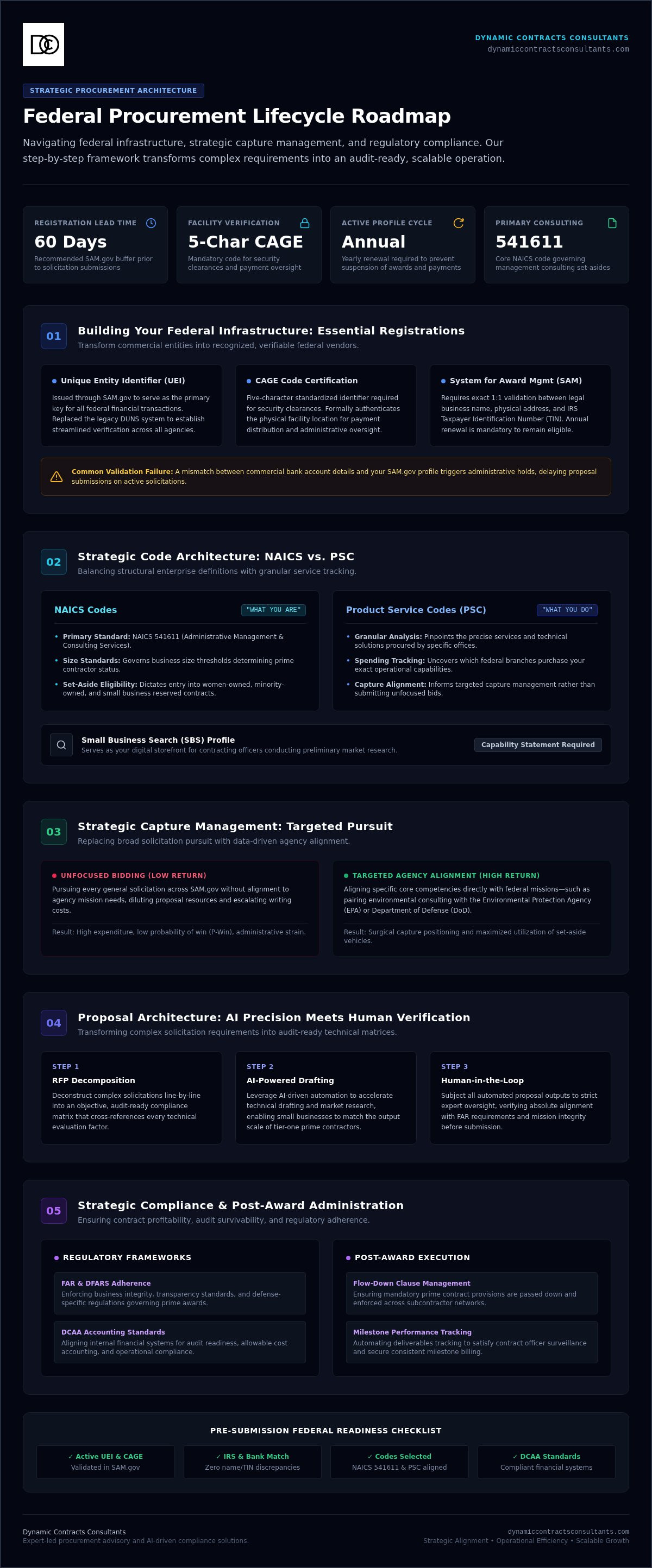
Establishing a robust administrative foundation is the first mandatory phase in securing your first government contract. You must transform your commercial entity into a recognized federal vendor by navigating a specific sequence of registrations and identifiers. This process begins with establishing your legal entity and obtaining a Unique Entity Identifier (UEI) via the System for Award Management (SAM.gov). This identifier serves as your primary key for all federal financial transactions, replacing the legacy DUNS system to provide a more streamlined verification process.
Simultaneously, you'll need to secure a Commercial and Government Entity (CAGE) code. This five-character identifier is required for security clearances and provides a standardized method for the government to identify your physical location for payments and administrative oversight. All these steps occur within the complex legal framework of the Federal Acquisition Regulation, which dictates the standards for business integrity and operational transparency required from all prime contractors. We view this infrastructure not as a hurdle, but as a strategic asset that validates your firm's readiness for high-stakes partnerships.
To better understand the timeline and milestones of this process, watch this helpful video:
Navigating the System for Award Management (SAM)
Registering in SAM.gov is often the first point of friction for new contractors. You'll need your legal business name, physical address, and Taxpayer Identification Number (TIN) to match your IRS records exactly. A common pitfall is the mismatch between bank account details and your SAM profile, which can trigger validation errors and delay your ability to bid on active solicitations. We recommend starting this process at least 60 days before you intend to submit a proposal. Maintaining an active profile requires an annual renewal; failing to update your registration can result in immediate disqualification from award considerations or a suspension of payments.
Strategic Code Selection: NAICS and PSC
Your visibility to contracting officers depends heavily on your choice of North American Industry Classification System (NAICS) codes. For many of our clients, NAICS 541611 (Administrative Management and General Management Consulting Services) serves as a primary designation. These codes define your business size and determine your eligibility for small business set-asides, such as those for women-owned or minority-owned entities. Choosing the wrong code can inadvertently disqualify you from opportunities specifically reserved for your firm's profile.
While NAICS codes define what your company is, Product Service Codes (PSC) define what you do. Utilizing PSC codes allows for more granular market research and opportunity tracking. By monitoring specific PSCs, you can identify which agencies are buying your exact services and tailor your capture management strategy accordingly. Finally, ensure your Small Business Search (SBS) profile is complete with a concise capability statement. This profile acts as your digital storefront, allowing procurement officers to find your firm during their initial market research phases for securing your first government contract.
Strategic Capture Management: Finding the Right Opportunities
Finding the right opportunities is the pivot point between administrative readiness and actual revenue. You shouldn't pursue every solicitation that appears on SAM.gov. Instead, we recommend a targeted approach that utilizes market research to identify specific agencies whose missions align with your core competencies. For example, if you provide environmental consulting, focusing on the EPA or the Department of the Interior yields a higher return on effort than casting a wide, unfocused net. Securing your first government contract requires this level of surgical precision to avoid wasting valuable bid and proposal resources.
We believe that understanding agency-specific spending patterns is essential for long-term success. By analyzing which departments consistently use your primary NAICS codes, you can build a pipeline of upcoming solicitations before they even reach the public portal. This proactive stance allows you to engage in pre-solicitation activities, such as responding to Sources Sought notices, which helps shape the final RFP in your favor. If you're unsure which agencies to target first, you can connect with our strategic advisors to refine your capture strategy.
Leveraging Small Business Set-Asides
The federal government has mandated goals for awarding contracts to small businesses, creating a significant advantage for firms with specific socioeconomic designations. Utilizing SBA federal contracting guidance helps you understand how to navigate categories such as the 8(a) Business Development program or HUBZone certifications. Being a minority-owned small business provides a distinct competitive edge, as agencies often struggle to meet their diversity spending targets. To maximize this advantage, you should integrate these certifications into The Definitive Guide to Developing a Strategic Government Contract Capture Plan to ensure you're targeting the right set-aside solicitations.
The Bid/No-Bid Analysis Framework
One of the most common mistakes when securing your first government contract is overextending your team on low-probability bids. We employ a rigorous bid/no-bid analysis to evaluate whether a solicitation is worth the high cost of proposal development. You must assess the RFP requirements against your current operational capacity and the competitive landscape. If an incumbent has held the contract for a decade with exceptional performance, your chances of unseating them might be lower than pursuing a new requirement. We utilize AI-driven bid-no-bid analysis to process these variables quickly, giving you a data-backed decision in minutes rather than days.
If a prime contract feels out of reach due to past performance requirements, don't overlook teaming agreements. Subcontracting under an established prime contractor allows you to build the necessary "past performance" profile while learning the nuances of agency-specific delivery. It's a strategic entry point that mitigates risk while positioning you for future prime awards. This approach ensures your business scales at a manageable pace while maintaining the operational excellence required for federal work.
Developing a Compliant and Compelling Technical Proposal
Securing your first government contract hinges on your ability to translate complex agency requirements into a compliant, high-scoring technical volume. You must approach the Request for Proposal (RFP) with clinical precision. Most unsuccessful bidders fail because they treat the solicitation as a suggestion rather than a strict set of instructions. We advocate for a methodology that prioritizes structural compliance over creative flair. Every response must be mapped directly to the government's stated needs to ensure your submission passes the initial administrative gate. Your proposal isn't just a marketing document; it's a legal offer that must mirror the specific language of the acquisition.
RFP Extraction and Compliance Matrix Generation
The foundation of a winning bid lies in deconstructing Sections L and M of the solicitation. Section L provides the specific instructions for how your proposal should be formatted and delivered, while Section M outlines the evaluation criteria the agency will use to score your response. We use these sections to identify every "shall," "must," and "will" requirement. These mandatory elements are then organized into a comprehensive compliance matrix. This document serves as your strategic roadmap, ensuring no requirement is overlooked. By adopting Strategic Methodologies in Federal Proposal Development, you can ensure your technical volume aligns perfectly with the Statement of Work (SOW) or Performance Work Statement (PWS). A non-compliant proposal is a disqualified proposal, regardless of your firm's technical capabilities.
AI-Driven Automation in Proposal Writing
While traditional firms rely on weeks of manual drafting, we leverage AI-driven automation to achieve operational efficiency. Our FARIFY AI tool accelerates the generation of technical volumes and Independent Government Cost Estimates (IGCEs) by processing solicitation data in real-time. This technology allows you to produce audit-ready documentation in minutes. However, we maintain a strict "human-in-the-loop" assurance protocol. AI provides the speed and structural accuracy, but our senior consultants provide the strategic nuance and visionary alignment required for complex acquisitions. This synergy ensures your pricing and technical approach are defensible during rigorous reviews.
Before submission, it's vital to cross-reference your internal systems with the DCAA pre-award accounting system adequacy checklist. This ensures your cost-accounting standards meet federal expectations. You don't want to win an award only to lose it during a pre-award audit. By integrating scalable intelligence into your workflow, you position your firm as a low-risk, high-value partner. This approach is the most efficient path toward securing your first government contract while building a foundation for sustainable growth in the federal marketplace.
Regulatory Compliance: Navigating DCAA and FAR Requirements
Securing your first government contract requires more than a compelling technical solution; it demands a rigorous commitment to regulatory transparency. While your technical volume demonstrates your capability, the audit process verifies your operational integrity. We've seen many promising firms disqualified at the final stage because their internal controls didn't meet federal standards. You must view compliance as a strategic asset rather than an administrative burden. This proactive stance builds immediate trust with contracting officers and positions your firm as a low-risk partner for long-term acquisitions.
Preparing for DCAA Audit Scrutiny
The Defense Contract Audit Agency (DCAA) serves as the financial watchdog for federal procurement. Before an award is finalized, you'll likely face a pre-award accounting system audit to ensure your firm can accurately track costs. Common pitfalls often include poorly defined indirect rate calculations or inconsistent timekeeping procedures that fail to segregate direct and indirect labor. We recommend implementing a system that aligns with Standard Form 1408 requirements well before your first submission. Our approach to DCAA Compliance Consulting: A Strategic Framework for Federal Contractor Success in 2026 provides the roadmap you need to mitigate risk during this high-stakes selection process. Expert-led consulting ensures your financial infrastructure is defensible under intense federal scrutiny.
Mastering the Federal Acquisition Regulation (FAR)
The Federal Acquisition Regulation is the primary body of rules governing all executive agency acquisitions. You must also account for agency-specific supplements, such as the DFARS for defense contracts or DOSAR for State Department requirements. These regulations dictate everything from procurement integrity to risk management protocols. We utilize FARIFY’s AI model, which is specifically trained on these complex acquisition regulations, to ensure every document we generate is precise and compliant. This AI-driven automation allows us to cross-reference thousands of pages of regulations in seconds, providing a level of accuracy that manual drafting simply can't match. Strategic compliance isn't just about following rules; it's about using the regulatory framework to protect your profit margins and ensure scalable growth.
Operational efficiency also extends to your supply chain. You're responsible for implementing rigorous flow-down clause management for any subcontractors you engage. This means ensuring that mandatory FAR clauses in your prime contract are legally mirrored in your subcontracting agreements. Failure to manage these clauses can lead to severe post-award complications and financial liability. If you're ready to ensure your systems are fully compliant and audit-ready, contact our experts at Dynamic Contracts Consultants LLC today to schedule a strategic review of your accounting and regulatory protocols. We'll help you navigate the complexities of federal oversight with confidence and precision.
Post-Award Administration: Ensuring Long-Term Contract Success
Securing your first government contract is a significant milestone, but the award notification represents the commencement of your professional obligation, not its conclusion. We've observed that many emerging contractors focus exclusively on the bid phase, neglecting the rigorous administrative requirements of contract performance. Effective post-award administration is the mechanism that converts a single win into a sustainable revenue stream. It requires a methodical approach to tracking deliverables and managing the complex web of federal reporting requirements. This phase is where your firm proves its operational efficiency and establishes its reputation as a reliable strategic partner.
Post-Award Compliance and Monitoring
You must establish robust contract administration protocols from day one. This involves monitoring the entire procurement lifecycle to ensure that every milestone is met with precision. We recommend using a centralized management system to track compliance with flow-down clauses and subcontracting plans, which were established during the proposal phase. Our Post-Award Compliance Services are designed to provide this level of oversight, ensuring your operational execution matches the promises made in your technical volume. For a deeper dive into these requirements, you can review our Comprehensive Guide to Post-Award Contract Administration in Federal Procurement. Proactive monitoring prevents the small deviations that can lead to cure notices or performance disputes.
Optimizing Your CPARS Narrative
Your performance on this initial award determines your future eligibility for larger acquisitions. The Contractor Performance Assessment Reporting System (CPARS) is the government's primary tool for evaluating vendor reliability. We view a positive CPARS narrative as a strategic asset. You shouldn't wait until the end of the performance period to document your successes. Instead, maintain a contemporaneous log of excellence, recording how you resolved technical disputes or exceeded delivery schedules. Securing your first government contract provides the baseline past performance data necessary to compete for larger prime awards. This proactive documentation is a core component of strategic acquisition planning, ensuring that your past performance ratings speak to your visionary alignment with agency goals.
Finally, you must navigate the contract closeout process with the same level of detail as the initial registration. This phase involves final indirect rate settlements, the formal release of claims, and the archiving of all project data. Maintaining an audit-ready trail throughout the performance period ensures that closeout remains a streamlined formality rather than a source of financial liability. By mastering these post-award complexities, you demonstrate the scalable intelligence and operational excellence that federal agencies demand from their long-term strategic partners. This disciplined approach ensures that your first contract isn't just a temporary success, but the foundation for scalable growth in the federal sector.
Strategizing for Scalable Growth in Federal Procurement
Success in federal contracting is a journey of precision and visionary alignment. We've discussed the technical foundations and the regulatory rigor required for long-term viability. Securing your first government contract is the catalyst that transforms your firm's operational efficiency into a scalable business model. It's about moving beyond simple registration and into a phase of strategic intelligence where every bid is audit-ready and every deliverable reinforces your reputation.
We provide the specialized support you need to maintain this level of excellence. As a prime contractor for the DoD and State Department, we combine deep industry expertise with our AI-driven FARIFY platform to generate compliant documentation in minutes. Whether you require expert DCAA compliance consulting or rapid acquisition planning, we position your business for long-term success. Leverage our strategic expertise to win your first government contract. Contact Dynamic Contracts Consultants LLC today.
Your journey toward federal success starts with a single, compliant step. We're here to ensure that step leads to sustainable and scalable growth for your firm. Let's build your federal future together with precision and purpose.
Frequently Asked Questions
What is the very first step to securing a government contract?
The absolute first step is establishing your legal entity and completing your registration in the System for Award Management (SAM.gov). This process provides you with a Unique Entity Identifier (UEI) and a CAGE code, which are mandatory for all federal vendors. Without these active identifiers, your firm is invisible to contracting officers. We recommend starting this registration at least 60 days before bidding to ensure all IRS and banking validations are finalized.
Do I need a specific certification to win a federal contract?
You don't strictly need a socioeconomic certification to win a contract, but they provide a significant competitive advantage. Programs like the 8(a) Business Development, HUBZone, or Women-Owned Small Business (WOSB) designations allow you to compete for set-aside solicitations. These certifications help agencies meet their mandatory small business spending goals. Securing your first government contract is often more efficient when targeting these restricted opportunities that limit the field of competition.
What is the Simplified Acquisition Threshold in 2026?
The Simplified Acquisition Threshold (SAT) is the dollar limit under which procurement procedures are streamlined to reduce administrative burdens. While this threshold is periodically adjusted for inflation under FAR 2.101, it currently facilitates faster awards for small businesses. You should monitor the latest Federal Acquisition Regulation updates for the exact 2026 figure. These "under-threshold" opportunities are excellent entry points because they require less complex technical and cost volumes.
How can AI help me win government contracts faster?
AI accelerates the procurement lifecycle by generating audit-ready documentation like Performance Work Statements (PWS) and compliance matrices in minutes. Our FARIFY platform utilizes specialized models trained on acquisition regulations to ensure precision that manual drafting can't match. By automating the repetitive elements of proposal writing and market research, you can submit more high-quality bids in less time. This allows smaller firms to achieve the operational efficiency typically reserved for large prime contractors.
What happens if my business fails a DCAA audit?
Failing a DCAA audit typically results in your firm being deemed "non-responsible" for cost-reimbursable or incentive-fee contracts. This disqualification can halt the award process for specific high-value solicitations until your accounting system is remediated. We provide expert DCAA compliance consulting to identify gaps in your timekeeping and indirect rate calculations before an auditor arrives. Maintaining an adequate accounting system is a mandatory prerequisite for long-term success in the federal marketplace.
Can a small business really compete with large prime contractors?
Small businesses can successfully compete by leveraging agility, niche expertise, and small business set-asides. Federal agencies are mandated to award a percentage of their total contracting dollars to small firms, creating a protected marketplace. By utilizing AI-driven automation for capture management and proposal development, you can mirror the sophistication of larger firms at a fraction of the cost. Teaming with other businesses also allows you to pool resources for larger requirements.
What are the most common reasons proposals are disqualified?
Proposals are most frequently disqualified for administrative non-compliance with Sections L and M of the solicitation. This includes missing "shall" or "must" requirements, improper formatting, or failing to address the specific evaluation criteria. Late submissions or an expired SAM registration are also immediate grounds for rejection. We emphasize the use of a rigorous compliance matrix to ensure every mandatory element is explicitly addressed, protecting your investment in the bidding process.
How do I find subcontracting opportunities if I'm not ready to be a prime?
You can find subcontracting opportunities by searching the SBA's SubNet database or networking with large prime contractors in your NAICS code. Many large firms are required to have subcontracting plans that include small business participation. Teaming agreements allow you to perform as a subcontractor, building the "past performance" narrative required for securing your first government contract as a prime later. This strategy provides a lower-risk entry point into complex agency environments.


