

In the 2026 procurement landscape, a single administrative oversight during contract termination can permanently damage your competitive standing under the government's new data-driven CPARS model. We recognize that managing an extensive backlog of expired contracts often feels like an insurmountable burden, especially when incomplete documentation prevents the full recovery of indirect costs. For many leaders, the fear that a missed deadline might trigger a negative performance event is a valid concern that keeps future contracts out of reach.
By utilizing our specialized federal contract closeout services, you can transition from a reactive posture to a position of strategic strength. We provide the expertise necessary to master the complexities of the current FAR overhaul, ensuring your records remain audit-ready for DCAA and agency reviews. Our approach focuses on protecting your reputation while maximizing financial recovery through meticulous attention to detail and scalable intelligence.
This article provides a comprehensive roadmap for achieving zero-backlog status and optimizing your performance ratings. We'll explore the latest regulatory shifts, the impact of the 4.75% Prompt Payment Act interest rate on late settlements, and how our visionary strategies ensure your business remains a preferred partner for federal agencies throughout the next fiscal cycle.
Key Takeaways
- Understand why professional federal contract closeout services are vital for maintaining a competitive edge as the CPARS model shifts toward a data-driven, negative-event logging system.
- Discover how to navigate the complexities of final indirect cost rate settlements and the submission of final invoices to ensure full financial recovery.
- Learn to identify and resolve unliquidated obligations (ULOs) to release stagnant funding and improve your standing with agency contracting officers.
- Establish robust internal controls and flow-down clause management to ensure your subcontract records remain compliant and audit-ready for DCAA reviews.
- Explore how integrating AI-driven automation through FARIFY can accelerate the generation of precise closeout documentation while maintaining human-in-the-loop oversight.
Navigating the Strategic Impact of Federal Contract Closeout Services
Federal contract closeout represents the critical final stage of the federal acquisition lifecycle, marking the essential transition from physical completion to administrative finality. It's a common misconception that a contractor's obligations end when the final deliverable is accepted. In reality, the administrative phase is where we secure your performance record and finalize financial recovery. Professional federal contract closeout services ensure that every detail is verified, preventing "stale" records from becoming liabilities during future agency reviews.
A strategic approach to closeout is mandatory for protecting your CPARS ratings in 2026. The government's move toward a data-driven performance model means that administrative delays or missed deadlines are now logged as specific negative performance events. Beyond reputation, there's a significant financial incentive to prioritize this phase. Closing out contracts allows for the recovery of unliquidated obligations (ULOs) and final payments that might otherwise remain trapped in agency accounts. Conversely, allowing a backlog of unclosed contracts to persist increases your DCAA audit risk profile, as it suggests a lack of robust internal controls over your post-award administration.
The Regulatory Framework: FAR Part 4.804
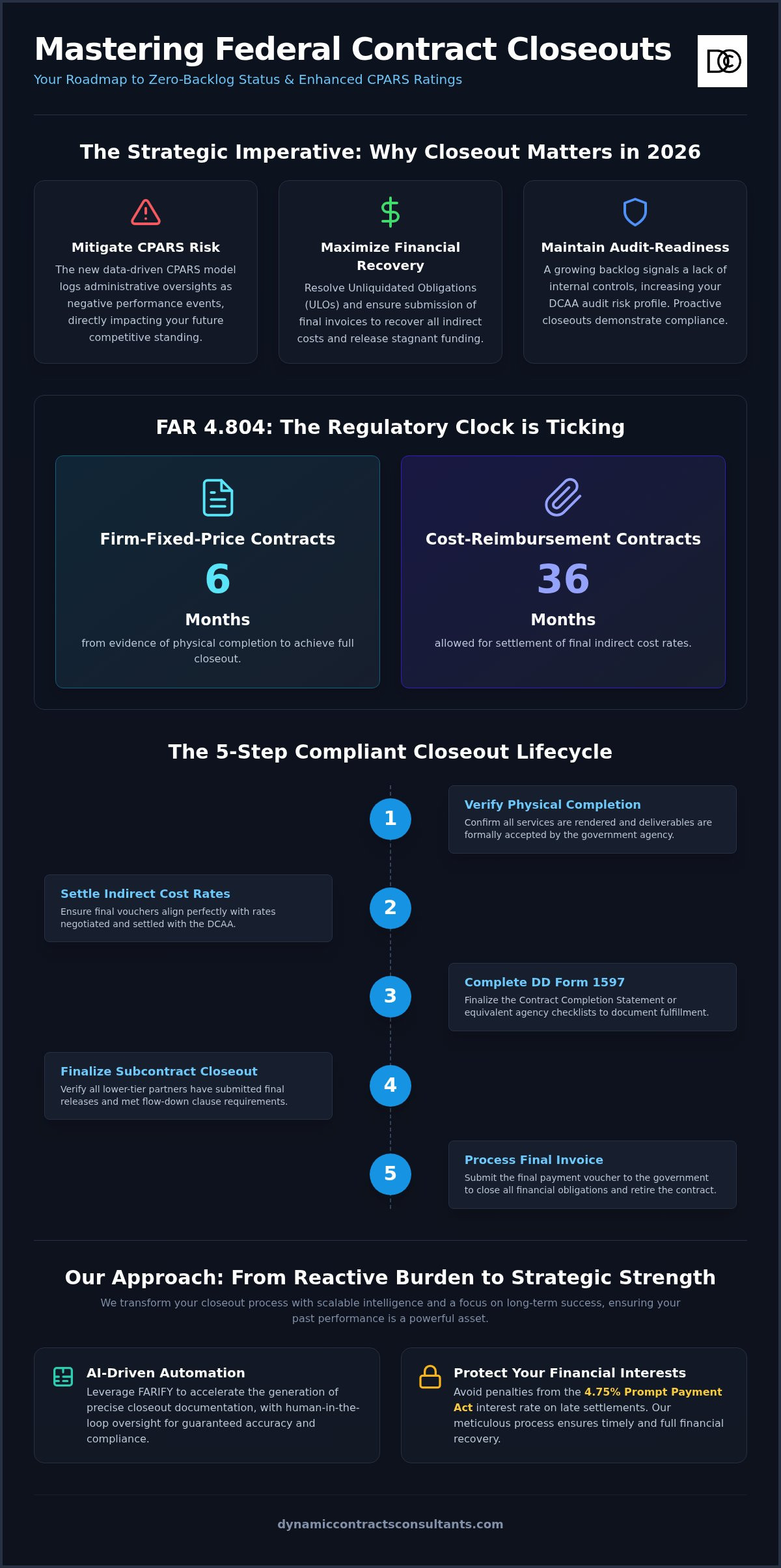
Under FAR 4.804, the timelines for closing a contract depend heavily on the specific contract type. For firm-fixed-price contracts, we must achieve closeout within six months of receiving evidence of physical completion. Cost-reimbursement contracts, which require the settlement of indirect cost rates, allow for a 36-month window. We consider a contract "physically complete" only when you've performed all required services and the government has formally accepted all deliverables. During this process, we coordinate with both the Contracting Officer (CO) and the Administrative Contracting Officer (ACO) to ensure all regulatory checklists are satisfied and the contract file is ready for retirement.
Closeout as a Competitive Advantage
Efficient administrative finalization is a hallmark of operational excellence that resonates with government agencies. They prefer partners who don't leave a trail of "administrative debt" behind them. When you demonstrate the ability to close out records promptly, you enhance your success in future strategic capture management services. It proves to the government that your team possesses the discipline to manage the full procurement lifecycle with precision. Our federal contract closeout services focus on this long-term success, ensuring your past performance remains a powerful asset rather than a liability for future bids.
The Lifecycle of a Compliant Federal Contract Closeout
The transition from an active performance period to official contract retirement is a multi-phased journey that requires meticulous attention to administrative detail. We define this lifecycle through a series of rigorous milestones designed to satisfy both FAR requirements and agency-specific protocols. Failing to follow these steps in sequence often leads to unliquidated obligations and unnecessary audit exposure. Our post-award compliance framework prioritizes a structured approach to these five essential steps:
- Step 1: Verification of physical completion. This involves confirming that all services are rendered and all deliverables are formally accepted by the government.
- Step 2: Final indirect cost rate settlement. For cost-reimbursable contracts, we ensure that final vouchers align with negotiated rates settled with the DCAA.
- Step 3: Completion of the Contract Completion Statement. We utilize the DD Form 1597 or equivalent agency checklists to document the fulfillment of all contractual obligations.
- Step 4: Subcontract closeout. We verify that all lower-tier partners have submitted their final releases and that flow-down clause requirements are met.
- Step 5: De-obligation and retirement. The final phase involves the government de-obligating remaining funds and officially closing the contract file.
Physical vs. Administrative Closeout Requirements
It's important to distinguish between task order completion and master contract closeout. While a specific project might be done, the master contract remains open until all administrative hurdles are cleared. We manage the "limbo" period by documenting the disposal of government-furnished property (GFP) and clarifying intellectual property rights. Research from the Naval Postgraduate School on Overcoming Common Closeout Bottlenecks suggests that proactive property disposal is a key factor in accelerating this phase.
Critical Documentation: From DD Form 1597 to Final Invoicing
The accuracy of your Contractor’s Release and Contractor’s Assignment of Refunds is paramount. These documents waive future claims against the government, so they must be executed with precision. We also ensure that patent reports and royalty disclosures are filed correctly to protect your commercial interests. If you're managing a complex portfolio, we recommend you reach out for a strategic consultation to ensure your final vouchers are audit-ready and reflect your full financial entitlement.
Overcoming Common Closeout Bottlenecks with Strategic Oversight
Strategic oversight serves as the primary mechanism for navigating the administrative friction that frequently halts the finalization of complex agreements. We often encounter "orphan" contracts, where the original project managers or administrative staff have departed, leaving a knowledge gap that stalls progress. In these scenarios, our federal contract closeout services provide the necessary continuity by reconstructing records and reconciling property discrepancies. Addressing mismatches between government and contractor property records early prevents the kind of protracted disputes that can delay final payment for years. We apply a "simple solutions to complex problems" philosophy to these hurdles, ensuring that administrative debt doesn't compromise your future bidding capacity.
Managing Indirect Rate Settlements and DCAA Audits
The wait for a formal DCAA audit can extend for several years, creating a significant backlog in your procurement lifecycle. We mitigate this risk by integrating DCAA compliance consulting into your ongoing operations, which ensures your final rate proposals are robust and defensible from the outset. For contracts meeting the specific thresholds defined in FAR 42.708, we leverage Quick-Closeout procedures. This allows us to negotiate settlements based on estimated rates, significantly accelerating the timeline for final payments without waiting for a formal audit of every fiscal year. Proactive measures like these are essential for resolving audit findings before they become permanent roadblocks to closeout.
Resolving Unliquidated Obligations (ULOs) and De-obligations
Unliquidated obligations (ULOs) represent funds that remain obligated to a contract but haven't been spent. These are more than just accounting entries; they're "trapped" capital that agencies are often eager to recover for other priorities. Our comprehensive federal contract closeout services include a detailed review of all financial records to identify excess funds that can be de-obligated. In cost-plus-award-fee (CPAF) environments, failing to resolve ULOs can lead to unrecovered costs if the final fee determination isn't documented with precision. We coordinate directly with the agency finance office for final fund reconciliation, ensuring that every dollar is accounted for. Managing the de-obligation process efficiently demonstrates a level of operational intelligence that significantly improves your long-term standing with the government.
Implementing an Audit-Ready Closeout Strategy
Strategic compliance requires a shift from reactive administration to a proactive, audit-ready posture. We establish rigorous internal controls that ensure every contract modification, deliverable acceptance, and financial reconciliation is documented in real-time. By utilizing specialized federal contract closeout services, you can ensure that your records remain defensible long after the period of performance ends. This level of operational efficiency is critical for meeting the six-year record retention requirements mandated for federal contractors. It protects your business from retroactive DCAA inquiries or agency disputes. Precision here is not optional.
Internal Controls for Post-Award Documentation
Maintaining a centralized repository for all compliance artifacts is the foundation of a successful closeout. We standardize the internal checklists for post-award contract administration to ensure that no deliverable or modification is overlooked. Our team conducts regular gap analyses to identify missing artifacts, such as final acceptance signatures or technical reports, before they become bottlenecks. This methodical approach ensures that when the time comes for finalization, your documentation is complete, organized, and ready for immediate agency review. We don't leave compliance to chance.
Flow-Down Clause Compliance in Subcontract Closeouts
One of the most overlooked risks in the procurement lifecycle is the interplay between subcontract finalization and prime contract closeout. We verify that all subcontractors have satisfied their specific flow-down requirements, including final patent reports and royalty disclosures. It's essential to ensure that your lower-tier partners have submitted their final releases of claims before you execute your own release to the government. This protects you from the risk of a subcontractor filing a claim after the prime contract has been officially retired. We help you manage this risk by documenting subcontractor compliance with the same level of precision applied to your own prime obligations.
Beyond technical deliverables, we ensure that all Procurement Integrity Act and ethics requirements are fully documented. This includes verifying that personnel who participated in the procurement process have adhered to post-employment restrictions and conflict-of-interest guidelines. If you need to strengthen your internal compliance framework or resolve a backlog of unclosed records, contact our expert consultants today to ensure your portfolio remains audit-ready and protected against future liabilities.
Optimizing Closeout Efficiency with Dynamic Contracts and FARIFY
Manual closeout processes are no longer sustainable in an environment where speed and precision are equally mandated by federal agencies. We recognize that the administrative burden of finalizing a contract can drain your internal resources and stall your growth. By integrating seasoned contract expertise with AI-driven automation, we offer a modern solution to the backlogs that often plague large-scale operations. Our federal contract closeout services leverage the power of FARIFY to transform complex regulatory requirements into audit-ready documentation with unprecedented speed. This synergy ensures that your team can focus on winning new business while we handle the intricate finality of your procurement lifecycle.
AI-Driven Document Generation for Rapid Closeouts
FARIFY serves as a vital force multiplier for your administrative teams. It extracts specific closeout requirements and generates comprehensive compliance matrices in minutes, a task that traditionally requires hours of manual labor. This reduction in administrative burden directly benefits your proposal writing and administration teams by freeing up resources for high-value capture activities. Every AI-generated output is built to meet strict FAR and DFARS standards, ensuring that speed never comes at the expense of regulatory accuracy. We utilize this scalable intelligence to manage high-volume backlogs, turning stagnant records into cleared files that no longer pose a risk to your performance profile.
Personalized Post-Award Administration and Compliance
While technology provides the speed, our "Human-in-the-Loop" advantage provides the necessary regulatory nuance. We leverage our CPCM and CFCM certified experts to navigate complex closeout negotiations that require professional judgment beyond the reach of simple automation. This is particularly vital when dealing with specialized agency requirements from the DoD, EPA, or NOAA. We provide customized templates and strategic oversight that align with these specific environments, ensuring a seamless transition from performance to retirement. Our experts review every automated output to ensure it reflects the specific realities of your contract performance.
Achieving a zero-backlog status requires a partner who understands both the legacy requirements of federal contracting and the future of digital transformation. We invite you to partner with Dynamic Contracts for comprehensive acquisition support to secure your past performance ratings and unlock capital for future growth. Our team is ready to apply these visionary strategies to your portfolio, ensuring long-term success in an increasingly data-driven federal market. We don't just close contracts; we protect your reputation and position your business for scalable growth.
Securing Your Competitive Future Through Administrative Precision
Mastering the final phase of the procurement lifecycle ensures your past performance remains a catalyst for growth rather than a source of risk. We've explored how professional federal contract closeout services mitigate the dangers of negative CPARS events while unlocking trapped capital from unliquidated obligations. By establishing audit-ready internal controls and adhering to strict record retention standards, you protect your enterprise from the long-term liabilities of the DCAA audit cycle.
Our approach integrates the high-level strategic oversight of Certified Professional Contracts Managers (CPCM) with the rapid, AI-powered document generation of FARIFY. This combination provides the scalable intelligence you need to resolve administrative backlogs without sacrificing precision. Whether you're navigating complex FAR and DFARS requirements or reconciling final indirect cost rates, we provide the expertise to ensure your portfolio is compliant and retirement-ready.
Streamline your federal contract closeout with our expert consultants today.
Let's transform your administrative burden into a strategic advantage that drives your next successful bid.
Frequently Asked Questions
What is the standard timeline for a federal contract closeout?
Standard timelines are dictated by FAR 4.804-1. Firm-fixed-price contracts should be finalized within 6 months of physical completion. Contracts requiring indirect cost rate settlements have a 36-month window, while all other contract types target a 20-month completion period. We utilize these benchmarks to measure the efficiency of our federal contract closeout services, ensuring your portfolio remains compliant with regulatory expectations and avoids unnecessary administrative backlogs.
What happens if a federal contract is not closed out on time?
Delays in finalization result in "administrative debt" and trapped capital in the form of unliquidated obligations. Agencies may view a backlog of unclosed contracts as a sign of weak internal controls, which increases your DCAA audit risk profile. Additionally, the modern CPARS model logs missed administrative deadlines as negative performance events. This can directly compromise your ability to secure future awards during the strategic capture management phase.
How does a contract closeout affect my company’s CPARS rating?
The 2026 CPARS overhaul emphasizes data-driven performance logging over subjective narratives. Efficient closeout demonstrates operational excellence and ensures that your final performance record is accurate and positive. Failing to provide final releases or delaying the submission of final vouchers can trigger negative entries. We ensure that every administrative milestone is documented to protect your reputation and maintain your status as a preferred federal partner in future bids.
Can I close out a contract before the final DCAA audit is complete?
You can often accelerate the process through Quick-Closeout procedures as defined in FAR 42.708. This allows us to negotiate final settlements based on estimated indirect rates rather than waiting for a formal DCAA audit of every fiscal year. This strategy is particularly effective for contracts that meet specific dollar thresholds or risk profiles. It enables you to recover final payments and retire the contract file significantly faster than traditional audit timelines allow.
What is the difference between physical and administrative closeout?
Physical closeout occurs once you've completed all services and the government has formally accepted all deliverables. Administrative closeout is the subsequent phase where we finalize indirect cost rates, submit the final invoice, and execute the Contractor’s Release. While physical completion ends your operational duties, administrative finality is what officially retires the contract record and releases the government from further financial liability, ensuring your audit-ready status is preserved across the procurement lifecycle.
What documents are required for a standard federal contract closeout?
A standard closeout package requires several critical artifacts to satisfy FAR requirements. This includes the Contract Completion Statement (DD Form 1597), the Contractor’s Release, and the Contractor’s Assignment of Refunds. We also ensure the inclusion of final patent reports, royalty disclosures, and a final voucher that aligns with settled indirect rates. Maintaining these documents in a centralized repository is a core component of our federal contract closeout services, providing a clear audit trail.
How can AI technology like FARIFY assist in the closeout process?
FARIFY utilizes AI-driven automation to extract specific closeout requirements and generate comprehensive compliance matrices in minutes. This technology significantly reduces the manual labor required to prepare closeout paperwork and audit-ready records. By automating the repetitive elements of document generation, we allow your team to focus on complex negotiations while ensuring that every output meets strict FAR and DFARS standards. It provides a scalable solution for managing high-volume contract backlogs with precision.
What are the record retention requirements after a contract is closed?
Federal regulations generally mandate a six-year record retention period following the final payment on a contract. You must maintain all contract modifications, deliverable acceptances, and financial records to remain defensible against retroactive DCAA inquiries. We help you establish internal controls that organize these artifacts during the closeout phase, ensuring your business is prepared for any future agency reviews. Proper retention is the final safeguard in a robust post-award administration strategy.


