

Your indirect rate is either your greatest competitive weapon or the primary reason you'll lose your next prime contract. Many contractors view these percentages as a burden of federal accounting, but they're actually the most powerful lever for balancing regulatory safety with market growth. We understand that the complexity of FAR and DFARS cost principles can feel overwhelming, especially when the fear of a failed audit looms over your financial planning. Professional DCAA indirect rate consulting isn't just about checking a box for the auditors; it's about building a financial architecture that supports scalable growth without sacrificing your margins.
We'll help you master these complexities to ensure your organization remains fully compliant while optimizing your pricing strategy for 2026. This framework provides the blueprint for audit-ready records and competitive rate pools that win bids. We'll examine how to structure your pools, implement scalable compliance, and leverage AI-driven tools to maintain precision in an increasingly scrutinized environment. By the end of this guide, you'll have the strategic insights needed to transform your indirect rates from a compliance hurdle into a distinct business advantage.
Key Takeaways
- Understand how strategic compliance transforms indirect rates from a regulatory burden into a mechanism for maximizing your cost recovery and contract profitability.
- Identify the optimal rate structure for your organization by comparing the distinct advantages of two-tier and three-tier cost pools.
- Master the essential steps for establishing a DCAA-compliant accounting system and developing provisional billing rates to ensure your organization is always audit-ready.
- Discover how our specialized DCAA indirect rate consulting leverages AI-driven automation to produce precise documentation that supports your scalable growth.
- Gain a visionary edge in the 2026 procurement lifecycle by aligning your financial architecture with the latest federal requirements and operational efficiency standards.
The Strategic Necessity of DCAA Indirect Rate Consulting
Indirect rates represent the lifeblood of a federal contractor's financial health. We define these rates as the mechanism for recovering legitimate business overhead costs that aren't directly attributable to a single project. Far from being a mere accounting entry, DCAA indirect rate consulting serves as a strategic bridge between your operational expenses and your revenue. Strategic compliance is essential because it ensures your organization maintains profitability, particularly on cost-plus contracts where every dollar of unallowable cost directly erodes your bottom line. Within the broader federal procurement lifecycle, these rates dictate your ability to scale, invest in talent, and survive the scrutiny of a post-award audit.
A common misconception persists among emerging contractors: the idea that lower rates are always better for winning bids. In reality, artificially suppressed rates often lead to under-recovery. This means you're essentially subsidizing the government's work out of your own profit margins. We've seen that a well-justified, slightly higher rate often signals a more mature, stable infrastructure to federal evaluators. It's about finding the "goldilocks zone" where your rates are low enough to be competitive but high enough to keep the lights on and the talent paid.
Impact on Proposal Win-Rates and Pricing Strategy
Your wrap rate is the total cost of a labor hour after all indirect burdens are applied. Correctly structured pools allow you to present a more competitive pricing volume without sacrificing the resources needed to execute the work. If you set your rates too low to appear cheap, you risk a financial shortfall that compromises project performance. We recommend integrating specialized rate analysis into your strategic capture management process. This ensures that your bids are both attractive to the agency and sustainable for your firm's long-term health. Precise rate forecasting allows you to bid with confidence, knowing your overhead recovery is mathematically sound.
Regulatory Risks of Mismanaged Indirect Pools
The consequences of mismanagement are severe and often permanent. DCAA audit findings can lead to payment suspensions, mandatory cost disallowances, or the loss of future eligibility for prime contracts. Without expert DCAA indirect rate consulting, unallowable costs like certain marketing expenses or entertainment often slip into indirect pools. This triggers red flags during an Incurred Cost Submission review. We help you establish a foundation of audit-ready records from the first day of the fiscal year. This proactive stance prevents the panic of retroactive corrections and ensures that your financial reporting remains a source of strength rather than a liability.
Decoding Indirect Cost Pools: Fringe, Overhead, and G&A
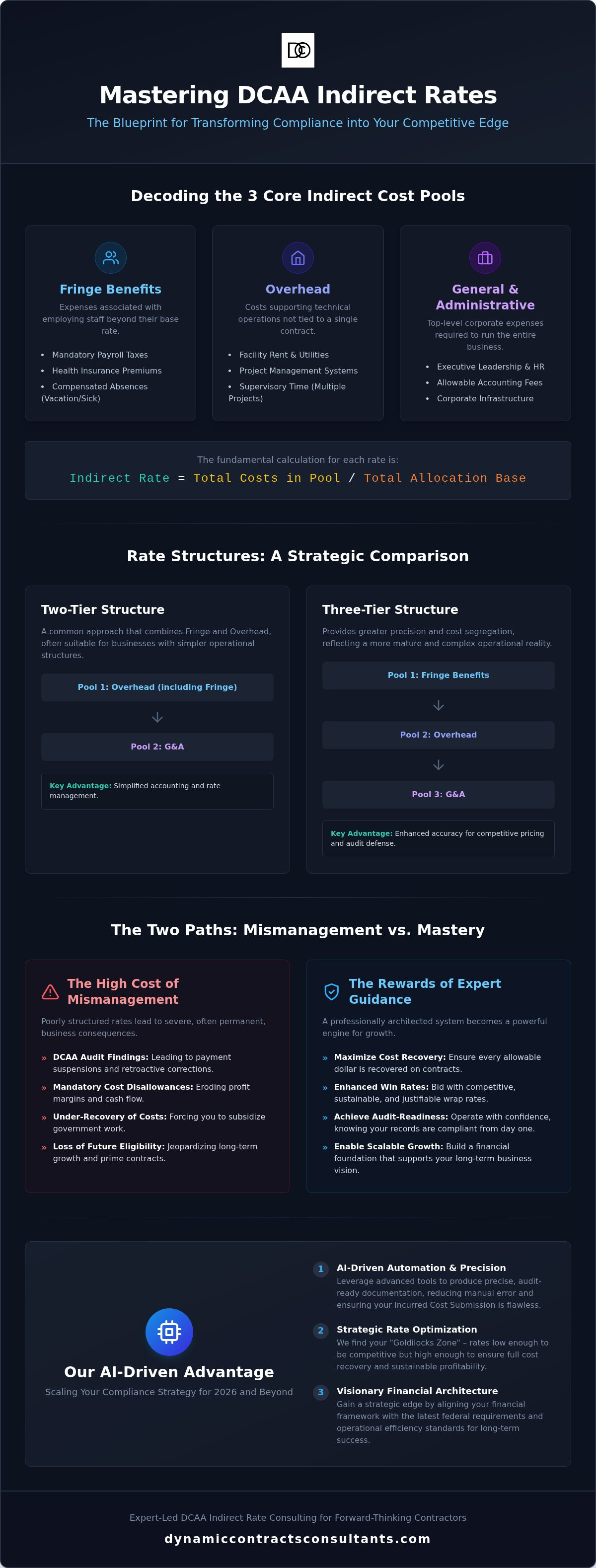
Structuring your indirect cost pools is a foundational step in establishing a compliant financial framework. We view these pools not just as accounting buckets, but as reflections of your operational reality. The Fringe Benefit pool captures expenses associated with employing staff beyond their base hourly rate. This includes mandatory payroll taxes, health insurance premiums, and compensated absences such as vacation or sick leave. Overhead pools represent costs that support specific technical operations but aren't tied to a single contract. Examples include facility rent, utilities, and the time of supervisors who manage multiple projects. Finally, General and Administrative (G&A) costs cover the "top-level" expenses required to run the entire corporate entity, such as executive leadership, human resources, and allowable accounting fees.
Selecting the correct allocation base is a critical decision in DCAA indirect rate consulting. You must choose between Direct Labor Dollars, which is standard for fringe and overhead, or a broader base like Total Value Added (TVA) or Total Cost Input (TCI) for G&A. The goal is to ensure that the base accurately represents the volume of activity that drives the costs in the pool. Choosing an inappropriate base can lead to skewed rates that either price you out of the market or leave your business under-funded during execution.
The Allocation Formula: Pool vs. Base
The indirect rate formula is the total pool of costs divided by the selected allocation base. While the math seems simple, the justification requires deep expertise. FAR 31.203 requires that the relationship between the pool and the base be "causal or beneficial." If you select a base that doesn't reflect how costs are actually incurred, you invite DCAA red flags during a system review. Common errors include using an inconsistent base across fiscal years or failing to exclude unallowable costs from the base itself. These mistakes can lead to distorted rates and significant audit risks.
Identifying and Segregating Unallowable Costs
Success in federal contracting requires a rigorous approach to FAR 31.205. Costs like entertainment, lobbying, and specific legal fees are strictly unallowable and must be removed from your indirect pools. We advocate for the FARify approach, utilizing AI-driven automation to flag these expenses before they reach your final submission. This scalable intelligence ensures that your team focuses on high-level strategy rather than manual data entry. To maintain compliance, you should establish separate general ledger accounts specifically for unallowable entries. If you're unsure how to structure these accounts for maximum efficiency, you can consult with our strategic compliance team to build a custom roadmap.
Two-Tier vs. Three-Tier Rate Structures: A Strategic Comparison
Selecting the appropriate indirect rate structure is a pivotal decision that impacts your organization's long-term financial agility. We've observed that many contractors default to a simpler model without considering how it might constrain their growth. Your choice between a two-tier or three-tier framework should be driven by your operational complexity and the nature of your contract portfolio. Expert DCAA indirect rate consulting ensures that your structure doesn't just meet the minimum regulatory requirements, but actively supports your competitive positioning in the federal marketplace. As you scale, the precision of your cost recovery becomes just as important as the quality of your technical delivery.
When to Choose a Two-Tier Structure
A two-tier structure typically consists of a Fringe pool and a General and Administrative (G&A) pool. We recommend this model for service-based small businesses where the primary cost driver is direct labor and there's minimal overhead outside of corporate functions. By grouping all non-direct costs into a single G&A pool, you streamline your internal accounting and simplify post-award contract administration and reporting. However, be aware of the limitations. A two-tier structure can inadvertently inflate your G&A rate, making your corporate office appear more expensive than it actually is, which may lead to challenges during price evaluations for larger contracts.
The Advantages of a Three-Tier Framework
For businesses with distinct facility requirements, manufacturing labs, or heavy R&D equipment, a three-tier framework is often the superior choice. This structure adds an Overhead pool to the Fringe and G&A components, allowing for much greater pricing precision. By separating overhead, you prevent a scenario where you're "subsidizing" a low-overhead service contract with the costs of a high-overhead laboratory facility. Aligning your financial architecture with the DCAA compliance consulting framework early in your growth cycle provides the scalability needed to pursue diverse contract types without needing a total system overhaul later.
Strategic compliance also involves choosing the right G&A base. Most firms use a Total Cost Input (TCI) base, which includes all direct costs plus fringe and overhead. This is generally the most stable option. However, if your business manages large subcontracts or high material volumes, a "Value-Added" G&A base might be more appropriate. A Value-Added base excludes subcontracts and materials, focusing G&A recovery on the labor value your firm actually provides. We help you evaluate these variables to determine when to transition from simplicity to complexity, ensuring your rates remain a tool for victory rather than a barrier to entry.
Best Practices for Rate Calculation and Audit Preparedness
Integrating DCAA indirect rate consulting into your daily operations requires a disciplined, step-by-step approach to maintain fiscal integrity. First, you must establish a DCAA-compliant accounting system that ensures clear cost segregation between direct, indirect, and unallowable expenses. This isn't a one-time setup; it's a living framework that supports every transaction your business makes. Second, you'll develop Provisional Billing Rates (PBRs) to use on current-year vouchers. These rates represent your best estimate of final costs and are vital for maintaining steady cash flow while staying within regulatory bounds.
To stay ahead of the curve, we recommend conducting monthly "rate vs. actual" reconciliations. This proactive habit prevents year-end surprises and ensures your financial health remains transparent to both your leadership and the government. Preparing your Incurred Cost Submission (ICS) becomes significantly more manageable when you have audit-ready supporting documentation compiled throughout the year. We leverage AI-driven automation through platforms like FARIFY to maintain a real-time compliance matrix, giving you a visionary edge in operational efficiency by flagging discrepancies before they become liabilities.
Managing Provisional Billing Rates Throughout the Year
Provisional billing rates aren't static figures to be set and forgotten. You must adjust your provisional rates when significant business changes occur, such as winning a substantial new contract or losing a major program. If your actual costs deviate significantly from your estimates, prompt communication with your Administrative Contracting Officer (ACO) is essential. We've seen that avoiding over-billing protects you from interest penalties and unnecessary audit scrutiny. Regular adjustments demonstrate to the government that your organization possesses a high level of fiscal maturity and control over its financial destiny.
The Incurred Cost Submission (ICS) Roadmap
The ICS is perhaps the most critical milestone in the federal financial calendar. You have a strict six-month window after the close of your fiscal year to file this submission. Utilizing post-award compliance services helps streamline the closeout process and ensures the accuracy of your final indirect cost rate proposal. Audit-ready means every pool cost is backed by a verifiable transaction and a FAR-compliant justification. By maintaining this standard, you'll find that the audit process becomes a routine validation rather than a source of organizational stress. If you're ready to modernize your compliance framework for the 2026 fiscal year, contact our strategic consulting team to begin your transformation.
Scaling Your Compliance Strategy with DCC and FARIFY
Dynamic Contracts Consultants LLC acts as your strategic partner by bridging the gap between complex federal requirements and your organization's operational goals. We've spent decades mastering the nuances of FAR and DFARS regulations to ensure that our DCAA indirect rate consulting provides more than just a compliance check. It delivers a roadmap for sustainable growth. By positioning ourselves as an extension of your team, we offer comprehensive lifecycle support that spans from initial acquisition planning to the final contract closeout. This holistic approach ensures that your financial architecture remains resilient throughout every phase of the procurement lifecycle.
The FARIFY advantage lies in our commitment to scalable intelligence. While generic accounting software often fails to account for the specific rigors of a DCAA audit, our platform produces compliant documentation in minutes rather than weeks. We've built a "human-in-the-loop" assurance model that combines the speed of AI-driven automation with the seasoned judgment of our Certified Professional Contracts Managers (CPCM). This synergy ensures that every output is mathematically precise and strategically sound, allowing you to focus on mission execution while we handle the regulatory heavy lifting.
AI-Driven Automation for Modern Contractors
Our AI technology is designed to accelerate the most time-consuming aspects of federal contracting. It automatically extracts RFP requirements and aligns them with your existing indirect rate structure to ensure total consistency. This capability significantly reduces the turnaround time for compliance matrices and solicitation drafts. Beyond back-office efficiency, our technology plays a vital role in optimizing win-rates via technical proposal editing. By ensuring your pricing and technical volumes are perfectly synchronized, we help you present a more professional and lower-risk profile to government evaluators.
Your Partner in Strategic Growth
We believe that compliance shouldn't be a hurdle to your success, but a foundation for it. Beyond preparing you for an audit, we help you build a scalable intelligence framework that empowers your internal team with visionary consulting. Our experts provide the clarity needed to make informed decisions about rate adjustments, pool restructuring, and capture strategy. This partnership transforms your financial operations into a high-performance engine capable of supporting larger and more complex prime contracts. If you're ready to secure your competitive advantage for 2026 and beyond, leverage our expert insights for your business growth-contact us today.
Future-Proofing Your Federal Financial Strategy for 2026
Winning in the 2026 federal marketplace requires a shift from reactive accounting to proactive financial engineering. We've explored how identifying the correct cost pools and selecting between two-tier or three-tier structures can transform your profitability. Your organization's ability to maintain audit-ready records while optimizing wrap rates is the ultimate differentiator during complex price evaluations. Precise rate management ensures you don't just win the contract but remain profitable throughout its execution.
Our team brings CPCM and CFCM certified expertise alongside proven prime contractor experience with the DoD and State Department to every engagement. By integrating DCAA indirect rate consulting with our AI-powered FARIFY platform, we ensure your documentation is both mathematically precise and strategically aligned with RFP requirements. This synergy of human intelligence and scalable automation protects your margins and secures your reputation with Administrative Contracting Officers. Don't let regulatory complexity stall your organization's growth. Secure your federal future: contact Dynamic Contracts Consultants for DCAA rate consulting. We're ready to help you build a compliant, competitive framework that stands up to the most rigorous scrutiny.
Frequently Asked Questions
What is the difference between a direct cost and an indirect cost in DCAA terms?
Direct costs are expenses specifically identifiable with one final cost objective, such as direct labor or materials for a specific contract. Indirect costs are those that benefit multiple projects or the entire corporate entity, like rent or executive salaries. We help you distinguish these clearly within your accounting system. This segregation is the foundation of effective DCAA indirect rate consulting, ensuring that you recover all allowable costs without risking audit findings for misallocation.
How often should I update my provisional billing rates?
You should update your provisional billing rates at least once a year, typically at the start of your fiscal year. However, we recommend more frequent adjustments if your business experiences significant shifts, such as winning a substantial prime contract or losing a key program. These changes can dramatically alter your actual overhead percentages. Keeping your rates current helps you avoid significant year-end reconciliations and prevents the government from overpaying or underpaying during performance.
What are the most common unallowable costs that DCAA looks for?
DCAA auditors specifically look for unallowable costs defined in FAR 31.205, including entertainment, lobbying, and alcoholic beverages. Other common red flags include certain legal fees, interest expenses, and federal income taxes. Our team uses the FARIFY platform to flag these entries automatically. By identifying these unallowable items during your monthly reconciliations, we ensure your indirect pools remain clean and your organization stays audit-ready from the very first day of the fiscal year.
Can a small business use a simple two-tier indirect rate structure?
Small businesses often find success with a two-tier structure, which typically includes Fringe and General and Administrative (G&A) pools. This model is particularly effective for service-based firms with minimal facility or equipment overhead. It simplifies your post-award administration and reduces the complexity of your annual incurred cost submissions. We evaluate your specific operational needs to determine if this simple structure provides the best balance between regulatory compliance and competitive pricing for your scalable growth.
What happens if my actual indirect rates are significantly higher than my provisional rates?
If your actual rates are significantly higher than your provisional rates, you risk under-recovering your legitimate business expenses. This means you're essentially funding government work out of your own profit margins. Conversely, if actual rates are lower, you may owe the government a refund, which can lead to interest penalties. We help you monitor these variances monthly. If a significant gap persists, we'll guide you through the process of submitting adjusted rates to your Administrative Contracting Officer.
How does AI technology like FARIFY help with DCAA compliance?
FARIFY leverages AI-driven automation to extract RFP requirements and generate compliant documentation in minutes. This technology streamlines the creation of compliance matrices and acquisition strategy documents that are traditionally labor-intensive. By using our "human-in-the-loop" assurance model, you get the speed of modern technology combined with the expertise of our CPCM-certified consultants. This scalable intelligence ensures that your DCAA indirect rate consulting framework is both technically precise and strategically optimized for the procurement lifecycle.
What is an Incurred Cost Submission (ICS) and when is it due?
An Incurred Cost Submission (ICS) is the final proposal of your actual indirect rates for a completed fiscal year. It's the mechanism the government uses to settle the difference between your provisional billing and actual costs. Per FAR requirements, you must submit your ICS within six months of the end of your fiscal year. We provide full-lifecycle support to ensure your submission includes all required schedules and audit-ready justifications to facilitate a smooth contract closeout process.
Do I need a DCAA-compliant accounting system before bidding on a cost-plus contract?
You typically must have a DCAA-compliant accounting system, or one that can be certified as such, before a cost-plus contract is awarded. Contracting officers often require a pre-award survey, known as an SF 1408, to verify your system's capability for cost segregation. We help you establish these systems early in your procurement lifecycle. This proactive approach ensures you're ready for the scrutiny of prime contractor audits for major agencies like the DoD or the State Department.


