

In the high-stakes environment of 2026 federal contracting, waiting for a Request for Proposal (RFP) to be released is often the fastest way to lose a bid. You've likely felt the frustration of investing significant resources into a proposal only to find the requirements were seemingly tailored for a competitor. This recurring pain point leads many growth-minded executives to ask: what is a capture manager and why is this role the deciding factor between a wasted pursuit and a high-value award? We recognize that low win-rates and resource drain are unsustainable in a market where the Simplified Acquisition Threshold has reached $350,000 and compliance standards like CMMC 2.0 are now mandatory.
We believe that winning is a result of strategic architecture built months before a solicitation exists. In this article, you'll discover the critical role of a capture manager in government contracting and how they leverage strategic intelligence to secure high-value federal awards. We'll provide a clear framework for integrating capture into your procurement lifecycle while highlighting how AI-driven automation through platforms like FARIFY.ai enhances your probability of success. You'll gain a comprehensive understanding of the capture manager's ROI and how they act as the essential architect of your federal win strategy.
Key Takeaways
- Learn what is a capture manager and why they're essential for positioning your firm to win high-value federal awards before the RFP is even released.
- Gain insights into the 12 to 18 month scouting cycle and how competitive intelligence helps you identify incumbent weaknesses early.
- Understand the critical distinction between capture management's strategic focus and the document-driven execution of proposal management.
- Explore how AI-driven automation and tools like FARIFY.ai accelerate market research and acquisition planning for audit-ready results.
- Master the integration of strategic compliance into your pursuit strategy to ensure alignment with 2026 FAR and DFARS requirements.
Defining the Capture Manager: The Architect of Federal Win Strategies
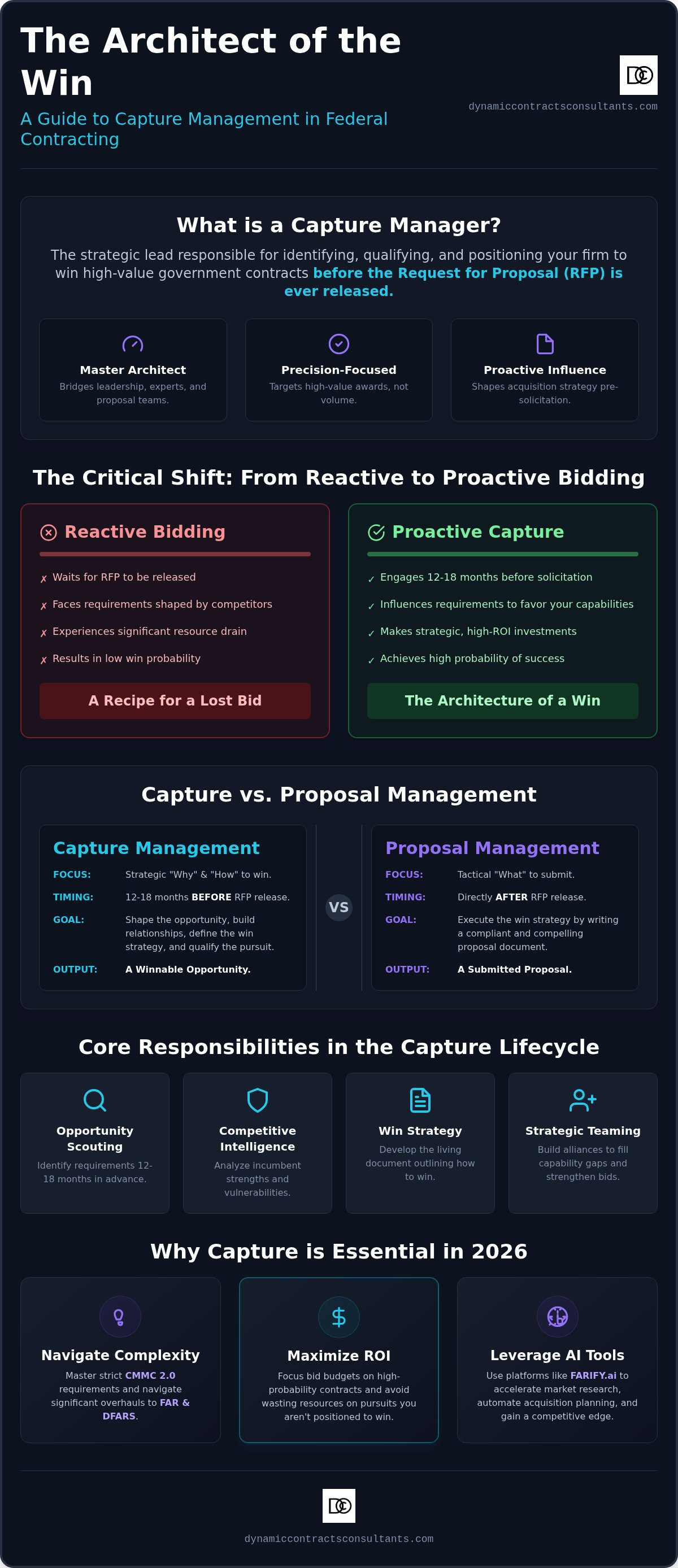
A capture manager is the strategic lead responsible for identifying, qualifying, and positioning your firm to win specific government contracts. While many business leaders confuse this role with traditional sales, the distinction is critical for success in the public sector. Unlike sales roles that focus on volume, capture management focuses on precision and alignment within the federal procurement lifecycle. We define capture management as the proactive process of influencing the acquisition strategy before a solicitation is released. This role is a specialized discipline within Business development, focused specifically on the high-stakes tactical maneuvers required to win a single, high-value award.
The role acts as a master architect, bridging the gap between your executive leadership, technical subject matter experts, and the proposal team. When you're asking "what is a capture manager," you should view them as the person who ensures your technical solution isn't just compliant, but also the most attractive option for the contracting officer. They translate high-level corporate goals into actionable win themes that resonate with the agency’s specific pain points, ensuring that we present a unified and persuasive front to the government.
To better understand this concept, watch this helpful video:
The Shift from Reactive to Proactive Bidding
In the federal space, waiting for the RFP to drop is a recipe for a low win-probability. By that point, the competitive landscape is often already set, and the requirements may have been shaped by contractors who engaged months earlier. We advocate for the "Left of Bang" concept, which focuses on engaging with the government during the acquisition planning phase, well before a formal solicitation exists. This proactive engagement allows you to understand the agency's needs and influence the requirements to favor your unique capabilities. Proactive capture significantly reduces the friction often found during the bid-no-bid analysis phase because you've already validated the opportunity's fit and built the necessary rapport.
Why Your Firm Needs a Capture Strategy in 2026
The federal contracting environment in 2026 is more complex than ever, with significant overhauls to the FAR and strict CMMC 2.0 requirements now in full effect. Your firm needs a capture strategy to navigate these hurdles and build "scalable intelligence" that supports sustainable growth. Without this disciplined approach, you risk the common pain of chasing the wrong opportunities and wasting valuable resources on bids you were never positioned to win. A robust capture process ensures that every pursuit is grounded in strategic compliance and operational efficiency. By prioritizing rigorous opportunity qualification, we help you focus your bid budget on the contracts that offer the highest return on investment.
Core Responsibilities: From Opportunity Scouting to Competitive Intelligence
The operational duties of this role extend far beyond basic lead generation. When analyzing what is a capture manager, we must examine the exhaustive intelligence gathering they perform well before a solicitation exists. They conduct market research to identify upcoming requirements 12 to 18 months in advance. This lead time is essential. It allows you to perform deep-dive competitive intelligence to understand the incumbent's strengths and vulnerabilities. We don't just look at their past performance; we analyze if they've met their contract ceilings or if their current technical approach is outdated according to 2026 standards.
A primary output of this phase is the 'Win Strategy.' This is a living document that outlines exactly how you'll beat the competition based on Section L and M criteria. It guides the development of teaming agreements by identifying:
- Strategic partners to fill technical capability gaps.
- Small business partners for set-aside compliance.
- Firms with specific agency-level past performance.
Strategic Acquisition Planning and Market Research
We help you navigate complex market research reports and pre-solicitation synopses to ensure you aren't blindsided by late-stage RFP changes. By analyzing the Performance Work Statement (PWS) and Statement of Work (SOW) during the draft phase, we can help you shape the requirement to highlight your firm’s unique value. This early involvement is critical for aligning your internal resources with the agency's long-term objectives. You can learn about our acquisition planning services to see how we streamline this intensive research phase.
The Bid/No-Bid Decision Framework
Success in 2026 requires a data-driven framework for evaluating whether an opportunity is worth the pursuit cost. Integrating the question of what is a capture manager into your organizational structure requires this clear decision-making process. We analyze risk factors, such as DCAA compliance and past performance requirements, to protect your bid budget. This rigorous qualification process is central to Capture Management Principles; it prevents your team from chasing contracts where the probability of win is low. We also examine the impact of the 2026 FAR and DFARS overhauls on specific contract types. For a deeper look at this process, explore The Bid/No-Bid Analysis Decision Framework. If you're ready to refine your pursuit strategy, you should consult with our team to ensure your pipeline is optimized for maximum ROI.
Capture vs. Proposal Management: Navigating the Procurement Lifecycle
We often see firms struggle because they conflate capture with proposal writing. While they're related, they serve distinct functions in the procurement lifecycle. Capture management represents the 'What' and 'Why' of a pursuit, focusing on the strategic alignment of your solution with the agency's mission. In contrast, proposal management is strictly the 'How', representing the tactical execution of the response document. The Role of a Capture Manager involves shaping the competitive landscape months before an RFP is even drafted, whereas proposal management begins the moment the solicitation is officially released.
The capture manager owns the external relationship and the overall win strategy; the proposal manager owns the document and the hard deadline. While capture managers influence the requirement, proposal managers ensure the response is 100% compliant with Section L instructions. If you're still asking what is a capture manager, it's helpful to view them as the visionary strategist who hands a blueprint to the proposal manager for construction. This distinction ensures that your team doesn't just write well, but writes the specific solution the government wants to buy.
The Strategic Hand-off: Ensuring Seamless Transition
The transition from capture to proposal is the most vulnerable point in the lifecycle. The transition is critical. We ensure this hand-off is seamless by using the Capture Plan as the foundation for the Proposal Outline. A robust 'Compliance Matrix' acts as the bridge here, mapping the intelligence gathered during the capture phase directly to the RFP requirements. You can explore our proposal writing expertise to see how we transform capture intelligence into audit-ready responses that meet the rigorous standards of 2026 federal acquisitions.
Collaborative Synergy for Maximum Win-Rates
Misalignment between these two functions often leads to 'strategic drift', where the final proposal fails to reflect the win themes established during the capture phase. We avoid this through a unified approach where technical volumes are continuously reviewed against the original win strategy. Compliance is the baseline. However, winning requires 'Human-in-the-loop' assurance to ensure that AI-driven tools remain aligned with the nuanced relationship intelligence only a capture manager can provide. By maintaining this synergy, we maximize your win-rates and ensure that your scalable intelligence is reflected in every page of the submission.
Essential Competencies and the Rise of AI-Driven Capture Tools
To succeed in the 2026 federal market, a professional must blend regulatory mastery with technological agility. When asking what is a capture manager in the current climate, you'll find that technical expertise alone is insufficient. They must possess "strategic compliance" knowledge, encompassing the latest FAR and DFARS overhauls. This includes the ability to translate complex federal financial standards into competitive cost-price strategies that align with agency budgets. We prioritize professionals who can synthesize these data points to create a price-to-win strategy that balances profit with competitive positioning.
Beyond numbers, they require elite negotiation skills. Establishing teaming agreements and managing flow-down clauses requires a deep understanding of post-award risks. We believe that a capture manager who can't navigate the nuances of a Teaming Agreement is a liability to the firm’s long-term operational efficiency. Their role is to ensure that every partnership established during the capture phase strengthens the overall bid without introducing unnecessary compliance vulnerabilities.
Leveraging AI for Rapid Acquisition Intelligence
The era of manual market research is ending. Our FARIFY platform represents the modern standard for AI-driven automation, generating compliant acquisition strategy documents in minutes rather than weeks. Capture managers now use AI for RFP requirement extraction and technical volume support, allowing them to focus on high-value relationship building. This shift ensures that acquisition planning remains audit-ready while significantly increasing the speed of the pursuit. By utilizing scalable intelligence, we help you identify capability gaps and potential partners with surgical precision, ensuring your pursuit remains both agile and compliant.
Certifications and Professional Standards
Professional standards provide the baseline for trust in complex business environments. We look for certifications such as the Certified Professional Contract Manager (CPCM) or the Certified Federal Contract Manager (CFCM). These credentials signify a commitment to the disciplined approach required for federal success in 2026. Deep expertise in federal contracting regulations is non-negotiable; every capture activity must be audit-ready from the start to prevent post-award complications. We bridge the gap between acquisition planning and post-award compliance by ensuring your win strategy is built on a foundation of regulatory precision. If you're looking to elevate your firm's pursuit capabilities, you should contact our strategic consultants today to discuss a customized capture framework.
Optimizing Your Pursuit Strategy with Strategic Capture Management Services
Understanding what is a capture manager is only the foundation of a successful federal growth strategy. The real value lies in the execution of a disciplined pursuit framework that transforms raw intelligence into secured contracts. We provide comprehensive capture management designed to improve your success rate in government acquisitions by eliminating the guesswork often found in the procurement lifecycle. Our methodology combines high-level human expertise with AI-powered speed to deliver simple solutions to complex administrative problems. By partnering with us, you gain a strategic ally dedicated to your scalable growth and operational precision.
We believe that success in the federal market requires more than just technical capability. It demands a sophisticated understanding of how to position that capability within the specific constraints of the 2026 regulatory environment. Our team acts as an extension of your leadership, ensuring that every opportunity you pursue is qualified, vetted, and strategically aligned with your firm's long-term objectives.
Tailored Solutions for Complex Federal Requirements
We customize every capture plan to align with the specific technical and regulatory demands of your industry. Whether your firm operates in Aerospace, Engineering, or Environmental Services, we adapt our approach to mirror the agency’s mission-critical needs. A unique advantage of our service is the early integration of DCAA compliance consulting during the capture phase. This proactive alignment ensures that your technical solutions are financially sound and audit-ready long before the award is made. You can learn about our post-award compliance services to understand how we mitigate risk across the entire contract duration.
Take the Next Step in Your Federal Growth
Proactive capture management remains the single most effective way to increase your ROI on federal bidding. It shifts your firm from a reactive stance to a position of market leadership. We leverage our extensive track record as a prime contractor for major agencies, including the DoD and NASA, to provide you with an insider perspective on win themes and evaluation criteria. Our team knows exactly what contracting officers look for in a winning response because we've been in the trenches ourselves. If you're ready to secure high-value awards and scale your operations, you should contact our experts to refine your capture strategy today.
Mastering the Federal Market Through Strategic Intelligence
Winning in the 2026 federal landscape requires a shift from reactive bidding to proactive architecture. We've explored how a disciplined approach to the procurement lifecycle creates a sustainable advantage by identifying opportunities 12 to 18 months before a solicitation exists. Understanding what is a capture manager serves as the first step toward transforming your firm from a participant into a preferred partner. By leveraging AI-driven automation through our FARIFY platform and maintaining strict DCAA compliance, we ensure your pursuit strategy is both agile and audit-ready.
We bring the perspective of a prime contractor for the DoD, State Department, EPA, and NOAA directly to your win themes. Our methodology bridges the gap between early intelligence and post-award success; it provides you with a scalable framework for federal growth. Don't leave your success to chance in a market defined by regulatory complexity and intense competition. We invite you to secure your next federal contract with our strategic capture management expertise. Your journey toward high-value awards begins with a commitment to strategic precision and visionary leadership. We look forward to building your win strategy together.
Frequently Asked Questions
What is the difference between a capture manager and a business development manager?
A business development manager identifies broad market trends and fills the pipeline with potential leads across various agencies. In contrast, the role of what is a capture manager focuses on winning a specific, qualified opportunity. While BD is about scale and long-term relationship building, capture management is a tactical discipline centered on technical alignment and win strategy for a single award. We view BD as the scout and the capture manager as the architect who builds the winning pursuit strategy.
How much does a capture manager typically cost for a federal contractor?
Hiring an internal capture manager represents a significant investment for any federal contractor. In 2026, the national median salary for this role is approximately $181,000; total pay ranges often span from $138,000 to $240,000. These figures vary based on security clearance and specialized experience. For many organizations, partnering with a strategic consulting firm provides access to this expertise at a fraction of the cost of a full-time executive hire, ensuring better scalability for your pursuit budget.
Can AI replace a capture manager in the government contracting space?
AI cannot replace the strategic intuition and relationship-building skills of a professional capture manager. However, it serves as a powerful force multiplier for operational efficiency. Our FARIFY platform utilizes AI-driven automation to generate audit-ready documents and market research in minutes. This human-in-the-loop approach ensures that while technology handles the data synthesis, human experts remain in control of the win strategy. This combination allows your team to focus on high-value customer engagement rather than administrative paperwork.
What are the most important KPIs for measuring capture management success?
The most effective metric for evaluating what is a capture manager’s success is the win rate on qualified opportunities. You should also track the capture ratio, which compares the total dollar value of contracts won against the total value of bids submitted. Other essential KPIs include the accuracy of Probability of Win assessments and the quality of established teaming agreements. These indicators help us measure the ROI of your pursuit strategy and ensure your resources are used effectively.
How does capture management improve my DCAA compliance posture?
A disciplined capture process improves your DCAA compliance posture by integrating federal financial standards into the initial pursuit phase. We ensure that cost-price strategies and teaming agreements are structured to meet strict audit requirements long before the proposal is written. This proactive alignment reduces the risk of post-award financial disputes. By maintaining audit-ready records throughout the capture lifecycle, you demonstrate a level of operational precision that contracting officers value during the evaluation and award process.
What is a capture plan, and why is it essential for federal bids?
A capture plan is a structured strategic document that serves as the blueprint for winning a specific federal solicitation. It details the agency's pain points, the competitive landscape, and your firm’s unique technical win themes. This plan is essential because it ensures that your executive leadership and proposal teams are perfectly aligned. Without a formal capture plan, firms often suffer from strategic drift, where the final proposal fails to address the core requirements that were identified early in the process.
How early should a capture manager get involved in a new opportunity?
Engagement should begin as early as 12 to 18 months before the anticipated RFP release date. This lead time is necessary for conducting thorough market research and influencing the government’s acquisition planning phase. By getting involved early, you can help shape the Performance Work Statement to align with your technical strengths. Early engagement also provides the time required to establish strategic teaming agreements and identify capability gaps that could hinder your success if left unaddressed until the solicitation drops.
What industries benefit most from professional capture management services?
Industries with high barriers to entry and complex regulatory requirements benefit most from these specialized services. This includes Aerospace, Engineering, and Environmental Services where FAR and DFARS compliance are mandatory contractual requirements. Firms seeking to bid as prime contractors for the Department of Defense or NASA also find these services indispensable. Regardless of the sector, any organization pursuing high-value federal awards requires a structured capture strategy to compete effectively against incumbents and established market leaders in 2026.


