

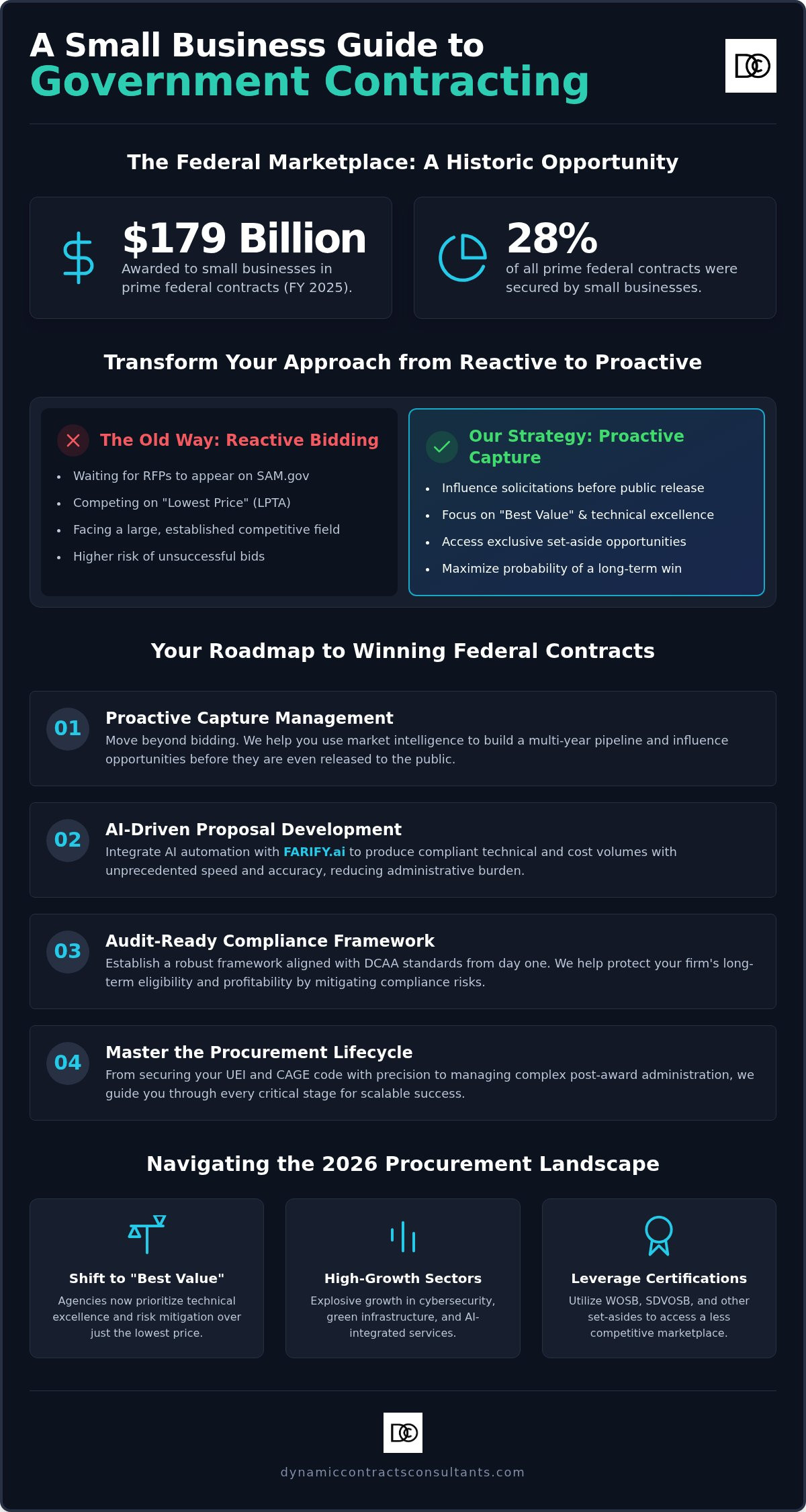
Nearly 28% of all prime federal contracts, totaling a record $179 billion, were awarded to small businesses in Fiscal Year 2025. While these figures represent a historic opportunity, we recognize that the reality of the 2026 landscape involves navigating the increasingly complex Federal Acquisition Regulation (FAR) and the significant financial risks of unsuccessful bids. Our small business guide to government contracting serves as a definitive resource to help you move past these barriers with precision and confidence. We understand the administrative burden and the persistent anxiety regarding DCAA audit compliance that often stifles small business growth.
We'll provide a clear roadmap to navigate the federal procurement lifecycle by integrating expert capture management with AI-driven proposal development. This guide promises to transform your approach from reactive bidding to strategic acquisition planning. You'll discover how to utilize FARIFY.ai for rapid, audit-ready document generation and how to align your internal systems with the latest DCAA reporting terminology. From understanding the SBA's updated size standards to mastering post-award administration, we'll equip you with the tools to establish a compliant, scalable framework for long-term success.
Key Takeaways
- Transition from reactive bidding to proactive capture management to influence solicitation requirements before they reach the public marketplace.
- Integrate AI-driven automation through FARIFY.ai to produce compliant technical and cost volumes with unprecedented speed and accuracy.
- Establish an audit-ready compliance framework that aligns with DCAA standards to protect your firm's long-term eligibility and profitability.
- Follow our small business guide to government contracting to master the entire procurement lifecycle, from securing your UEI to managing post-award deliverables.
- Optimize your operational efficiency by utilizing data-driven bid-no-bid analysis to focus resources on the most viable and lucrative contract opportunities.
Navigating the Federal Marketplace: Why Small Businesses Must Act Strategically
The federal government remains the world’s most significant consumer, allocating billions annually to small business contracts. Winning in this space requires more than just a registration; it demands a proactive, data-driven approach to the acquisition lifecycle. We view strategic contracting as a disciplined methodology where you influence the market before a solicitation even hits the street. This small business guide to government contracting highlights that success in 2026 relies on understanding the shift toward "Best Value" awards. Agencies now prioritize technical excellence and risk mitigation over the "Lowest Price Technically Acceptable" (LPTA) models of the past. It's no longer enough to be the cheapest; you must be the most reliable and capable partner.
Your status as a minority-owned small business serves as a powerful differentiator. The federal government has established statutory goals, including a 23% prime contracting target for small businesses, with specific sub-goals for Women-Owned (WOSB) and Service-Disabled Veteran-Owned (SDVOSB) firms. Leveraging these certifications allows you to access exclusive set-aside opportunities that reduce the competitive field. We help you navigate these designations to ensure you’re maximizing your eligibility for every available dollar.
The 2026 Federal Procurement Landscape
Current spending trends show explosive growth in cybersecurity, green infrastructure, and AI-integrated services. The Small Business Administration (SBA) has recently proposed significant increases to size standards for consulting services, potentially expanding the "small" designation to firms with much higher annual receipts. While the "Strategic Sourcing" initiative aims to streamline buying, it can create barriers by bundling contracts into large vehicles. We help you identify your specific niche within primary NAICS codes to ensure you aren't sidelined by these large-scale procurement shifts. It's vital to monitor these changes, as they dictate the competitive landscape for the next decade.
Defining Your Value Proposition for Federal Agencies
A generic business model is a recipe for failure in the federal market. Contracting Officers (COs) look for specialized expertise that addresses specific agency pain points. Your Capability Statement shouldn't just list what you do; it must articulate how your core competencies align with the agency’s mission goals. We emphasize developing a value proposition that highlights operational efficiency and audit-ready compliance from day one. By focusing on your unique strengths, you transform from a vendor into a strategic partner. You can explore our specialized acquisition services to see how we refine these propositions for our clients.
Establishing Your Foundation: From Registrations to Strategic Capture Management
Foundational readiness is the first barrier to entry in federal procurement. While many firms treat registration as a administrative hurdle, we view it as a strategic deployment of your corporate identity. This small business guide to government contracting emphasizes that precision in your initial setup prevents costly delays during the award phase. You must secure your Unique Entity Identifier (UEI) and CAGE code through SAM.gov with absolute accuracy. These identifiers are more than just serial numbers; they are the keys to your financial and legal visibility within the federal ecosystem. Misalignment here can trigger "Material weaknesses" in your profile that disqualify you before your technical proposal is even reviewed.
Registration alone does not guarantee a seat at the table. We define capture management as the critical phase where you influence the solicitation before it is released to the public. Successful contractors don't wait for a Request for Proposal (RFP) to appear on SAM.gov. Instead, they use market research tools like USASpending.gov and FPDS to build a multi-year pipeline. By analyzing spending patterns, you can identify which agencies are likely to need your specific expertise. If you're looking to scale rapidly, we recommend exploring teaming agreements or the SBA mentor-protégé program to bridge capability gaps and access larger contracts. You can learn more about our strategic capture management services to see how we help firms position themselves for these high-value opportunities.
The Essential Registration Checklist
Accuracy in your SAM.gov profile is non-negotiable. Ensure your legal business name, physical address, and taxpayer identification number (TIN) match your IRS records exactly. You must also select the correct NAICS codes that reflect your actual service portfolio. Choosing too many codes can dilute your perceived expertise, while choosing too few can hide you from relevant set-asides. Your Dynamic Small Business Search (DSBS) profile is equally vital. It acts as your digital storefront for Contracting Officers. We suggest optimizing your DSBS keywords and capabilities narrative to ensure you appear in targeted searches for specific agency needs.
Implementing a Robust Capture Strategy
A proactive capture strategy shifts your focus from reactive bidding to long-term relationship building. You should establish early contact with Small Business Professionals (SBPs) and Prime contractors who already hold major vehicles. These relationships provide insights into "forecasted" opportunities that aren't yet public. Understanding the Governing Rules and Responsibilities helps you stay compliant while you engage these stakeholders. For a deeper dive into this methodology, read The Definitive Guide to Developing a Strategic Government Contract Capture Plan. If you need assistance refining your market entry, contact us for a strategic consultation.
The Science of Winning: AI-Driven Proposal Development and Grant Writing
Winning a federal contract isn't an accident of creative writing; it's the result of rigorous technical alignment and strategic precision. This small business guide to government contracting positions proposal development as a technical discipline where compliance is the baseline. Strategy is the differentiator. Before drafting a single word, we perform a rigorous Bid-No-Bid analysis to protect your operational efficiency. This data-driven filter ensures you only pursue opportunities where your win probability is highest, preventing the high cost of failed attempts. Once a "Go" decision is reached, we align every response perfectly with Section L and Section M of the solicitation. Section L provides the instructions for preparation, while Section M reveals the evaluation criteria. We ensure your proposal mirrors these requirements exactly. Even a minor formatting error can lead to immediate disqualification.
For a broader view of these regulatory expectations, you can consult the SBA Guide to Federal Contracting, which outlines the fundamental responsibilities for prospective vendors. Our methodology ensures that your technical volumes aren't just compliant but are vision-led and results-oriented, positioning you as a low-risk, high-value partner for any agency.
Leveraging AI for Scalable Intelligence in Proposals
We utilize AI-driven automation via FARIFY.ai to generate compliant Technical and Cost volumes in minutes rather than weeks. This technology drastically reduces the turnaround time for complex Statement of Work (SOW) and Performance Work Statement (PWS) generation. By automating the repetitive aspects of acquisition planning, we allow your team to focus on the high-impact strategic elements of the bid. We maintain a "human-in-the-loop" assurance process where our experts verify every AI-generated output. This ensures that all documents meet rigorous FAR standards and remain audit-ready from the moment of submission. You can explore our professional proposal writing services to see how we apply this scalable intelligence to your specific pipeline.
Grant Writing for Federal Funding Success
It's vital to recognize the distinction between federal contracts and grants. While contracts are procurement actions for specific goods or services, grants are financial assistance provided to achieve a public purpose. Strategic grant writing requires navigating specific compliance requirements that often differ from standard FAR clauses. We help small businesses understand these nuances to capture non-dilutive funding that can fuel research and development. For detailed insights on using technology in this area, refer to our sibling article, AI for Grant Writing: A Strategic Guide to Federal Funding Success in 2026. This dual-track approach ensures your business captures every potential revenue stream while maintaining a robust compliance framework.
Mitigating Risk: Understanding DCAA Compliance and FAR Regulations
DCAA compliance represents the gold standard for financial integrity in the federal marketplace. While earlier sections of this small business guide to government contracting focused on winning work, this phase focuses on protecting your award. We provide specialized DCAA compliance consulting to ensure your accounting systems aren't just functional; they must be truly audit-ready. Navigating the Federal Acquisition Regulation (FAR) is complex enough, but adding agency-specific supplements like DFARS or DOSAR requires a level of precision that manual processes can't consistently achieve. We help you conduct proactive risk assessments to identify mandatory flow-down clause requirements before they transform into legal or financial liabilities.
Establishing an Audit-Ready Accounting System
The Defense Contract Audit Agency (DCAA) scrutinizes specific operational areas: labor distribution, timekeeping, and indirect rate structures. You must also distinguish between allowable and unallowable costs with absolute clarity. Preparing for the Pre-Award Survey (SF 1408) is a critical step to prove your system's adequacy to Contracting Officers. In 2026, the DCAA has updated its reporting terminology to categorize findings as "Material weaknesses" or "System deficiencies," making initial precision vital. For a deeper analysis of these requirements, review our guide on DCAA Compliance Consulting: A Strategic Framework for Federal Contractor Success in 2026. We ensure your framework meets these evolving government auditing standards.
Strategic Compliance with FAR and DFARS
Compliance also involves ethical and operational standards defined by the Procurement Integrity Act. You're responsible for managing mandatory flow-down clauses for your subcontractors, a task that often leads to system deficiencies if handled incorrectly. We utilize AI-generated compliance matrices to ensure 100% adherence to solicitation requirements, effectively mapping every clause to a specific internal control. This visionary approach to strategic compliance is a cornerstone of our small business guide to government contracting, allowing you to scale without the fear of a negative audit finding. If you need to verify your system's readiness, book a DCAA compliance audit-readiness review with our expert team to secure your business's future.
Scaling Success: Post-Award Administration and Lifecycle Management
Winning the contract is a significant milestone, but it's only the beginning of your journey in federal procurement. Post-award administration is where your firm’s reputation and long-term profitability are established. We provide comprehensive contract administration to ensure you meet every deliverable while maintaining audit-ready records. This final phase of our small business guide to government contracting emphasizes that execution is just as strategic as the bid itself. You must manage contract modifications and closeout procedures with extreme precision to avoid "System deficiencies" that could impact your future eligibility. Every modification is a formal legal action that requires the same level of scrutiny as the original solicitation.
Your success is measured through the Contractor Performance Assessment Reporting System (CPARS). Positive narratives in CPARS are the most valuable asset for securing future awards. We help you document your performance in a way that resonates with future Contracting Officers, turning every successfully managed task into a credential for your next bid. Effective communication with your Contracting Officer Representative (COR) ensures that any potential issues are mitigated before they result in a negative rating.
Optimizing Contract Performance and Monitoring
Establishing a consistent cadence for reporting and performance monitoring is vital to exceed agency expectations. You need a clear operational plan to manage the transition from award to execution without disrupting your internal resources. We help you track deliverables and manage milestones to ensure your firm remains in good standing with the government. You can discover our post-award compliance and administration services to see how we streamline these complex requirements. Maintaining visibility over your contract's financial health is critical, especially when managing the Prompt Payment Act interest rate for late payments, which is 4.75% per annum for the latter half of 2026. This level of oversight ensures that your cash flow remains stable throughout the procurement lifecycle.
The Path to Sustainable Growth
Sustainable growth in the federal market comes from leveraging your current prime contracts to secure larger, more complex awards. A successful project isn't finished until the closeout is complete. We use contract closeout data to refine your next capture strategy, identifying which core competencies were most profitable and where operational efficiency can be improved. This data-driven feedback loop is what separates high-growth enterprises from stagnant ones. For a deeper understanding of these processes, read our Comprehensive Guide to Post-Award Contract Administration in Federal Procurement. By treating the end of one contract as the strategic foundation for the next, you ensure your business remains a visionary leader in the federal marketplace. We partner with you to turn each award into a scalable intelligence asset for your firm's future.
Strategic Leadership in the 2026 Federal Marketplace
Mastering the federal procurement lifecycle in 2026 demands a shift from reactive bidding to visionary leadership. We've explored how integrating AI-driven automation with disciplined capture management transforms your firm's competitive posture. This small business guide to government contracting highlights that success isn't just about winning the award; it's about maintaining DCAA audit-ready assurance and operational excellence throughout the contract's duration. By leveraging AI-powered FARIFY technology, you can produce compliant, high-impact proposals while protecting your resources through rigorous bid-no-bid analysis.
Our proven track record with agencies like the DoD, EPA, and NOAA ensures that your business has a strategic partner capable of navigating the most complex regulatory environments. We're committed to your long-term growth and scalable intelligence. It's time to move beyond the complexity of the FAR and establish a framework for sustainable success. Partner with Dynamic Contracts Consultants LLC for Strategic Acquisition Success and take the first step toward securing your firm's future in the federal arena. Your potential for growth is limitless when your foundation is built on precision and expertise.
Frequently Asked Questions
What are the primary requirements for a small business to start government contracting?
To begin, you must obtain a Unique Entity Identifier (UEI) and a CAGE code by registering in the System for Award Management (SAM.gov). It's also necessary to identify relevant NAICS codes, such as 541611 for management consulting, and ensure your Dynamic Small Business Search (DSBS) profile is optimized for discovery. We recommend establishing a compliant accounting system early, as this foundational readiness is vital for any firm pursuing federal set-aside opportunities.
How does AI-driven automation improve the federal proposal development process?
AI-driven automation, specifically through our FARIFY.ai platform, reduces the turnaround time for drafting technical and cost volumes from days to minutes. This technology extracts complex RFP requirements and generates compliant drafts for SOW and PWS documents with high precision. We maintain a "human-in-the-loop" assurance process to ensure all AI-generated outputs remain audit-ready. This approach allows your team to focus on high-level strategy rather than repetitive administrative drafting.
Is DCAA compliance mandatory for all small business federal contractors?
DCAA compliance isn't mandatory for every contract, but it's the gold standard for firms pursuing cost-reimbursement or incentive-fee awards. The DoD and other agencies require that your accounting system is deemed adequate to track and allocate costs accurately before such contracts are awarded. We provide specialized consulting to help you pass the SF 1408 Pre-Award Survey. Establishing these systems ensures you aren't disqualified from lucrative opportunities due to system deficiencies.
What is the difference between a prime contractor and a subcontractor in government work?
A prime contractor holds the direct legal relationship with the federal agency and is responsible for all deliverables and regulatory compliance. A subcontractor works under the prime, often providing specialized expertise or helping the prime meet small business participation goals. We've served as a prime contractor for the DoD, State, EPA, and NOAA, while also acting as a subcontractor on municipal projects. Both roles are strategic entry points within the procurement lifecycle.
How can a small business find forecasted government contracting opportunities?
You can identify forecasted opportunities by utilizing market research tools like USASpending.gov and the Federal Procurement Data System (FPDS). This small business guide to government contracting emphasizes that most agencies publish annual acquisition forecasts long before solicitations reach SAM.gov. By analyzing these forecasts, you can engage in proactive capture management and build relationships with Small Business Professionals. This strategy allows you to influence requirements during the pre-solicitation phase.
What are the most common FAR compliance pitfalls for new contractors?
The most frequent pitfalls include failing to manage mandatory flow-down clauses for subcontractors and ignoring the strict ethical standards of the Procurement Integrity Act. Many new contractors also struggle with "Material weaknesses" in their timekeeping or indirect rate structures, which can trigger negative audit findings. We help you mitigate these risks by providing audit-ready documentation and compliance matrices. Avoiding these errors is critical, as noncompliance can lead to contract termination or suspension.
How do I ensure my proposal is compliant with Section L and M requirements?
Ensuring compliance requires a line-by-line alignment of your technical volume with the instructions in Section L and the evaluation criteria in Section M. Your proposal must mirror the agency’s requested format while explicitly addressing how you'll meet the "Best Value" metrics. We utilize AI-generated compliance matrices to track every requirement throughout the drafting process. This methodical approach ensures your response is both technically superior and fully compliant with all solicitation instructions.
What is a CPARS narrative and why does it matter for my business growth?
A CPARS narrative is the formal record of your performance on a federal contract, stored in the Contractor Performance Assessment Reporting System. These ratings are the primary data point Contracting Officers use to evaluate past performance for future awards. Positive narratives are essential for scaling your business and securing more complex prime contracts. We provide CPARS narrative support to ensure your successes are documented accurately, facilitating sustainable growth and future wins in the marketplace.


