

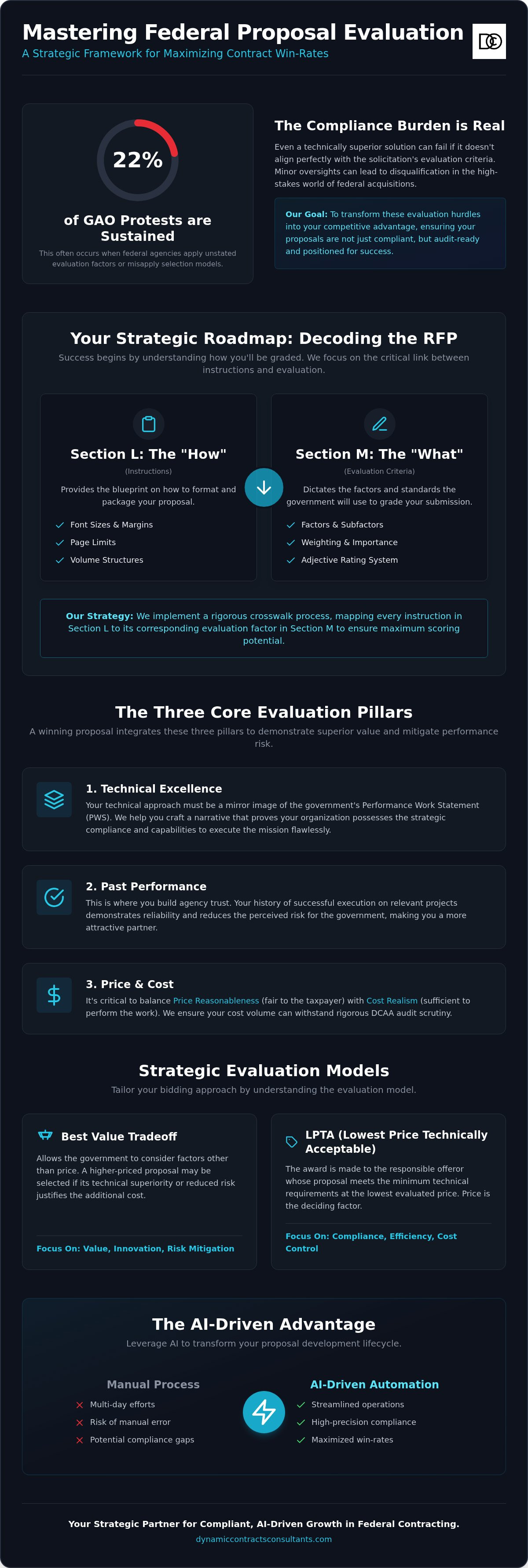
Approximately 22% of GAO protests are sustained because federal agencies applied unstated evaluation factors or misapplied selection models. This statistic highlights a sobering reality for many contractors; even a technically superior solution can fail if it doesn't align perfectly with the specific government proposal evaluation criteria outlined in the solicitation. we recognize the immense pressure you face when deciphering the subtle but critical distinctions between Section L instructions and Section M evaluation factors. The fear of disqualification due to a minor compliance oversight is a constant burden in the high-stakes world of federal acquisitions.
We've developed this strategic framework to help you manage these complexities and leverage AI-driven insights to maximize your contract win-rates in 2026. You'll gain a clear understanding of how to quantify "Best Value" and implement a repeatable process for compliance mapping. We'll examine the latest regulatory shifts, including the $10 million TINA threshold and the $350,000 Simplified Acquisition Threshold, while providing a roadmap to transform evaluation hurdles into your competitive advantage. Our goal is to ensure your technical volume is not just compliant, but audit-ready and positioned for long-term success.
Key Takeaways
- Identify why Section M of the RFP serves as your primary roadmap for understanding how agencies will grade your submission and prioritize their requirements.
- Learn to balance technical risk mitigation with cost-effectiveness to meet the rigorous standards of modern federal acquisitions and build agency trust.
- Navigate the strategic differences between Best Value Tradeoffs and LPTA models to tailor your bidding approach for maximum competitive advantage.
- Implement a repeatable compliance mapping process to ensure your technical volume aligns perfectly with all government proposal evaluation criteria before submission.
- Discover how AI-driven automation can transform your proposal development lifecycle from a multi-day effort into a streamlined, high-precision operation.
Decoding Federal Government Proposal Evaluation Criteria
Federal agencies use government proposal evaluation criteria as the objective yardstick to measure the quality, feasibility, and inherent risk of your offer. These standards aren't suggestions; they are the legal basis upon which the government determines which contractor provides the best value. To understand these requirements, we always direct our clients to Section M of the Request for Proposal (RFP). While many contractors start with the Statement of Work, the truly successful ones start with Section M to understand how they'll be graded. For a foundational government contract proposal overview, it's helpful to remember that every element of your submission must serve these specific grading factors.
Most solicitations center on the "Big Three" primary factors: Technical Excellence, Past Performance, and Price or Cost. However, the government's language can often be intentionally broad or frustratingly vague. We specialize in deciphering this ambiguous terminology to ensure your response isn't flagged as "non-responsive." Our proposal writing services focus on translating these complex requirements into a narrative that demonstrates absolute compliance while highlighting your unique strengths.
The Critical Link Between Section L and Section M
There's a fundamental distinction between Section L and Section M that often confuses even experienced contractors. Section L provides the instructions on how to package your proposal, covering font sizes, page limits, and volume structures. Section M, conversely, dictates what the evaluators will actually grade. A common pitfall occurs when a team follows every formatting rule in Section L but fails to map their content to the government proposal evaluation criteria in Section M. We advocate for a rigorous crosswalk process where every instruction in Section L is paired with its corresponding evaluation factor in Section M. This ensures that you don't just "turn in the homework" but actually earn the highest possible marks.
Understanding Evaluation Factors and Subfactors
Agencies weight their criteria differently depending on the mission's complexity. Primary factors are often broken down into significant subfactors, such as "Management Approach" or "Key Personnel Qualifications." These subfactors carry specific weights that can make or break your score. Evaluators typically use adjective rating systems, such as Outstanding, Good, Acceptable, Marginal, or Unacceptable, to document your proposal's strengths and weaknesses. Ultimately, these scores are synthesized into a recommendation for the Source Selection Authority (SSA). The SSA is the individual responsible for the final award decision, and their choice is heavily influenced by how clearly you've addressed the established subfactors. Precision in this area is non-negotiable for success.
The Core Pillars: Technical Excellence, Past Performance, and Cost
To win in 2026, you must view the technical, past performance, and cost volumes as an integrated defense against performance risk. The government proposal evaluation criteria require more than just a list of capabilities. They demand a narrative that proves your organization possesses the strategic compliance necessary to execute the mission without disruption. We focus on helping you build a proposal that doesn't just meet the minimum requirements but provides the "Best Value" through superior risk mitigation.
When developing your cost volume, it's vital to differentiate between price reasonableness and cost realism. While reasonableness ensures the taxpayer isn't overpaying, realism confirms your proposed costs are sufficient to actually perform the work. As outlined in the Federal Acquisition Regulation (FAR) 15.305, agencies must evaluate these factors to ensure the offeror understands the technical requirements. We frequently assist our partners in achieving DCAA compliance to survive the rigorous audit scrutiny that often follows high-value contract awards.
Demonstrating Technical Realism and Feasibility
Your technical approach must be a mirror image of the government's Performance Work Statement (PWS). We recommend starting each major section with a single, high-impact sentence that defines your solution with a quantifiable outcome. For instance, rather than stating you provide IT support, you might state that your solution achieves 99.9% system uptime through automated patch management. Today's evaluators also look for differentiators in supply chain security and cybersecurity risk mitigations. Documenting these proactively shows you've anticipated the operational challenges of the modern procurement lifecycle.
Leveraging Past Performance for Strategic Advantage
Past performance is often the most subjective area of the evaluation process. You should select contracts that are both relevant and recent, typically within the last three years. Relevancy isn't just about the type of work; it's about the scope, complexity, and magnitude of the project. We help our partners draft CPARS narratives that don't just report success but highlight specific instances of operational efficiency. If you're working with subcontractors, managing their past performance data within your teaming agreement is essential to present a unified, low-risk front to the agency. If you're struggling to align your project history with a specific RFP, you can reach out to our consultants for a strategic review of your capture management strategy.
Strategic Evaluation Models: Best Value Tradeoff vs. LPTA
Agencies typically select an evaluation model based on the complexity of the mission and the availability of market solutions. Understanding whether a solicitation follows a Best Value Tradeoff or a Lowest Price Technically Acceptable (LPTA) model is the first step in tailoring your approach to the specific government proposal evaluation criteria. In a tradeoff environment, the government is looking for "strengths"—features of your proposal that exceed requirements in a way that benefits the agency. Conversely, LPTA is often described as a "race to the bottom" where the award goes to the lowest price once technical acceptability is established. Your capture strategy must pivot based on these models to avoid wasting resources on unnecessary technical "gold-plating" or, conversely, failing to justify a premium price.
Navigating the Best Value Tradeoff Process
In a Best Value Tradeoff, your goal is to prove that your technical superiority justifies a higher price point. This requires identifying discriminators that directly mitigate agency risks or increase operational efficiency. We help you identify these "valuable" strengths during the capture phase to ensure they resonate with the Source Selection Authority. Our strategic capture management services focus on aligning your unique capabilities with the agency's pain points. By focusing on innovation and AI-driven automation, you can provide "extra" value that evaluators can use to justify a higher rating. You aren't just selling a service; you're selling a lower risk profile and a more advanced technical future for the agency.
Winning in an LPTA Environment Without Sacrificing Margin
Winning an LPTA contract requires a different mindset. You must be 100% technically acceptable, but any effort spent beyond that "minimum" threshold is essentially wasted margin. We've seen many contractors fail because they were "too good" for the requirement, proposing expensive, high-end solutions where the agency only needed basic support. By reviewing example evaluation criteria, you can see how agencies define the floor for technical acceptability. To win here, we recommend streamlining your operations through AI-driven automation to lower your price floor. This allows you to remain competitive on price while maintaining your desired profit margins. The key is to strip out everything that doesn't directly contribute to meeting the government proposal evaluation criteria at the lowest possible cost.
Ultimately, your success depends on how well you've analyzed the agency's underlying motivation. Some agencies claim they want a tradeoff but actually evaluate proposals with an LPTA mindset. We provide the bid-no-bid analysis and strategic oversight necessary to ensure you're playing the right game for the right contract.
Pre-Submission Auditing: Ensuring Absolute Compliance
Audit-ready proposals require a systematic review process that begins long before the submission deadline. We use a rigorous gap analysis to identify exactly where your technical volume might fall short of the government proposal evaluation criteria. This isn't just about checking boxes; it's about ensuring your narrative is defensible and transparent. While AI-driven automation can accelerate document generation, we maintain a human-in-the-loop review process. This ensures that every nuance of the solicitation is addressed with professional precision. To understand how this level of pre-award detail affects your long-term success, you can read our guide to post-award compliance to see how pre-award precision pays off.
Building a Bulletproof Compliance Matrix
A compliance matrix is your most powerful internal tool for strategic alignment. We extract every "shall," "must," and "will" from the RFP to create a structured checklist. By cross-referencing Section L instructions with Section M evaluation factors, we ensure your proposal is easy for the agency to grade. Think of the matrix as an evaluator's guide. When evaluators can quickly locate your answers to specific government proposal evaluation criteria, they're more likely to assign higher ratings. This structured approach eliminates the risk of being deemed non-responsive due to a missing certification or a misaligned technical response.
Mitigating Performance Risk and Audit Readiness
Absolute compliance extends beyond the technical response into the realms of financial and operational readiness. You must demonstrate that your organization is prepared for Procurement System Reviews (CPSR) and potential DCAA audit scrutiny. We help you document flow-down clauses in your proposal to prove you have total control over your subcontracting network. This builds agency trust by showing you've mitigated performance risk at every level of the procurement lifecycle. If you're concerned about your financial system's adequacy, you can explore our DCAA compliance consulting to ensure you meet the highest standards of accountability.
Don't leave your submission to chance. You can contact our expert consultants today for a comprehensive pre-submission audit of your proposal package to maximize your win-rate.
Optimizing Win-Rates with AI-Driven Proposal Development
The traditional proposal lifecycle often demanded weeks of manual labor to ensure every paragraph aligned perfectly with the government proposal evaluation criteria. In 2026, the standard for operational efficiency has shifted significantly. We utilize FARIFY LLC to accelerate this entire process, moving from initial solicitation review to a compliant draft in minutes rather than days. This technological leap allows you to respond to a higher volume of opportunities without sacrificing the precision required for high-stakes federal contracts. The Dynamic Contracts Consultants LLC advantage lies in our ability to maintain audit-ready standards while leveraging scalable intelligence to provide a significant competitive advantage for your firm.
While the speed of AI is impressive, we recognize that software alone cannot navigate the political and strategic nuances of a major agency acquisition. We provide expert human oversight for all AI-generated content, ensuring that the PWS or SOW generation reflects the actual operational realities of your business. This synergy between human expertise and AI-driven automation creates a proposal that's both technically superior and fully compliant with the regulatory framework of the FAR and DFARS. By combining our deep industry knowledge with cutting-edge technology, we help you navigate complex requirements with unprecedented speed.
Leveraging FARIFY for Rapid Compliance Mapping
Compliance mapping is frequently the most labor-intensive phase of proposal development. FARIFY LLC utilizes advanced AI models specifically trained on the Federal Acquisition Regulation to extract requirements instantly and accurately. This tool doesn't merely list requirements; it structures them into a logical framework that mirrors the evaluator's checklist. We also leverage these capabilities to generate Independent Government Cost Estimates (IGCEs) and comprehensive market research reports. These documents provide the objective data needed to support your cost volume and justify your price reasonableness to the agency. Learn about our proposal writing services to understand how we combine these technical tools with strategic storytelling.
The Future of Capture Strategy in 2026
The most successful contractors have transitioned from reactive bidding to proactive, AI-informed capture management. By the time an RFP is released, the most well-positioned firms have already spent months shaping the requirement. AI-driven automation allows you to analyze historical spending patterns and agency trends to identify these opportunities 12 to 18 months in advance. This proactive stance ensures that your technical solution is already aligned with the government proposal evaluation criteria before the official solicitation hits the street. Combining strategic compliance with this level of technological speed is the only way to consistently outperform the competition in the modern procurement landscape. We invite you to contact us today to integrate these AI-driven strategies into your federal acquisition planning.
Transforming Compliance into Competitive Advantage
Navigating the complex landscape of federal procurement in 2026 demands a shift from reactive document drafting to proactive strategic alignment. We have explored how mastering government proposal evaluation criteria allows your firm to mitigate performance risks while clearly articulating the "Best Value" you bring to the agency. Success is no longer just about meeting minimum technical standards; it is about demonstrating a sophisticated understanding of the procurement lifecycle through precision and scalable intelligence.
Our team brings proven prime contractor experience with agencies like the DoD and EPA to every engagement. We combine expert DCAA compliance consulting with the AI-powered FARIFY LLC platform to ensure your documents are generated rapidly without sacrificing audit-ready quality. This human-in-the-loop approach guarantees that your technical and cost volumes survive the most rigorous scrutiny. Dynamic Contracts Consultants LLC provides the disciplined oversight and specialized terminology needed to win in high-stakes environments where the smallest error can result in disqualification.
Secure your next contract with our expert proposal writing services and let us help you build a repeatable process for federal success. We are committed to your long-term growth and operational excellence in this evolving marketplace. Your journey toward winning more contracts starts with a strategy built on absolute compliance and visionary innovation.
Frequently Asked Questions
What are the most common evaluation factors in federal proposals?
The primary factors typically include technical capability, past performance, and cost or price. Agencies use these government proposal evaluation criteria to determine which offeror presents the lowest risk and highest value. Technical subfactors often focus on management approach and key personnel qualifications. Past performance evaluates your recent project history, while cost analysis ensures your pricing is both reasonable and realistic for the scope of work defined in the solicitation.
How do I find the evaluation criteria in a government RFP?
You'll find these standards in Section M of a standard federal RFP, titled Evaluation Factors for Award. While Section L provides formatting instructions, Section M is the scorecard evaluators use to grade your response. We recommend reviewing this section first to align your technical narrative with the agency's priorities. This ensures every strength you propose directly maps to a factor that carries weight in the final source selection decision.
What is the difference between price reasonableness and cost realism?
Price reasonableness confirms that your proposed price isn't excessively high compared to the market or the Independent Government Cost Estimate (IGCE). Cost realism, conversely, ensures your numbers aren't suspiciously low, which could indicate a lack of technical understanding. We use FARIFY to generate accurate IGCEs that support these cost volumes. This dual analysis protects the government from overpaying and from contractors who underbid and fail to perform.
Can an agency use evaluation criteria not listed in the RFP?
Agencies are legally prohibited from using evaluation factors that aren't explicitly stated in the solicitation. If an agency applies unstated government proposal evaluation criteria, it's a primary ground for a GAO protest. Approximately 22% of protests are sustained due to these types of evaluation errors. We help you audit your proposal against the RFP to ensure your submission addresses only the factors the government is authorized to grade.
How does a compliance matrix help with proposal evaluation?
A compliance matrix acts as an internal audit tool that extracts every RFP requirement into a structured checklist. It bridges the gap between Section L instructions and Section M grading factors. By using this matrix, we ensure your technical volume is 100% compliant and easy for evaluators to navigate. This systematic approach reduces the risk of disqualification and ensures that no mandatory requirement is overlooked during the proposal lifecycle.
What is a 'Best Value' decision in government contracting?
A Best Value decision is a tradeoff process where the government may select a higher priced proposal if its technical superiority justifies the extra cost. This model focuses on identifying strengths that exceed the minimum requirements. We specialize in helping you articulate these discriminators through AI driven automation and expert oversight. The goal is to prove that your solution offers the most advantageous outcome for the agency's mission despite a premium price.
How does the government rate past performance for new contractors?
If you don't have a relevant project history, the government typically assigns a Neutral rating for past performance. This ensures you aren't penalized for being a new entrant. However, we often help clients leverage the experience of key personnel or subcontractors to build agency trust. This strategic approach allows you to demonstrate capability even without a long corporate record, provided the expertise is relevant to the current solicitation.
Why is Section M more important than Section L for strategy?
Section L tells you how to format your proposal, but Section M tells you how to win it. Strategy must be driven by the scorecard in Section M because it dictates which technical features the government values most. We focus on Section M to identify the weights and subfactors that will determine your final score. Understanding the grading criteria allows you to prioritize resources on the sections that have the greatest impact on the award.


