

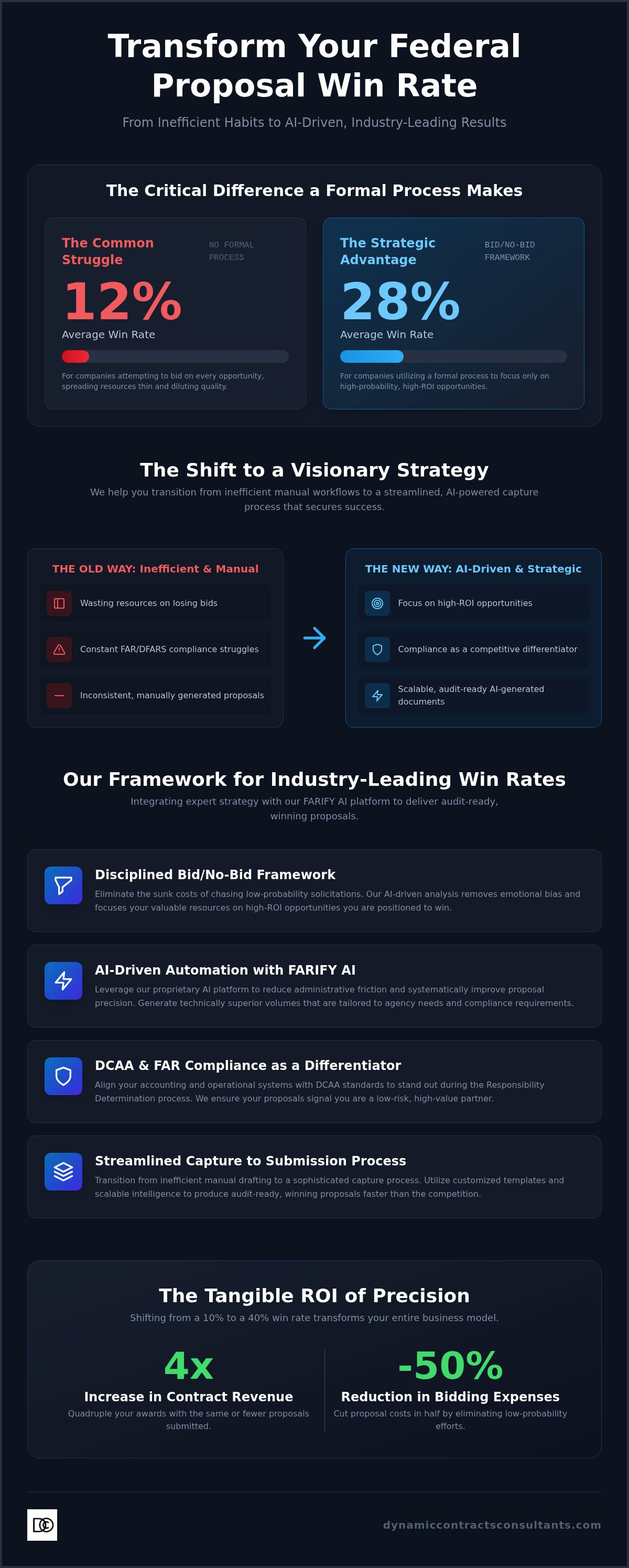
Did you know that companies utilizing a formal "Bid/No-Bid" decision process achieve an average win rate of 28%, while those attempting to bid on every opportunity struggle at just 12%? You likely recognize the exhaustion of wasting internal resources on losing bids or the constant struggle to maintain FAR/DFARS compliance. It's a common challenge in federal acquisition where manual proposal generation often leads to inconsistent results and missed benchmarks. We understand that improving proposal win rate requires a departure from these inefficient habits toward a capture process that's both streamlined and sophisticated.
We'll help you master the methodologies and AI-driven strategies necessary to transform your results from average to industry-leading. You'll learn how to leverage scalable intelligence to generate audit-ready documents and differentiate your technical volumes effectively. This guide provides a comprehensive look at how we merge DCAA-compliant capture management with the speed of our FARIFY AI platform. We'll walk you through the transition from inefficient manual workflows to a visionary, results-oriented strategy that secures your success in the 2026 federal marketplace.
Key Takeaways
- Learn how a disciplined Bid/No-Bid framework eliminates the sunk costs of chasing low-probability solicitations and focuses resources on high-ROI opportunities.
- Discover how leveraging AI-driven automation and FARIFY AI reduces administrative friction while systematically improving proposal win rate through technical precision.
- Understand why aligning your accounting and operational systems with DCAA standards serves as a critical competitive differentiator during the Responsibility Determination process.
- Master the transition from manual, inefficient drafting to a streamlined capture process that utilizes customized templates and scalable intelligence for audit-ready results.
- Explore the benefits of a strategic partnership that integrates expert proposal writing with end-to-end contract administration to ensure long-term operational efficiency.
The Economics of Proposal Win Rates: Why High Volume Often Leads to Low ROI
In federal acquisition, we define your win rate as the simple ratio of contracts awarded to the total number of proposals submitted. While it's tempting to measure success by the volume of activity, a high-frequency approach often masks a deteriorating return on investment. Chasing low-probability solicitations creates a "sunk cost" trap where valuable internal resources are spread too thin to achieve technical excellence. Precision matters more than pace. By shifting our focus toward improving proposal win rate through high-fit targeting, we prioritize a "Strategic Win Rate" that values quality over sheer quantity. This methodology ensures your firm isn't just participating in the government procurement process, but dominating the specific niches where your capabilities align perfectly with agency needs.
Calculating the True Cost of a Lost Bid
Every unsuccessful bid represents more than just a missed revenue opportunity; it's a direct drain on your operational efficiency. We've observed that firms spend hundreds of personnel hours on technical volumes and compliance matrices for opportunities they were never positioned to win. This strain on your Subject Matter Experts (SMEs) results in an immense opportunity cost, as these professionals could have spent that time on capture management for contracts with a higher probability of award. Research from 2026 indicates that companies with a formal "Bid/No-Bid" process achieve a 28% win rate, while those bidding on every opportunity see that figure drop to 12%. Our proposal writing services are designed to mitigate this risk by focusing on precision rather than volume. Transitioning from a 10% to a 40% win rate can effectively quadruple your contract revenue while simultaneously reducing your overall bidding expenses by half.
The Psychology of the Contracting Officer
Contracting Officers (COs) and technical evaluators remember the firms that submit repetitive, low-quality responses. This shotgun approach signals a lack of serious commitment to the agency's mission. COs prefer working with contractors who demonstrate an intimate understanding of the solicitation rather than those who treat the process as a numbers game. If you consistently provide generic proposals that fail to address the specific nuances of Section L and M requirements, you risk being branded as a high-risk contractor. We believe your reputation within an agency is a valuable asset that must be protected. A high-precision submission signals to the government that you're a low-risk partner capable of meeting complex FAR/DFARS standards. When you align your technical volume with the agency's specific pain points, you move from being another name in the pile to a preferred, visionary strategist. Precision in improving proposal win rate is as much about building trust with the CO as it is about the technical solution itself.
Strategic Capture Management: The Bid/No-Bid Decision Framework
Success in federal contracting isn't determined at the writing stage; it's decided during the capture phase. We advocate for a rigorous filter that prevents your team from chasing "wired" solicitations where an incumbent holds an insurmountable lead. Establishing a repeatable process is the foundation for improving proposal win rate across all agency departments. Our approach utilizes AI for bid-no-bid analysis to objectively evaluate opportunities against the Federal Acquisition Regulation (FAR) standards and your specific past performance. This data-driven method removes the emotional "must-win" bias that often leads to strategic failure and helps you focus on high-value targets that offer a genuine path to award.
5 Critical Criteria for Your Bid/No-Bid Matrix
A robust matrix provides a quantitative score for every opportunity, allowing you to compare diverse solicitations on an equal playing field. We recommend evaluating these five pillars to ensure operational efficiency and a higher return on your bidding investment:
- Technical Alignment: You must determine if your solution meets 100% of the mandatory requirements without excessive R&D or cost overruns.
- Competitive Landscape: Assessment of the incumbent is vital. Verified 2026 data shows incumbents have a 72% win rate, while new competitors face a significantly lower 18% success probability.
- Past Performance Narratives: High-precision bids require at least three relevant past performance citations with "exceptional" or "very good" ratings.
- Probability of Win (pWin): This metric should account for your relationship with the agency and your understanding of their specific mission goals.
- Strategic Compliance: Every bid must align with your long-term growth objectives and your current personnel capacity to execute the work.
Early Acquisition Planning and Teaming Agreements
Effective capture management begins months before the RFP release. We focus on identifying gaps in your technical volume early, allowing you to secure strategic partners through teaming agreements that bolster your bid. This proactive stance lets you influence the solicitation drafting during the Request for Information (RFI) stage, ensuring the final requirements don't inadvertently exclude your unique capabilities. By the time the final RFP drops, you've already positioned your firm as a low-risk, visionary leader in the eyes of the evaluation board. If you're ready to refine your selection process, our experts can help you build a custom decision framework that maximizes your ROI and focuses your efforts on improving proposal win rate through intelligence and precision.
Leveraging AI-Driven Automation for Technical Proposal Precision
The shift to AI-assisted proposal development marks a definitive paradigm shift in federal contracting. With 68% of proposal teams now reporting AI usage as of 2026, we've moved beyond the era of manual drafting where teams spent weeks piecing together technical volumes. By adopting AI-driven automation, you can reduce administrative friction and focus your energy on the high-level strategy required for improving proposal win rate. Our methodology relies on customized federal proposal templates that serve as a foundation for every submission, ensuring that your responses are consistently professional and structured for success. For organizations seeking specialized funding, we also integrate specialized methodologies for AI for grant writing to ensure your technical approach aligns with agency-specific objectives.
FARIFY: Accelerating Compliance Matrix Generation
Our proprietary FARIFY AI platform transforms the way we analyze solicitations. It extracts complex RFP requirements in minutes, a task that previously took days of manual labor. FARIFY cross-references Section L and Section M to ensure 100% compliance alignment, flagging potential gaps before they become critical failures. This level of precision is vital for maintaining DCAA compliance from the very beginning of the project lifecycle. Whether you're generating PWS, SOW, or SOO drafts, our platform produces audit-ready outputs that meet the most stringent federal financial standards. This speed allows us to provide proposal writing services that are both agile and deeply rooted in regulatory accuracy.
Balancing Speed with Strategic Intelligence
Speed is a significant advantage, but it must be balanced with strategic intelligence. We know that generic AI tools often fail in the federal space because they lack "regulatory grounding." These tools don't understand the nuances of the FAR or agency-specific supplemental regulations. That's why we maintain a human-in-the-loop process where our credentialed experts refine every AI-generated narrative. This approach ensures that technical volumes aren't just compliant, but visionary and persuasive. Our validation process ensures that technical volumes are audit-ready before they ever reach a contracting officer's desk. By automating the initial document generation, we create space for more rigorous internal review cycles. This extra time allows for "Red Team" assessments that identify weaknesses, which is a critical step in improving proposal win rate and ensuring long-term contract success.
Compliance as a Competitive Differentiator: DCAA and FAR Alignment
Compliance in the federal marketplace is often viewed as a regulatory burden, but we position it as a critical competitive differentiator. In a high-stakes environment where the government seeks to minimize performance risk, framing your accounting and operational systems as low-risk assets is essential for improving proposal win rate. Our DCAA compliance consulting prepares you for the "Responsibility Determination," the phase where a contracting officer verifies that your business possesses the financial and technical capability to perform. Demonstrating a mastery of flow-down clause management signals a level of subcontracting maturity that many competitors lack. When your records are "audit-ready" from the initial submission, you provide the evaluation board with the confidence necessary to award high-value contracts.
Navigating FAR/DFARS and Specialized Regulations
Addressing complex requirements like ITAR, EAR, or the Foreign Corrupt Practices Act (FCPA) directly within your proposal narrative showcases a sophisticated understanding of the regulatory landscape. We help you integrate these specialized clauses into a robust quality control review process. This transparency proves that your firm isn't just aware of the rules but has the infrastructure to enforce them. For many of our clients, positioning their minority-owned status serves as a strategic advantage to help agencies meet their government-wide prime contracting goals. For FY2026, these goals include a 5% target for Small Disadvantaged Businesses (SDB), making your status a key element in the agency's evaluation criteria.
Pre-Award Compliance and Risk Mitigation
We conduct deep-dive gap analyses to identify and rectify regulatory weaknesses before you hit "submit." Utilizing our government proposal review services ensures your submission is compliant with the latest FY2026 National Defense Authorization Act (NDAA) changes, such as the increased Truth in Negotiations Act (TINA) threshold of $10 million. This proactive approach builds a CPARS-ready culture from the very first page of your technical volume. By the time you reach the award phase, you've already mitigated the risks that derail average contractors. If you want to transform compliance into a strategic strength, contact our experts to start improving proposal win rate through operational excellence.
Scaling Your Federal Acquisition Strategy with Dynamic Contracts Consultants LLC
Integrating proposal writing services with a long-term capture strategy is the only sustainable way to achieve growth in the federal sector. We provide end-to-end support that spans the entire procurement lifecycle, from initial acquisition planning to the final contract closeout. This holistic approach ensures that every bid you submit is part of a broader vision for improving proposal win rate and operational efficiency. Our solution-driven methodology prioritizes cost-effective relationships and prompt completion, positioning your firm as a reliable partner for agency stakeholders. By establishing a partnership with Dynamic Contracts Consultants LLC, you gain access to scalable intelligence that transforms your internal bidding capabilities into a high-performance engine.
Post-Award Oversight and CPARS Optimization
We believe that post-award contract administration is the actual foundation of your next win. Government evaluators scrutinize your past performance, making CPARS narratives a vital asset for your future technical volumes. We help you manage these narratives to build a stellar record, ensuring that your execution matches the promises made during the proposal phase. Through rigorous post-award compliance monitoring, we protect your reputation and ensure that your performance ratings remain "Exceptional" or "Very Good." This oversight mitigates the risk of negative reviews that could hinder your efforts in improving proposal win rate on future solicitations.
Your Path to a 2026 Federal Growth Strategy
Developing a government contract capture plan for the next fiscal year requires a blend of data and specialized expertise. We leverage our team's credentials, including CPCM and CFCM certifications, to bolster your bidding team and provide a layer of professional authority that few other consultants can offer. Our role is to act as a strategic extension of your business, providing the tools and insights necessary for digital transformation in a complex regulatory environment. To begin your journey toward industry-leading success, your next actionable steps include requesting a customized proposal template or a comprehensive capture audit. We are ready to help you navigate the 2026 marketplace with precision, intelligence, and a commitment to long-term success.
Mastering the Future of Federal Acquisition
The 2026 federal marketplace demands a transition from traditional, manual workflows to a strategy defined by scalable intelligence and strategic compliance. We've demonstrated that improving proposal win rate isn't a result of increasing your bid volume, but of refining your capture management and ensuring every technical volume is audit-ready. By integrating our FARIFY AI platform with the deep expertise of our CPCM and CFCM certified professionals, you can eliminate administrative friction and focus on high-value mission goals.
As a minority-owned small business with prime contractor experience across agencies like the DoD and EPA, we understand the precision required to win. We provide the end-to-end support necessary to transform your operational efficiency and build a stellar past performance record. It's time to move beyond average results and position your firm as a visionary leader in government contracting. Optimize your win rate with our expert proposal writing services to secure your growth in the coming fiscal year. We're ready to help you achieve the results your expertise deserves.
Frequently Asked Questions
What is considered a "good" proposal win rate in federal contracting?
A win rate of 40% is generally the industry benchmark for government-specific proposals as of 2025. However, the definition of success varies based on your specific market niche and the complexity of the solicitations. We focus on improving proposal win rate by prioritizing high-fit targets rather than sheer volume. Achieving a rate significantly above this average often requires a combination of rigorous capture management and advanced technical precision.
How does AI improve the win rate for government proposals?
AI improves success by accelerating the extraction of RFP requirements and generating compliant technical volumes with speed and precision. Our FARIFY platform creates audit-ready documents in minutes, allowing your team more time for strategic "Red Team" reviews. This automation reduces administrative friction and ensures that your responses are perfectly aligned with Section L and M requirements. It's a scalable intelligence tool that transforms your internal proposal development lifecycle.
Can a small business compete with large incumbents on technical win rates?
Small businesses can compete effectively by leveraging their agility and specialized expertise to address specific agency pain points. While large contractors often have an incumbent advantage, we help you overcome this by developing high-precision past performance narratives. Utilizing teaming agreements also allows you to fill technical gaps and present a low-risk solution. Your minority-owned status can further differentiate your bid by helping agencies meet their prime contracting goals for FY2026.
What are the most common reasons federal proposals are rejected?
Rejections typically stem from a failure to meet mandatory compliance standards or a lack of technical alignment with Section L and M. Common pitfalls include incomplete compliance matrices, missing past performance citations, or failure to address the specific evaluation criteria. We also see rejections when firms bid on opportunities where they don't meet the small business size standards. Rigorous gap analysis and a disciplined bid/no-bid process are essential to avoid these preventable errors.
How does DCAA compliance affect my proposal evaluation?
DCAA compliance serves as a primary trust builder during the government's Responsibility Determination process. It proves that your accounting and operational systems are low-risk assets capable of managing federal funds. While it's a binary requirement for many cost-reimbursable contracts, having audit-ready records provides a significant competitive edge during the technical evaluation. We position your compliance as a strategic differentiator that signals maturity and professional authority to the contracting officer and evaluation board.
Is it better to focus on win rate by volume or win rate by dollar value?
Focusing on win rate by dollar value is generally more sustainable for long-term growth and operational efficiency. Bidding on every opportunity leads to a "shotgun approach" that drains internal resources and damages your credibility with agencies. We advocate for a "Strategic Win Rate" that prioritizes high-value, high-fit targets where your probability of win is highest. This methodology ensures a better ROI on your bid submissions and prevents the personnel exhaustion associated with high-volume bidding.
How can we use capture management to influence solicitation drafting?
You can influence solicitation drafting by engaging with agencies during the pre-solicitation phase through Requests for Information (RFIs). This proactive capture management allows you to suggest requirements that align with your unique capabilities or identify potential gaps in the government's approach. By the time the final RFP is released, your solution is already positioned as a low-risk option. We help you develop a capture plan that targets these early engagement opportunities for maximum impact.
What role does past performance play in improving win rates?
Past performance is a critical evaluation factor that directly correlates with your perceived risk as a contractor. Agencies look for "Exceptional" or "Very Good" CPARS ratings on relevant contracts to justify an award. We help you build a CPARS-ready culture starting with the proposal phase and continuing through post-award contract administration. Demonstrating a history of prompt completion and cost-effective relationships is essential for improving proposal win rate on future solicitations across the federal landscape.


