

The 2026 National Defense Authorization Act recently increased the threshold for Certified Cost or Pricing Data to $10 million, but this regulatory relief doesn't eliminate the underlying financial risk in government contracting. You've likely felt the mounting pressure of complex FAR and DFARS requirements. Perhaps you're wondering if a single overlooked flow-down clause might trigger a devastating DCAA audit failure. It's a common concern for leaders who want to scale without sacrificing compliance or profitability.
We understand that the margin for error has never been thinner, and we're here to help you turn these regulatory hurdles into a competitive advantage. Our strategic guide provides a comprehensive framework for identifying and mitigating contract liabilities through a blend of expert oversight and AI-driven precision. We'll show you how to streamline your compliance processes, master bid-no-bid analysis, and ensure your documentation is always audit-ready. By the end of this guide, you'll have the tools to manage the procurement lifecycle with absolute confidence and visionary intelligence.
Key Takeaways
- Master the systematic identification of liabilities across the entire acquisition lifecycle to differentiate your firm from standard commercial competitors.
- Learn to mitigate financial risk in government contracting by proactively monitoring cost overruns and indirect rate fluctuations before they impact your profitability.
- Leverage AI-driven automation to extract complex RFP requirements and identify compliance gaps with the precision required for modern federal standards.
- Implement a rigorous bid/no-bid analysis during the capture management phase to ensure every pursuit aligns with your operational capabilities.
- Discover how strategic compliance and expert-led frameworks secure your federal acquisition lifecycle while maintaining audit-ready documentation.
The Fundamentals of Government Contract Risk Assessment in 2026
Government contract risk assessment is a systematic process designed to identify and quantify liabilities across the entire acquisition lifecycle. It's not a static checklist. Instead, it's a dynamic strategy that begins during capture management and continues through post-award administration. Unlike commercial B2B agreements where risk primarily centers on performance and payment, Government procurement in the United States introduces complex layers of regulatory oversight. You aren't just managing a project; you're managing a relationship with a sovereign entity governed by the Federal Acquisition Regulation (FAR) and Defense Federal Acquisition Regulation Supplement (DFARS).
Effectively managing financial risk in government contracting requires you to look beyond simple profit margins. We integrate risk assessment directly into your bid/no-bid decision-making process. This ensures you only pursue high-value acquisitions that align with your operational capacity and compliance maturity. We define risk assessment as the proactive shield against DCAA audit failures.
The Consequences of Inadequate Risk Oversight
Poor risk management leads to severe financial penalties. Unallowable costs can erode your bottom line rapidly because the government won't reimburse expenses that don't meet strict regulatory criteria. Beyond immediate cash flow issues, the long-term damage of a negative Contractor Performance Assessment Reporting System (CPARS) narrative is devastating. These narratives act as a permanent record, directly diminishing your future win rates. In extreme cases, legal exposure from non-compliance can lead to debarment, effectively ending your ability to participate in the federal marketplace.
Regulatory Foundations: FAR 39.102 and Beyond
FAR 39.102 establishes the standard for managing risk in complex federal acquisitions, particularly those involving information technology and large-scale services. This regulation requires agencies to identify and manage risk throughout the procurement cycle. As a contractor, your internal controls must align with these federal standards to remain competitive. Our strategic compliance services focus on building these controls from the ground up.
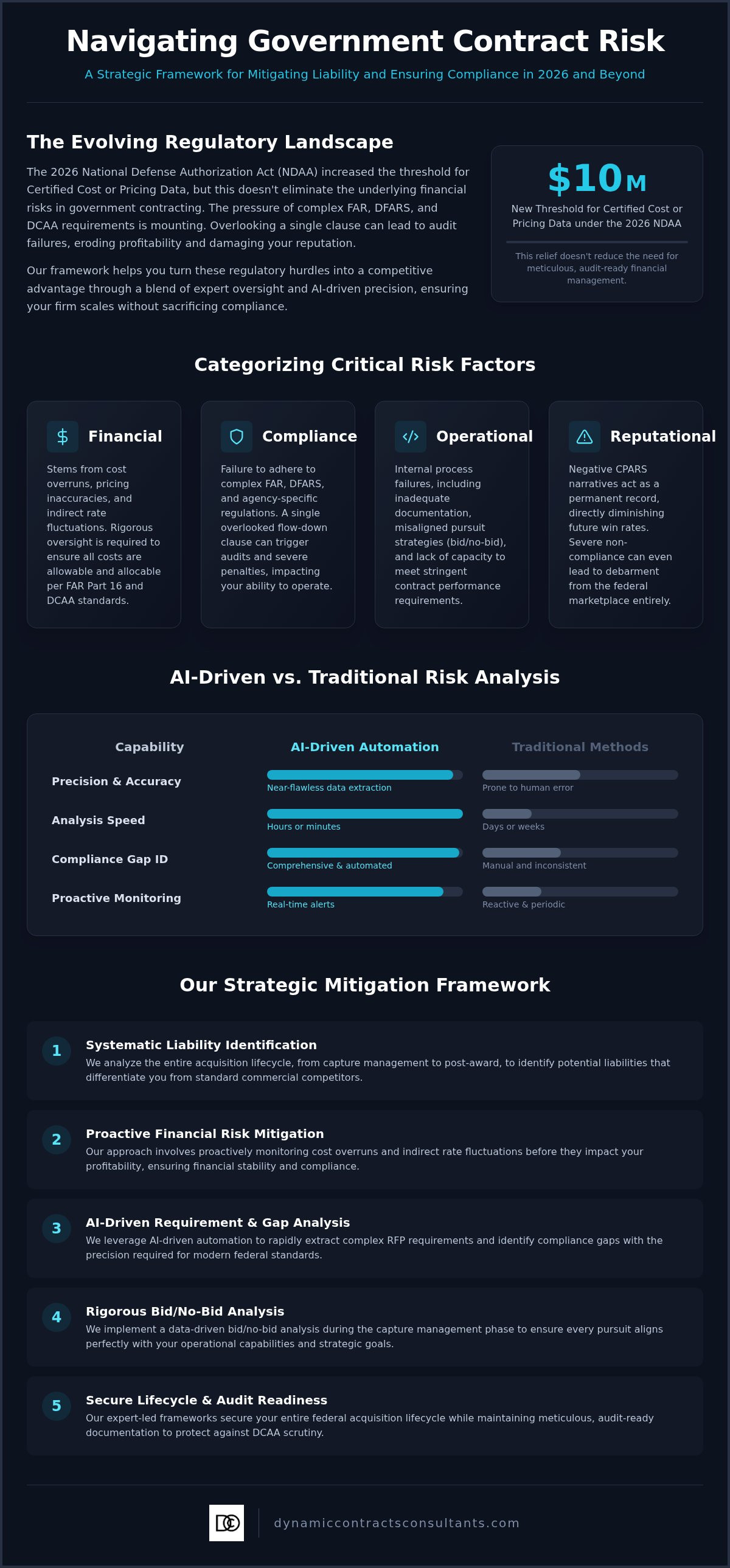
The regulatory environment is shifting significantly. For instance, the 2026 NDAA raised the threshold for Certified Cost or Pricing Data to $10 million for applicable contracts awarded after June 30, 2026. While this provides some relief, it doesn't reduce the need for precision. We utilize an audit-ready philosophy to ensure every record and financial statement meets the highest level of agency scrutiny. This methodology protects your revenue and positions your firm as a trustworthy partner for long-term federal growth.
Categorizing Critical Risk Factors: Financial, Compliance, and Operational
Identifying the specific categories of risk is the first step toward a resilient acquisition strategy. We categorize these factors into four distinct pillars: financial, compliance, operational, and legal. Each requires a unique mitigation strategy to ensure long-term profitability and strategic growth. By understanding where vulnerabilities lie, you can transform potential liabilities into managed assets during the procurement lifecycle.
Financial and Cost-Related Liabilities
Financial risk in government contracting often stems from cost overruns, pricing inaccuracies, and indirect rate fluctuations. These aren't just accounting errors; they're strategic failures that can erode your margins before a project even begins. According to Federal Acquisition Regulation (FAR) Part 16, the choice of contract type is the primary mechanism for allocating this risk between you and the government. Fixed-price contracts carry "hidden obligations" where you bear the full burden of technical performance and cost. Conversely, cost-reimbursement contracts require rigorous oversight to ensure costs are allowable and allocable. Utilizing DCAA compliance consulting significantly mitigates the risk of rejected cost proposals by ensuring your accounting systems meet federal standards. We focus on a detailed financial analysis of every proposal to ensure a cost-effective relationship for both parties.
Compliance and Regulatory Vulnerabilities
Compliance risks extend beyond simple bookkeeping. You must navigate a complex maze of agency-specific supplements like DFARS or DOSAR while maintaining strict adherence to DCAA accounting standards. One of the most overlooked areas is the management of flow-down clauses. Whether you're the prime or a subcontractor, failing to properly implement these clauses can lead to immediate contract termination. Our post-award compliance services provide a structured approach to managing these requirements, ensuring that every layer of your supply chain remains compliant with ITAR, EAR, and other regulatory frameworks.
Operational risks include technical performance gaps and milestone delays that can trigger liquidated damages or negative CPARS entries. Supply chain disruptions are particularly critical in 2026. Agencies are increasingly scrutinizing domestic sourcing to meet revised Buy American thresholds and cybersecurity resilience under CMMC. Legal risks often hide in the ambiguity of the Statement of Work (SOW) or Performance Work Statement (PWS). Vague requirements lead to scope creep and uncompensated effort that your firm cannot recover. Additionally, strict adherence to the Procurement Integrity Act is non-negotiable. Violations lead to immediate disqualification and potential debarment. If you're concerned about how these factors intersect with your current portfolio, consult with our strategic experts for a detailed risk analysis.
AI-Driven vs. Traditional Risk Analysis: Enhancing Precision and Speed
The traditional era of federal contracting relied heavily on manual document review, a process notoriously prone to fatigue and oversight. In 2026, we've transitioned into an AI-powered era where speed and precision are no longer mutually exclusive. This shift isn't just about efficiency. It's about achieving a level of accuracy that human eyes alone can't sustain when analyzing hundreds of pages of complex regulatory text. By leveraging AI-driven automation, you can identify the primary drivers of financial risk in government contracting during the earliest stages of the procurement lifecycle. This transition allows your team to move away from administrative data entry and toward high-level strategic planning.
FARIFY’s AI platform acts as your technological edge by extracting complex RFP requirements and identifying compliance gaps in minutes. Traditional methods typically result in compliance matrices that take days to compile and remain vulnerable to human error. Our automated approach reduces these errors significantly, ensuring that no obscure flow-down clause or agency-specific requirement is missed. This scalable intelligence enables your firm to bid on more complex, higher-value opportunities without a proportional increase in your administrative overhead.
The Role of FARIFY in Rapid Document Generation
Operational efficiency in 2026 depends on the rapid generation of accurate, audit-ready documentation. FARIFY generates drafts for Performance Work Statements (PWS), Statements of Work (SOW), and Statements of Objectives (SOO) that are designed to minimize performance ambiguity. Ambiguity is often the root cause of unallowable costs and performance disputes. By turning days of manual analysis into minutes of automated review, we provide a decisive speed advantage in competitive environments. Every AI-generated output is meticulously cross-referenced with federal, state, and local regulations to ensure your records meet the highest standards of agency scrutiny from the outset.
The Necessity of Human-in-the-Loop Assurance
While technology provides the speed, our CPCM-certified experts provide the essential strategic oversight. We maintain that AI alone is insufficient for managing the multifaceted intricacies of federal acquisition. Our framework incorporates a "human-in-the-loop" model for final risk verification. This ensures that every automated insight is validated by a seasoned strategist who understands the specific political and operational nuances of your target agency. We don't just provide data; we provide actionable intelligence.
We utilize AI for bid-no-bid analysis to quantify technical and financial risk in government contracting, but our experts make the final determination based on your firm’s unique competitive positioning. This balance of automated speed and expert-led verification ensures that every proposal we support meets our internal excellence in service standards. It’s this hybrid approach that protects your profit margins and builds long-term trust with your government partners.
Building a Robust Risk Mitigation Framework: A Step-by-Step Approach
Managing financial risk in government contracting requires a disciplined, five-step framework that integrates compliance into every phase of the acquisition lifecycle. We don't view risk mitigation as a final hurdle. Instead, it's a foundational strategy that begins long before a proposal is submitted and continues until the final invoice is paid. By following a structured methodology, you can identify potential liabilities before they impact your profitability.
Capture Management and Pre-Award Scrutiny
The first step in our framework is conducting a comprehensive pre-solicitation risk assessment during the capture management phase. We use market research and solicitation drafting analysis to identify "red flags" early in the lifecycle. These flags might include ambiguous Performance Work Statements (PWS) or restrictive clauses that shift an unfair amount of financial risk onto the contractor. Once these risks are identified, Step 2 involves a rigorous bid/no-bid analysis. This analysis determines if the potential reward justifies the compliance and capability gaps your firm must bridge. Utilizing strategic capture management services ensures that every pursuit is aligned with your firm’s risk tolerance and operational capacity. We also emphasize the importance of teaming agreements during this stage. A well-structured agreement allows you to share risk with strategic partners, ensuring that no single entity bears the full burden of complex federal requirements.
Managing Post-Award Flow-Down and Subcontract Risks
Step 3 focuses on developing a formal risk mitigation plan that specifically addresses subcontract management. It's vital to establish protocols ensuring that subcontractors adhere to the primary contract requirements through precise flow-down clauses. If a subcontractor fails to meet a regulatory standard, the prime contractor remains financially liable. In Step 4, we implement continuous post-award monitoring. This involves tracking deliverables and milestones to prevent performance-based risks that could lead to liquidated damages. We also provide CPARS narrative support to ensure your performance record remains stellar, which is critical for future win rates. Our Post-Award Contract Administration Guide offers deeper insights into maintaining this level of oversight throughout the project lifecycle.
The final phase, Step 5, is the execution of a clean contract closeout. Many firms overlook this step, yet it's the only way to ensure final audit readiness and release any remaining obligations. A successful closeout confirms that all costs are accounted for and all deliverables have been formally accepted by the agency. This five-step approach transforms compliance from a burden into a scalable asset. If you're ready to implement a robust framework that protects your margins, contact our certified experts today to discuss your custom risk strategy.
Strategic Compliance: How We Secure Your Federal Acquisition Lifecycle
Dynamic Contracts Consultants LLC, founded in 2015, acts as your strategic partner by providing simple solutions to complex federal problems. As a minority-owned small business with prime contractor experience across the DoD, State Department, EPA, and NOAA, we possess an intimate understanding of the operational hurdles that drive financial risk in government contracting. We don't just offer advice. We provide a comprehensive compliance shield that protects your firm from the earliest stages of capture management through the final contract closeout.
Our approach centers on the synergy between our certified experts and the FARIFY AI platform. While technology provides the speed to identify compliance gaps, our CPCM, CFCM, and CCCM-NCMA certified professionals provide the strategic oversight necessary for audit-ready assurance. This "human-in-the-loop" model is what separates us from software-only competitors who lack the hands-on experience required for DCAA audit defense. We leverage this scalable intelligence to ensure your firm achieves operational efficiency without compromising regulatory integrity.
Expert-Led Proposal and Grant Writing Services
A winning bid requires more than just technical capability. It demands a proposal that's both persuasive and strictly compliant with Section L and Section M requirements. We draft technical volumes that align perfectly with these evaluation criteria, making it easy for agency officials to award you high scores. Our customized proposal templates are built to maximize your evaluation outcomes by highlighting your strengths within a compliant framework. For those pursuing non-dilutive funding, we also provide a strategic guide for AI for grant writing to ensure your applications meet the highest federal standards.
Audit-Ready Assurance for Long-Term Success
Survival in the federal marketplace depends on your ability to withstand the scrutiny of DCAA audits and Procurement System Reviews (CPSR). We prepare your firm for these critical evaluations by establishing internal controls that mirror the government's own standards. This proactive stance on financial risk in government contracting ensures that your accounting and purchasing systems are never a liability. We also provide dedicated CPARS narrative support, helping you document your performance in a way that builds a formidable reputation for future competitions.
We're committed to your long-term growth and technical transformation. By integrating our expert consulting with cutting-edge AI tools, we provide the lifecycle support you need to win more contracts and manage them with absolute precision. Explore our full range of federal acquisition services to discover how we can secure your firm’s success in the 2026 regulatory environment.
Securing Your Competitive Edge in 2026
Mastering the complexities of federal acquisition requires a shift from reactive problem-solving to proactive strategic compliance. We've explored how a systematic framework effectively mitigates financial risk in government contracting by identifying liabilities at the earliest stages of the lifecycle. By integrating AI-driven automation for rapid requirement extraction with expert human oversight, your firm can navigate the 2026 regulatory landscape with absolute precision. This hybrid approach ensures that every bid is backed by audit-ready documentation and a clear understanding of flow-down liabilities.
Our team of Certified Professional Contracts Managers (CPCM) brings prime contractor experience with major agencies, including the DoD and NASA, to your specific business challenges. We combine this seasoned expertise with the scalable intelligence of our FARIFY platform to streamline your procurement lifecycle. Don't let compliance hurdles stall your growth or threaten your profitability. Secure your next federal award with our expert risk assessment services and transform your administrative requirements into a powerful strategic asset. We look forward to partnering with you on your journey toward scalable success.
Frequently Asked Questions
What is the primary goal of a government contract risk assessment?
The primary goal is to systematically identify and quantify potential liabilities throughout the acquisition lifecycle to protect your firm’s profitability. By evaluating performance, schedule, and cost variables, you can mitigate financial risk in government contracting before it impacts your bottom line. This process ensures that every decision, from teaming agreements to resource allocation, is data-driven. It transforms compliance from a reactive burden into a strategic advantage for long-term federal growth.
How does FARIFY AI ensure my contract documents are audit-ready?
FARIFY AI produces audit-ready documentation by utilizing models trained specifically on federal acquisition regulations rather than generic datasets. It extracts RFP requirements and generates compliant PWS, SOW, and IGCE drafts in minutes. To ensure absolute precision, we incorporate a human-in-the-loop review process where our CPCM-certified experts verify all outputs. This hybrid approach guarantees that your records meet the strict scrutiny of federal agencies while significantly reducing the time spent on manual document preparation.
What are flow-down clauses and why do they pose a risk to contractors?
Flow-down clauses are primary contract requirements that prime contractors must pass to their subcontractors to ensure total project compliance. They pose a significant risk because the prime contractor remains financially and legally responsible for the subcontractor's performance and regulatory adherence. If a sub fails to meet DCAA accounting standards or ITAR regulations, it's the prime that faces penalties or negative CPARS entries. Effective management of these clauses is vital for protecting your firm’s reputation.
Can Dynamic Contracts Consultants LLC help with DCAA audit preparation?
Yes, we provide specialized DCAA compliance consulting to ensure your accounting and purchasing systems meet federal standards. Our experts help you prepare for audits and Procurement System Reviews (CPSR) by establishing rigorous internal controls and audit-ready records. We leverage our experience as a prime contractor for agencies like the DoD and NASA to identify potential vulnerabilities. This proactive preparation minimizes the risk of rejected cost proposals and ensures your financial operations remain beyond reproach.
Is AI-driven risk assessment reliable for federal compliance requirements?
AI-driven risk assessment is highly reliable when built on specialized platforms like FARIFY that focus exclusively on the FAR and DFARS. Generic AI often misses the nuance of specific agency supplements, but our platform extracts requirements with high precision. Reliability is further enhanced by our team of CPCM and CFCM experts who perform final risk verification. This combination of scalable intelligence and seasoned oversight ensures your compliance strategy is both modern and technically sound for federal requirements.
What is the difference between pre-award and post-award risk management?
Pre-award risk management focuses on capture management, solicitation analysis, and the bid/no-bid decision to ensure you pursue the right opportunities. Post-award risk management involves contract administration, deliverable tracking, and managing flow-down clauses during project execution. Both phases are critical for managing financial risk in government contracting. While pre-award strategy prevents you from entering bad agreements, post-award oversight protects your revenue and ensures a clean contract closeout that is ready for agency audits.
How does a bid/no-bid analysis improve my contract win-rate?
A bid/no-bid analysis improves your win-rate by filtering out solicitations where your firm has significant compliance or capability gaps. Instead of wasting resources on low-probability pursuits, you focus your efforts on high-value acquisitions where you have a clear competitive advantage. We use AI-generated acquisition planning to quantify these risks quickly. This disciplined approach ensures your proposal team delivers higher quality responses for the contracts you are most likely to win and execute profitably.
Why is CPARS narrative support considered part of risk management?
CPARS narrative support is a form of reputation risk management because your past performance ratings directly influence your ability to win future awards. A single negative narrative can disqualify your firm from high-value opportunities for years. We help you document your performance, milestones, and compliance successes throughout the contract lifecycle. This proactive record-keeping ensures that the final evaluation reflects your excellence, protecting your firm’s brand and securing your position as a trusted federal partner.


