
What if a single "inadequate" rating on your accounting system audit cost you more than just a fine, but your entire pipeline of future prime contracts? It's a sobering reality for many federal contractors who view compliance as a checkbox rather than a strategic asset. We understand the anxiety that stems from the complexity of FAR and DFARS requirements. You've invested years into building your firm's reputation; however, the consequences of a failed DCAA audit can dismantle that progress in a matter of weeks through contract suspensions or even potential debarment.
We believe that regulatory hurdles shouldn't dictate your firm's ceiling. This 2026 guide is designed to help you discover the critical financial, legal, and strategic risks of DCAA non-compliance while providing a clear recovery framework to protect your federal standing. We'll examine the specific types of audit failures you might encounter and provide a comprehensive roadmap for remediation. By the end of this article, you'll have the insights needed to maintain a "low-risk" contractor status and approach your next audit with absolute confidence in your operational efficiency and strategic compliance.
Key Takeaways
- Gain a comprehensive understanding of DCAA audit opinions to prevent the immediate financial impact of disallowed costs and payment withholdings.
- Evaluate the long-term consequences of a failed DCAA audit, ranging from damaging CPARS reports to the strategic risk of contract debarment.
- Learn our structured approach for implementing a Corrective Action Plan (CAP) that effectively addresses the root cause deficiencies in your accounting system.
- Discover how you can utilize FARIFY.ai and our specialized consulting to maintain "low-risk" contractor status through scalable intelligence and AI-driven automation.
- Master the remediation framework necessary to protect your current prime contracts and ensure your firm’s future standing in the federal marketplace.
Understanding the DCAA Audit Landscape and Common Failure Modes
The Defense Contract Audit Agency (DCAA) operates as the primary financial oversight body for the Department of Defense (DoD), ensuring that every dollar allocated to federal contracts is utilized according to strict regulatory standards. For your firm, the DCAA isn't merely an administrative observer; it's the gatekeeper of your federal revenue stream. As we move through 2026, the complexity of these oversight mechanisms has intensified. The consequences of a failed DCAA audit now extend beyond simple accounting adjustments, often resulting in a complete erosion of your competitive standing. We've observed that the agency has shifted its focus toward digital traceability, meaning that traditional manual spreadsheets are no longer sufficient to demonstrate strategic compliance.
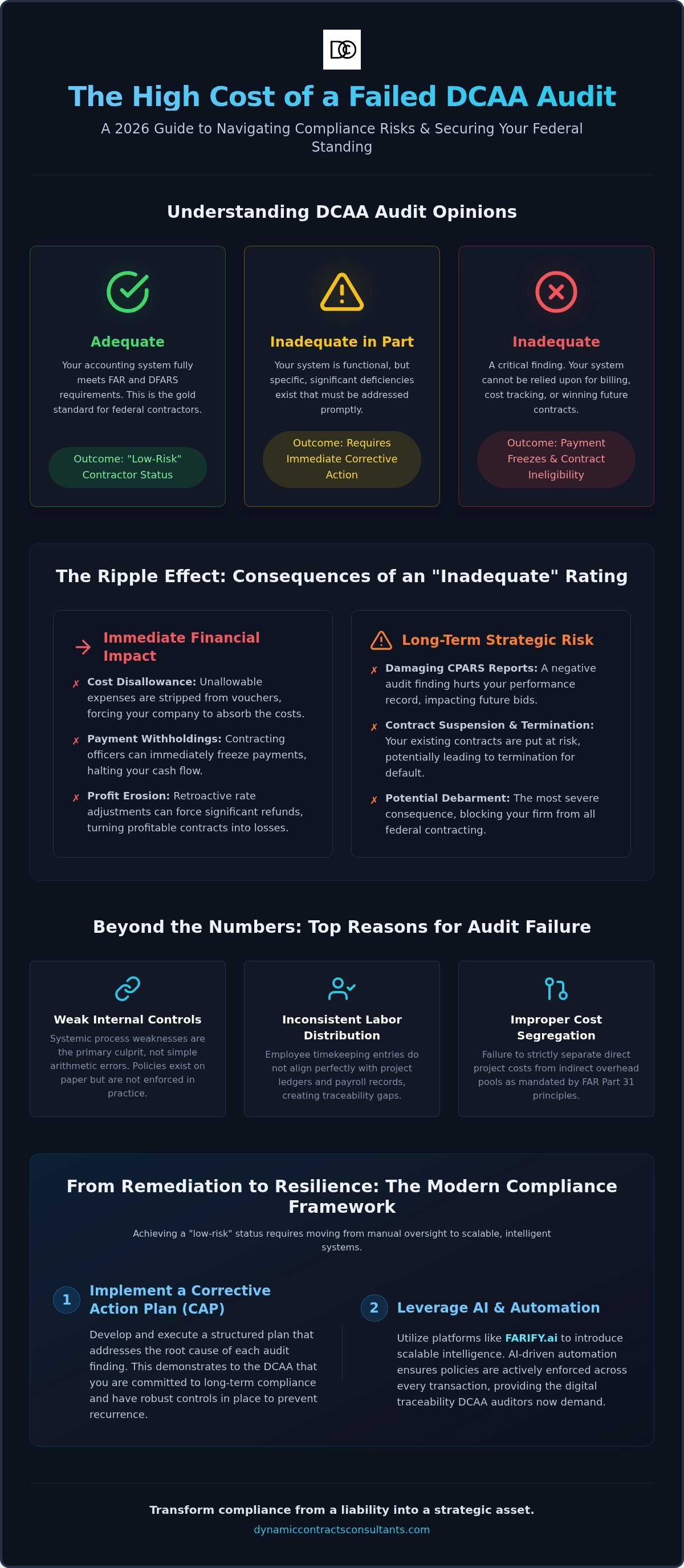
During an audit, your systems will receive one of three primary opinions. An "Adequate" opinion confirms that your processes meet FAR and DFARS requirements, allowing you to maintain your "low-risk" status. An "Inadequate in Part" rating signals that while your systems are functional, specific deficiencies exist that require immediate corrective action. The most critical risk is an "Inadequate" opinion, which indicates that your accounting system cannot be relied upon for billing or cost tracking. This finding can trigger immediate payment freezes and prevent you from winning future cost-reimbursable contracts.
The Spectrum of DCAA Audit Types
Your compliance journey typically begins with the SF 1408 pre-award survey, which evaluates if your system is capable of segregating costs before a contract is even granted. We've seen many contractors lose major opportunities because they couldn't pass this initial hurdle. Once a contract is active, incurred cost audits scrutinize your actual expenditures to ensure they align with what you've billed. If the DCAA identifies unallowable costs during this phase, you face the risk of retroactive cost disallowance. Finally, comprehensive accounting system reviews serve as the ongoing benchmark for your firm's operational efficiency and long-term eligibility for complex DoD work.
Why Contractors Fail: Beyond Simple Math
Compliance failures rarely stem from simple arithmetic errors; they're usually the result of systemic weaknesses in internal controls. Inconsistent labor distribution is a primary culprit. If your employees' timekeeping entries don't align perfectly with your project ledgers and payroll, the DCAA will likely find your system inadequate. Failing to strictly separate direct costs from indirect pools as mandated by FAR 31 principles remains another significant failure mode. We believe that achieving post-award compliance requires a transition from manual oversight to scalable intelligence. By integrating AI-driven automation into your procurement lifecycle, you can ensure that your policies aren't just written on paper but are actively enforced through every transaction.
Immediate Financial Penalties and Payment Disruptions
When the DCAA identifies systemic failures within your accounting system, the financial impact is swift and uncompromising. You face a combination of immediate revenue loss and long-term profit erosion that can destabilize even the most established firms. The consequences of a failed DCAA audit manifest most visibly through the mechanism of cost disallowance. This occurs when auditors determine that specific expenses don't comply with FAR Part 31 standards. These unallowable costs are stripped from your vouchers, forcing your company to absorb expenses you expected the government to reimburse. In 2026, the DCAA has increased its focus on over-billed amounts, frequently applying compounded interest charges that significantly increase the total fiscal damage of a negative finding.
Cost Disallowance and Profit Erosion
Profit erosion often stems from retroactive rate adjustments that occur long after the fiscal year has closed. If your indirect rates are found to be unsupported, you might be forced to issue significant refunds to the government, creating a sudden liability on your balance sheet. We've seen how these adjustments can turn a profitable contract into a net loss overnight. Allocability is the measure of whether a cost is assigned to a contract based on the relative benefits received, serving as the fundamental justification for every expense claimed. Without a robust system to prove this benefit, your costs will be deemed unallowable, directly reducing your bottom line.
Administrative Payment Withholds
Beyond cost disallowance, the most disruptive financial penalty is the administrative payment withhold. Under DFARS 252.242-7005, a "significant deficiency" notice allows Contracting Officers to freeze a percentage of your incoming invoices. Typically, this results in a 5% withhold for a single deficiency, which can escalate to 10% if multiple system flaws are identified. This creates a structural cash flow crisis that can last for months while you navigate the remediation process. It's not just a delay; it's a liquidity trap that threatens your ability to meet payroll or fulfill supplier obligations. Protracted delays during the remediation phase often force contractors to seek external financing, adding further interest costs to an already expensive failure.
Remediation itself represents a massive hidden expense. Fixing a broken system requires an intensive investment in post-award compliance strategies and internal overhauls. The administrative burden of conducting root cause analyses and retraining staff often exceeds the initial audit penalties. We recommend a proactive approach to identify these vulnerabilities before they escalate into formal deficiencies. If you're unsure about your system's current integrity, it's prudent to speak with our strategic consultants to secure your cash flow against future disruptions.
The Strategic Cost: Contract Terminations and Debarment Risks
While the immediate financial sting of disallowed costs is painful, the long-term consequences of a failed DCAA audit often prove fatal to a firm's growth trajectory. When the government loses confidence in your accounting integrity, they don't just withhold payments; they begin evaluating your fundamental eligibility as a responsible contractor. This process often starts with a "Show Cause" notice, a formal demand for you to justify why your contract shouldn't be terminated. If your response fails to demonstrate a clear path toward remediation, you risk a Termination for Default. This isn't just a lost project; it's a permanent stain on your record that signals to every agency that you are a high-risk partner.
The ripple effects continue through the Contractor Performance Assessment Reporting System (CPARS). A failed audit translates into negative ratings for business relations and management, effectively poisoning your past performance record for years. In extreme cases, systemic non-compliance can lead to the ultimate sanction: Suspension and Debarment. The "Domino Effect" of such a failure often includes:
- Immediate dissolution of existing teaming agreements as partners distance themselves from risk.
- Loss of "Prime" eligibility for all upcoming cost-plus RFPs.
- Increased administrative scrutiny on every other active federal project in your portfolio.
Being placed on the excluded parties list means your business is barred from federal procurement entirely. This is a catastrophic outcome that typically results in total operational collapse for firms dedicated to the public sector.
Impact on Capture Management and Future Bids
In the 2026 federal marketplace, agencies prioritize "low-risk" status during Section M evaluations. If you're currently operating under a Corrective Action Plan (CAP) due to an inadequate system, your risk rating becomes "unacceptable" for many high-value opportunities. We've seen talented firms lose out on massive awards simply because their back-office systems couldn't meet the rigorous standards of strategic compliance. To navigate these hurdles, you can leverage our Strategic Capture Management Services to ensure your risk profile remains a competitive asset rather than a liability.
Reputational Damage in the Small Business Ecosystem
Your reputation within the teaming ecosystem is equally vulnerable. Large prime contractors are increasingly diligent in vetting their small business partners for DCAA readiness before signing subcontracts. If your accounting system fails an audit, you may find yourself forced into secondary roles or excluded from joint ventures altogether. Prime contractors won't risk their own standing by partnering with a firm that lacks operational efficiency. Protecting your brand's strategic compliance profile is essential for maintaining your status as a reliable Prime and securing your place in the federal procurement lifecycle.
Developing a Post-Audit Remediation and Compliance Strategy
If your firm is grappling with the consequences of a failed DCAA audit, the path forward requires a disciplined, structured response. It's not enough to simply patch a software error; you must address the systemic deficiencies that led to the "inadequate" finding. We believe that a successful recovery begins with a rigorous root cause analysis to determine whether the failure resulted from flawed policies, inadequate training, or technical system limitations. In 2026, regulatory standards demand a robust Internal Control Environment that prioritizes digital traceability and real-time data integrity. We recommend rebuilding your compliance architecture from the ground up to ensure that every transaction is mapped to a specific regulatory requirement, effectively turning your back-office operations into a strategic asset.
The Corrective Action Plan (CAP) Framework
A well-constructed Corrective Action Plan (CAP) serves as your formal roadmap for remediation and is often the only way to prevent contract termination. You must establish measurable milestones for policy updates, system testing, and control validation. Transparency with your Administrative Contracting Officer (ACO) is vital during this phase; they need to see that you're taking proactive steps to restore the government's confidence in your operations. For a detailed breakdown of managing these requirements, you can refer to our Post-Award Compliance guide. This framework outlines how to structure your CAP to satisfy both DCAA auditors and agency stakeholders while maintaining your procurement lifecycle momentum.
Mock Audits and System Validation
We've found that the most successful remediations involve a "dry run" before the official follow-up review from the agency. Engaging third-party consultants for a Mock Audit allows you to identify lingering vulnerabilities in a low-stakes environment, providing a layer of scalable intelligence to your compliance efforts. This phase should include intensive training for your employees on updated timekeeping and expense reporting protocols to ensure your staff understands the logic behind the new controls. Audit-ready records differ from standard commercial accounting because they require an immutable trail of justification that links every transaction directly to an allowable contract objective under FAR 31. Validating your system through a mock audit ensures that your remediation has taken hold and that you're ready to regain your "low-risk" contractor status.
Remediation is an intensive process that requires both technical precision and strategic oversight. If you're facing a significant deficiency notice and need a structured path to recovery, contact our compliance experts to begin your remediation strategy today.
Leveraging Expert Consulting and AI for Audit-Ready Operations
We believe that the 2026 regulatory environment requires a fundamental shift from reactive remediation to continuous, AI-driven compliance. While previous sections detailed the severe consequences of a failed DCAA audit, we focus here on the technological and strategic evolution that prevents these failures entirely. Manual oversight is no longer a viable defense against the granular scrutiny of modern audits. By integrating scalable intelligence into your daily operations, you can transform compliance from a burden into a competitive advantage that wins contracts. We position our firm as the strategic partner that bridges the gap between complex FAR requirements and operational efficiency.
Our proprietary tool, FARIFY.ai, represents the cutting edge of this transformation. It allows you to generate audit-ready documentation in minutes rather than days, ensuring that your records are consistently aligned with the latest FAR and DFARS requirements. This isn't just about speed; it's about the precision that only AI-driven automation can provide in a high-stakes environment where a single documentation gap can trigger a significant deficiency finding.
AI-Driven Automation in the Procurement Lifecycle
AI technology allows you to proactively manage the entire procurement lifecycle with unprecedented accuracy. We use these tools to generate complex Performance Work Statements (PWS) and detailed compliance matrices that align perfectly with DCAA standards. This automation significantly reduces human error in critical administrative areas. Key advantages of our AI-driven approach include:
- Continuous generation of PWS and SOW documents that align with DCAA expectations.
- Real-time creation of compliance matrices to ensure 100% requirement coverage.
- Automated monitoring of flow-down clauses to mitigate subcontractor risk.
By ensuring that every requirement is tracked from the prime contract down to the smallest vendor, you insulate your firm against the risks of cost disallowance. For a deeper look at this methodology, read our guide on DCAA Compliance Consulting: A Strategic Framework for 2026.
The Dynamic Advantage: Precision and Scalable Intelligence
At Dynamic Contracts Consultants LLC, we balance this technological speed with "human-in-the-loop" professional oversight. We don't just provide software; we act as your strategic partner, ensuring that AI-produced documents meet the nuanced interpretations of DCAA auditors. Our solution-driven approach focuses on establishing a "low-risk" contractor profile, which is essential for improving your proposal win-rates. When you demonstrate that your back-office systems are as sophisticated as your technical solutions, you inspire confidence in agency evaluators. You can explore our Proposal Writing Services to see how we integrate these compliant frameworks into your technical volumes.
Avoiding the consequences of a failed DCAA audit is only the first step toward federal success. By partnering with Dynamic Contracts Consultants LLC, you're investing in a future where operational efficiency and strategic compliance drive your firm’s growth. We're here to ensure your federal standing remains unshakeable through every stage of the contract lifecycle.
Securing Your Competitive Edge in the Federal Marketplace
Maintaining a "low-risk" status in 2026 requires more than basic accounting; it demands a fusion of scalable intelligence and rigorous internal controls. We've explored how the consequences of a failed DCAA audit can ripple through your entire procurement lifecycle, from immediate payment withholds to the long-term strategic damage of a negative CPARS entry. You don't have to navigate these complexities alone. Our team of Certified Professional Contracts Managers (CPCM) provides the "human-in-the-loop" expertise necessary to ensure your systems meet the highest standards of strategic compliance.
As a minority-owned small business with extensive prime contractor experience, we understand the high stakes of your federal mission. By leveraging the AI-powered precision of our FARIFY technology, you can achieve audit-ready operations that protect your current contracts and enhance your future proposal win-rates. Don't wait for a deficiency notice to modernize your compliance architecture. Secure your federal standing with our expert DCAA compliance consulting today. We're ready to help you turn regulatory requirements into simple, scalable solutions for your long-term business growth.
Frequently Asked Questions
Can a small business survive a failed DCAA audit?
Yes, small businesses can survive if they act decisively to implement a Corrective Action Plan (CAP). Survival depends on your ability to address systemic deficiencies before the government initiates termination proceedings. We help firms navigate this by providing a structured roadmap to restore the government's trust. Recovery is achievable when you demonstrate a commitment to rebuilding your internal control environment and pass the follow-up review.
How long does the remediation process typically take?
The timeline varies based on the audit findings, but a typical remediation cycle takes between six to twelve months. This includes the time needed to conduct a root cause analysis, update written policies, and train staff on new protocols. Once these changes are implemented, the contractor must wait for the DCAA to schedule a follow-up review to validate the effectiveness of the new system controls.
Will a failed audit automatically lead to contract termination?
A failed audit doesn't trigger an automatic termination, but it significantly increases the risk of a "Show Cause" notice. The government prefers remediation if you are responsive to findings. However, the consequences of a failed DCAA audit often include being barred from new cost-reimbursable awards until your system is deemed adequate. This can lead to a strategic revenue gap that threatens your firm's long-term viability.
Is there a difference between a DCAA audit and a DCMA review?
The DCAA focuses specifically on financial and cost accounting audits to protect the government's fiscal interests. In contrast, the Defense Contract Management Agency (DCMA) handles broader contract administration, including system reviews like the Contractor Purchasing System Review (CPSR). While the DCAA provides the audit report, the DCMA’s Administrative Contracting Officer (ACO) usually makes the final determination on system adequacy and determines any payment withholds.
What are the most common timekeeping errors that lead to audit failure?
Failure to record hours on a daily basis and inconsistent labor distribution are the most frequent triggers for audit failure. Other common issues include employees charging time to incorrect project codes or supervisors failing to approve timesheets promptly. These errors suggest a lack of internal controls, leading auditors to conclude that the contractor’s labor costs are unreliable and potentially unallowable under FAR 31 standards.
How much does a DCAA compliance consultant cost compared to potential penalties?
The cost of professional compliance consulting is a strategic investment that is significantly lower than the financial damage of audit failure. Potential penalties include a 5% to 10% payment withhold on all invoices and the total disallowance of indirect costs. By engaging experts, you avoid the compounded interest charges on over-billed amounts and the massive administrative expense of emergency remediation after a negative finding.
Can AI software like FARIFY replace a human compliance officer?
AI software like FARIFY.ai doesn't replace a human compliance officer; it provides scalable intelligence to empower them. Our platform generates audit-ready documentation in minutes, but we maintain a "human-in-the-loop" approach to ensure regulatory accuracy. This combination allows for continuous compliance monitoring while providing the expert judgment needed to handle complex interpretations of FAR and DFARS requirements. We believe technology should enhance, not replace, professional expertise.
What happens if fraud is detected during a DCAA audit?
If the DCAA detects evidence of fraud, they refer the matter to the Office of Inspector General (OIG). This shifts the situation from an administrative audit to a criminal or civil investigation. The consequences of a failed DCAA audit involving fraud are severe, including immediate suspension, debarment, and substantial legal penalties under the False Claims Act. We emphasize that maintaining transparent, audit-ready records is the best defense against such findings.


