

What if the contract risks most likely to disrupt performance are buried in cost assumptions, audit records, or subcontract flow-down clauses? A disciplined government contract risk assessment helps you identify those liabilities before they affect compliance, revenue, or delivery. In FY 2025, the Defense Contract Audit Agency reported that its oversight presence led contractors to voluntarily remove more than $3.8 billion in unallowable costs from incurred cost submissions before audits began.
For government contractors, the challenge is familiar: DCAA audit expectations, complex FAR and DFARS requirements, and obligations passed down through subcontract clauses can make risk difficult to see across the procurement lifecycle. Effective management takes more than a document review. It requires structured analysis, clear supporting evidence, and experienced oversight.
In this guide, we outline a practical framework for identifying, assessing, and mitigating contract liabilities in 2026. You’ll learn how bid/no-bid analysis can support stronger pursuit decisions, how audit-ready documentation strengthens compliance processes, and how AI-driven tools such as FARIFY can accelerate risk identification. Our approach combines scalable intelligence with expert-led DCAA and FAR compliance support to help you make informed decisions before risks become costly setbacks.
Key Takeaways
- Use a government contract risk assessment to map liabilities across the acquisition lifecycle, rather than treating compliance as a single pre-award task.
- Separate financial, compliance, and operational exposures to see where cost assumptions, accounting practices, or contract requirements need closer review.
- Combine AI-driven document analysis with expert oversight to identify solicitation requirements and potential compliance gaps more efficiently.
- Strengthen capture decisions by assessing risks before solicitation and using bid/no-bid analysis to weigh compliance and capability gaps.
- Explore how Dynamic Contracts Consultants LLC combines acquisition and compliance expertise with FARIFY technology to support your federal contracting lifecycle.
The Fundamentals of Government Contract Risk Assessment in 2026
A government contract risk assessment is a structured review of potential liabilities across the acquisition lifecycle, from capture and proposal development through performance and closeout. It considers not only whether you can deliver the work, but also whether your pricing, accounting practices, internal controls, and contract obligations can withstand federal scrutiny. The general risk assessment process provides a useful foundation. Federal contracting adds requirements tied to the specific solicitation, contract clauses, and oversight environment.
Unlike a typical commercial B2B agreement, a federal contract may involve FAR or DFARS requirements, agency oversight, and audit expectations that affect how work is priced, documented, and performed. Your review should connect each regulatory exposure to a business impact. For example, check whether proposed staffing, schedule, and pricing assumptions leave enough capacity and margin to perform the work responsibly.
For a related acquisition perspective, watch this Defense Acquisition University Media video:
A risk assessment can help identify weaknesses in cost practices and supporting evidence before they become audit findings. For a useful review, document what needs attention, what evidence supports your conclusions, and who is responsible for resolving each gap.
Risk analysis also informs bid/no-bid decisions. Before committing proposal resources, assess whether your organization understands the requirements, can support its pricing assumptions, and has the controls and capacity to perform. A disciplined review can show when a pursuit aligns with your capabilities and when unresolved gaps call for mitigation or a decision not to bid.
The Consequences of Inadequate Risk Oversight
Weak oversight can lead to unallowable costs being questioned or removed, affecting contract economics and increasing the work needed to explain or correct records. Poor performance may also be documented in CPARS evaluations. Negative narratives can weaken a contractor’s position in future source selections, although they do not determine outcomes by themselves. Depending on the circumstances and applicable processes, serious compliance failures may create legal exposure or risk of suspension or debarment. These are potential consequences, not automatic results of every error.
Regulatory Foundations: FAR 39.102 and Beyond
FAR 39.102 addresses policy for information technology acquisitions. It is relevant when an acquisition involves IT, but it is not a universal risk checklist for every federal contract. Your assessment should account for the solicitation’s actual terms and applicable FAR or DFARS clauses. Internal controls should translate those requirements into assigned responsibilities, consistent records, and decisions that can be reviewed.
Our audit-ready approach organizes documentation so that key decisions, costs, approvals, and supporting evidence can be traced and explained under agency scrutiny. That discipline supports strategic compliance throughout the procurement lifecycle, rather than relying on a last-minute effort to reconstruct the record.
Categorizing Critical Risk Factors: Financial, Compliance, and Operational
A useful government contract risk assessment groups exposures by their potential effects on contract cost, compliance, delivery, and business continuity. FAR 39.102 provides policy guidance for risk management in IT acquisitions. Its emphasis on management and mitigation of risk is a reminder to consider potential problems early, while tailoring your review to the specific contract and applicable requirements.
Financial and Cost-Related Liabilities
Financial risk can stem from inaccurate pricing assumptions, cost overruns, or indirect rates that do not reflect expected performance costs. Weakly supported cost data and inconsistent accounting practices can also complicate proposal evaluation and increase the risk of questioned costs. DCAA compliance consulting can help contractors assess cost accounting practices, strengthen supporting documentation, and identify proposal weaknesses before submission.
Contract type affects how you manage financial exposure. Under a fixed-price arrangement, cost growth can reduce your margin if the agreed price does not change to reflect higher performance costs. Under a cost-reimbursement arrangement, allowable-cost rules and documentation requirements shape what may be reimbursed. In either case, compare the statement of work, pricing assumptions, contract clauses, and incorporated obligations. Identify commitments that may require unplanned resources. These are not automatically “hidden” costs; they are risks that can be missed when contract documents are reviewed in isolation.
Compliance and Regulatory Vulnerabilities
Compliance analysis should identify which requirements apply to the contract. FAR and DFARS clauses may be supplemented by agency-specific provisions, such as DOSAR requirements for State Department acquisitions. DCAA-related accounting expectations also need to be reflected in your cost processes and records. For work involving controlled items or technical data, assess applicable ITAR or EAR requirements rather than assuming they apply to every federal project.
Flow-down clauses deserve particular attention because they can pass relevant prime contract obligations to subcontractors. A prime should identify applicable terms, communicate them accurately, and maintain a process for tracking subcontractor compliance. Subcontractors need to understand the obligations incorporated into their agreements. Structured post-award compliance services can help organize clause tracking and ongoing contract administration.
Operational and Legal Exposures
Operational risks include supply chain disruption, technical performance gaps, and milestones that depend on resources or approvals not yet secured. Map dependencies against the delivery schedule and identify where a delay could affect other contract commitments. Legal and integrity risks can arise when a SOW or PWS leaves scope, acceptance criteria, or responsibilities unclear. Resolve ambiguities through appropriate contract channels and maintain safeguards that support adherence to Procurement Integrity Act requirements.
AI-Driven vs. Traditional Risk Analysis: Enhancing Precision and Speed
Traditional risk analysis often depends on staff manually reading solicitation documents, copying requirements into spreadsheets, and comparing them with internal policies and capabilities. That work remains valuable, but repetitive extraction and cross-checking can take time and leave room for omissions, especially when requirements are spread across an RFP and its attachments. In a government contract risk assessment, AI-driven analysis can speed up this first-pass review while leaving interpretation and decisions to expert judgment.
FARIFY.ai applies AI to procurement documents to extract RFP requirements and flag potential compliance gaps in minutes. It can support compliance matrices and gap analyses, giving proposal and capture teams a structured starting point. Consistent extraction can reduce manual transcription errors, but it does not establish compliance on its own. Your team still needs to confirm that each requirement is interpreted correctly, assigned to an owner, and addressed with appropriate evidence.
The Federal Acquisition Regulation on risk management provides an agency-side reference for assessing, monitoring, and controlling acquisition risks. For contractors, a clear, traceable analysis helps your team respond to government requirements and explain how risks will be managed.
The Role of FARIFY in Rapid Document Generation
FARIFY can assist with drafting acquisition documents such as PWS, SOW, and SOO materials, helping teams organize requirements and reduce ambiguity during document development. AI-supported review can also surface missing information or inconsistencies for human follow-up. The benefit is not just faster drafting. It is the ability to focus expert attention on unresolved scope, compliance, and delivery questions instead of routine document comparison.
Generated content should be validated against the governing solicitation, contract terms, and applicable requirements. Federal, state, and local rules vary by context, so review AI outputs against the specific jurisdiction and acquisition rather than treating them as automatically compliant.
Human-in-the-Loop Assurance
AI can identify patterns and organize information, but it cannot replace accountable professional judgment. Our CPCM-certified experts can review flagged requirements, assess the significance of gaps, and connect findings to capture strategy and compliance processes. This combination of automated speed and experienced oversight supports scalable intelligence: your team can evaluate complex opportunities without treating a generated matrix as a final risk decision.
For teams refining opportunity selection, our discussion of AI for Bid-No-Bid Analysis explores how AI can inform pursuit decisions while keeping strategic review central.
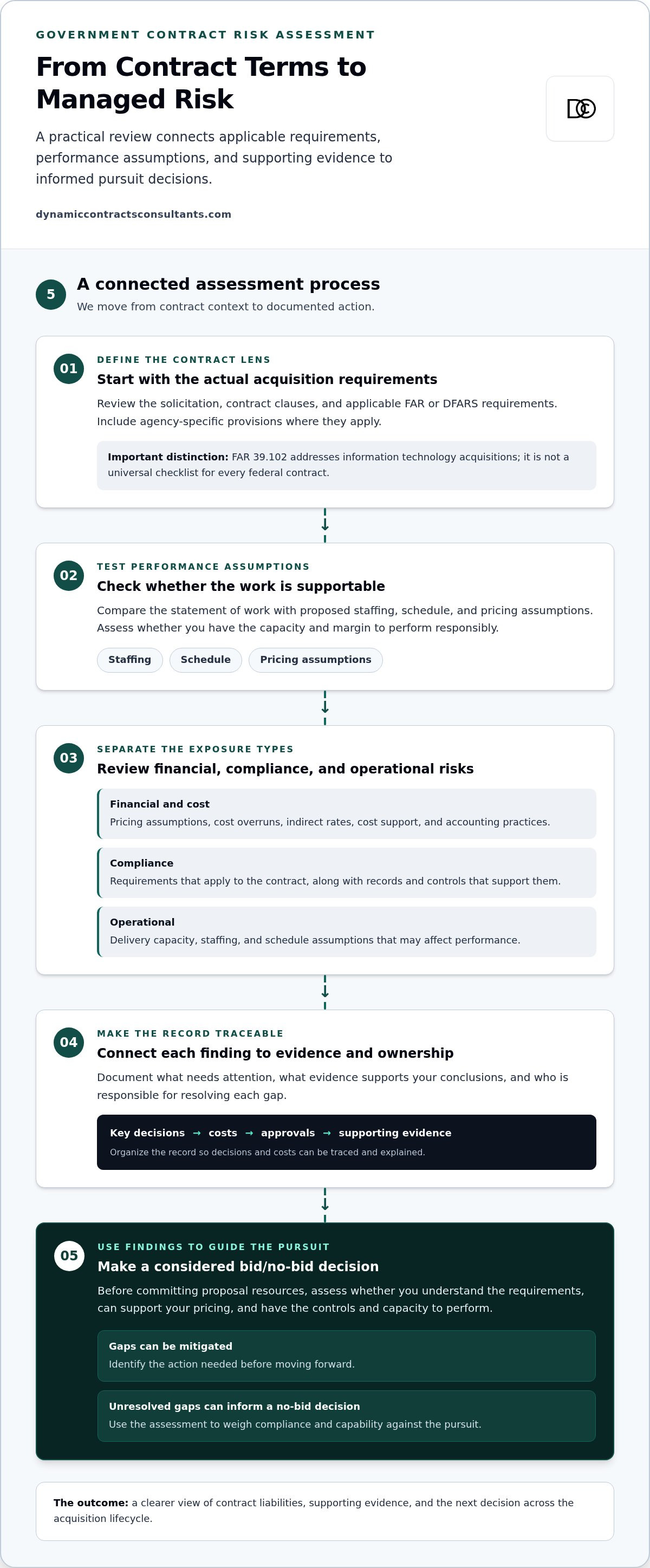
Building a Robust Risk Mitigation Framework: A Step-by-Step Approach
A strong government contract risk assessment becomes operational when each exposure has an owner, a response, and a documented review point. Use the following steps to carry risk controls from early opportunity analysis through contract closeout.
Capture Management and Pre-Award Scrutiny
During capture, compare the opportunity’s requirements with your technical, staffing, schedule, pricing, and compliance capabilities. Market research can clarify the acquisition environment, while solicitation development and review can surface unclear scope, unrealistic milestones, or dependencies that need attention. Teaming agreements should define roles, deliverables, communication, and responsibilities so collaboration does not create accountability gaps. Our strategic capture management services support disciplined preparation before proposal commitments are made.
- Step 1: Assess pre-solicitation risks. Record opportunity assumptions, likely requirements, resource needs, and unresolved questions during capture. Assign an owner to each material issue and track what must be validated before proposal submission.
- Step 2: Make a rigorous bid/no-bid decision. Evaluate compliance and capability gaps alongside strategic fit, pricing support, staffing, and delivery capacity. Decide whether each gap can be resolved during the pursuit or creates unacceptable execution exposure.
- Step 3: Establish a mitigation plan. Document each risk, its potential effect, the mitigation action, responsible lead, and monitoring trigger. For subcontracted work, map applicable prime contract requirements to subcontract terms and define how evidence, deliverables, and emerging issues will be communicated.
Managing Post-Award Flow-Down and Subcontract Risks
After award, maintain a clause and obligation matrix linking relevant prime contract terms to responsible internal teams and subcontractors. Track acknowledgement, assigned owners, required evidence, deliverable dates, and open exceptions in a consistent record. Review milestone status with subcontractors early enough to address slippage, dependency issues, or incomplete documentation before they affect prime performance. Our post-award compliance support helps structure this ongoing administration.
- Step 4: Monitor performance and records. Compare actual progress with milestones, document corrective actions, and retain evidence of decisions and outcomes. Keep CPARS-related performance records factual and current so that reporting is supported by contract evidence, not reconstructed at the end of performance.
- Step 5: Close out with an organized record. Reconcile contract documentation, outstanding deliverables, subcontract records, and financial support. Resolve open items and preserve the final audit trail. A planned closeout reduces the chance that missing explanations or scattered records will undermine later review.
We help contractors connect capture decisions, flow-down controls, post-award monitoring, and closeout in a coordinated compliance process. Engage our team to strengthen risk controls across your contract lifecycle.
Strategic Compliance: How We Secure Your Federal Acquisition Lifecycle
Dynamic Contracts Consultants LLC partners with government contractors to turn complex acquisition and compliance requirements into practical processes. Our guiding principle is “simple solutions to complex problems,” supported by lifecycle expertise and technology designed to improve operational efficiency. As a minority-owned small business with prime contractor experience involving the DoD and EPA, we understand how disciplined preparation and documentation contribute to federal contract performance.
Our consultants work alongside FARIFY’s AI-powered tools to combine document analysis with human judgment. AI can help organize requirements and generate documentation, while experienced professionals review context, validate outputs, and identify issues that require a strategic decision. That human-in-the-loop approach matters: a generated document is a starting point, not a substitute for accountable review. It connects your government contract risk assessment to actions your team can sustain from capture through post-award administration.
Expert-Led Proposal and Grant Writing Services
Proposal development requires more than persuasive language. Technical volumes must respond to the solicitation, remain consistent with the proposed solution, and address the stated evaluation criteria. We help structure proposal content around Section L instructions and Section M evaluation criteria, creating clear traceability between what the solicitation requests and what your response demonstrates. This alignment supports responsiveness without promising an evaluation outcome.
Our grant writing and AI-supported workflows apply the same emphasis on clarity, requirements, and review. For a closer look at the role of AI in this work, read our guide to AI for Grant Writing.
Audit-Ready Assurance for Long-Term Success
Audit readiness depends on consistent records, defined processes, and evidence that supports business decisions. We provide DCAA compliance consulting and acquisition support to help organize documentation, assess control gaps, and prepare your team for scrutiny. For Procurement System Reviews (CPSR), readiness depends on having procurement practices and records that can be clearly explained and supported. Preparation should reflect your organization’s systems and the review context.
Accurate, well-organized performance records also help teams prepare factual CPARS narratives by connecting reported outcomes to contemporaneous contract evidence. We bring these practices together across proposal development, compliance, and post-award administration so your processes can scale as your federal portfolio grows.
Explore our full range of federal acquisition services to see how our expert-led support and AI-driven tools can strengthen your acquisition lifecycle.
Build a More Resilient Federal Contracting Strategy
A disciplined government contract risk assessment helps you identify financial, compliance, and performance exposures before they disrupt delivery or weaken your audit position. The strongest approach connects early capture and bid/no-bid decisions with post-award monitoring, subcontract flow-down controls, and an organized closeout record.
Technology can accelerate document review, requirement extraction, and gap identification, but it works best alongside expert oversight. Our CPCM-certified professionals pair contract expertise with the AI-powered FARIFY platform to support faster analysis and more consistent documentation. Dynamic Contracts Consultants also brings prime contractor experience with agencies including the DoD and EPA, informing our practical understanding of federal acquisition demands.
With coordinated support across the procurement lifecycle, you can strengthen strategic compliance, improve operational efficiency, and prepare your organization to pursue growth with greater discipline. Discuss your federal contract risk assessment needs with our team to identify practical next steps for your business. A clear, well-supported process can help you approach your next opportunity with confidence.
Frequently Asked Questions
What is the primary goal of a government contract risk assessment?
The primary goal is to identify and manage potential liabilities before they disrupt contract performance, compliance, or financial results. A government contract risk assessment reviews exposure across the acquisition lifecycle, including pricing assumptions, accounting practices, contract clauses, delivery capacity, and subcontractor responsibilities. The findings help your team assign owners, document mitigation actions, and make informed pursuit and performance decisions, rather than waiting for an audit or missed milestone to reveal a weakness.
How does FARIFY AI help make my contract documents audit-ready?
FARIFY uses AI-powered document generation and analysis to organize acquisition requirements and produce supporting materials, including compliance matrices and post-award documentation. Its tools can help teams create audit-ready records in minutes while reducing repetitive manual work. Audit readiness still depends on accurate source information and appropriate review. Our human-in-the-loop approach helps validate outputs against relevant contract requirements and ensures your team can explain and support the decisions reflected in its records.
What are flow-down clauses, and why do they pose a risk?
Flow-down clauses are prime contract requirements incorporated into a subcontract when applicable. They create risk when relevant terms are omitted, passed down inaccurately, or not understood and tracked by the subcontractor. For example, a prime may need to map a contract obligation to a subcontract deliverable, responsible owner, and evidence requirement. Clear clause review, communication, and ongoing monitoring help both parties understand responsibilities and reduce gaps that could affect prime contract performance.
Can Dynamic Contracts Consultants help with DCAA audit preparation?
Yes. Dynamic Contracts Consultants provides DCAA compliance consulting and supports contractors in organizing records and strengthening compliance processes in preparation for audit scrutiny. This may include reviewing cost documentation, accounting practices, and supporting evidence so your team can identify gaps and address them systematically. Preparation is tailored to the contractor’s circumstances and applicable requirements. Consulting support does not guarantee an audit outcome or replace your organization’s responsibility for accurate records.
Is AI-driven risk assessment reliable for federal compliance?
AI can help extract requirements, compare documents, and flag potential gaps, but it should support rather than replace professional review. Federal compliance depends on the solicitation, contract terms, and applicable regulations, so teams must validate AI-generated findings against authoritative requirements and project context. FARIFY combines AI-powered document support with human review, helping your team work more efficiently while retaining accountable expert judgment over interpretations, risk decisions, and final documentation.
What is the difference between pre-award and post-award risk management?
Pre-award risk management focuses on evaluating an opportunity before you submit a proposal or accept an award. It includes assessing requirements, pricing assumptions, capability gaps, and bid/no-bid considerations. Post-award management addresses risks during performance, including clause tracking, subcontractor coordination, deliverables, milestones, records, and closeout. Both stages matter: early analysis informs whether and how to pursue work, while ongoing controls help manage obligations after award.
How does a bid/no-bid analysis improve my win-rate?
A bid/no-bid analysis can improve pursuit discipline by helping your team prioritize opportunities that align with its capabilities, compliance readiness, resources, and strategic objectives. It does not guarantee a higher win-rate, but it can reduce effort spent on bids with unresolved capability or compliance gaps. A documented assessment also clarifies what must be addressed before submission, helping your proposal team focus on opportunities it can pursue with a credible, well-supported response.
Why is CPARS narrative support considered part of risk management?
CPARS narrative support is part of performance risk management because clear, evidence-based records help your organization describe contract outcomes accurately. Maintaining documentation during performance makes it easier to support statements about milestones, deliverables, corrective actions, and results. A well-organized factual record can also help your team prepare for performance reporting and respond consistently to concerns. CPARS support does not control an evaluation, but it helps ensure your account is grounded in documented contract performance.


