

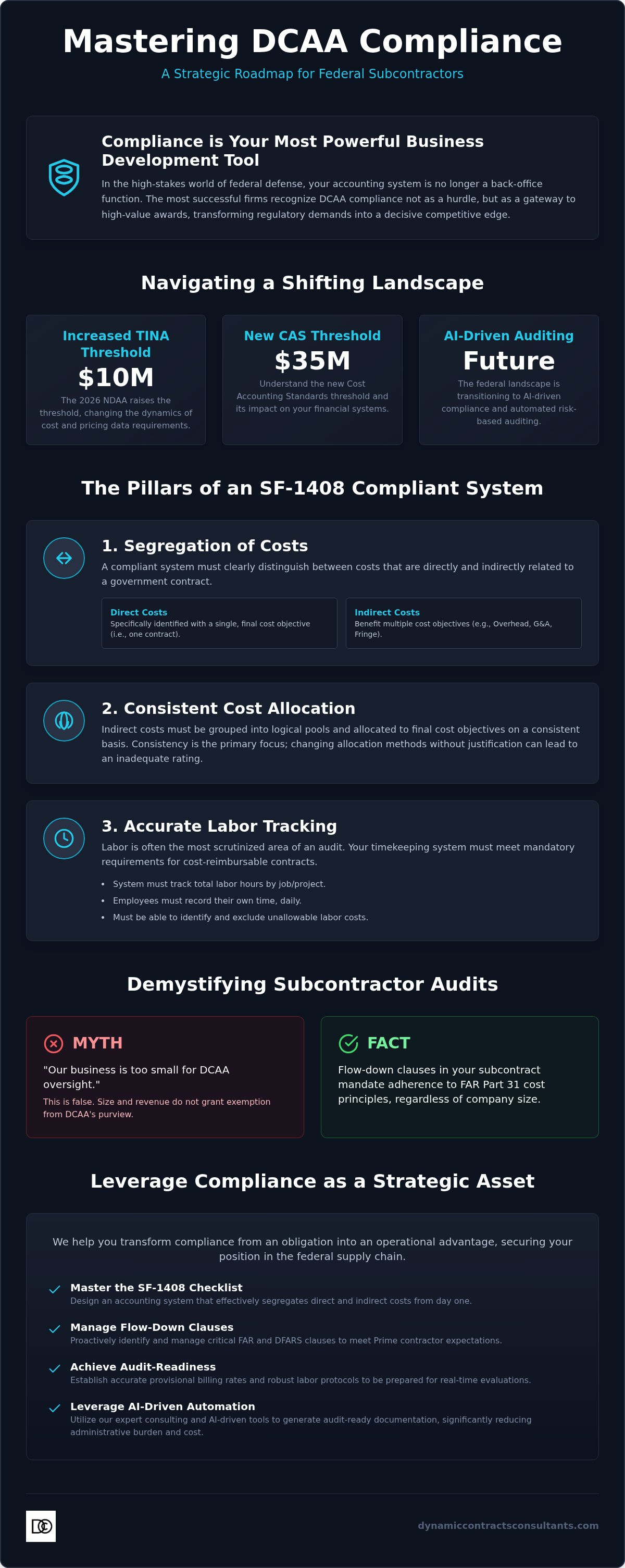
In the high-stakes world of federal defense, your accounting system is no longer just a back-office function; it is your most powerful business development tool. While many firms view the Defense Contract Audit Agency as a hurdle, the most successful teams recognize that dcaa compliance for small business subcontractors is actually a gateway to high-value awards. With the 2026 NDAA increasing the TINA threshold to $10 million, the landscape is shifting rapidly. We know that deciphering the FAR and DFARS feels like learning a second language while the pressure from Prime contractors to maintain an approved system continues to mount.
We understand that the high cost of traditional consulting often makes these regulations feel out of reach for growing teams. This guide provides the clear roadmap you need to build an adequate accounting system without the typical administrative bloat. We will show you how to master DCAA requirements and secure your position in the federal supply chain with expert-led strategies. From understanding the new $35 million CAS threshold to implementing AI-driven precision, we'll explore the essential steps to maintain a competitive edge for future federal awards.
Key Takeaways
- Understand the specific requirements of the SF-1408 Evaluation Checklist to design an accounting system that effectively segregates direct and indirect costs.
- Identify and manage critical FAR and DFARS flow-down clauses to ensure your firm meets the rigorous oversight standards expected by Prime contractors.
- Prepare for real-time evaluations and floor checks by establishing accurate provisional billing rates and robust labor tracking protocols.
- Discover how dcaa compliance for small business subcontractors functions as a strategic asset that mitigates audit risk and secures your position in the federal supply chain.
- Leverage AI-driven automation and expert consulting to generate audit-ready documentation, significantly reducing the time and cost of regulatory adherence.
Navigating DCAA Compliance as a Small Business Subcontractor
The Defense Contract Audit Agency (DCAA) serves as the essential financial gatekeeper for Department of Defense (DoD) expenditures. Its primary function involves auditing contract costs to ensure they are reasonable, allowable, and allocable under federal regulations. For your business, this means that every financial transaction tied to a government contract is subject to scrutiny. In the 2026 federal landscape, we see a significant transition toward AI-driven compliance and automated risk-based auditing. Establishing dcaa compliance for small business subcontractors is no longer just an administrative hurdle; it's a strategic necessity for any firm looking to scale within the federal supply chain.
Prime contractors are increasingly selective about their partners. They understand that a subcontractor with a deficient accounting system creates a massive liability for the entire project. By maintaining an audit-ready posture, you demonstrate operational maturity and reduce the Prime's risk. We've seen how this proactive approach transforms small firms from simple vendors into preferred strategic partners who can handle complex, cost-reimbursable work with confidence.
The Relationship Between DCAA and the Small Business Subcontractor
Prime contractors carry the burden of ensuring their entire team remains compliant. Consequently, they will evaluate your financial systems with the same rigor the government applies to them. It's vital to distinguish between the Defense Contract Management Agency (DCMA), which handles contract administration, and the DCAA, which focuses exclusively on financial audits. The legal benchmark you must achieve is an "adequate" accounting system. This isn't a subjective term; it refers to a system capable of segregating costs, tracking labor hours accurately, and excluding unallowable expenses. Our post-award compliance expertise ensures that your systems meet these exacting standards from the start of the performance period.
Common Misconceptions About Subcontractor Audits
A frequent misconception is that small businesses are exempt from DCAA oversight because of their size or revenue. This is false. Flow-down clauses in your subcontract agreement mandate adherence to FAR Part 31 cost principles regardless of your company's headcount. Another critical distinction involves the timing of oversight. A Pre-Award Survey, often utilizing the SF-1408, evaluates whether your system is designed to handle government work. In contrast, a Post-Award Audit examines your actual historical data to verify that you followed those designs. Understanding that dcaa compliance for small business subcontractors applies throughout the entire contract lifecycle is the first step toward long-term success in the defense sector. You're facing the same scrutiny as the largest defense contractors; your advantage lies in your ability to adapt quickly.
Establishing an Adequate Accounting System (SF-1408)
Achieving dcaa compliance for small business subcontractors requires more than just installing accounting software. It demands a system designed to meet the rigorous standards of the SF-1408 Evaluation Checklist. We utilize AI-driven automation to audit-proof your accounting policies, ensuring that your procedural manuals align perfectly with current regulatory expectations. By automating the identification of unallowable costs, we reduce the risk of human error during the invoicing process, which is a major factor in maintaining your status as a qualified federal partner.
The Core Pillars of a DCAA-Compliant System
A compliant system rests on the clear segregation of direct costs from indirect costs. Direct costs are those specifically identified with a single contract, while indirect costs, such as Overhead, G&A, and Fringe, must be grouped into logical pools and allocated consistently. You can find detailed templates and checklists within the official DCAA Guidance to help structure these pools. Consistency is the primary focus here. If you change how you allocate costs mid-stream without proper justification, you risk an inadequate rating during a system review.
Labor tracking is often the most scrutinized area of any audit. Your timekeeping system must track labor by job, requiring employees to record their own time daily. This isn't just a best practice; it's a mandatory requirement for cost-reimbursable contracts. Additionally, your system must automatically identify and exclude unallowable costs as defined by FAR Part 31, such as entertainment, interest, or certain legal fees. Failing to filter these out during the billing process is a fast track to audit exceptions and potential penalties that could jeopardize your future awards.
Preparing for the Pre-Award Accounting System Survey
Standard Form 1408 (SF-1408) is the Standard Form used to evaluate a system before contract award. When an auditor conducts a pre-award survey, they perform a virtual or in-person review of your internal controls. They aren't just looking at your ledger; they're evaluating the "tone at the top" regarding compliance. They want to see that your staff understands the requirements and that your written policies match your actual day-to-day operations. Documentation for every transaction must be readily available and cross-referenced to specific job codes.
Common pitfalls include missing written policies, lack of employee training on timekeeping, or failing to demonstrate that the system is currently operational. Understanding the nuances of dcaa compliance for small business subcontractors is much easier with a partner who understands the procurement lifecycle. If you're concerned about your current setup, seeking strategic guidance can help you identify gaps before the auditor arrives. We provide a human-in-the-loop assurance, combining regulatory precision with scalable intelligence to ensure your system is robust enough for any federal award.
Managing Flow-Down Clauses and Subcontractor Responsibilities
Prime contractors carry a legal and financial burden to ensure their entire supply chain remains audit-ready. When you sign a subcontract, you aren't just agreeing to deliver a product or service; you're often inheriting a complex web of Federal Acquisition Regulation (FAR) and Defense Federal Acquisition Regulation Supplement (DFARS) requirements. Maintaining dcaa compliance for small business subcontractors involves more than just internal accounting; it requires a deep understanding of how these specific clauses flow down from your Prime contractor. If your systems are found deficient, the Prime faces a high risk of "non-compliance by association," which can jeopardize their own Contractor Purchasing System Review (CPSR) rating. Prime contractors must adhere to strict guidelines regarding subcontractor compliance and oversight to protect the government's interests and their own operational standing.
Strategic Management of Contract Flow-Downs
Managing multiple flow-down requirements across various contracts creates a significant administrative burden for smaller firms. We recommend utilizing a compliance matrix to track every obligation, from specialized labor categories to unique reporting cycles. Our approach leverages AI-driven automation to extract and analyze clause requirements from complex contract documents, ensuring nothing is missed during the transition from award to execution. We provide comprehensive Post-award compliance and flow-down management to ensure your team remains audit-ready throughout the procurement lifecycle. This strategic compliance model allows you to focus on performance while we manage the regulatory precision required for your accounting and reporting systems.
Subcontractor Monitoring and Reporting
The reporting requirements for subcontractors are often as rigorous as those for Primes. For instance, the Federal Funding Accountability and Transparency Act (FFATA) mandates specific executive compensation and first-tier subcontract data reporting. You must also maintain meticulous records that can be produced during a Prime’s CPSR, as any gap in your documentation reflects poorly on their oversight. Proactive communication with your Prime contractor is essential. By providing them with regular, transparent updates on your system's status, you establish yourself as a low-risk partner. This transparency is a key component of dcaa compliance for small business subcontractors, as it builds the trust necessary for long-term scalable growth. We help you establish these reporting frameworks, ensuring your data is accurate, timely, and fully compliant with all flow-down mandates.
Audit Preparedness: Pre-Award to Real-Time Evaluations
Audit preparedness is not a static state; it's an active operational discipline that requires constant vigilance. While the SF-1408 focuses on your system's design, real-time evaluations test whether your team actually follows those designs in their daily workflows. For dcaa compliance for small business subcontractors, this often manifests as unannounced labor evaluations or floor checks. We ensure your firm is ready by implementing "human-in-the-loop" reviews for all AI-generated documentation, providing a level of regulatory precision that automated platforms alone cannot guarantee. This approach balances scalable intelligence with the nuanced understanding of a certified professional.
Surviving the DCAA Labor Floor Check
A labor floor check is a real-time audit where an evaluator interviews your employees to verify they are working on the projects they are charging. You must train every team member on proper timekeeping procedures before they record a single hour on a federal contract. We recommend a strict checklist to maintain readiness:
- Daily Labor Recording: Employees must enter their time by the end of each shift without exception.
- Employee Ownership: Each timesheet requires a digital or physical signature from the individual performing the work to certify accuracy.
- Supervisor Oversight: Managers must verify and approve charges, but they cannot enter time on behalf of their subordinates.
- Audit Trail for Adjustments: Any changes to previously submitted time must include a clear, documented reason for the reclassification.
The Annual Incurred Cost Submission (ICS) Requirement
If you hold cost-reimbursable or time-and-materials contracts, you must submit an Incurred Cost Submission within six months of your fiscal year-end. This critical document reconciles your provisional billing rates, which are the estimated indirect rates used for invoicing throughout the year, with your actual year-end costs. Establishing accurate provisional rates early in the procurement lifecycle prevents significant over-billing or under-billing, both of which can lead to severe cash flow disruptions or repayment obligations. You can explore our broader methodology in our guide on DCAA Compliance Consulting: A Strategic Framework for 2026.
Managing dcaa compliance for small business subcontractors requires a balance of sophisticated automation and expert oversight. We don't just provide software; we act as your strategic partner to ensure your ICS is audit-ready and your provisional rates align with your long-term growth goals. If you are ready to transition from basic accounting to a high-performance compliance strategy, reach out to our certified professionals today for a personalized evaluation of your systems.
Strategic Compliance with Dynamic Contracts Consultants LLC
We view dcaa compliance for small business subcontractors as a strategic asset rather than a defensive necessity. Dynamic Contracts Consultants LLC integrates acquisition planning and bid-no-bid analysis with rigorous post-award administration to ensure your firm remains competitive. Our team acts as the critical bridge between technical compliance and the visionary goal of winning more complex federal awards. While federal oversight remains stringent, the pressure on subcontractors to be flawless has never been higher. We provide the structural stability your firm needs to navigate this scrutiny while maintaining the agility of a small business.
Our affiliate platform, FARIFY LLC, accelerates the generation of audit-ready documentation through AI-driven automation. This technology allows us to analyze flow-down clauses and generate compliant reports with a speed that traditional consulting firms cannot match. Dynamic Contracts Consultants LLC maintains a human-in-the-loop strategy to ensure that every automated output meets the highest standards of regulatory precision. We manage the full contract lifecycle, ensuring that your accounting practices remain consistent from the initial proposal through to the final closeout. This continuity is essential for firms that want to avoid the common pitfalls of inconsistent cost accounting practices.
Why Small Businesses Partner with Us
Partnering with Dynamic Contracts Consultants LLC grants your organization immediate access to CPCM, CFCM, and CCCM certified experts. You receive the high-level strategic guidance of an enterprise compliance department without the prohibitive overhead of full-time executive staff. We offer a unique blend of AI-driven speed and disciplined human oversight, ensuring that your internal controls are both cutting-edge and compliant with FAR Part 31 cost principles. We don't just provide software; we provide a partnership focused on scalable growth. You can explore our full suite of contract services to understand how we align capture management with long-term operational efficiency.
Taking the Next Step Toward Federal Success
The journey toward a certified "adequate" accounting system rating begins with a thorough compliance gap analysis. Dynamic Contracts Consultants LLC works with you to identify procedural weaknesses and implement the scalable intelligence required to mitigate audit risk. The long-term ROI of this investment is clear; it transforms your firm into a preferred partner for Prime contractors who are increasingly wary of subcontractor deficiencies. An approved system is a prerequisite for the most lucrative cost-reimbursable work in the defense sector. You're building a foundation for future awards every time you strengthen your internal controls. Contact our experts to secure your DCAA compliance today and position your business for sustainable growth in the federal marketplace.
Strategic Growth Through Regulatory Precision
Mastering dcaa compliance for small business subcontractors represents the definitive step toward securing high-value federal awards in an increasingly scrutinized marketplace. By establishing an adequate accounting system and proactively managing complex flow-down clauses, you transform your firm from a vendor into an indispensable strategic partner. Audit preparedness is an active operational discipline that requires both technical precision and visionary oversight to maintain a long-term competitive advantage.
Our team of Certified Professional Contracts Managers (CPCM) provides the human-in-the-loop assurance necessary to navigate the full procurement lifecycle with confidence. We combine deep expertise in DoD and NASA contracts with the AI-powered speed of FARIFY to generate audit-ready documentation in minutes. This unique blend of scalable intelligence and strategic consulting ensures your business remains compliant from the initial proposal through to final contract closeout.
Secure your federal future with a DCAA compliance consultation. We're ready to help you mitigate audit risk and achieve sustainable success in the complex 2026 defense landscape.
Frequently Asked Questions
Is DCAA compliance required for all small business subcontractors?
DCAA compliance is not universally required for all small business subcontractors; it depends primarily on the contract type and the specific clauses flowed down by your Prime contractor. While firm-fixed-price awards typically have fewer accounting requirements, any cost-reimbursable, time-and-materials, or labor-hour contract will mandate a compliant system. You should carefully review your subcontract agreement for FAR 52.216-7 to determine your specific financial reporting obligations.
What is an "adequate" accounting system according to the DCAA?
An adequate accounting system is one that satisfies the criteria in the SF-1408 Evaluation Checklist, specifically the ability to segregate direct costs from indirect costs. Your system must demonstrate the capability to track labor by project, identify unallowable expenses under FAR Part 31, and produce consistent financial reports. This designation is essential for dcaa compliance for small business subcontractors seeking to perform on complex Department of Defense projects.
Can I use QuickBooks for DCAA-compliant accounting?
You can use QuickBooks for DCAA-compliant accounting, but the software is not compliant out of the box without significant configuration and procedural controls. You must implement external timekeeping systems and specialized indirect rate calculators to bridge the gaps in standard QuickBooks functionality. We help contractors establish these manual and automated workarounds to ensure their QuickBooks environment meets the rigorous standards of a pre-award survey.
How long does a DCAA accounting system audit typically take?
The duration of a DCAA accounting system audit varies based on the audit type and the complexity of your financial records. A pre-award survey might conclude in a matter of weeks once the auditor receives all requested documentation, but the process depends heavily on the agency's current backlog. Comprehensive post-award system audits or incurred cost audits can span several months, especially if your initial submissions require significant clarification or corrections.
What are flow-down clauses, and why do they matter for compliance?
Flow-down clauses are specific FAR and DFARS provisions from the Prime contractor’s agreement that are legally transferred into your subcontract. These clauses matter because they mandate your adherence to federal standards for accounting, ethics, and reporting regardless of your company's size. Failing to manage these requirements can lead to immediate contract termination or a Prime contractor’s refusal to issue future work orders due to the risk you represent.
How much does it cost to become DCAA compliant as a small business?
The cost of achieving compliance depends on your current infrastructure, the complexity of your indirect rate structure, and the software solutions you select. You should account for expenses related to timekeeping systems, accounting software upgrades, and professional consulting to design your internal policies. We focus on providing a high ROI by replacing expensive traditional consulting with efficient, AI-driven strategies that reduce the total cost of ownership for compliance.
What happens if a subcontractor fails a DCAA audit?
Failing a DCAA audit typically results in an inadequate system rating, which prevents you from receiving cost-reimbursable contract awards until the deficiencies are corrected. This failure creates significant risk for your Prime contractor, potentially leading to the loss of your current subcontract or exclusion from future bidding opportunities. We help firms rectify these deficiencies by implementing strategic compliance measures that address the specific findings identified by the auditor during their review.
How can AI tools like FARIFY help with DCAA compliance?
AI tools like FARIFY help achieve dcaa compliance for small business subcontractors by automating the extraction of clause requirements and generating audit-ready documentation in minutes. This technology reduces the administrative burden of manual data entry while ensuring that your policies align with the latest regulatory changes. We use these tools to provide scalable intelligence, allowing your team to maintain precision without the overhead of a large, permanent administrative department.


