

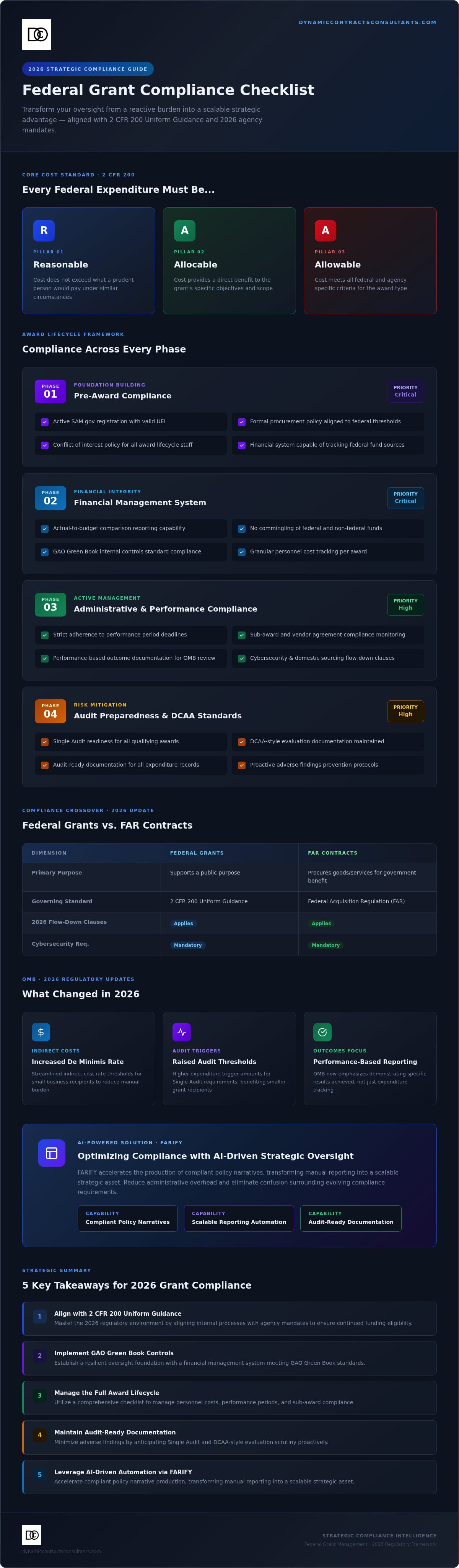
In 2026, treating federal grant management as a mere administrative checkbox is the fastest way to jeopardize your organization's financial future. We understand the persistent anxiety that comes with managing complex awards. You likely feel the weight of manual tracking and the constant fear that a single oversight could trigger a devastating audit finding. It's frustrating to juggle grant-specific rules against general federal acquisition regulations while trying to maintain operational efficiency. This guide provides a comprehensive grant compliance checklist for federal awards designed to transform your oversight from a reactive burden into a scalable strategic advantage.
Mastering the complexities of federal grant management requires a blend of rigorous internal controls and forward-thinking technology. We've developed this strategic oversight framework to help you reduce administrative overhead and eliminate the confusion surrounding evolving compliance requirements. You'll gain access to a clear, actionable roadmap that integrates AI-driven automation with our deep procurement expertise. By the end of this guide, you'll have the tools to ensure your reporting processes are efficient, your documentation is audit-ready, and your funding remains secure for the long term.
Key Takeaways
- Master the 2026 regulatory environment by aligning your internal processes with 2 CFR 200 Uniform Guidance and specific agency mandates to ensure continued funding eligibility.
- Establish a resilient foundation for oversight by implementing a financial management system and internal controls that meet the rigorous GAO Green Book standards.
- Utilize our comprehensive grant compliance checklist for federal awards to manage the award lifecycle, from tracking personnel costs to adhering to strict performance periods.
- Minimize the risk of adverse findings by maintaining audit-ready documentation that anticipates the high-level scrutiny of Single Audits and DCAA-style evaluations.
- Leverage AI-driven automation through FARIFY to accelerate the production of compliant policy narratives, transforming manual reporting into a scalable strategic asset.
Navigating the 2026 Federal Grant Compliance Landscape
Federal grant compliance represents the disciplined adherence to 2 CFR 200, commonly referred to as the Uniform Guidance, alongside specific mandates issued by individual awarding agencies. We view compliance as a strategic necessity. It's the primary mechanism for maintaining your eligibility for future federal funding cycles and protecting your reputation. For 2026, the Office of Management and Budget (OMB) continues to refine the regulatory environment, emphasizing a transition toward performance-based outcomes. This shift requires you to demonstrate not just where the money went, but what specific results were achieved. Implementing a robust grant compliance checklist for federal awards ensures your organization can meet these evolving expectations without stalling operational momentum.
The Uniform Guidance (2 CFR 200) Framework
The core pillars of the Uniform Guidance framework include Administrative Requirements, Cost Principles, and Audit Requirements. These standards form the backbone of federal financial integrity. Your accounting must prove that all expenditures are "Reasonable, Allocable, and Allowable." Costs are considered reasonable if they don't exceed what a prudent person would pay under similar circumstances. They're allocable if they provide a direct benefit to the grant's objectives. Finally, they're allowable if they meet all federal and agency-specific criteria. Recent 2026 updates have streamlined reporting thresholds for small businesses, increasing the de minimis indirect cost rate and raising audit triggers to reduce the manual burden on smaller recipients.
Grants vs. Contracts: Understanding the Compliance Crossover
It's essential to distinguish between the compliance rigor of a federal grant and a contract governed by the Federal Acquisition Regulation (FAR). Grants typically support a public purpose, whereas FAR-based contracts procure goods or services for the government's direct benefit. Despite these differences, 2026 has seen an increase in "flow-down" clauses that apply to both types of instruments, particularly regarding cybersecurity and domestic sourcing requirements. We've observed that high-performing organizations treat these requirements with the same level of precision regardless of the award type. Administrative oversight serves as the bridge between grant award and project success. Our post-award compliance strategies integrate this oversight into your procurement lifecycle, ensuring that every sub-award and vendor agreement remains fully compliant with federal standards. By utilizing a comprehensive grant compliance checklist for federal awards, you can effectively manage these crossover risks and maintain a standard of audit-ready excellence.
Pre-Award and Financial System Checklist: Building the Foundation
Establishing a compliant foundation is a non-negotiable prerequisite for any organization seeking to secure and maintain federal funding. Precision is paramount. We've observed that high-performing entities prioritize these structural elements long before the first dollar is drawn down. Your journey begins with verifying active registrations in SAM.gov and maintaining a valid Unique Entity Identifier (UEI). These digital credentials serve as your primary identity within the federal ecosystem. You must also develop a formal procurement policy that strictly aligns with federal micro-purchase and simplified acquisition thresholds. A robust conflict of interest policy for all employees involved in the award lifecycle is mandatory to prevent ethical lapses that could lead to funding termination. Utilizing a detailed grant compliance checklist for federal awards during this phase ensures no foundational stone is left unturned.
Financial Management System Requirements
Your financial management system must be capable of identifying the source and application of all federal funds with absolute precision. Federal regulations require "actual to budget" comparison reporting to ensure funds are spent exactly as intended. This level of granularity prevents the commingling of funds and ensures total transparency for agency oversight. Don't leave it to chance. For organizations seeking the highest level of assurance, implementing DCAA compliant accounting systems is a strategic move that satisfies the most rigorous grant auditors. We specialize in aligning these complex systems with your operational goals to ensure long-term scalability and intelligence.
Internal Controls and Risk Assessment
Internal controls are the specific safeguards designed to prevent fraud, waste, and abuse within your organization. The "Control Environment" is the heart of these safeguards, as defined by the GAO Green Book standards. You must maintain a comprehensive suite of internal control documents to protect your award integrity. Essential records include:
- Automated Timekeeping: Ensuring labor costs are accurately allocated to the correct federal award.
- Travel Policies: Adhering to federal per diem rates and standardized authorization workflows.
- Procurement Records: Documenting the competitive rationale for vendor selection and price analysis.
We recommend conducting an annual internal risk assessment to identify compliance gaps before they manifest as audit findings. This proactive approach ensures your operations are resilient and consistently audit-ready. If you're looking to strengthen your internal oversight, you can consult with our compliance experts to build a customized risk mitigation strategy tailored to your specific project needs.
Administrative and Performance Compliance: Managing the Award Lifecycle
Managing a federal award requires vigilant attention to the "Period of Performance." You must ensure all expenditures occur within the authorized window. While pre-award costs are sometimes permissible, they usually require specific agency approval and must be necessary for the project's efficient start. We recommend integrating these critical dates into your grant compliance checklist for federal awards to prevent unallowable cost findings. Beyond dates, submission of timely financial (SF-425) and performance (RPPR) reports is critical. Unlike basic reporting services, we view these documents as strategic assets. High-quality performance narratives do more than satisfy a requirement; they build the administrative record that secures your organization’s reputation for future funding competitions.
Personnel and Timekeeping Standards
Federal labor laws demand rigorous "Standards for Documentation of Personnel Expenses." You can't simply estimate hours or use budget estimates. 100% time reporting is often mandatory for staff, even those only partially dedicated to the grant. This ensures that every dollar of salary charged is supported by records reflecting the total activity of the employee. This level of precision prevents common audit triggers like "ghost charging" or unverified labor distributions. To navigate these complexities, many organizations leverage our post-award contract administration services. We help you establish labor distribution systems that withstand the highest levels of scrutiny while maintaining high operational efficiency.
Sub-recipient Monitoring and Oversight
If your award involves sub-recipients, you assume the role of a pass-through entity. This carries significant oversight responsibility. The 2026 requirements emphasize formal agreements that include all necessary federal flow-down clauses. You must conduct regular, risk-based oversight and document your sub-recipient risk assessments annually. These assessments should evaluate the sub-recipient’s prior experience with similar awards and the results of previous audits. If a sub-recipient has an audit finding, you're required to issue a "management decision" within six months. This decision must clearly state whether the finding is sustained and what corrective actions are required. This proactive oversight protects your organization from being held liable for a partner’s non-compliance and ensures the overall integrity of the award lifecycle.
Mitigating Risk: Audit Preparedness and DCAA Standards
Effective risk mitigation transforms the audit process from a source of persistent anxiety into a routine verification of your operational excellence. We believe that maintaining an audit-ready posture is the only sustainable way to manage federal awards in 2026. A critical component of your grant compliance checklist for federal awards must be a robust document retention policy. While the federal minimum is three years from the date of the final expenditure report, certain agencies mandates longer periods. You should also prioritize your Negotiated Indirect Cost Rate Agreement (NICRA) early in the award lifecycle. This agreement is vital for recovering overhead costs and ensuring your financial reporting reflects the true cost of project execution. Precision in these foundational areas prevents the administrative friction that often leads to negative audit outcomes.
Preparing for the Single Audit (Subpart F)
The Single Audit, governed by Subpart F of the Uniform Guidance, is triggered when an organization spends $1,000,000 or more in federal awards during its fiscal year. This threshold was recently increased from $750,000 to reduce the administrative burden on smaller recipients. Auditors primarily focus on "Major Programs" and perform rigorous internal control testing to ensure compliance with federal mandates. To prepare effectively, you should organize the following documentation:
- Detailed General Ledger entries mapped to specific award identifiers.
- Proof of competitive procurement for all vendor contracts and sub-awards.
- Signed timekeeping records that align perfectly with your payroll system.
- Sub-recipient monitoring logs and documented risk assessment reports.
Responding to findings with a proactive Corrective Action Plan (CAP) is essential for maintaining your funding. A well-structured CAP can prevent "Questioned Costs" from becoming repayment demands that drain your organization's liquidity.
Leveraging DCAA Standards for Grant Success
Recipient organizations that adopt Defense Contract Audit Agency (DCAA) standards often find themselves at a significant competitive advantage during the evaluation phase. We consider essential preparation for DCAA audit scrutiny to be a best practice even for those primarily focused on grants. Having a DCAA-approved accounting system demonstrates to federal agencies that you possess the sophisticated internal controls required for large-scale, complex awards. Our strategic compliance frameworks reduce audit anxiety by building these high-level standards into your daily workflows. If you're concerned about your current level of preparedness, you can schedule an audit readiness assessment with our team to identify and close any gaps before the official notification arrives.
Optimizing Compliance with AI-Driven Strategic Oversight
AI-driven automation is no longer a futuristic concept; it's the current standard for operational efficiency in federal award management. Relying on manual tracking is slow and increases your risk of costly human error. We recognize that the sheer volume of documentation required for modern awards can overwhelm even the most disciplined administrative teams. By integrating advanced technology into your grant compliance checklist for federal awards, you can transition from a defensive posture to a visionary strategy that prioritizes long-term success.
Accelerating Compliance with FARIFY
FARIFY.ai serves as a technological accelerator. It's capable of extracting complex requirements from award documents in a matter of minutes, providing you with a clear roadmap for execution. This tool generates audit-ready documentation and reporting narratives with a level of precision that manual processes simply cannot match. We believe that compliance shouldn't be an afterthought. Using AI for grant writing ensures that your adherence to federal standards begins at the proposal stage, rather than during a post-award scramble.
AI technology also excels at creating comprehensive compliance matrices and performing automated gap analyses. These tools allow you to identify potential vulnerabilities in your internal controls before they become audit liabilities. We maintain a strict "Human-in-the-Loop" approach to this process. Every AI-generated output is reviewed by our seasoned consultants, ensuring it meets the highest standards of regulatory rigor. This synergy between scalable intelligence and human expertise guarantees that your documentation is both technically accurate and strategically sound.
Partnering for Scalable Growth
Choosing Dynamic Contracts Consultants LLC and FARIFY provides you with a holistic solution for the 2026 federal landscape. We combine over a decade of acquisition experience with cutting-edge automation to offer a scalable compliance framework. This partnership allows your organization to focus on your core mission while we handle the complexities of the procurement lifecycle and administrative oversight. Our team ensures that your internal systems are not just compliant, but optimized for maximum performance.
It's time to move beyond reactive compliance. By adopting a proactive, AI-driven management style and utilizing a modern grant compliance checklist for federal awards, you can ensure your organization remains audit-ready and eligible for the most prestigious federal awards. We're here to guide you through every phase of this digital transformation. Contact our experts to secure your federal award compliance today and discover how our integrated approach can drive your scalable growth.
Securing Your Organization's Future Through Strategic Compliance
The 2026 federal landscape demands a shift from manual, reactive oversight to a model of scalable intelligence. We've outlined how establishing a rigorous financial foundation and leveraging AI-driven automation are the dual pillars of modern award management. By utilizing our comprehensive grant compliance checklist for federal awards, you can transform administrative burdens into a competitive advantage that ensures long-term funding stability. Our approach integrates proven prime contractor experience with agencies like the DOD, EPA, and NOAA to provide you with a standard of excellence that is inherently audit-ready.
Dynamic Contracts Consultants LLC is uniquely positioned to help you implement DCAA-ready accounting systems and accelerate your documentation processes through FARIFY. This combination of human strategic partnership and technological precision minimizes risk while maximizing operational efficiency. Don't let the complexity of federal regulations stall your mission. We invite you to Schedule a Strategic Compliance Consultation today to align your internal controls with the highest standards of federal integrity. Your success in the federal ecosystem depends on the precision of your compliance framework, and we're here to ensure you lead with confidence.
Frequently Asked Questions
What is the most common reason for federal grant audit findings?
The most frequent causes for audit findings involve inadequate documentation of personnel expenses and failure to adhere to established procurement policies. Auditors often identify "questioned costs" when an organization’s timekeeping records don't match payroll or when vendor selection lacks a documented competitive rationale. Maintaining a rigorous grant compliance checklist for federal awards helps you avoid these pitfalls by ensuring every expenditure is supported by a clear, verifiable administrative record.
How do 2026 federal grant rules differ from previous years?
2026 federal grant rules reflect a shift toward reducing administrative burdens through increased financial thresholds for recipients. The Single Audit trigger has risen to $1,000,000, and the de minimis indirect cost rate is now set at 15% to better support smaller organizations. These updates emphasize performance-based outcomes over simple line-item tracking, requiring you to demonstrate the tangible impact of your federal funding through sophisticated reporting narratives.
Can I use AI to help with federal grant reporting and compliance?
You can certainly leverage AI-driven automation to enhance your reporting and compliance workflows throughout the award lifecycle. Our FARIFY platform accelerates the generation of audit-ready documentation and extracts critical requirements from complex award notices in minutes. While AI provides scalable intelligence, we recommend a "Human-in-the-Loop" approach where experts review all generated content to ensure it aligns perfectly with specific agency mandates and strategic goals.
What are the record retention requirements for federal awards in 2026?
Federal regulations generally require you to retain all financial and programmatic records for a minimum of three years from the date of the final expenditure report. It’s vital to recognize that specific agencies or individual award terms may mandate longer retention periods, sometimes extending to seven or ten years. Your grant compliance checklist for federal awards should include a localized retention schedule that accounts for these variations to prevent premature document destruction.
Is a DCAA-compliant accounting system required for all federal grants?
A DCAA-compliant accounting system isn't strictly mandatory for all federal grants, but it’s considered a best practice for organizations managing complex or high-value awards. These systems provide the level of internal control and cost-segregation rigor that federal auditors expect during a Single Audit. Implementing such a system early in your procurement lifecycle positions you as a low-risk recipient, potentially increasing your success rate in future funding competitions.
What happens if my organization is found non-compliant during a federal audit?
Non-compliance during a federal audit can result in severe administrative and financial penalties for your organization. The awarding agency may disallow specific costs, requiring you to repay funds from non-federal sources. In more serious cases, you might face the suspension of active funding or even formal debarment from receiving future federal awards. Proactive risk mitigation and regular internal assessments are essential for protecting your organization’s financial integrity and reputation.
How do I calculate indirect cost rates for a federal grant?
You can calculate indirect cost rates by either applying the standard 15% de minimis rate or by negotiating a formal Indirect Cost Rate Agreement (NICRA) with your cognizant agency. A NICRA allows you to recover a more accurate percentage of your overhead costs, such as rent and administrative salaries, based on your actual historical data. This process requires a detailed proposal supported by your financial management system and a clear, documented allocation plan.
What is the difference between a sub-recipient and a contractor under 2 CFR 200?
The distinction between a sub-recipient and a contractor depends on the nature of the relationship and the work being performed. A sub-recipient is an entity that carries out a portion of the federal program’s objectives and is subject to the same compliance rigor as the prime recipient. In contrast, a contractor provides goods or services within normal business operations and doesn't assume responsibility for the program’s specific programmatic outcomes or performance goals.


