

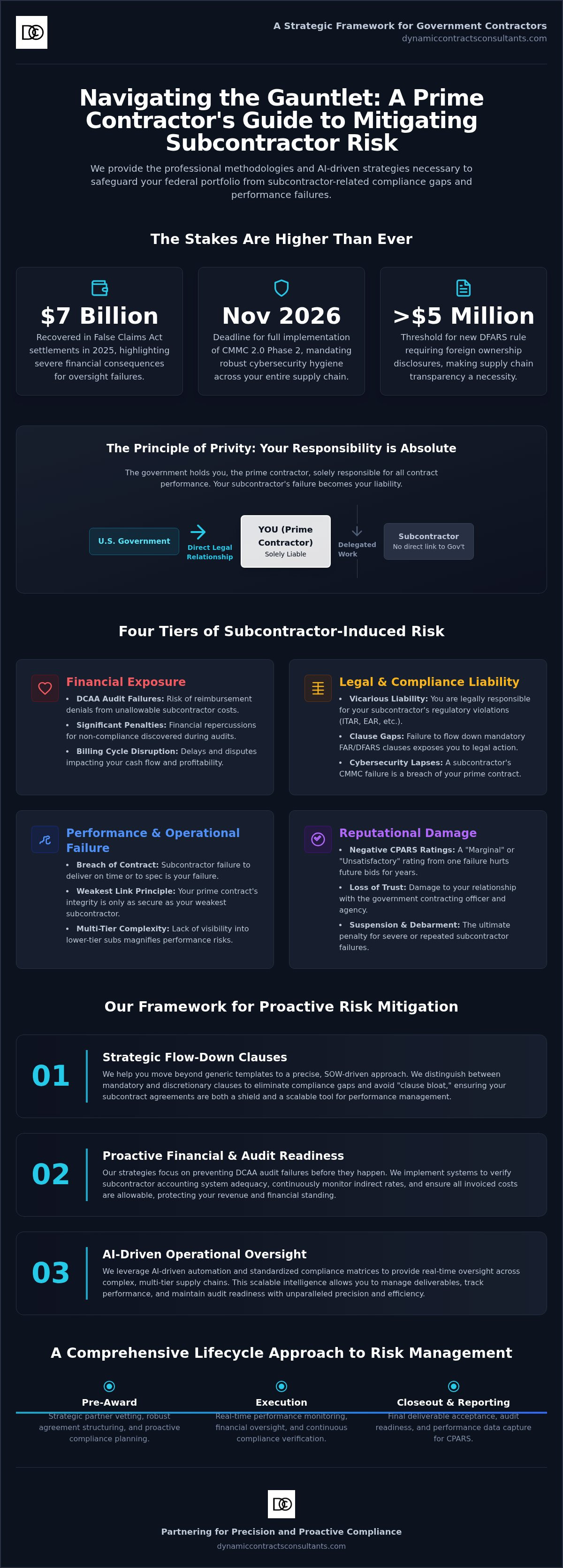
The Department of Justice recovered nearly $7 billion in False Claims Act settlements during 2025, a sobering figure that underscores the severe financial consequences of oversight failures. As we move toward the full implementation of CMMC 2.0 Phase 2 in November 2026, the burden of mitigating subcontractor risk in government contracts has shifted from a secondary administrative task to a primary strategic requirement. Precise adherence to the upcoming DFARS rule on foreign ownership, which requires disclosures for contracts exceeding $5 million, isn't just a best practice; it's a necessity for maintaining eligibility.
You recognize that your prime contract's integrity is only as secure as the weakest link in your multi-tier supply chain. The anxiety surrounding potential DCAA audit failures or the omission of critical flow-down clauses is a rational response to an increasingly litigious environment where even minor omissions lead to legal exposure. Managing performance across multiple tiers requires more than just manual oversight; it demands a systematic, data-driven approach.
This article provides the professional methodologies and AI-driven strategies necessary to safeguard your federal portfolio from subcontractor-related compliance gaps. We'll examine a scalable framework for tier-monitoring, a checklist for mandatory clause compliance, and the role of human-in-the-loop AI in maintaining audit readiness across the entire contract lifecycle.
Key Takeaways
- Understand how the legal principle of privity of contract places ultimate responsibility for subcontractor performance on the prime contractor, directly influencing future CPARS ratings.
- Learn to distinguish between mandatory and discretionary flow-down clauses to ensure regulatory requirements are precisely tailored to the subcontractor's specific statement of work.
- Implement a proactive strategy for mitigating subcontractor risk in government contracts by verifying accounting system adequacy and monitoring indirect rates to prevent DCAA audit failures.
- Discover how AI-driven automation and standardized compliance matrices provide the real-time oversight necessary to manage deliverables across complex, multi-tier supply chains.
- Establish a comprehensive lifecycle approach to risk management that bridges the gap between technical execution and the stringent regulatory demands of 2026.
The Critical Stakes: Why Subcontractor Risk is a Prime Responsibility
The principle of privity of contract dictates that a direct legal relationship exists only between the federal government and the prime contractor. Consequently, the government looks solely to the prime for the successful execution of all requirements, regardless of whether specific tasks are performed by lower-tier partners. This structural reality means that mitigating subcontractor risk in government contracts isn't merely a management preference but a fundamental legal obligation. When a subcontractor fails to deliver on time or within technical specifications, the prime contractor remains the sole entity liable for breach of contract or performance deficiencies.
The financial exposure extends deep into the billing cycle. If a subcontractor includes unallowable costs in their invoices, the prime contractor faces the risk of reimbursement denials or significant penalties during a DCAA audit. Beyond financial loss, the reputational damage is often permanent. Cybersecurity lapses, particularly during the phased implementation of CMMC 2.0, or violations of labor laws within the supply chain, can lead to immediate suspension or debarment. The government expects you to maintain complete visibility into your supply chain hygiene at all times.
Understanding Regulatory Liability Under FAR and DFARS
Under FAR and DFARS regulations, prime contractors bear the total responsibility for ensuring that all mandatory flow-down clauses are strictly observed by their subcontractors. High-risk compliance areas include the Procurement Integrity Act, as well as ITAR and EAR requirements for sensitive technical data. Vicarious liability in federal procurement refers to the legal principle where a prime contractor is held responsible for the regulatory violations or performance failures of its subcontractors, despite not having directly committed the infraction. Without robust oversight, a subcontractor's administrative oversight becomes your legal crisis.
The Impact on Future Contract Awards
A single subcontractor failure can lead to a "Marginal" or "Unsatisfactory" rating in the Contractor Performance Assessment Reporting System (CPARS). These records are permanent and serve as the primary source of truth for evaluation boards during future source selections. A negative rating regarding supply chain management results in years of lost opportunities and diminished competitive standing. Effective vetting of partners through strategic capture management is essential to ensure that every teaming partner possesses the maturity required to sustain a federal engagement. Preventing these risks at the pre-award phase is far more cost-effective than managing a crisis during contract execution.
Strategic Flow-Down Clauses: The Foundation of Regulatory Compliance
Establishing a robust subcontract agreement isn't merely a legal formality; it's the primary mechanism for shifting liability and ensuring operational continuity. Effective subcontract management begins with the precise selection of legal provisions, as mitigating subcontractor risk in government contracts requires a proactive rather than reactive posture. Primes must distinguish between clauses that are legally required by the federal government and those that serve as strategic shields for the prime organization's own interests.
The scope of work (SOW) or performance work statement (PWS) should dictate the depth of these clauses. A generic approach often leads to "clause bloat," which can unnecessarily increase costs, or "compliance gaps," which leave the prime exposed. For instance, the "Changes" and "Termination" clauses must be mirrored from the prime contract to ensure the prime has the authority to redirect or end a subcontractor's effort if the government takes similar action at the higher level. Without these mirrored rights, a prime might find itself legally obligated to pay a subcontractor for work the government no longer requires.
Mandatory FAR and DFARS Flow-Downs
Mandatory flow-down clauses are non-negotiable provisions that the prime must include to remain compliant with the prime contract. Key examples include FAR 52.222-50 (Combating Trafficking in Persons), FAR 52.203-17 (Contractor Employee Whistleblower Rights), and FAR 52.215-2 (Audit and Records-Negotiation). These clauses ensure that federal standards for ethics and transparency extend through every tier of the supply chain.
Special attention is required for FAR 52.219-9, which governs small business subcontracting plans. Primes are responsible for ensuring that subcontractors provide timely reports on their own small business participation, a task that often requires dedicated oversight. We provide specialized expertise in managing contract flow-down requirements to ensure no mandatory provision is overlooked during the assembly of sub-tier agreements.
Discretionary Clauses for Enhanced Protection
While mandatory clauses satisfy the government, discretionary clauses protect the prime contractor's bottom line. A "Right to Audit" clause that exceeds federal minimums allows the prime to inspect a subcontractor's financial records immediately if discrepancies arise, rather than waiting for a formal DCAA inquiry. Similarly, "Stop Work" orders provide a vital mechanism to freeze subcontractor activity during disputes or performance failures, preventing the accumulation of unallowable costs.
In the current regulatory environment, including specific cybersecurity requirements like NIST SP 800-171 is a critical discretionary move. Even if CMMC requirements aren't yet fully active for a specific task, these standards shield the prime from data breaches that could jeopardize the entire program. Coupling these with strong indemnification and insurance requirements shifts the financial burden of third-party claims or regulatory fines back to the party responsible for the breach. If you're concerned about the adequacy of your current agreements, you can consult with our compliance strategists to review your flow-down architecture.
Navigating DCAA Scrutiny: Mitigating Financial and Audit Risks
The Defense Contract Audit Agency (DCAA) maintains a strict expectation that prime contractors serve as the first line of defense against financial irregularities within their supply chains. Primes have an affirmative duty to verify that their subcontractors possess accounting systems capable of generating reliable and transparent cost data. Mitigating subcontractor risk in government contracts necessitates a deep understanding of how these financial systems interact with federal regulations. Primes don't just oversee technical execution; they validate the financial foundations of their partners. Failure to validate a subcontractor's internal controls can lead to the disallowance of costs, resulting in significant financial clawbacks that the prime must eventually absorb.
Subcontractor Accounting System Adequacy
DCAA evaluation criteria focus on a system's ability to segregate direct and indirect costs, identify unallowable expenses under FAR Part 31, and maintain a logical timekeeping process. Primes must conduct "Pre-Award" surveys to assess these systems before a subcontract is finalized, particularly for cost-reimbursement or incentive-fee arrangements. Our specialized DCAA compliance consulting provides the technical framework required to evaluate these complex financial structures. This proactive assessment prevents the common pitfall of discovering systemic accounting failures only after a formal government audit has commenced.
Managing subcontractor "Proprietary Rate" data presents a unique administrative challenge. Subcontractors often hesitate to share sensitive indirect rate information with a prime who may also be a competitor. To address this, the prime should facilitate a direct submission process where the subcontractor provides the necessary data to the DCAA or the Administrative Contracting Officer (ACO) for independent verification. This approach preserves the subcontractor's trade secrets while satisfying the prime's obligation to ensure cost reasonableness. Additionally, invoice review processes must ensure that every dollar billed aligns with established labor categories and supported time records.
Managing Indirect Rates and Price Analysis
Compliance with the Truth in Negotiations Act (TINA) requires primes to obtain certified cost or pricing data for subcontracts exceeding specified thresholds. When an exception for commercial items is claimed, the prime must still perform a rigorous price analysis to justify the award value as fair and reasonable. This analysis should leverage historical data, market research, and independent cost estimates to establish a defensible position. While modern software can streamline these calculations, a human-in-the-loop requirement is essential for verifying the accuracy of AI-generated cost estimates against the specific nuances of the federal procurement environment. It's this level of oversight that ensures a prime remains audit-ready throughout the contract lifecycle.
Operationalizing Oversight: AI-Driven Monitoring and Performance Management
Manual tracking via legacy spreadsheets is no longer a viable strategy for mitigating subcontractor risk in government contracts. The complexity of modern federal programs, especially with the 2026 regulatory shifts, requires real-time visibility into deliverable status and financial health. Primes must implement a standardized Subcontractor Compliance Matrix for every engagement. This matrix serves as a definitive roadmap, aligning subcontractor milestones with prime contract requirements and ensuring that no regulatory obligation is overlooked during technical execution.
Automated early warning systems now allow primes to identify project delays or cost variances before they jeopardize the program. By integrating performance data into a centralized dashboard, project managers can address minor deviations before they escalate into significant performance failures. This data isn't just for internal use; it's the primary foundation for objective CPARS input. Standardizing the collection of subcontractor performance data ensures that your past performance ratings are based on verifiable facts, protecting your reputation for future source selections.
Harnessing FARIFY for Document Compliance
FARIFY.ai transforms the administrative burden of contract management by generating compliant Statements of Work (SOW) and Performance Work Statements (PWS) in minutes. The platform's AI capabilities extend to contract modification analysis, identifying subtle changes in requirements that could lead to scope creep or uncompensated work. It's this level of precision that ensures all documentation remains audit-ready, providing a clear trail of compliance that satisfies the most rigorous DCAA or agency reviews. Using AI-supported documentation doesn't just save time; it establishes a standard of accuracy that manual processes can't match.
Establishing a Robust Monitoring Cadence
A disciplined monitoring cadence is essential for maintaining control over multi-tier supply chains. Primes should implement Quality Assurance Surveillance Plans (QASP) for all critical sub-tiers, defining the exact frequency and scope of progress reviews. These reviews shouldn't be mere status updates. They must be deep-dive assessments of technical progress and regulatory adherence, ensuring that flow-down requirements are being met in real time. If your current oversight processes lack this level of rigor, you should contact our experts to build a custom monitoring framework tailored to your specific contract portfolio.
Partnering for Precision: Comprehensive Lifecycle Risk Mitigation Solutions
The mark of a sophisticated prime contractor lies in their ability to maintain operational fluidity while adhering to the most stringent regulatory frameworks. As we have explored, mitigating subcontractor risk in government contracts isn't an isolated event. It's a continuous lifecycle process that demands precision from the initial teaming agreement to the final contract closeout. Integrated post-award contract administration serves as the essential bridge between technical execution and regulatory compliance, ensuring that every milestone reached is also a milestone documented for audit purposes.
Bridging this gap requires a disciplined approach to record-keeping. Audit-ready record preparation isn't a task to be performed at the end of the year; it's a byproduct of daily management. When documentation is prepared with the expectation of DCAA scrutiny, the prime contractor gains a level of security that allows for scalable growth. Dynamic Contracts Consultants LLC serves as the strategic partner that provides this oversight, allowing your technical teams to focus on mission success while we ensure the administrative foundation remains unassailable.
From Acquisition Planning to Contract Closeout
Risk mitigation must be baked into the contract's DNA long before the first invoice is submitted. Our support begins during acquisition planning, where we assist in drafting robust teaming agreements and conducting exhaustive subcontractor vetting. This early-stage rigor is critical for pre-award compliance and serves as a primary defense against costly bid protests that can stall a program for months. By utilizing our proposal writing services, you ensure that risk mitigation strategies are integrated into your response from day one, signaling to evaluators that your supply chain is mature and reliable.
Your Strategic Partner in Federal Success
Dynamic Contracts Consultants LLC brings a unique perspective as a minority-owned firm with deep, practical expertise in the complexities of FAR and DFARS. We don't offer generic advice; we provide the methodical, strategic guidance required to manage the nuanced demands of federal procurement in 2026. Our approach combines seasoned human analysis with the speed and precision of our AI-powered FARIFY platform, ensuring that your compliance posture is both accurate and efficient. This hybrid model provides the human-in-the-loop verification that modern government contracts demand.
Federal success in an era of heightened oversight requires a partner who understands the system's every detail and pitfall. We invite you to elevate your compliance standards and secure your prime contracts against the vulnerabilities of the supply chain. You can schedule a strategic consultation with our specialists today to build a scalable framework for your 2026 contract portfolio.
Securing Your Federal Portfolio for 2026 and Beyond
The regulatory environment of 2026 demands a shift from reactive monitoring to a proactive, technologically integrated strategy. Success in this landscape requires the precise execution of flow-down requirements and the continuous validation of subcontractor accounting systems. By transitioning away from manual oversight and adopting automated, data-driven frameworks, prime contractors can effectively protect their CPARS ratings and maintain audit readiness. It's this comprehensive approach that ensures your supply chain supports, rather than compromises, your mission objectives.
Dynamic Contracts Consultants LLC provides the specialized support necessary for mitigating subcontractor risk in government contracts through every phase of the lifecycle. Our team of DCAA Compliance Specialists and Certified Professional Contracts Managers (CPCM) utilizes the AI-powered FARIFY platform to deliver speed and regulatory precision. This combination of deep industry expertise and advanced automation ensures that your compliance posture remains unassailable under government scrutiny. Secure your federal contracts with expert risk mitigation—contact us today. We look forward to helping you achieve scalable, compliant growth in the federal marketplace.
Frequently Asked Questions
What is the most common mistake primes make when managing subcontractors?
The most frequent error is failing to verify a subcontractor's accounting system maturity before the contract award. Primes often assume that technical competence automatically equates to regulatory readiness. This oversight leads to the submission of unallowable costs and significant performance delays. Such failures eventually jeopardize the prime contractor's CPARS rating and can result in financial penalties that are difficult to recover after the fact.
Are prime contractors liable if a subcontractor fails a DCAA audit?
Yes, the prime contractor bears ultimate financial responsibility for all costs billed to the government. If a subcontractor's system is found inadequate, the DCAA may disallow those costs at the prime level. The prime must then attempt to recover funds from the subcontractor, which is often legally complex and time-consuming. This structural liability emphasizes why rigorous pre-award vetting is a non-negotiable requirement for federal primes.
Which FAR flow-down clauses are mandatory for all subcontracts?
Mandatory clauses include FAR 52.222-50 regarding Combating Trafficking in Persons and FAR 52.203-13 concerning the Contractor Code of Business Ethics and Conduct. Additionally, FAR 52.215-2 for Audit and Records-Negotiation is essential for cost-reimbursement agreements. Primes must ensure these provisions are explicitly stated to maintain compliance with their own prime contract. Omissions can lead to immediate regulatory scrutiny and potential breach of contract claims from the government.
How can AI improve subcontractor risk management in government contracting?
AI improves risk management by providing real-time deliverable tracking and automated document analysis. Systems can flag inconsistencies in subcontractor invoices or identify missing compliance certifications across multi-tier supply chains. This automation reduces the administrative burden of mitigating subcontractor risk in government contracts while increasing the accuracy of performance monitoring. By shifting from manual spreadsheets to automated dashboards, primes gain a significant competitive advantage in program oversight and audit readiness.
What happens if a subcontractor refuses to accept certain flow-down clauses?
If a subcontractor refuses mandatory clauses, the prime cannot legally award the subcontract without risking their own contract standing. For discretionary clauses, the prime must conduct a thorough risk-benefit analysis to determine the potential impact on performance. Persistent refusal of regulatory requirements usually indicates a lack of administrative maturity. This makes the partner a high-risk liability that could jeopardize the entire program's success and future award eligibility.
How often should a prime contractor audit its subcontractors for compliance?
Primes should conduct formal compliance reviews at least annually, or more frequently for high-risk cost-reimbursement subcontracts. Continuous monitoring of deliverables and monthly invoice reconciliations serve as the first line of defense. These regular intervals ensure that any deviations from federal standards are corrected long before a government auditor arrives. Establishing a disciplined audit cadence is a primary method for mitigating subcontractor risk in government contracts throughout the performance period.
What is the role of a Subcontracting Plan in federal risk mitigation?
A Subcontracting Plan, required under FAR 52.219-9 for large businesses, establishes formal goals for small business participation. It functions as a risk mitigation tool by forcing the prime to document and monitor their supply chain diversity and compliance. Failure to meet these goals or provide accurate reporting can lead to liquidated damages and negative past performance ratings. It's a critical component of a prime's overall regulatory strategy and long-term standing.
Can FARIFY help with managing subcontractor flow-down compliance?
FARIFY automates the generation of compliant subcontract documents and analyzes modifications for potential regulatory gaps. It ensures that all mandatory FAR and DFARS clauses are correctly integrated based on the specific contract type and scope. This AI-driven approach provides an audit-ready trail of documentation that simplifies the complex task of managing sub-tier compliance. By using FARIFY, primes can ensure that their flow-down architecture is both precise and defensible during government reviews.


