

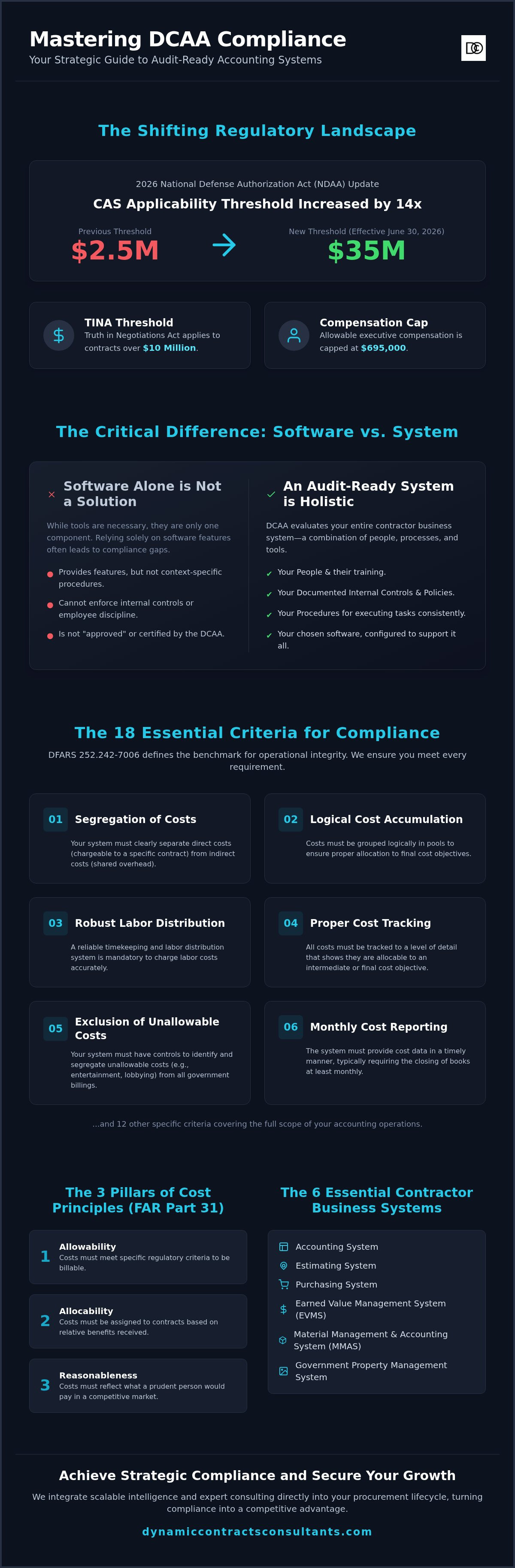
Did you know the 2026 National Defense Authorization Act increased the CAS applicability threshold by 14 times, moving it from $2.5 million to $35 million? This massive shift, effective June 30, 2026, fundamentally redefines how we approach DCAA compliant accounting system requirements. While these higher thresholds reduce the regulatory burden for many, the core expectation for precision remains absolute. We recognize the anxiety that comes with a pre-award audit, especially when a single mistake in the 18 specific SF 1408 criteria could cost you a career-defining contract. It's a complex environment where the high cost of specialized software often adds unnecessary pressure to your bottom line.
We'll show you how to master this landscape by implementing an audit-ready system that secures your federal contracts without over-investing in unnecessary tools. You'll learn the critical difference between software features and the internal procedures that DCAA auditors actually scrutinize. This guide provides a clear checklist for system adequacy, covering the $10 million TINA threshold and the $695,000 compensation cap. By the end, you'll have the confidence to face any audit, knowing your operations meet the highest standards of strategic compliance and operational efficiency.
Key Takeaways
- Navigate the 2026 regulatory landscape by understanding the latest CAS and TINA threshold updates that impact your contract eligibility and reporting obligations.
- Master the DCAA compliant accounting system requirements by focusing on the 18 specific criteria outlined in DFARS 252.242-7006 for post-award success.
- Differentiate between software features and system procedures to ensure your accounting framework passes DCAA scrutiny regardless of the specific tool you use.
- Streamline your audit preparation through formalized policy development and AI-powered automation to reduce risk and operational overhead.
- Leverage scalable intelligence and expert consulting to integrate compliance directly into your procurement lifecycle for long-term growth.
The Regulatory Framework: Understanding DFARS and FAR Accounting Standards
Establishing a foundation for federal success requires a deep understanding of the regulatory environment managed by the Defense Contract Audit Agency (DCAA). For contractors, "Accounting System Adequacy" is not a subjective term; it is strictly defined under FAR 16.301-3 and DFARS 252.242-7006. An adequate system must provide reasonable assurance that your accounting data is reliable and that costs are recorded in accordance with applicable laws. We see many firms mistakenly believe that purchasing specific software guarantees compliance, but the DCAA does not "approve" individual tools. Instead, they evaluate your entire contractor business system, which encompasses your people, internal controls, and documented procedures.
We recognize that the Administrative Contracting Officer (ACO) serves as the ultimate authority in determining system adequacy. Achieving a "passed" audit status is a prerequisite for bidding on cost-reimbursable or incentive-fee contracts, which often carry higher profit potential but require greater transparency. Meeting DCAA compliant accounting system requirements signals to the government that your firm possesses the scalable intelligence and operational efficiency necessary to manage complex federal funds responsibly.
To better understand the practical application of these regulations, watch this helpful video:
The Intersection of FAR Part 31 and Cost Accounting Standards
Compliance rests on the three pillars of FAR Part 31: allowability, allocability, and reasonableness. A cost is allowable only if it meets specific regulatory criteria; it is allocable if it is assigned to a contract based on the relative benefits received. Reasonableness is determined by what a prudent person would pay in a competitive market. Unallowable costs, such as entertainment or lobbying, must be strictly excluded from all government billings. Under the 2026 NDAA, the CAS applicability threshold has increased to $35 million, meaning your system requirements may shift as your contract volume grows toward the $100 million full coverage mark.
The Six Essential Contractor Business Systems
While the accounting system is the foundation, it is part of a broader framework of six essential contractor business systems. These include estimating, purchasing, earned value management, material management, and government property management systems. The oversight of these systems is typically split between the DCAA, which focuses on financial audits, and the DCMA, which handles technical and administrative compliance. We provide specialized DCAA compliance consulting to help you synchronize these systems, ensuring that your procurement lifecycle remains audit-ready at every stage.
The 18 Essential Criteria for a DCAA Compliant Accounting System
The 18 criteria established in DFARS 252.242-7006 represent the definitive benchmark for operational integrity in federal contracting. We believe that achieving these standards is not merely a hurdle to clear; it's a strategic advantage that positions your firm as a reliable partner for the Department of Defense. To meet DCAA compliant accounting system requirements, your organization must transition from basic financial recording to a sophisticated, project-centric accounting framework. This transition requires the seamless integration of cost accumulation, labor distribution, and indirect rate management.
Technical Requirements for Cost Accumulation
Your General Ledger must be structured to provide a clear, unambiguous segregation of direct costs from indirect costs. We recommend reviewing the official Pre-award Accounting System Adequacy Checklist to understand how auditors evaluate your chart of accounts during a survey. A robust system identifies and accumulates direct costs by individual contract or project, ensuring that every dollar spent is traceable to a specific cost objective. This requires a logical and consistent method for the allocation of indirect costs to intermediate and final cost objectives, preventing the arbitrary shifting of expenses between projects.
Automated workflows should be configured to exclude unallowable costs, such as alcohol or excess executive compensation, from your indirect pools. We focus on the precision of these exclusions to protect your firm from potential audit findings or payment delays. Monthly reconciliation between your General Ledger and project cost reports is essential to maintain data integrity and ensure your financial statements reflect actual contract performance. This disciplined approach to technical cost accumulation builds the foundation for long-term scalability in the federal marketplace.
Timekeeping and Labor Distribution Protocols
Labor is typically the largest expense for government contractors and the area of greatest audit risk. DCAA expectations for timekeeping are rigorous, requiring employees to record their time daily and supervisors to approve those entries within a defined cycle. Your system must maintain a permanent, unalterable audit trail for any labor reclassifications or corrections made after the initial entry. We've seen that manual spreadsheets are the primary cause of audit failure for emerging contractors because they lack the necessary controls and transparency required by federal regulations.
Managing labor reclassifications requires a documented process that justifies why a change was necessary and who authorized it. We emphasize the use of integrated labor distribution systems that automatically flow hours into the General Ledger based on pre-defined project codes. If you're unsure how your current setup measures up against these benchmarks, you can consult with our strategic experts to conduct a thorough gap analysis of your internal controls.
Bridging the Gap: Why Software Alone is Not a Compliance Solution
We often encounter the misconception that purchasing a specific software package instantly makes a firm "DCAA-approved." In reality, the DCAA does not certify software. Compliance is an operational state achieved through the synergy of your people, your processes, and your tools. While a robust accounting platform is necessary, it's only one component of the broader business system. DCAA compliant accounting system requirements are only met when your software is configured to follow your documented internal controls and regulatory obligations. Without a strategic compliance framework, even the most expensive enterprise tool can fail an audit if your team lacks the training to use it correctly.
Choosing the right platform depends on your current scale and growth trajectory. Entry-level tools like QuickBooks are popular for their ease of use, but they often require complex, manual "patchwork" add-ons to handle indirect rate allocations and labor distribution. Conversely, enterprise solutions like Deltek or Unanet are built specifically for the federal market, offering built-in controls that align with the Defense Federal Acquisition Regulation Supplement (DFARS). We help you evaluate these options not just as software, but as the engine of your procurement lifecycle, ensuring your choice supports scalable intelligence and long-term success.
Internal Controls and the "Human-in-the-Loop"
A compliant system relies heavily on the "human-in-the-loop" to maintain the integrity of financial data. This starts with a rigorous control environment where segregation of duties is clearly defined; the person who approves an invoice shouldn't be the same person who issues the payment. We emphasize establishing strict authorization limits to prevent unauthorized expenditures and ensure every transaction follows a documented approval path. To maintain readiness, we recommend conducting regular internal "mock audits." These proactive reviews help identify procedural gaps in your post-award compliance before a DCAA auditor ever steps through your door.
Data Integrity and Audit Trail Standards
Data integrity is the cornerstone of any audit-ready system. Your accounting records must be immutable, meaning the system must prevent the deletion or unauthorized alteration of financial data once it's entered. If changes are necessary, your software must maintain a comprehensive audit trail that records who made the change, when it happened, and why it was authorized. As you move your operations to the cloud, you must also ensure your data hosting meets FedRAMP or CMMC security standards. These technical safeguards are critical during the "Transaction Walkthrough" portion of a DCAA audit, where auditors trace a single cost from the initial purchase order all the way to the final invoice submitted to the government.
Preparing for Pre-Award and Post-Award DCAA Audits
Audit readiness is a continuous discipline rather than a single event. We recommend a structured five-step approach to ensure your system remains resilient under federal scrutiny. First, conduct a comprehensive gap analysis against the SF 1408 criteria to identify hidden vulnerabilities. Second, formalize your accounting policies to mirror your actual daily operations, ensuring they aren't just generic templates. Third, organize a centralized electronic "Audit Room" where labor and cost records are indexed and readily accessible. Fourth, train your staff on DCAA interview protocols and the absolute necessity of daily timekeeping honesty. Finally, engage a strategic partner to perform a final review of your compliance matrix before the auditor arrives. This proactive methodology transforms a stressful event into a routine validation of your operational efficiency.
Navigating the SF 1408 Pre-Award Survey
The SF 1408 survey serves as the primary gatekeeper for contractors seeking cost-reimbursable awards. It determines if your design meets DCAA compliant accounting system requirements before the government risks funds on your performance. Auditors utilize 18 specific questions to judge your system's adequacy, focusing on your ability to segregate costs and track labor. You must demonstrate that your system is operationally ready even if you haven’t yet begun work on the specific contract. This involves showing that your chart of accounts and labor distribution protocols are fully functional and supported by documented internal controls. Our DCAA Audit Preparation Services focus on bridging these technical gaps through scalable intelligence and expert oversight.
Post-Award Scrutiny: Incurred Cost Submissions
Once you secure a contract, the focus shifts to long-term post-award scrutiny. The annual requirement for Incurred Cost Proposals (ICP) is a primary driver of DCAA activity for established contractors. System adequacy is paramount here; if your accounting system fails to accurately track and allocate costs throughout the fiscal year, your ICP will be vulnerable to significant adjustments or payment withholdings. A compliant system simplifies the generation of audit-ready post-award documents, reducing the administrative burden on your internal team. We integrate these requirements into our contract administration services to ensure your procurement lifecycle remains compliant from award through closeout. Strategic compliance ensures that your financial data is consistently reliable, allowing you to focus on contract performance and growth. If you’re facing an upcoming survey or need to validate your current controls, contact our strategic experts for a comprehensive system review.
Strategic Compliance: Leveraging AI and Expert Consulting
We view compliance not as a static administrative burden but as a dynamic engine for growth within the federal marketplace. Meeting DCAA compliant accounting system requirements is just the first step in a broader strategy for federal dominance. By integrating your financial data with modern capture management, you can prepare more accurate Independent Government Cost Estimates (IGCE) that reflect your actual operational costs. This level of precision ensures that your bids are both competitive and profitable, reducing the risk of underperformance or financial loss during contract execution.
Managing the complexities of flow-down clauses requires a level of scalable intelligence that few firms can provide through manual processes alone. When you utilize our expertise, we ensure that your subcontractors meet the same rigorous standards required of a prime contractor, protecting your firm from third-party non-compliance findings. Our position as a minority-owned small business with prime contract experience for the DoD, State, and EPA allows us to provide a unique perspective that balances technical precision with the practical realities of small business operations.
The FARIFY Advantage: Audit-Ready Outputs in Minutes
Through AI-driven automation, our affiliate platform, FARIFY.ai, extracts critical RFP requirements and aligns them with your existing accounting cost pools. This technology significantly reduces the turnaround time for generating compliance matrices and technical volume drafts, allowing your team to focus on strategy rather than clerical data entry. We ensure that every document generated is baked with current FAR and DFARS regulatory standards, providing you with audit-ready outputs that withstand the most rigorous DCAA scrutiny. This marriage of technology and expertise is what we call scalable intelligence, and it's essential for firms looking to grow their federal footprint in 2026.
Your Strategic Partner in the Procurement Lifecycle
Moving toward operational excellence means looking beyond the immediate audit to the long-term health of your business. We assist you through every phase of the procurement lifecycle, from initial acquisition planning to the final closeout. Our team provides dedicated support for CPARS narrative development, ensuring your performance is documented accurately to influence future award decisions. We don't just help you pass a survey; we help you build a resilient business system that supports sustainable growth and digital transformation. Partner with us for DCAA-compliant proposal development and experience the difference that expert-led, AI-enhanced consulting can make for your firm's success.
Mastering Strategic Compliance in the Federal Marketplace
Success in 2026 requires an integrated approach where regulatory precision meets scalable intelligence. We've demonstrated how the recent shifts in CAS and TINA thresholds provide new opportunities for growth, provided your internal controls remain ironclad. Mastering DCAA compliant accounting system requirements isn't about the software you buy; it's about the rigorous processes and people you deploy to manage the procurement lifecycle. By moving beyond manual spreadsheets and embracing AI-driven automation, you position your firm as a sophisticated partner ready for any pre-award or post-award challenge.
Our Asian-American, minority-owned small business brings a decade of leadership and prime contract experience with the DoD, State, and EPA. We specialize in navigating the complexities of FAR, DFARS, and ITAR regulations to ensure your operations are resilient. With our affiliate platform, FARIFY, we generate audit-ready documentation in minutes, allowing you to focus on mission success rather than administrative hurdles. Leverage our DCAA compliance expertise for your next federal contract and secure your place in the future of government contracting. We're here to transform your compliance burden into a strategic advantage.
Frequently Asked Questions
How do I get a DCAA approved government accounting system?
You don't receive "approval" for software; you pass an audit of your entire business system. The process begins when a Contracting Officer requests a pre-award survey. We help you prepare by aligning your people, processes, and tools with the 18 criteria of DFARS 252.242-7006. This ensures your operations meet the DCAA compliant accounting system requirements before the government risks funds on your performance.
Is QuickBooks an acceptable accounting system for federal contracting?
QuickBooks is acceptable only when configured with specific add-ons and rigorous internal controls. While it isn't "DCAA-approved" out of the box, it can support compliance for smaller contractors if you implement daily timekeeping and project-based cost tracking. As you approach the 2026 CAS threshold of $35 million, we often recommend transitioning to enterprise solutions like Deltek or Unanet to maintain operational efficiency and scalable intelligence across your organization.
What is the SF 1408 Pre-Award Survey and why does it matter?
The SF 1408 is the official checklist used by auditors to evaluate if your system design is adequate for cost-reimbursable contracts. It matters because failing this survey disqualifies you from winning specific award types. The survey reviews your ability to segregate direct and indirect costs and track labor by project. We utilize this checklist to conduct thorough gap analyses, ensuring your system is operationally ready before the formal audit begins.
Can a small business pass a DCAA audit without expensive ERP software?
Yes, small businesses can pass an audit by focusing on documented procedures rather than expensive tools. Compliance is about the integrity of your data and the effectiveness of your internal controls. By utilizing strategic compliance frameworks and AI-driven automation like FARIFY, you can generate audit-ready documentation without the overhead of enterprise ERP systems. We focus on helping you build a lean, compliant system that scales with your contract volume and complexity.
Who is responsible for requesting a DCAA accounting system audit?
The Administrative Contracting Officer (ACO) or Procurement Contracting Officer (PCO) is responsible for requesting the audit. Contractors cannot request an audit themselves. Usually, this request is triggered when you are under consideration for a cost-plus-fixed-fee contract. We recommend having your DCAA compliant accounting system requirements in place well before this request arrives to avoid delays in the procurement lifecycle or losing a potential award due to system inadequacy.
What happens if my accounting system is found to be inadequate?
If your system is found inadequate, you may lose the contract award or face payment withholdings on existing cost-reimbursable work. The Contracting Officer will issue a notice of deficiency, requiring a corrective action plan to address the gaps. We assist firms in remediating these findings by updating policies and restructuring charts of accounts. Resolving these issues quickly is vital to maintaining your reputation and your eligibility for future federal opportunities.
How does AI technology like FARIFY assist with DCAA compliance?
FARIFY uses AI-powered automation to extract critical RFP requirements and align them with your accounting cost pools. It accelerates the generation of compliant solicitation and acquisition documents, reducing turnaround time from days to minutes. This technology ensures that FAR and DFARS standards are consistently applied across your documentation. It provides a level of scalable intelligence that reduces human error and ensures your records remain audit-ready throughout the entire procurement lifecycle.
What are the most common reasons for failing a DCAA accounting system audit?
Audit failures often stem from poor labor distribution and the lack of an unalterable audit trail. Many firms fail because they use manual spreadsheets that don't prevent unauthorized data alteration. Other common issues include the improper segregation of unallowable costs and inconsistent indirect rate allocations. We help you eliminate these risks by formalizing your accounting policies to reflect actual daily operations and implementing robust internal controls that meet federal standards.


