

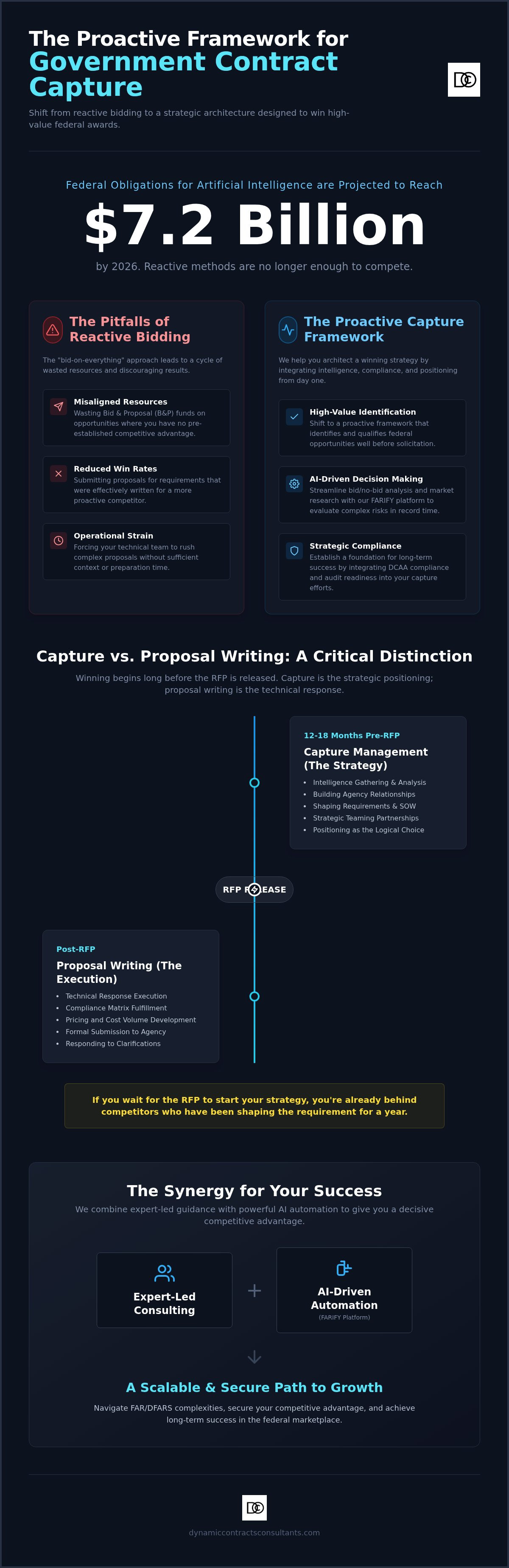
Did you know that federal obligations for Artificial Intelligence are projected to reach $7.2 billion in 2026? This explosive growth signals a shift where reactive bidding methods are no longer sufficient for firms aiming to secure high-value awards. Developing a sophisticated government contract capture strategy is no longer just about tracking RFPs. It requires architectural precision in the pre-solicitation phase to ensure your firm is positioned for success long before a formal solicitation is released.
We understand the frustration of high bid costs and stagnant win rates, particularly when managing the intricate layers of FAR and DFARS requirements. It's a complex environment where even a minor compliance oversight can disqualify a technically superior proposal. We'll show you how to master the systematic process of identifying and securing federal opportunities through a blend of regulatory expertise and AI-driven intelligence.
Our guide details a repeatable framework for capture management that integrates our FARIFY platform to accelerate market research. We'll explore how to align your capture efforts with long-term DCAA compliance and audit readiness, ensuring your growth remains both scalable and secure.
Key Takeaways
- Shift from a reactive "bid-on-everything" approach to a proactive framework that identifies high-value federal opportunities well before the solicitation phase.
- You'll learn to architect a winning government contract capture strategy by creating solution-driven plans that align your unique capabilities with specific agency requirements.
- Streamline your decision-making process with automated bid/no-bid analysis, using our FARIFY platform to evaluate complex risks and market research data in record time.
- Establish a foundation for long-term success by integrating DCAA compliance and strategic teaming partnerships into your capture efforts from day one.
- Leverage the synergy of expert-led consulting and AI-driven automation to navigate FAR/DFARS complexities and secure a competitive advantage in the 2026 federal marketplace.
The Strategic Framework of Government Contract Capture Strategy
A successful government contract capture strategy functions as the proactive architecture of the procurement lifecycle. It's a process that takes place long before a Request for Proposal (RFP) ever hits SAM.gov. Understanding the broader government procurement process is essential for contractors who want to move beyond reactive bidding. We view capture as the period where you build relationships, analyze agency needs, and position your firm as the logical choice for the upcoming requirement.
Many firms fall into the trap of a reactive "bid-on-everything" approach. This strategy inevitably leads to a massive drain on resources and discouragingly low win rates. A reactive approach often results in several organizational failures:
- Misaligned Resources: Spending bid and proposal (B&P) funds on opportunities where you have no competitive advantage.
- Reduced Win Rates: Submitting proposals for requirements that were essentially written for a more proactive competitor.
- Operational Strain: Forcing your technical team to rush through complex requirements without sufficient context or preparation.
Instead, we advocate for "strategic compliance" as a primary differentiator. This means integrating audit readiness and regulatory alignment into your capture process from the start. By aligning your specific capabilities with agency mission goals, you reduce risk for the government and increase your own operational efficiency.
To better understand how these steps translate into actual wins, watch this helpful video:
Capture vs. Proposal Writing: Understanding the Distinction
While often used interchangeably, capture and proposal writing serve distinct functions in your growth strategy. Proposal writing is the technical execution of a response; capture is the intelligence gathering and strategic positioning that makes that response win. Winning a contract often starts 12 to 18 months before the solicitation release. We define capture strategy as the systematic alignment of business intelligence with federal requirements. If you wait for the RFP to start your strategy, you're already behind competitors who have been shaping the requirement for a year.
The Role of Capture in the Federal Procurement Lifecycle
Effective capture management maps directly to the acquisition strategy documentation phase of the agency. Early involvement allows you to contribute to market research and potentially help shape the Statement of Work (SOW) or Performance Work Statement (PWS). This level of engagement ensures that the final solicitation reflects a solution you are uniquely qualified to provide. By participating in industry days and responding to Sources Sought notices, you provide the government with the data it needs to refine its requirements. To leverage these advantages, many successful contractors utilize our strategic capture management services to ensure they remain ahead of the procurement curve. This proactive stance transforms the complex acquisition process into a manageable, repeatable path toward long-term success with a robust government contract capture strategy.
Architecting a Winning Capture Plan: Beyond the Pipeline
Transitioning from passive market research to a formal government contract capture strategy requires a shift from simply tracking data to actively architecting solutions. While a pipeline lists potential leads, a capture plan details the tactical steps necessary to mitigate risks and neutralize competitors. We emphasize a solution-driven approach that addresses agency pain points before they are even codified in a solicitation. This proactive stance ensures your firm isn't just another name on a list of bidders, but a recognized partner with a demonstrated understanding of the mission.
Intelligence gathering is the bedrock of this architecture. You must look beyond basic procurement data to understand the incumbent's performance history, the specific budgetary pressures for the 2026 fiscal year, and the technical hurdles the agency currently faces. Unlike competitors who focus solely on relationship building, we believe that integrating FAR and DFARS compliance matrices into your capture plan is a technical requirement that cannot be overlooked. This depth of intelligence allows you to build a framework that de-risks the contract for the government from the very beginning.
Intelligence Gathering and Market Research
Effective research involves utilizing specialized tools to analyze agency spending patterns and previous award data. It's critical to identify the "Gatekeepers" in the contracting office and the "Influencers" within the program office. By leveraging detailed market research reports, we help you validate your competitive positioning against incumbents. This process ensures your team isn't just bidding; you're positioning for a win based on verifiable intelligence and operational efficiency. If you find your current process lacks this depth, you can consult with our experts to refine your approach.
Customer Alignment and Value Proposition Development
Your value proposition must speak the specific language of the target agency. It's not enough to list generic capabilities; you need to align your technical strengths with the anticipated Section L and M requirements. This alignment ensures that when you transition to our proposal writing services, the narrative is already primed for high scores. We recommend using customized proposal templates during the capture phase to standardize this transition. This ensures that every piece of intelligence gathered by your capture team is effectively communicated to your proposal writers, maintaining the integrity of your solution throughout the procurement lifecycle.
Data-Driven Decision Making: Bid/No-Bid Analysis and AI Integration
The most critical filter in your pipeline is a rigorous bid no-bid analysis framework. Many contractors struggle with "emotional bidding," where the desire for growth overrides the reality of technical or financial limitations. We've seen firms exhaust their resources chasing "must-win" contracts that they were never qualified to execute. By implementing a data-driven government contract capture strategy, you replace gut feelings with scalable intelligence. This ensures your bid and proposal (B&P) funds are reserved for opportunities where your probability of winning (PWin) is highest.
Our approach leverages AI-driven automation via FARIFY to analyze complex solicitations for risk in minutes rather than days. This speed allows you to make a "Go" decision based on objective criteria: technical fit, past performance relevance, and financial viability. If an opportunity doesn't align with your core competencies or presents an unmanageable risk to your margins, the framework provides the justification to walk away early.
The Mechanics of AI-Generated Acquisition Planning
We use FARIFY as an AI-powered platform for rapid document generation to streamline the acquisition planning phase. The platform generates audit-ready documentation that traditionally takes weeks to compile manually. By extracting RFP requirements early, we perform a comprehensive gap analysis against your current capabilities. This process significantly reduces the turnaround time for Independent Government Cost Estimate (IGCE) preparation and market research reports. You'll gain the ability to see exactly where your team excels and where you might need to seek a teaming partner to fill technical voids.
Risk Assessment and Mitigation Strategies
Identifying "killers" in a solicitation is essential for long-term success. These killers often include unfavorable contract terms, unrealistic delivery schedules, or high cost-risk structures that could jeopardize your firm's stability. Our strategy uses AI to compare current opportunities against your successful past performances, highlighting potential friction points before you commit. While the technology provides the data, we maintain a human-in-the-loop assurance model. Our experts validate every AI-produced risk assessment to ensure it accounts for the nuances of FAR and DFARS compliance. This blend of technology and human expertise ensures that your risk mitigation strategies are both comprehensive and executable.
Operationalizing the Strategy: Teaming, Compliance, and RFP Positioning
Successful execution requires more than just a "Go" decision. It demands the operationalization of your government contract capture strategy through precise teaming and regulatory alignment. We focus on identifying technical gaps in your current portfolio and filling them with strategic partners who enhance your past performance scores. This process isn't just about meeting small-business set-aside goals; it's about building a team that the government views as a low-risk, high-capability solution. By establishing these relationships early, you ensure that your team is cohesive and ready to perform the moment the contract is awarded.
Managing capture risk also involves a deep dive into flow-down clauses. These contractual requirements often carry significant compliance burdens for subcontractors that can impact your overall pricing and risk profile. If these aren't addressed during the capture phase, they can lead to post-award disputes or margin erosion. We utilize a comprehensive compliance matrix to track every requirement from day one, ensuring that every role, responsibility, and regulatory obligation is codified long before the RFP is released. This level of detail differentiates a winning bid from one that is merely compliant.
Strategic Teaming and Subcontract Management
Selecting the right partners is a clinical process within your government contract capture strategy. You must evaluate potential teammates based on their complementary strengths and verifiable past performance in the target agency. A clear teaming agreement is essential; it must define work-share, roles, and responsibilities with surgical precision. Our approach manages the entire subcontract lifecycle, ensuring that your pre-award strategy aligns perfectly with your post-award delivery obligations. This prevents the common pitfall of having a strong team on paper that fails to deliver due to poorly defined boundaries.
Pre-Award Compliance and Audit Readiness
Many contractors wait until they receive an award to consider their accounting systems. This is a strategic error that can disqualify you from certain high-value opportunities. We believe that DCAA compliance consulting should be integrated into your capture lifecycle from the beginning. If you're pursuing cost-reimbursement contracts, your accounting system must be prepared for DCAA scrutiny before the government even considers your bid. Your capture strategy directly influences your indirect rate structures and overall price-to-win. Ensuring this alignment early guarantees that you remain audit-ready and competitive. For firms looking to bridge the gap between bidding and execution, our expertise in post-award compliance ensures your growth is sustainable and compliant.
If you're ready to secure your technical and regulatory architecture for the 2026 fiscal year, contact our strategic advisors today.
Executing Your Capture Strategy with Dynamic Contracts Consultants LLC
We believe that a modern government contract capture strategy requires a synthesis of seasoned expertise and cutting-edge technology. Our approach at Dynamic Contracts Consultants LLC isn't just about providing advice; it's about delivering a scalable intelligence framework. By blending our expert-led consulting with FARIFY’s AI-driven automation, we simplify the most complex aspects of FAR and DFARS regulations. This solution-driven methodology ensures that your firm can focus on mission execution while we handle the technical architecture of the capture lifecycle. We provide end-to-end support that moves your organization away from reactive bidding toward a position of professional authority.
The FARIFY Advantage: Speed, Precision, and Compliance
Speed and precision are the hallmarks of our technological edge. FARIFY, our AI-powered platform for rapid document generation, allows us to produce solicitation drafts, Performance Work Statements (PWS), and Statements of Work (SOW) in minutes. This capability ensures you stay ahead of the competition during the critical pre-solicitation phase when requirements are still being shaped. Every output is designed to be audit-ready, meeting the strict federal standards required for high-value contracts. We achieve operational efficiency through automated tracking of deliverables and milestones, which significantly reduces the administrative burden on your internal teams. This automation allows for human-in-the-loop assurance, where our experts verify every detail to guarantee compliance.
Partnering for Scalable Growth
Our reliability is rooted in a proven track record as a prime contractor for the Department of Defense (DoD), the State Department, the EPA, and NOAA. This deep-seated experience allows us to navigate the nuances of diverse agency requirements with surgical precision. Additionally, our minority-owned small business status adds diversity value to your teaming strategy, helping you meet agency-specific set-aside goals while strengthening your competitive posture. We offer comprehensive lifecycle support, ranging from initial acquisition planning and bid/no-bid analysis to final contract closeout. This holistic approach ensures that your capture efforts aren't just about winning a single contract, but about building a sustainable, scalable federal practice. If you're ready to optimize your government contract capture strategy for the 2026 fiscal year, we invite you to leverage our expertise for your long-term success.
Contact us today to schedule a consultation and discover how our blend of expert consulting and AI-driven intelligence can transform your federal procurement outcomes.
Securing Your Competitive Advantage in the 2026 Federal Marketplace
Transitioning from a reactive bidder to a proactive strategist is essential for firms aiming to capture a significant share of federal spending. We've shown that success requires the seamless integration of AI-driven intelligence and rigorous regulatory compliance. By utilizing our FARIFY platform, your team can generate audit-ready market research and acquisition documentation in minutes, providing a distinct speed advantage over competitors. Our staff of Certified Professional Contracts Managers (CPCM) ensures every strategic decision is rooted in deep expertise and audit readiness.
Our proven record as a prime contractor for the DoD, State Department, EPA, and NOAA allows us to provide the visionary leadership your business needs to scale. We help you move beyond simply tracking opportunities to actively architecting solutions that resonate with agency mission goals. It's time to transform your procurement lifecycle into a repeatable engine for growth and long-term success.
Leverage our expert insights to optimize your government contract capture strategy today. We look forward to partnering with you to navigate the complexities of the federal landscape with precision and confidence.
Frequently Asked Questions
What is the primary difference between capture planning and capture strategy?
Capture strategy represents the overarching vision and competitive positioning used to influence a procurement. In contrast, capture planning is the tactical documentation of that vision. Your government contract capture strategy defines how you'll win by identifying agency pain points and establishing relationships. The plan then operationalizes this by assigning specific tasks, timelines, and resources to team members to ensure every milestone is met before the solicitation is released.
How early should a company begin its government contract capture strategy?
You should ideally begin the process 12 to 18 months before the anticipated solicitation release. This extended timeframe allows your team to engage with program managers and contracting officers during the market research phase. Early involvement provides the opportunity to influence the Statement of Work and understand the incumbent’s weaknesses. Starting late often results in a reactive posture where you're forced to follow requirements a competitor helped define.
Can AI like FARIFY really ensure compliance with complex FAR and DFARS regulations?
FARIFY functions as an AI-powered platform for rapid document generation that significantly accelerates the compliance review process. It analyzes complex FAR and DFARS clauses to identify risks in minutes. While the AI provides incredible speed and precision, we maintain a human-in-the-loop assurance model. Our experts validate all automated outputs to ensure they meet strict federal standards and remain audit-ready throughout the entire procurement lifecycle.
What are the most critical factors to consider in a Bid/No-Bid analysis?
The most critical factors include technical capability, relevant past performance, and financial viability. You must objectively assess whether your firm can meet the Section L and M requirements without excessive risk. We use a data-driven framework to evaluate the probability of win (PWin) against the cost of the bid. Avoiding emotional bidding ensures your resources are concentrated on high-value opportunities where your solution offers the greatest mission alignment.
How does DCAA compliance factor into the pre-award capture process?
DCAA compliance must be established during the capture phase to ensure your accounting system is prepared for pre-award audits. This is especially vital for cost-reimbursement contracts where the government scrutinizes your indirect rate structures. Integrating compliance early prevents disqualification during the evaluation phase. We help you architect a compliant financial framework that supports your price-to-win strategy while maintaining the transparency required by federal oversight agencies.
What role do teaming agreements play in a successful capture plan?
Teaming agreements allow you to fill technical gaps and meet small-business set-aside goals by partnering with complementary firms. These agreements must define work-share and responsibilities with surgical precision to avoid post-award disputes. A successful government contract capture strategy uses teaming to enhance past performance scores and present a unified, low-risk solution. We prioritize selecting partners who bring specific agency intimacy or niche capabilities that strengthen your competitive posture.
How can a small business leverage capture strategy to compete with large prime contractors?
Small businesses can compete by leveraging their agility and specialized niche expertise to solve specific agency problems that larger primes might overlook. Utilizing set-aside programs like 8(a) or WOSB provides a protected path to prime contracts. By focusing on a proactive capture approach, you can build the necessary customer intimacy and shape requirements before they reach the open market. This levels the playing field against incumbents with more substantial resources.
What is the most common mistake contractors make during the capture phase?
The most frequent error is reactive bidding, which occurs when a contractor waits for the RFP to appear on SAM.gov before starting their strategy. At that stage, the incumbent or a proactive competitor has likely already influenced the requirements. Other common mistakes include failing to perform a rigorous bid/no-bid analysis or ignoring DCAA compliance until after the award. These oversights lead to wasted resources and significantly lower win rates.


