

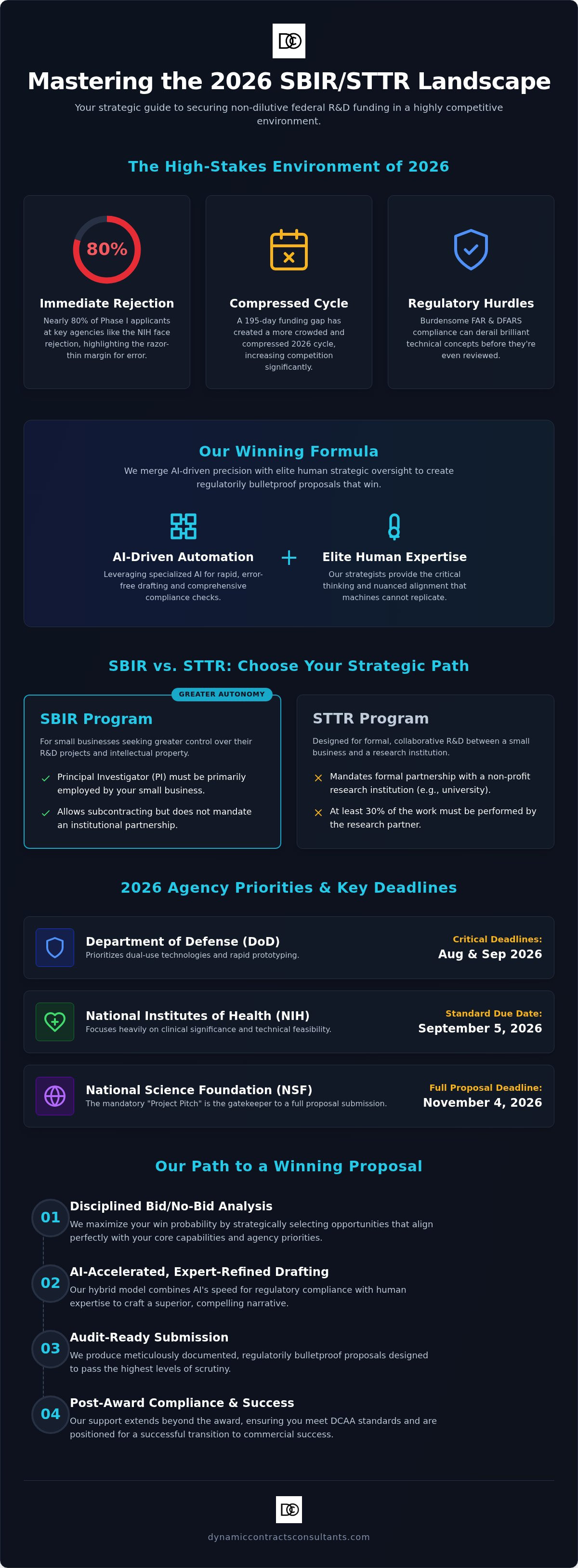
With nearly 80% of Phase I applicants at agencies like the NIH facing immediate rejection, the margin for error in federal R&D has never been thinner. You understand that non-dilutive capital is the most strategic way to scale your technology, but the 195-day funding gap earlier this year has left the 2026 cycle more crowded and compressed than ever. This is why specialized SBIR grant writing services have become essential for firms that cannot afford the time-intensive cycles of failed submissions.
We've seen how burdensome FAR and DFARS compliance requirements can derail even the most brilliant technical concepts before they reach a reviewer's desk. Our approach combines AI-driven automation with elite human expertise to ensure your proposal is both scientifically superior and regulatorily bulletproof. We'll help you master the complexities of these solicitations to secure the funding you need for Phase I, Phase II, and beyond. In this article, we'll examine the 2026 regulatory shifts and our methodology for producing audit-ready documentation that bridges the gap between R&D and commercial success.
Key Takeaways
- Understand the critical shifts in the 2026 federal landscape and how new legislation impacts your R&D funding eligibility.
- Discover why the most successful firms use SBIR grant writing services that blend AI-driven precision with expert human strategic oversight.
- Learn the specific components of a winning proposal, starting with a disciplined bid/no-bid analysis to maximize your win probability.
- Identify the post-award compliance requirements, including DCAA standards, that are essential for transitioning from Phase I to commercial success.
- Explore how a comprehensive approach to the procurement lifecycle creates a scalable path for national innovation and long-term growth.
The 2026 SBIR Landscape: Strategic Opportunities for Innovation
The Small Business Innovation Research (SBIR) program and the Small Business Technology Transfer (STTR) program serve as the primary engines for federal non-dilutive R&D funding. These initiatives obligate over $4.6 billion annually, specifically targeting small businesses capable of high-impact innovation. Following the reauthorization through the Small Business Innovation and Economic Security Act (S. 3971) on April 13, 2026, the programs are now secured through September 30, 2031. This extension provides much-needed stability after the 195-day funding gap that disrupted the previous cycle. We've seen that this gap has created a compressed and highly competitive environment for the remainder of 2026, requiring a level of precision that standard technical writing cannot provide.
To better understand the nuances of application and time management in this environment, watch this helpful video:
Success in 2026 demands more than just technical merit; it requires a strategic alignment with federal acquisition goals. We've refined our SBIR grant writing services to address this shift, moving beyond simple proposal drafting to provide comprehensive proposal writing that accounts for the full procurement lifecycle. You aren't just selling a technology. You're offering a solution to a specific agency pain point within a rigid regulatory framework that now includes heightened scrutiny of foreign influence and cybersecurity practices.
Understanding the SBIR vs. STTR Distinction
While both programs provide non-dilutive capital, their structural requirements differ significantly. The STTR program mandates a formal partnership with a research institution, such as a university or a federal lab, which must perform at least 30% of the work. In contrast, SBIR allows you more autonomy, though the principal investigator must be primarily employed by your small business. We help you determine which vehicle aligns with your commercialization goals, especially as agencies now implement stricter due diligence regarding ownership and capital sources under the 2026 reauthorization guidelines.
Agency-Specific Priorities in 2026
Each agency operates with distinct technical and administrative filters that you must navigate. The DoD continues to prioritize dual-use technologies and rapid prototyping, with critical deadlines in August and September 2026 for DARPA and Navy components. Conversely, the NIH maintains a standard due date of September 5, 2026, focusing heavily on clinical significance and technical feasibility. If you're targeting the NSF, the "Project Pitch" remains the mandatory gatekeeper before you can submit a full proposal by the November 4, 2026 deadline. Our team monitors these shifting priorities to ensure your capture strategy is synchronized with current agency needs.
Selecting SBIR Grant Writing Services: Human Expertise vs. AI Acceleration
The debate surrounding artificial intelligence in federal procurement often presents a false choice between human intuition and machine speed. We believe the most effective SBIR grant writing services in 2026 utilize a "human-in-the-loop" methodology. This approach doesn't replace the strategist; it empowers them. While generic large language models often struggle with the specific nuances of agency solicitations found on the official SBIR/STTR website, specialized platforms like FARIFY.ai are built specifically for the federal regulatory environment. This distinction is critical because an AI that doesn't understand the Federal Acquisition Regulation (FAR) can't produce an audit-ready document.
The Pitfalls of Traditional 'Human-Only' Grant Writing
Traditional, human-only writing processes often suffer from significant bottlenecks, particularly during the compressed solicitation windows we're seeing in late 2026. Manual drafting is inherently prone to error and can easily overlook subtle updates in FAR or DFARS compliance. We've observed that teams led solely by technical experts often produce brilliant scientific narratives that fail because they aren't "procurement-ready." A proposal that is technically sound but fails a Section L formatting check or lacks alignment with Section M evaluation criteria is a wasted investment. Relying on manual cross-referencing for these complex requirements increases the risk of a non-compliant submission that never reaches the technical reviewers.
The Synergy of Scalable Intelligence and Strategic Oversight
Scalable intelligence allows us to generate compliance matrices and gap analyses in minutes rather than days. By using AI-driven automation for the structural elements of proposal writing, our senior consultants can focus on the high-level strategy of your bid. This synergy ensures 100% compliance with Section L and M requirements while maintaining the sophisticated narrative voice necessary to survive rigorous triage. Our domain experts refine these technical volumes to ensure they speak directly to agency mission goals, creating a submission-readiness framework that stands up to the most demanding federal audits. This integrated approach transforms the proposal from a simple application into a strategic asset for your firm's growth.
If you're ready to leverage this blend of technology and expertise to accelerate your submission, you can discuss your project with our strategic partners to ensure every requirement is met with precision.
The Anatomy of a Winning SBIR Proposal: From Capture to Submission
Successful participation in the Small Business Innovation Research (SBIR) program isn't a result of chance. It's the outcome of a disciplined procurement lifecycle that we call Strategic Capture Management. Our SBIR grant writing services don't start with drafting; they begin with a cold, analytical look at the solicitation requirements and your firm's capability to meet them. We use a four-step framework to transition your innovation from a conceptual pitch to a funded federal contract.
Step 1 involves a rigorous bid/no-bid analysis. We evaluate the agency’s specific pain points against your technical roadmap to ensure alignment. Step 2 focuses on technical volume development, where we balance high-level innovation with practical feasibility. Step 3 addresses the commercialization plan, which is often the primary point of failure for Phase II applicants. We help you articulate a credible path to market that satisfies federal reviewers. Finally, Step 4 includes a comprehensive compliance review and the preparation of audit-ready documentation to ensure your proposal survives the administrative triage.
Strategic Capture Management and Bid Analysis
We believe that strategic capture management services are the foundation of any high-value grant pursuit. By conducting deep market research, we identify solicitations where your technology has the highest probability of winning. We leverage FARIFY.ai for rapid RFP requirement extraction, allowing us to build a compliance map in minutes. This automated precision ensures that no mandatory clause or formatting rule is missed, letting you focus on the technical excellence of your solution.
Phase I vs. Phase II: Tailoring the Narrative
Your narrative strategy must shift as you move through the program. Phase I is about proving technical merit and feasibility within extremely tight page constraints. You've got to be concise and impactful. Phase II requires a transition from R&D toward a scalable commercial product. When you utilize professional SBIR grant writing services, you gain a partner that integrates CPARS narrative support early in this process to help you build a documented track record of performance. This strategic foresight ensures that your proposal isn't just a technical paper but a professional business case for federal investment.
Beyond the Award: Ensuring DCAA Compliance and Post-Award Success
Receiving your award notice is a transformative moment, but it also triggers a fundamental shift in your relationship with the federal government. You've transitioned from a grant applicant to a prime contractor, a role that carries a complex set of administrative and financial responsibilities. We've found that the most successful innovators view the award as the beginning of a long-term strategic partnership rather than a one-time transaction. Professional SBIR grant writing services must prepare you for this transition by establishing a framework for post-award compliance long before the first milestone is reached.
Mitigating Risk with DCAA Compliance Consulting
If your goal is to secure Phase II or Fast-Track funding, your accounting system must be prepared for the scrutiny of the Defense Contract Audit Agency (DCAA). Unlike the relatively flexible reporting of Phase I, later stages often involve cost-plus-fixed-fee (CPFF) contracts that require rigorous tracking of every dollar. Our approach to DCAA Compliance Consulting ensures your firm is ready for this shift by implementing systems that handle indirect rate management and real-time labor distribution.
- Establishment of a compliant chart of accounts that separates direct and indirect costs.
- Implementation of tamper-proof timekeeping systems to meet federal labor standards.
- Strategic management of indirect rates to ensure full cost recovery on CPFF contracts.
- Preparation for the trend toward continuous, embedded audits that DCAA is adopting in late 2026.
Post-Award Contract Administration and Oversight
The administrative burden of managing a federal contract can quickly overwhelm a small R&D team. Effective post-award compliance services provide the oversight necessary to manage deliverables, technical milestones, and the eventually required contract closeout documentation. This oversight is particularly critical when managing subcontractors or research partners in an STTR setting. You're responsible for ensuring that all flow-down clauses are properly integrated into your subcontracts, as any compliance failure by a partner ultimately reflects on you as the prime contractor. By maintaining audit-ready records throughout the procurement lifecycle, you protect your company's reputation and ensure you're positioned for future funding opportunities.
To ensure your internal systems are ready to handle the complexities of federal oversight and protect your funding, you can consult with our compliance experts to build a scalable infrastructure for success.
The Dynamic Advantage: Integrated SBIR Solutions for National Innovation
We believe that the complexity of the 2026 federal R&D environment demands more than a freelance writer; it requires a strategic ally. Our SBIR grant writing services are built on a foundation of professional authority and technological innovation. Since our founding in 2015, we've served as a prime contractor for agencies like the DoD, EPA, and NOAA. As a minority-owned firm, we bring a disciplined perspective to every engagement, specializing in the deep intricacies of FAR and DFARS compliance that often baffle even the most experienced research teams. Our commitment to your success extends from the initial Phase I feasibility study to the final commercialization of your technology.
Our partnership with FARIFY.ai allows us to move at a speed that traditional firms can't match. By utilizing AI-driven automation for acquisition planning and bid-no-bid analysis, we generate audit-ready documentation in minutes. This isn't just about efficiency; it's about precision. We ensure that every mandatory clause and flow-down requirement is addressed with scalable intelligence, providing a level of accuracy that manual drafting simply can't guarantee. This technological advantage, paired with our deep regulatory expertise, ensures your proposal is both visionary and compliant.
Why Strategic Partnership Trumps Simple Writing Services
When you view our full range of proposal writing services, you'll see that we don't just provide content; we provide "human-in-the-loop" assurance for every technical volume. Simple writing services often fail because they lack a B2B focus on scalable growth. We act as your strategic partner, ensuring that your R&D efforts are aligned with the long-term procurement lifecycle. This approach transforms a single grant application into a sustainable pipeline of federal funding, positioning your firm as a reliable partner for national innovation.
Take the Next Step Toward Federal Funding Success
Success in the federal marketplace requires a proactive stance. We encourage you to schedule a consultation so we can assess your current R&D portfolio and identify the highest-probability opportunities for your specific technical niche. Whether you're navigating the compressed 2026 deadlines or preparing for the per-firm proposal caps coming in 2027, we'll tailor our services to meet your unique needs. Position Dynamic Contracts Consultants as your long-term acquisition partner and leverage our expertise to secure the non-dilutive capital your innovation deserves. Let's build a compliant, scalable, and successful future for your technology together.
Securing the Future of Your National Innovation
The 2026 federal R&D landscape demands a shift from traditional drafting to a comprehensive procurement strategy. You've learned that securing non-dilutive funding requires more than technical excellence; it necessitates a rigorous adherence to the FAR/DFARS environment and a proactive approach to DCAA compliance. By utilizing specialized SBIR grant writing services, your firm can navigate compressed solicitation cycles with AI-driven precision. Compliance is non-negotiable. We've spent years serving as a prime contractor for the DoD, NASA, and EPA, refining a "human-in-the-loop" methodology that guarantees audit-ready documentation via FARIFY.ai.
This integrated approach doesn't just help you win Phase I; it builds a scalable infrastructure for Phase II and commercialization success. It's our mission to act as your long-term strategic partner, ensuring your technology reaches the mission-critical stages where it can truly impact national innovation. Partner with Dynamic Contracts Consultants for Audit-Ready SBIR Success and leverage our expertise to transform your R&D portfolio into a sustainable federal pipeline. Your innovation has the potential to solve the nation's most complex challenges, and we're ready to help you secure the capital to make it happen.
Frequently Asked Questions
What is the typical success rate for SBIR grant writing services?
Success rates vary significantly by agency. NIH averages 15-18% while DARPA reaches 25-30%. While we don't claim a specific win-rate percentage, professional SBIR grant writing services improve your probability by ensuring technical merit aligns with procurement criteria. Our strategic oversight addresses high rejection rates by mitigating administrative errors that lead to triage. This ensures your innovation receives the technical review it deserves without being disqualified on a technicality.
How does FARIFY AI ensure my SBIR proposal is compliant with FAR/DFARS?
FARIFY.ai utilizes specialized algorithms to perform rapid RFP requirement extraction and compliance mapping against federal regulations. It generates audit-ready documentation in minutes, identifying specific FAR and DFARS clauses that apply to your contract. This AI-driven automation eliminates manual errors in Section L and M cross-referencing. Our human experts then refine the technical narrative to ensure it's both scientifically superior and regulatorily bulletproof for your specific agency.
Do you provide SBIR Phase II commercialization plan writing?
We specialize in developing comprehensive Phase II commercialization plans, which are often the primary point of failure for applicants. Our team helps you articulate a credible path to market, including market research and competitor analysis. We ensure your plan meets the rigorous standards of reviewers who look for a transition from R&D to a scalable technology. This focus on commercial viability is essential for securing the larger awards available in 2026.
Is DCAA compliance required for all SBIR Phase I winners?
DCAA compliance isn't strictly required for all Phase I winners, but it's essential if you intend to pursue Phase II or cost-reimbursable contracts. Establishing a compliant accounting system early prevents delays in receiving larger awards. We provide the necessary consulting to ensure your indirect rates and timekeeping systems meet federal audit scrutiny. This proactive approach protects your company's reputation and ensures you're ready for the financial oversight that comes with federal funding.
Can you help with resubmission strategy after an NIH or NSF rejection?
We offer a structured approach to resubmission by conducting a deep-dive analysis of your previous Summary Statement or reviewer comments. Our experts identify technical gaps and administrative weaknesses that led to the initial rejection. We then leverage our SBIR grant writing services to pivot your narrative. This ensures the revised proposal directly addresses every reviewer concern while aligning with the updated 2026 priorities of agencies like the NIH or NSF.
What is the difference between a grant writer and a capture manager?
A grant writer focuses on the narrative and technical volume, while a capture manager oversees the entire procurement lifecycle. Our approach integrates both roles to provide a strategic advantage. While the writer produces the text, the capture manager performs bid-no-bid analysis and ensures your firm is positioned to win before drafting begins. This synergy ensures your proposal isn't just technically sound but is also aligned with the agency's broader acquisition goals.
How long does the SBIR proposal development process typically take?
A standard development cycle typically takes six to eight weeks, although this varies based on solicitation complexity. Given the compressed 2026 deadlines following the funding gap, we use FARIFY.ai to accelerate administrative phases. This efficiency allows more time for the critical human refinements that ensure your proposal stands up to rigorous triage. We help you manage these tight timelines without sacrificing the precision required for audit-ready documentation.
Do you support SBIR applications for the Department of Defense (DoD)?
We provide extensive support for DoD applications, including DARPA, the Navy, and the Army. Our expertise in DFARS compliance and dual-use technology positioning is particularly valuable for these high-stakes solicitations. Since we've served as a prime contractor for the DoD, we understand the specific nuances required to navigate their rapid prototyping requirements. We ensure your proposal speaks the language of defense acquisition while meeting every technical and administrative requirement.


