

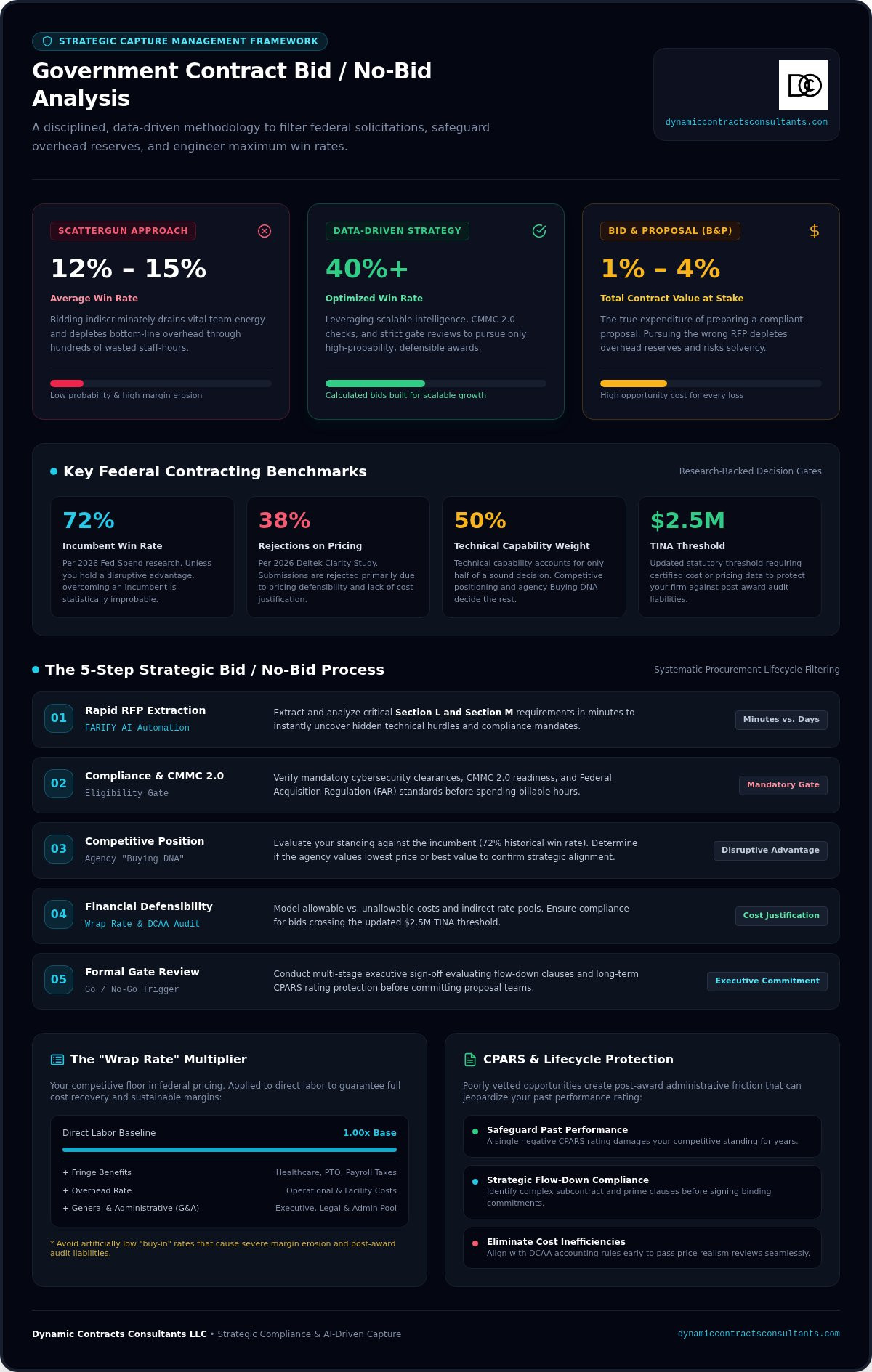
Did you know that contractors who bid indiscriminately on every pipeline opportunity average a win rate of only 12% to 15%? This scattergun approach doesn't just drain your team's energy; it actively erodes your bottom line through hundreds of wasted staff-hours. We understand that in the 2026 federal market, a rigorous government contract bid no bid analysis is no longer a luxury. It's a foundational requirement for any firm that values its overhead and long-term stability.
You've likely experienced the frustration of manual RFP reviews that miss hidden compliance costs or technical pitfalls until it's too late to turn back. We believe your expertise deserves a more disciplined, data-driven methodology. This guide provides a strategic profitability framework to filter federal opportunities and protect your margins through AI-enhanced capture strategy. We'll walk you through a 5-step process that covers everything from CMMC 2.0 eligibility gates to financial defensibility under the updated $2.5 million TINA threshold. You'll learn how to integrate scalable intelligence into your procurement lifecycle to achieve win rates that can reach 40% or higher, ensuring every proposal you submit is a calculated step toward growth.
Key Takeaways
- Leverage FARIFY’s AI-driven automation for rapid RFP extraction to identify critical Section L and M requirements in minutes.
- Implement a repeatable government contract bid no bid analysis framework to filter out low-probability solicitations and protect your firm’s overhead.
- Integrate DCAA compliance consulting insights from Dynamic Contracts Consultants LLC into your financial modeling to establish a competitive "Wrap Rate."
- Evaluate complex risk factors such as flow-down clauses and contract type disparities to maintain strategic compliance throughout the procurement lifecycle.
- Transition from indiscriminate bidding to a data-driven capture strategy that utilizes scalable intelligence to optimize your organizational win-rate.
What is Government Contract Bid No Bid Analysis?
A government contract bid no bid analysis is the systematic evaluation process we use to determine both the feasibility and the ultimate profitability of a federal solicitation. It isn't merely a checklist; it's a rigorous assessment of whether a specific opportunity aligns with your firm’s core competencies and financial objectives. We view this as the most critical gate in our strategic capture management services at Dynamic Contracts Consultants LLC. Without this filter, your business risks falling into the trap of chasing revenue at the expense of actual profit.
Small businesses often face a harsh reality where the opportunity cost of a losing proposal is immense. Research indicates that preparing a compliant federal proposal consumes between 1% and 4% of the total contract value in bid and proposal expenditure. For many firms, pursuing the wrong RFP isn't just a waste of time. It can bankrupt a small business by depleting overhead reserves that should've been allocated to high-probability wins. This is why we advocate for strategic compliance as an early filter. By aligning your bid decisions with the Federal Acquisition Regulation standards from the start, we help you identify high-risk solicitations before you invest a single billable hour.
The Strategic Filter: Beyond Technical Capability
Technical capability only accounts for 50% of a sound bid decision. We look deeper. You must assess your competitive position against the incumbent, who historically holds a 72% win rate according to 2026 Fed-Spend research. If the incumbent is performing well, your chances are low without a disruptive advantage. Dynamic Contracts Consultants LLC also evaluates the agency’s Buying DNA to see if they prioritize lowest price or best value. If your model doesn't align, a no-bid is the smarter choice.
The Impact on the Procurement Lifecycle
A disciplined approach to government contract bid no bid analysis ripples through the entire procurement lifecycle. When we help you select the right contracts, we reduce post-award administration friction. Poorly vetted contracts often lead to unforeseen compliance costs that erode your margins and damage your CPARS ratings. A negative CPARS report can haunt your firm for years, making future wins even harder to achieve. We define the Gate Review process as a formal, multi-stage assessment that mandates an opportunity meet specific technical, financial, and regulatory criteria before your team commits resources to a full proposal effort.
The Financial Architecture of a "Bid" Decision
Profitability in the federal sector isn't accidental; it's engineered. While the initial evaluation determines if you can perform the work, the financial architecture of your proposal determines if you should. A robust government contract bid no bid analysis must account for the reality that 38% of proposals are rejected primarily due to pricing defensibility and a lack of cost justification, according to the 2026 Deltek Clarity Government Contracting Study. If your pricing structure cannot withstand a DCAA audit or a rigorous price realism analysis, even the most technically superior proposal becomes a liability.
We utilize DCAA compliance consulting through Dynamic Contracts Consultants LLC to establish your financial "Go/No-Go" triggers early in the procurement lifecycle. This involves a deep dive into your indirect rate structure, ensuring that your bid isn't just competitive, but sustainable over the long term. For contracts exceeding the $2.5 million TINA threshold, the requirement for certified cost or pricing data makes this financial gate even more critical for protecting your firm from post-award audit risks.
Protecting Margins through Indirect Rate Analysis
Your "Wrap Rate", representing the multiplier applied to direct labor to cover fringe benefits, overhead, and general and administrative (G&A) expenses, serves as your competitive floor. At Dynamic Contracts Consultants LLC, we help you distinguish between allowable and unallowable costs, ensuring your bid remains compliant while protecting your margins. By applying scalable intelligence, we project how a new award will impact your existing rate pools. You should avoid the temptation of "buying in" with artificially low rates; if you can't justify your costs, you risk a failed audit or a contract that drains your cash flow over its entire lifecycle.
IGCE Benchmarking: The Reality Check
Aligning your proposal with the Independent Government Cost Estimate (IGCE) is essential for credibility. Different FAR Part 16 contract types allocate risk differently between you and the government. For instance, a Firm-Fixed-Price contract places all performance and cost risk on your shoulders, making an accurate IGCE comparison critical. We utilize FARIFY’s AI-driven platform to rapidly analyze historical agency spending patterns, allowing you to benchmark your costs against historical reality. Bidding significantly below the IGCE often signals a lack of understanding of the requirement, which is a frequent "No-Bid" trigger for sophisticated firms.
Beyond direct labor, you must factor in the hidden costs of strategic compliance. Security clearances, specialized accounting software for DCAA requirements, and the management of complex flow-down clauses for subcontractors all erode your bottom line if not priced correctly. If you're unsure how these variables affect your next bid, consult with our strategic partners at Dynamic Contracts Consultants LLC to refine your financial modeling before committing your proposal team to a losing effort.
How to Conduct a Government Contract Bid No Bid Analysis: A 5-Step Guide
Conducting a government contract bid no bid analysis requires a transition from emotional optimism to clinical objectivity. We've developed a five-step framework that transforms raw solicitation data into a strategic roadmap for your capture team. This process ensures your resources focus only on opportunities where you possess a clear path to both award and long-term profitability.
- Step 1: Rapid RFP Extraction. We use AI to pull Section L (Instructions), Section M (Evaluation Criteria), and Section C (Description/Specs) in minutes to identify immediate disqualifiers.
- Step 2: Capability Gap Analysis. We evaluate your technical scores and past performance history against the specific evaluation criteria to ensure you aren't bidding from a position of weakness.
- Step 3: Financial Modeling. We calculate fully burdened labor rates and project profit margins based on FAR Part 16 contract types to verify fiscal sustainability.
- Step 4: Risk Assessment. We identify "Kill Clauses" or unmanageable compliance burdens, such as Phase 1 CMMC 2.0 requirements or restrictive flow-down clauses that could erode your bottom line.
- Step 5: The Final Scorecard. We apply a weighted scoring system to make an objective "Bid" or "No-Bid" recommendation that aligns with your organizational goals.
Step 1 & 2: Leveraging AI for Rapid Discovery
Integrating AI into your government contract bid no bid analysis transforms what used to be weeks of manual research into a few hours of high-level review. We utilize FARIFY to generate compliance matrices that highlight "No-Bid" red flags immediately, such as a lack of specific NAICS experience or missing facility clearances. While AI provides the speed, we maintain a human-in-the-loop approach to ensure every gap report is verified by a CPCM-certified expert before moving to the financial modeling phase. This combination of speed and precision allows you to pivot away from losing efforts before they consume your budget.
Step 3, 4 & 5: The Strategic Decision
The final stages of the analysis quantify your "Win Probability" (P-Win) by blending competitive intelligence with resource availability. We establish "Hard No" triggers, such as negative margin projections or the absence of mandatory key personnel. If you don't have the internal infrastructure to support a specific contract type, we help you recognize that risk early. To ensure consistency across your organization, we utilize customized federal proposal templates that standardize the decision output. This repeatable methodology allows your executive team to see exactly why a specific opportunity was filtered out, protecting your overhead and ensuring your pipeline consists only of high-value targets.
Evaluating Contract Types and Compliance Risks
A successful government contract bid no bid analysis must look beyond the Statement of Work to the underlying contract vehicle. Each contract type dictates how financial risk is shared between your firm and the agency. In 2026, we see agencies leaning heavily into Firm-Fixed-Price (FFP) models to shift performance risk to the contractor. While FFP offers predictable revenue, it leaves zero room for error in your cost modeling. Conversely, Cost-Plus-Fixed-Fee (CPFF) contracts provide a safety net for unpredictable scopes but mandate a DCAA-approved accounting system. If your current infrastructure doesn't meet these rigorous standards, a "No-Bid" is the only responsible decision to protect your firm from immediate disqualification or future audit failures.
You must also evaluate the complexity of flow-down clauses. These regulatory requirements must be passed to your subcontractors, often increasing their overhead and eroding your overall project margin. In Time and Materials (T&M) environments, the primary risk is scope creep. Without disciplined project management, you might find your team exceeding the ceiling price before the deliverables are complete, turning a profitable win into a financial liability.
FFP vs. Cost-Reimbursable: The Profitability Gap
Bidding on FFP contracts requires a higher contingency margin to account for inflation, supply chain volatility, and labor shifts. We help you build these buffers into your bid/no-bid modeling to ensure you aren't bidding away your profit. While cost-reimbursable contracts protect your direct margins, they significantly increase post-award compliance burdens. For large-scale acquisitions, you must also consider whether the Cost Accounting Standards (CAS) apply, as this introduces a layer of reporting that can overwhelm unprepared teams.
Compliance as a Competitive Advantage
We believe that "burdensome" requirements are actually strategic opportunities. By maintaining an audit-ready mindset from day one of your capture plan, you turn complex regulations into "No-Bid" triggers for your less-prepared competitors. Our DCAA consulting and scalable intelligence enable you to pursue highly technical opportunities that others find too administratively complex. This strategic compliance ensures that when you decide to "Bid," you do so with the confidence that your operational efficiency will outperform the field throughout the procurement lifecycle.
If your team is struggling to quantify the risks of a specific solicitation, contact our strategic advisors today for a comprehensive risk assessment.
Optimizing Your Win-Rate with Dynamic and FARIFY
In 2026, the increasing complexity of federal procurement demands a synthesis of human expertise and machine speed. We position our partnership as the definitive solution for contractors who refuse to settle for the industry average 12% win rate. By integrating a rigorous government contract bid no bid analysis into your capture strategy, we ensure your resources are concentrated on opportunities with the highest probability of success and profitability. We don't just help you find work; we help you find the right work that aligns with your financial and operational goals.
The Dual-Force Advantage
FARIFY acts as the engine for rapid discovery, generating PWS/SOW and IGCE documents in minutes to support rapid bid decisions. This speed allows you to make decisive "No-Bid" calls before incurring heavy overhead. However, we believe that software alone doesn't win contracts. Our CPCM, CFCM, and CCCM-NCMA certified staff provide the critical human oversight needed to align these outputs with the nuances of the procurement lifecycle. We draw upon our extensive experience as a prime contractor for the DoD, State Department, EPA, and NOAA to ensure your proposal is technically superior and financially defensible. Our post-award contract administration services further protect the margins you secured during the bid phase by maintaining strict compliance through closeout.
Our proposal writing services translate your technical strengths into a compliant, high-scoring narrative that resonates with agency evaluators. We utilize scalable intelligence to level the playing field, allowing small, minority-owned businesses to compete effectively for Tier-1 federal contracts against large, entrenched incumbents. This data-driven approach removes the guesswork from acquisition planning, replacing it with a repeatable framework for sustainable growth.
Your Strategic Partnership for 2026
You should evaluate your current bid/no-bid success metrics to identify where manual processes or incomplete data are slowing your growth. We're here to help you optimize those gates and increase your win probability through a more disciplined approach. Contact our experts to refine your capture strategy and secure your place as a leader in the 2026 federal market. Precision, intelligence, and a commitment to strategic compliance are the only paths to long-term federal success. We look forward to building a partnership that transforms your procurement outcomes and protects your bottom line.
Secure Your Competitive Advantage in the 2026 Federal Market
Transitioning toward a data-driven government contract bid no bid analysis is essential for firms seeking scalable growth. By synthesizing the 10x faster RFP analysis of our AI-powered FARIFY platform with the deep regulatory expertise of our CPCM-certified staff, you'll eliminate the overhead drain of non-viable proposals. We've established that a disciplined framework doesn't just protect your margins; it aligns your capture strategy with the rigorous expectations of agencies like the DoD, State Department, and EPA.
Success in the modern procurement lifecycle requires more than technical capability. It demands strategic compliance and a commitment to operational efficiency. Whether you're evaluating complex contract risks or building audit-ready financial models, our team provides the sophisticated advisory needed to transform your pipeline into a high-yield asset. We invite you to optimize your federal win-rate with our strategic capture and AI services. Together, we'll ensure your firm possesses the precision and intelligence required to dominate the 2026 acquisition landscape. Your path to sustainable federal growth starts with a more intelligent bid decision.
Frequently Asked Questions
What are the most common red flags in a government RFP that should trigger a "No-Bid"?
Common red flags include overly restrictive key personnel requirements that your firm cannot realistically meet or evaluation criteria that clearly favor a specific incumbent’s proprietary solution. We also look for ambiguous Statements of Work that suggest a high risk for unmanageable scope creep. If a solicitation mandates a facility clearance you don't possess or requires past performance in a NAICS code outside your core expertise, these are definitive triggers for a no-bid decision.
How does AI improve the accuracy of a bid/no-bid analysis?
AI-driven automation through platforms like FARIFY improves accuracy by rapidly extracting complex requirements from Section L and M of a solicitation. This process eliminates human oversight errors during the initial shredding phase of a government contract bid no bid analysis. By generating precise compliance matrices in minutes, AI allows our CPCM-certified experts to focus on high-level strategic alignment and risk mitigation rather than manual document review, ensuring every decision is backed by data.
What is the difference between a technical bid/no-bid and a financial bid/no-bid?
A technical bid/no-bid assessment evaluates whether your team possesses the specific skills, certifications, and past performance required to execute the Statement of Work. In contrast, a financial bid/no-bid analysis focuses on your indirect rate structure, Wrap Rate, and the availability of a DCAA-compliant accounting system. Both are essential components of the procurement lifecycle, as technical excellence cannot compensate for a contract that is financially unsustainable or administratively impossible to manage.
How much should a company spend on a proposal relative to the contract value?
Most federal contractors should expect to spend between 1% and 4% of the total contract value on proposal development costs. For mid-size opportunities, this often equates to 100 to 300 staff-hours of effort. Because these costs are generally unrecoverable if you lose, we emphasize a disciplined government contract bid no bid analysis to ensure you only commit these significant resources to solicitations where your probability of win justifies the investment.
Can a small business use bid/no-bid analysis to compete with larger prime contractors?
Yes, small businesses use scalable intelligence to identify specific niches where large prime contractors are vulnerable due to documented CPARS deficiencies or high overhead rates. By applying a rigorous filtering process, your firm can bypass low-probability enterprise bids and focus on set-aside opportunities where you possess a technical advantage. This strategic compliance allows you to compete effectively by out-maneuvering larger competitors through superior agility and more competitive indirect rate structures.
What role does the Independent Government Cost Estimate (IGCE) play in the bid decision?
The Independent Government Cost Estimate (IGCE) serves as the agency's benchmark for price realism and reasonableness. If your proposed price is more than 20% below the IGCE, it often signals a lack of technical understanding to the contracting officer, leading to immediate rejection. We use IGCE data to determine if a solicitation is financially viable for your firm or if the agency’s budget expectations are too low to sustain a profitable delivery.
How often should we review our bid/no-bid criteria?
We recommend reviewing your bid/no-bid criteria at least quarterly or whenever significant regulatory changes occur, such as the October 2025 updates to FAR thresholds. As your firm gains new past performance or achieves certifications like CMMC 2.0 Level 2, your eligibility for higher-tier contracts expands. Regularly refining these gates ensures your capture strategy remains aligned with your current operational efficiency and the evolving federal acquisition landscape.
How does DCAA compliance impact the decision to bid on cost-plus contracts?
DCAA compliance is a non-negotiable prerequisite for bidding on cost-plus-fixed-fee (CPFF) contracts, as these require an audit-ready accounting system to track allowable costs. If your firm hasn't yet undergone a successful pre-award accounting system survey, bidding on these opportunities is likely a waste of overhead. We help you evaluate your system’s readiness during the acquisition planning phase to ensure you don't commit to a contract type that triggers unmanageable administrative burdens.


