

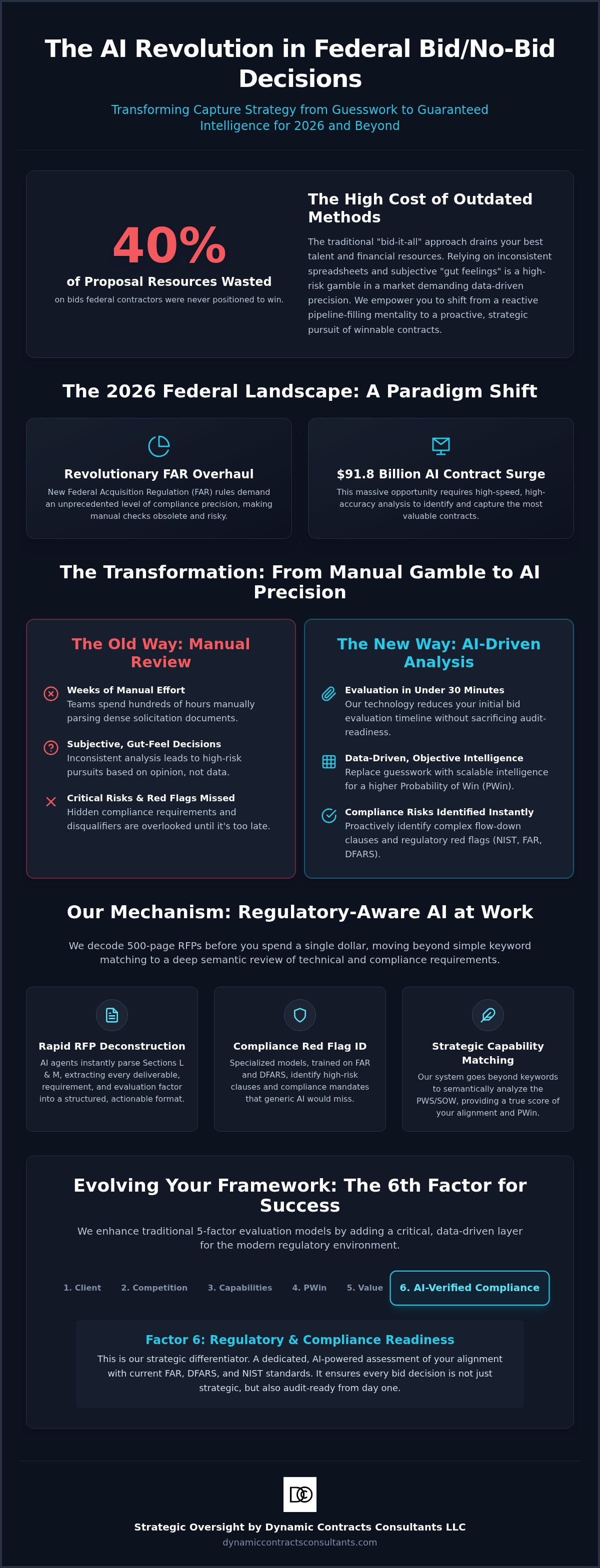
Did you know that the average federal contractor still wastes approximately 40% of their proposal resources on bids they were never positioned to win? The 2026 environment is defined by the Revolutionary FAR Overhaul and a $91.8 billion surge in AI-related contract potential; your capture team can't afford to rely on gut feelings or inconsistent spreadsheets. We've seen how using AI for bid-no-bid analysis transforms this process from a manual gamble into a high-precision strategic advantage. By integrating scalable intelligence into your initial review, you'll identify critical compliance red flags in 500-page RFPs before you spend a single dollar on drafting.
We understand that the pressure to fill the pipeline often leads to a "bid-it-all" mentality that drains your best talent. You're likely looking for a way to ensure every pursuit aligns with your core capabilities and the latest NIST 800-171 Revision 3 standards. This article will show you how to leverage regulatory-aware AI to eliminate resource waste and focus your capture efforts on the federal contracts you're most likely to win. We'll explore the shift toward AI-driven risk assessments, the impact of the 2026 CAS applicability thresholds, and how to build an audit-ready decision framework that scales with your growth.
Key Takeaways
- Transition from subjective manual qualification to a data-driven capture strategy that accounts for the high-volume complexities of the 2026 federal market.
- Learn the technical advantages of using AI for bid-no-bid analysis to rapidly parse Section L and M requirements while identifying high-risk flow-down clauses.
- Enhance your traditional evaluation models by adding a sixth factor for Regulatory & Compliance Readiness, specifically tailored to current NIST and FAR standards.
- Discover how a centralized AI Document Hub and automated agents can streamline your monitoring of specific NAICS codes and agency portals for more rapid decision-making.
- Explore how strategic oversight from Dynamic Contracts Consultants LLC combined with FARIFY technology can reduce your bid-evaluation timeline to under 30 minutes without sacrificing audit-readiness.
The Strategic Leverage of AI in Bid-No-Bid Decision-Making
AI-driven bid-no-bid analysis represents the sophisticated intersection of machine learning and federal capture strategy. It's a methodology where high-computational power meets regulatory expertise to determine a firm's probability of win (PWin) with surgical precision. In the context of the 2026 Revolutionary FAR Overhaul, manual qualification processes are increasingly becoming a liability. We've observed that traditional decision-making process frameworks often fail to account for the sheer volume of data produced by modern agency portals and the rapid shift in procurement methods. By using AI for bid-no-bid analysis, your organization can move beyond simple go/no-go checklists toward a model of scalable intelligence that accounts for both technical capability and strategic compliance.
The opportunity cost of pursuing low-probability solicitations in 2026 is higher than ever. With federal AI spending increasing by 966% since 2024, the market is flooded with complex opportunities that demand significant resources. Chasing the wrong contract doesn't just waste money; it prevents your capture team from focusing on winnable, high-value projects. Specialized AI identifies "hidden" disqualifiers, such as specific past performance requirements or obscure compliance mandates, within the first 24 hours of an RFP release. This rapid assessment ensures you don't commit technical experts to a 500-page solicitation that contains a non-negotiable red flag.
The Evolution of Capture Management
Capture management has transitioned from subjective "gut feelings" to an objective, data-backed discipline. While legacy teams once relied on historical relationships and keyword matching, modern success requires a semantic understanding of Performance Work Statement (PWS) and Statement of Work (SOW) requirements. Generic AI models lack the specialized training needed to interpret the nuances of the FAR or DFARS. Our approach utilizes tools like FARIFY.ai to ensure your analysis is grounded in the specific regulatory constraints of the federal sector, providing a level of precision that general-purpose automation cannot match.
Maximizing ROI Through Selective Bidding
Calculating the true cost of a losing proposal involves more than just labor hours; it includes the lost potential of alternative pursuits. Using AI for bid-no-bid analysis allows smaller firms to leverage the same level of competitive intelligence as "Big Prime" contractors, effectively leveling the playing field. By automating the initial risk assessment, you can allocate your proposal budget toward the 20% of opportunities that will drive 80% of your revenue growth. A Strategic No-Bid represents a disciplined commitment to scalable growth by preserving high-value resources for solicitations where your technical and regulatory alignment is absolute. We invite you to explore our strategic consulting services to refine your capture lifecycle.
Decoding the AI Mechanism: Regulatory-Aware Opportunity Intelligence
Regulatory-aware intelligence is the differentiator between generic automation and a specialized procurement tool. While standard AI might summarize text, a specialized engine like FARIFY.ai specifically targets the nuances of Section L and Section M to map out every deliverable and evaluation factor. By using AI for bid-no-bid analysis, we can move beyond surface-level keyword matching to a deep semantic review of technical requirements. This mechanism identifies complex flow-down clauses that impact post-award compliance, ensuring you don't inherit unmanageable risk. Predicting audit risk at the earliest stage of the procurement lifecycle allows your team to maintain strategic compliance without the traditional 24-hour manual scramble.
Parsing Complex Federal Solicitations
Modern RFPs often exceed 500 pages, burying management constraints and technical requirements in dense legal jargon. Specialized AI agents automate the extraction of these elements, distinguishing between "must-have" technical specifications and "nice-to-have" management approaches. This process is particularly vital for identifying uncommon FAR clauses, such as the 2026 CAS applicability threshold increase to $35 million or new FedRAMP certification paths. Within minutes, the system builds a comprehensive compliance matrix. This rapid output informs the bid decision by highlighting clauses that could impact long-term profitability or operational efficiency.
- Requirement Mapping: Linking Section M evaluation criteria directly to your internal capability data.
- Clause Detection: Flagging NIST 800-171 Revision 3 requirements that may necessitate immediate cybersecurity investments.
- Risk Signaling: Identifying aggressive delivery schedules or restrictive intellectual property clauses.
Predictive Win Probability (P-Win) Modeling
Objective P-Win modeling requires integrating internal capabilities with external market realities. AI-driven automation evaluates your firm’s capability gap by comparing past performance data against specific solicitation requirements. It doesn't just look at what you've done; it analyzes how well your past successes align with the agency’s current spending patterns and competitor intelligence. If you're unsure how these new standards affect your current pipeline, our team can help you analyze your capture strategy with expert oversight.
We believe that "human-in-the-loop" verification remains essential. While using AI for bid-no-bid analysis provides the data, our experts interpret those scores to ensure the "Strategic No-Bid" aligns with your long-term growth objectives. This hybrid approach balances scalable intelligence with the nuanced judgment required to navigate high-stakes federal acquisitions. The result is a refined pipeline where every pursuit is backed by technical evidence and a clear path to award.
AI-Enhanced Scoring vs. Traditional 5-Factor Frameworks
Traditional capture teams often rely on a static 5-factor model, evaluating strategic fit, win probability, resource availability, projected profit, and generic risk. While this framework provides a baseline, it's inherently reactive and struggles to keep pace with the 2026 federal procurement surge. By using AI for bid-no-bid analysis, we introduce a critical sixth factor: Regulatory & Compliance Readiness. This factor doesn't just ask if you can perform the technical work; it determines if you can meet the specific audit and security standards, such as NIST 800-171 Revision 3, without compromising your long-term profit margins.
The distinction between manual "Resource Capacity" and AI-driven "Skill-Set Mapping" is profound. A manual review might confirm that five engineers are available for a project, but AI-driven automation cross-references those individuals' specific past performance and certifications against the Section L technical requirements. If a solicitation requires a "20x" FedRAMP certification path that your team hasn't yet secured, the AI flags this gap instantly. Traditional scoring methods often fail to account for mid-solicitation amendments, which can fundamentally shift the risk profile of a contract overnight. AI systems monitor these updates continuously, recalculating your P-Win score the moment a new amendment is uploaded to the agency portal.
Beyond Static Scoring Weights
Buying agencies have distinct priorities; the DoD values technical superiority and cyber resilience differently than civilian agencies like the GSA. Our AI-driven models adjust scoring weights in real-time based on the specific agency's historical award patterns and the latest FAR Council deviations. Integrating DCAA compliance consulting into your risk score ensures that your bid-no-bid decision accounts for complex cost-accounting standards before you invest in a proposal. This dynamic adjustment is essential when agencies release amendments that change the simplified acquisition threshold or micro-purchase requirements mid-cycle.
The AI-Driven Decision Matrix
Visualizing win probability through AI-generated dashboards provides a level of clarity that spreadsheets cannot replicate. You can set "Automatic No-Bid" triggers based on specific regulatory red flags, such as a lack of required facility clearances or non-compliance with new supply chain integrity rules. By using AI for bid-no-bid analysis, your decision matrix becomes a living document that learns from your historical win/loss data stored in your CRM. This feedback loop ensures that your capture strategy evolves with every award, refining your focus on the contracts where your competitive edge is most pronounced and your operational efficiency is maximized.
Implementing an AI-Driven Bid/No-Bid Workflow for 2026
Transitioning from manual spreadsheets to a high-performance capture engine requires a systematic roadmap that includes using AI for bid-no-bid analysis as a core competency. We recommend establishing a centralized AI Document Hub where every solicitation is ingested for immediate processing and archival. By configuring AI agents to monitor specific NAICS codes and agency portals, you ensure that no relevant opportunity is missed during the rapid fourth-quarter spending surges. This centralized approach creates a single source of truth, allowing your team to maintain strategic compliance across multiple concurrent pursuits while ensuring all data remains audit-ready.
Step 1: Automated Opportunity Discovery
Setting up smart filters allows you to move beyond basic keyword matches to analyze the underlying intent and technical capability required by the agency. Using AI for bid-no-bid analysis enables your team to condense 100+ page RFPs into concise, two-page decision briefs that highlight essential evaluation factors. This accelerated discovery phase identifies high-probability matches early, allowing you to leverage customized federal proposal templates to begin drafting while competitors are still performing their initial document review. This speed provides a critical advantage in a market where the simplified acquisition threshold has increased to $350,000, necessitating a faster volume of responses.
Step 2: The Regulatory Deep Dive
Once an opportunity passes the initial filter, the system performs a comprehensive "Clause Check" against the FAR, DFARS, and specific agency supplements. This automated review identifies mandatory subcontracting goals and complex teaming requirements that could impact your long-term operational efficiency. We've found that this layer of analysis is critical for detecting new certification paths or changes in cost accounting standards. However, we must emphasize that AI-driven analysis must be validated by a strategic capture management expert to ensure the final decision aligns with your firm’s overarching mission and risk tolerance.
Standardizing the "First Pass" analysis through automated compliance matrices ensures that every stakeholder enters decision meetings with the same objective data. These AI-facilitated sessions focus on high-level strategy rather than administrative document review. To maintain a competitive edge, we continuously train the underlying model on your firm’s unique proposal successes and past performance data. This iterative refinement ensures your "Strategic No-Bid" triggers become more accurate over time, reflecting your evolving competitive position and win rates in the federal market.
Implementing this workflow transforms your capture team into a high-precision unit capable of navigating the most complex 2026 solicitations with confidence. If you're ready to modernize your internal processes and eliminate resource waste, we invite you to schedule a strategic consultation to discuss your specific automation needs and growth objectives.
Navigating High-Stakes Federal Acquisitions with Dynamic Contracts Consultants LLC
Dynamic Contracts Consultants LLC serves as the definitive bridge between high-speed AI efficiency and seasoned strategic oversight. In a regulatory environment as complex as the 2026 federal market, technology alone isn't a panacea. Success requires a partner who understands the nuances of the FAR Council's latest overhaul as deeply as the algorithms driving your document analysis. By using AI for bid-no-bid analysis through our FARIFY.ai platform, your team can accelerate the evaluation process from days to under 30 minutes per solicitation. This speed allows you to respond to more opportunities with greater precision, ensuring your resources are always allocated to the highest-probability wins.
We ensure that every bid-no-bid decision your team makes is "Audit-Ready" for future DCAA reviews. A significant gap in many capture strategies is the failure to document the logical basis for pursuit decisions, which can lead to complications during post-award audits or cost-accounting challenges. Our methodology integrates verifiable data and regulatory intelligence into the early decision-making process. This proactive approach protects your firm from inheriting unmanageable risks and ensures that every contract you pursue is one you can actually execute within your established compliance framework.
Strategic Partnership for Growth
Our partnership model combines AI-driven automation with seasoned procurement lifecycle advisory to help you scale your proposal volume without compromising quality. We've seen how inconsistent decision-making across different capture teams can lead to resource exhaustion. By standardizing your evaluation through our scalable intelligence tools, you create a unified strategic front. This discipline significantly reduces the risk of post-award compliance failures. We believe that better pre-award selection is the most effective tool for ensuring long-term profitability and operational stability.
Getting Started with AI-Driven Capture
Digital transformation in the federal sector is no longer an optional advantage; it's a baseline requirement for competitive firms. We invite you to request a demo of the FARIFY platform to witness how using AI for bid-no-bid analysis can redefine your internal capture management framework. Our team of experts is ready to consult with you to refine your decision matrix, identify capability gaps, and implement a workflow that maximizes your win rate. Take the next step in modernizing your acquisition strategy by leveraging our unique blend of technological innovation and deep federal expertise. Reach out to us today to begin your transition toward a more data-driven and successful proposal lifecycle.
Securing Your Competitive Advantage in the 2026 Federal Market
The 2026 federal procurement landscape demands a fundamental shift from reactive capture efforts to proactive, scalable intelligence. We've explored how transitioning from static spreadsheets to using AI for bid-no-bid analysis empowers your team to identify critical compliance hurdles and winnable opportunities with surgical precision. By integrating the FARIFY platform, which generates compliant documents in minutes, you can focus your proposal resources on the contracts that truly drive growth while maintaining strategic compliance.
Our seasoned federal acquisition strategy team and expert DCAA compliance consulting provide the necessary human-in-the-loop assurance to navigate high-stakes solicitations. This combination of cutting-edge technology and deep industry expertise ensures your decision-making process remains audit-ready and results-oriented. You don't have to navigate these complex regulatory shifts alone. We invite you to contact our experts today to integrate AI into your federal capture strategy and redefine your firm's path to award. Your future success starts with a more disciplined and intelligent approach to the bid lifecycle.
Frequently Asked Questions
Is AI for bid-no-bid analysis secure for sensitive government data?
Security is a non-negotiable requirement for federal contractors. We utilize secure environments that prioritize data sovereignty and encryption to ensure your proprietary solicitation reviews remain protected. Our platforms don't use public, unsecured models to train on your data; instead, we focus on FedRAMP-certified paths and NIST 800-171 compliance to maintain the highest levels of confidentiality for your sensitive capture intelligence.
Can AI accurately identify FAR/DFARS compliance risks in a solicitation?
Regulatory-aware AI specifically parses Section L and Section M to flag complex clauses that human reviewers might overlook in a 500-page document. It identifies critical updates, such as the 2026 CAS threshold increase to $35 million or new NIST 800-171 Revision 3 requirements. This precision ensures your decisions are grounded in actual regulatory risk rather than surface-level summaries or manual checklists.
How does AI-driven bid-no-bid analysis improve my win rate?
By using AI for bid-no-bid analysis, you eliminate the 40% resource waste typically spent on unwinnable pursuits and reallocate those assets to high-probability contracts. This strategic selectivity ensures your proposal team only works on solicitations where your technical capability and past performance scores are maximized. Focusing on quality over quantity is the most effective path to a higher win rate in 2026.
Does using AI for capture management replace the need for a proposal manager?
AI acts as a force multiplier for your proposal manager rather than a replacement. It automates the administrative burden of parsing documents and building compliance matrices, allowing your experts to focus on win themes and high-level strategy. Human oversight remains essential for validating AI-generated probability scores and interpreting nuanced agency relationships that data alone cannot fully capture.
How long does it take to implement an AI-driven bid-no-bid workflow?
A basic implementation can be completed within a few weeks, though full integration into your capture lifecycle depends on your organization's complexity. We begin by setting up your AI Document Hub and configuring agents for your specific NAICS codes. This structured approach ensures your team can start analyzing live solicitations almost immediately while we refine the model on your firm's unique historical successes.
Can AI analyze competitor behavior during the bid-no-bid phase?
Specialized AI integrates historical award data and agency spending patterns to predict which competitors are likely to pursue a specific solicitation. By analyzing past performance trends and teaming behaviors, the system provides an objective look at the competitive landscape. This intelligence allows you to adjust your P-Win score based on the likely strengths and weaknesses of incumbents and new market entrants.
What is the difference between generic AI and regulatory-aware AI like FARIFY?
Generic AI lacks the specialized training required to interpret the complex legal language of federal acquisitions. Regulatory-aware AI, such as FARIFY.ai, is built specifically on the FAR, DFARS, and agency supplements to provide audit-ready document analysis. It understands the functional impact of specific clauses on profitability and compliance, whereas generic models often hallucinate or misinterpret technical requirements in high-stakes environments.
How much does it cost to implement AI for federal bidding?
Implementation costs vary based on the scale of your capture operations and the level of strategic consulting required for your digital transformation. We provide scalable solutions that range from platform subscriptions for smaller firms to comprehensive enterprise integrations for large primes. We recommend consulting with our team to determine a framework that delivers the highest ROI for your specific procurement lifecycle and growth objectives.


