

We view recognition as operational support, not a courtesy. To reduce proposal team burnout, we help you make workloads manageable, set clear expectations, allow recovery time, and acknowledge the contributions that keep complex submissions moving. Burnout is more than fatigue after a deadline; it can develop when sustained demands are not matched by enough support.
As you coordinate deadlines, content, reviews, and subject-matter input, pressure can build throughout a proposal cycle. We know wellness resources alone are not a complete answer: workload design, communication, flexibility, and whether people feel their work is valued all matter. Support works best when we help you build it into how your team plans and delivers proposals, not add it only after someone is struggling.
In this article, we explain how mental health support, clear leadership expectations, flexible schedules, employee feedback, and meaningful recognition can help you create a more sustainable proposal workflow. We also show how workload planning and timely acknowledgment reinforce each other, helping your team maintain focus across demanding bid cycles.
Key Takeaways
- We recommend building wellness support into your proposal operations, with open communication and practical resources available before strain escalates.
- Set clear bid priorities and expectations with your teams so they can focus effort on viable opportunities and understand how you will evaluate success.
- Plan flexible schedules and recovery time around your major submissions to make demanding bid cycles more sustainable.
- Use employee feedback to identify workload bottlenecks, then adjust assignments, deadlines, and team processes to support your teams.
- Recognize specific contributions to show your team how each person’s work supports the proposal effort and wider goals.
1. Workplace wellness and mental health support
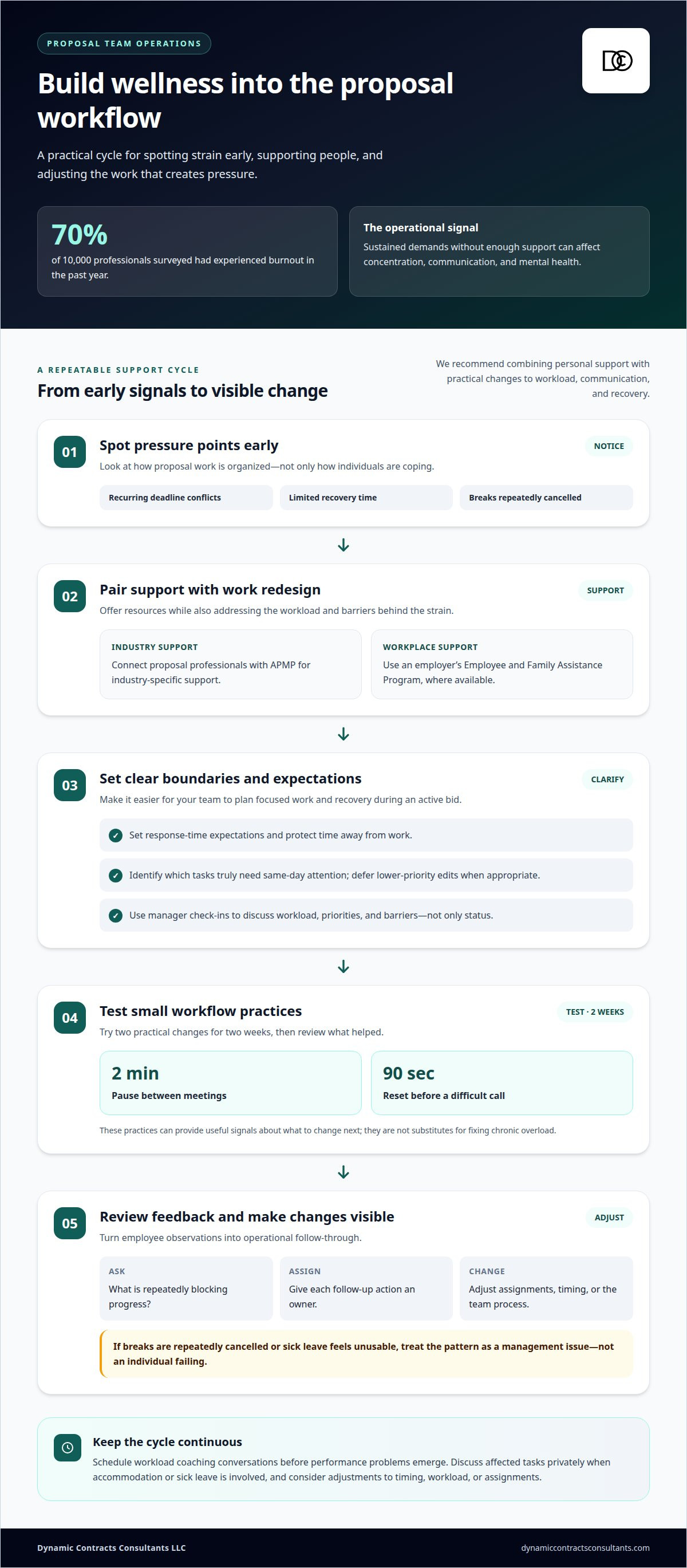
We address workplace wellness by examining how you organize proposal work, not only individual stress. One survey of 10,000 professionals found that 70% had experienced burnout in the past year. For teams preparing government submissions, sustained deadlines and limited recovery can affect concentration, communication, and mental health. We recommend identifying pressure points early, then pairing employee support with changes to the work itself.
We encourage proposal professionals to connect with APMP for industry-specific support and use an employer’s Employee and Family Assistance Program for workplace support, where available. We also recommend that managers schedule coaching check-ins about workload, priorities, and barriers rather than waiting for performance problems. A brief weekly conversation, for example, may reveal that one writer is waiting for subject-matter input while another has capacity to help.
We believe a supportive workplace culture depends on clear boundaries and consistent management. You can set response-time expectations, protect time away from work, and avoid treating late-night availability as commitment. During an active bid, you might identify which tasks truly need same-day attention and defer lower-priority edits. Clear expectations help your employees plan focused work and recovery.
We recommend handling accommodation and sick-leave conversations privately and with attention to the employee’s stated needs. Discuss which tasks are affected and consider adjustments to timing, workload, or assignments. Flexible sick-leave practices also let employees take time away when ill instead of working with impaired concentration. This approach helps you reduce avoidable errors and interpersonal strain while keeping essential proposal work moving.
We recommend low-lift changes to make wellness part of your daily workflow. Your team can test two practical changes for two weeks, then review what helped: for example, schedule a two-minute pause between meetings and use a 90-second reset before a difficult call. You can coach employees to notice which practices reduce stress and share observations during a team review. These steps are not substitutes for fixing chronic overload, but they provide specific signals about what should change next.
To reduce proposal team burnout, we recommend combining personal support with operational changes. Track recurring deadline conflicts, make it routine to ask for help, and assign an owner to each follow-up action. If employees say breaks are repeatedly cancelled or sick leave feels unusable, treat those patterns as management issues. A credible wellness approach responds to feedback with visible changes instead of putting responsibility for mental health solely on individuals.
2. Leadership expectations and communication
We help you reduce avoidable rework by defining what your team must deliver and why. In a poll of approximately 350 proposal professionals, 09% identified managing company expectations as the most stressful part of managing a proposal. At kickoff, we recommend clarifying your intended win strategy, proposal quality target, approval authority, and decision deadlines. For example, distinguish mandatory compliance content from enhancements that can be removed if time or resources tighten.
We recommend making uncertainty visible before it becomes a writing emergency. Use a shared risk register to record each issue, its owner, its impact, and the next decision date. A delayed subject-matter expert response, for instance, can threaten a section’s completion and review window. We advise escalating that dependency early, agreeing on an alternate source of input, and revising the plan rather than silently transferring the pressure to writers.
We recommend disciplined communication for your proposal reviews. Tie comments to evaluation criteria, distinguish scoring impact from personal preference, and challenge the strategy rather than the writer. “This evidence does not address the stated requirement” gives your team a usable correction. “Rewrite this” leaves the scope unclear and can trigger unnecessary drafting cycles.
We help you improve alignment by connecting individual assignments to your proposal strategy and explaining changes as they happen. If a bid’s priority shifts, state which deliverables remain essential, which deadlines move, and who approves the revised plan. Transparent updates about your organizational direction can also reduce uncertainty. A brief rationale helps your employees see how their work contributes to decisions, rather than receiving major changes as isolated instructions.
We recommend that your regular manager check-ins focus on decisions and obstacles, not just status. Ask what input is missing, which approval is at risk, and what work should be deprioritized if a new request arrives. Set a few weekly outcomes, then revisit them when urgent demands compete. This gives your team a practical way to protect capacity without treating every request as equally important.
We believe communication is most effective when it creates a record your whole team can use. Keep decisions, owners, and due dates in a shared workspace, and summarize changes after review meetings. If expectations or approval paths remain unclear across bids, discuss your proposal workflow with our team to identify where clearer planning and coordination could support your workload.
3. Work-life balance and flexible schedules
We plan proposal schedules around focused writing, review cycles, and recovery after submission. An APMP member survey about RFP responses found that 19% of proposal professionals reported working nights and weekends. We treat overtime as a workload signal, not as a routine scheduling method. Together, we can map critical deadlines against your available writing and review capacity, then identify tasks to move or reassign before late work becomes the default.
After a major submission, we recommend reducing core contributors’ workload before assigning the next bid. A recovery day or lighter assignment gives your employees room to reset and can help prevent consecutive high-intensity cycles. For example, your proposal manager might schedule administrative closeout first and delay a complex writing assignment until contributors have regained capacity. We find planned recovery more useful than expecting employees to compensate for intense periods with personal time.
We can help you use flexible schedules to give employees more control over when they do work that requires concentration. Remote work may also reduce interruptions during tasks such as drafting a compliance matrix or reviewing source documents. We recommend setting shared availability windows for decisions while leaving room for focused writing at other times. Clear handoffs are essential: owners, deadlines, and urgent escalation paths should remain visible to your whole team.
We use automation to reduce repetitive administrative work when it supports a well-defined process. Together, we can identify recurring tasks, such as reformatting standard content or locating approved source material, and assess whether a controlled workflow can handle them. Human review remains important for accuracy, relevance, and alignment with solicitation requirements. This directs your team’s skilled attention toward analysis and tailored writing instead of repeated manual work.
We help reduce friction by examining how information moves between contributors. If your writers repeatedly chase the same sources, we can help create a central repository with clear ownership and review dates. If meetings interrupt drafting, we recommend reserving a meeting-free block each week and using concise written updates for routine status. These changes help your team manage competing demands without lowering standards or leaving essential decisions undocumented.
We know boundaries depend on consistent behavior from managers and team members. Leaders can send messages during working hours or schedule them for later, rather than implying employees must respond at night. Before accepting a new request, we assess its deadline, required expertise, and effect on current commitments. Flexible schedules work best when we set realistic workload limits, document handoffs, and plan recovery time between demanding submissions.
4. Employee feedback and workload improvement
We use employee feedback to turn workload pressure into operational information our managers can act on. We ask proposal team members where work stalls, which assignments routinely expand, and what causes avoidable rework. We use short check-ins during active bids and a retrospective after submission. We record each issue, its effect, and a specific action owner, such as securing earlier subject-matter input or clarifying who approves final content.
We can improve our staffing and capacity planning by mapping each bid’s work against available skills, deadlines, and existing commitments. We identify critical roles, review competing submissions, and reserve capacity for reviews, compliance checks, and unexpected changes. If a qualified employee is already assigned elsewhere, we adjust the schedule or scope instead of assuming extra hours will close the gap.
We recognize that no single staffing ratio fits every proposal team. Capacity depends on the solicitation’s complexity, response requirements, available source content, review needs, and employees’ experience. We track effort by phase and role across completed bids, then use those records to improve future estimates without treating one proposal’s workload as a universal benchmark.
We treat last-minute RFPs and unrealistic deadlines as a call for an explicit decision, not silent overtime. We assess the submission window, mandatory requirements, available contributors, and approval time, then determine what we can complete to the required standard. We escalate trade-offs promptly, set a decision point, and apply clear bid/no-bid criteria when the workload cannot support a credible response.
We monitor schedule patterns that can conceal high-pressure conditions, including deadlines, overdue inputs, review cycles, after-hours work, and assignments concentrated on the same employees. A simple workload board can show you owners, dependencies, and due dates. If critical reviews repeatedly get squeezed into the final stage, we move milestones earlier and set subject-matter input deadlines before writers’ completion dates.
We see emotional exhaustion as both an employee concern and a delivery risk. A proposal team under sustained pressure may have less capacity for careful writing, coordination, and quality review. Missed details can weaken compliance and clarity, while persistent overload can contribute to disengagement or turnover. We treat these as risks to manage, not inevitable outcomes.
We close the feedback loop. After a bid, we tell employees which workload concerns led to changes, which remain unresolved, and who owns the next step. If rotating assignments shows that one specialist handles every difficult section, we cross-train another team member and revise future allocations. This practical response makes feedback useful for staffing, workload improvement, and reliable proposal execution.
5. Recognition for proposal team contributions
We can help you keep a demanding proposal cycle from making effort feel invisible through meaningful recognition. Gallup research links burnout with workload mismanagement, unclear expectations, and feeling undervalued. Acknowledgment will not fix an overloaded schedule, but it can show your employees that leaders see the work behind a submission. We recommend connecting recognition to specific actions instead of offering generic praise after every deadline.
Make recognition specific and timely. During a proposal retrospective, we encourage you to identify the analyst who clarified a complex requirement, the subject-matter expert who supplied useful evidence, or the editor who caught a material inconsistency. Explain how the contribution helped meet an evaluation need or improve the response. Specific feedback clarifies which behaviors matter and gives you a better basis for future assignments.
Recognize the less visible work that supports proposal quality, too. A coordinator who maintains version control, a reviewer who resolves conflicting comments, or a writer who reorganizes content for clarity can make a significant contribution. We recommend recording these examples in project closeout notes, then sharing appropriate feedback with the employee and their supervisor. This helps you ensure contributions are acknowledged across roles and bid stages.
Choose a format that suits the person and the contribution. Some employees value acknowledgment in a team meeting; others prefer a direct message describing their work. Ask about that preference during routine check-ins, then apply it when recognizing a difficult deliverable or helpful collaboration. Avoid praising constant overtime. Thanking someone for late-night work without addressing its cause can reinforce the pressure your team needs to reduce.
Recognition is more credible when it connects to development and fair opportunity. SHRM reports that employees cited limited growth and advancement opportunities among the top five workplace stressors. You can recognize strong compliance analysis and offer a suitable opportunity to develop that skill on a future assignment. The opportunity should fit the employee’s workload and interests, not add responsibility without support.
Use a simple recognition practice after each submission: document meaningful contributions, deliver specific feedback, and identify follow-through. If a team member repeatedly rescues an unclear process, thank them while also correcting the process so their productivity does not depend on recurring extra effort. We find recognition works best alongside sound workload decisions. To strengthen your proposal process with expert support, connect with our team.
Dynamic Contracts Consultants LLC
We help organizations align proposal and compliance work with their priorities across the procurement lifecycle. Our Proposal Writing, Grant Writing, DCAA Compliance Consulting, and Capture Management services can support capacity needs and operational efficiency. Where appropriate, AI-assisted tools can support proposal development while your team retains oversight of priorities, reviews, and decisions.
Engage us when proposal responsibilities compete with other critical work or your pursuit needs focused expertise. We can work with you to define the support that fits your organizational needs and next steps. Contact Dynamic Contracts Consultants LLC to discuss how we can support your workload.
Build a More Sustainable Proposal Operation
We recommend making your next bid a practical test of a more sustainable way of working. Choose one change, assign an owner, and review whether it improves coordination without shifting pressure to another employee. Our consistent approach to reducing proposal team burnout can strengthen how your organization plans and delivers future submissions.
When proposal demands exceed your internal capacity, we can provide external expertise to support your team’s work. Dynamic Contracts Consultants LLC provides Proposal Writing, Grant Writing, and DCAA Compliance Consulting. Our services can address your proposal development and compliance needs while you retain oversight of priorities, decisions, and workload.
We encourage you to consider where your team needs support, then define the work and desired outcomes before the next pursuit begins. A focused discussion with us can clarify whether additional proposal or compliance expertise fits your current priorities. Contact Dynamic Contracts Consultants LLC to discuss your needs with us and identify a practical next step for your team.
With deliberate planning and suitable support, we can help your next proposal cycle move forward with greater clarity and a more sustainable pace.
Frequently Asked Questions
What is burnout?
We define burnout as a pattern of work-related exhaustion and reduced ability to engage effectively with responsibilities. For proposal professionals, it may develop when intense deadlines, changing requirements, and limited recovery persist over time. We recognize that feeling tired after a demanding submission does not, by itself, establish burnout. To respond effectively, we recommend noticing persistent changes in energy or engagement and examining whether job demands align with available support.
What are the common causes of burnout on proposal teams?
We find that burnout can develop when proposal demands remain high while employees have little control over priorities, resources, or schedules. Common pressure points include overlapping bids, delayed technical input, repeated scope changes, unclear approvals, and review comments that arrive too late for thoughtful revision. We recommend identifying specific causes by examining where work accumulates across recent submissions, rather than assuming everyone experiences the same strain.
What are the signs of burnout among proposal professionals?
Possible signs include persistent exhaustion, reduced concentration, withdrawal from collaboration, irritability, or difficulty recovering between submissions. You might notice a previously engaged writer becoming unusually quiet during reviews or making more avoidable errors. We view these observations as prompts for a supportive conversation, not a diagnosis. Discuss changes privately, ask what work conditions may be contributing, and consider professional health support if the employee requests it.
How can proposal teams balance workloads and prevent chronic overtime?
We recommend reviewing capacity before accepting new work, not after deadlines start slipping. Map each bid’s major deliverables to named owners, dependencies, and approval stages, then identify conflicts with existing assignments. If a new request displaces planned work, decide what changes and communicate that decision to your team. After submission, review where overtime occurred and use those records to adjust future estimates, handoffs, or staffing plans.
What proposal processes and tools reduce repetitive work and deadline pressure?
We recommend standardized intake forms, reusable content libraries, version-control practices, and clear review workflows to reduce repeated administrative work. A controlled library of approved capability statements, for example, helps your writers find existing material instead of rebuilding it for each response. Assign owners to maintain source content and flag outdated material. Automation may assist with repetitive formatting or document organization, while qualified reviewers remain responsible for accuracy and proposal-specific relevance.
How can leaders support proposal team well-being and psychological safety?
We support psychological safety by responding constructively when employees raise workload risks, disclose errors, or ask for help. You can thank a team member for identifying a missing dependency, then resolve the issue without assigning personal blame. Make escalation routes clear, protect private conversations, and explain decisions that affect workload. Consistent follow-through matters: employees are less likely to raise concerns if earlier feedback produced no visible response.
How can organizations measure proposal team burnout and track improvement?
We recommend monitoring trends through confidential employee feedback and operational indicators, such as after-hours work, delayed handoffs, repeated deadline changes, and turnover. Interpret these signals together, since no single measure establishes burnout or its cause. Compare patterns across bid phases and teams, protect individual privacy, and record which process changes follow feedback. Reviewing the same indicators over time can show whether your workload conditions are improving or need further attention.


