

We can make the case for leadership to fund capture planning by clarifying where to invest before an RFP is released, without promising a win. To explain why your leadership should invest in capture planning, we tie the work to a specific opportunity: its strategic fit, your capabilities, competitive position, resource needs, and the risks of proceeding. For large government opportunities, we recommend that teams begin planning twelve to twenty-four months before the anticipated RFP release.
We recognize that leaders expect a practical rationale for pre-RFP work. Our disciplined capture plans turn early customer and competitor intelligence into a pursuit strategy and give leadership milestones for deciding whether the opportunity should advance. This evidence-based approach helps us explain why leadership should invest in capture planning without relying on generic claims or promises of success.
In this article, we explain how we qualify opportunities and shape strategy before solicitation, present a plan as a leadership decision document, and align operations, pricing, contracts, and proposal teams. We also show how we tailor the effort to your opportunity, so the investment case reflects the pursuit’s actual needs.
Key Takeaways
- We qualify opportunities against our strategic fit, capabilities, customer priorities, and the resources we need to pursue them.
- We translate customer and competitor intelligence into a focused win strategy with differentiators decision makers value.
- We engage operations, pricing, contracts, and proposal teams early so our approach reflects delivery and pricing considerations.
- We use a living capture plan and leadership gate reviews to evaluate pursuit risks and make informed bid/no-bid decisions.
- We match competitive analysis and capture support to your opportunity, then involve Dynamic Contracts Consultants when specialized capture or proposal expertise can help.
Qualifying opportunities and developing a win strategy
We connect opportunity qualification to your strategy, available capabilities, and likely customer priorities. This gives leadership a reasoned basis for committing resources before proposal development begins. To explain how to convince leadership to invest in capture planning, we show how these factors shape a specific pursuit.
Strategic Capture Planning
Strategic capture planning is a structured way to assess an opportunity’s fit, risks, and path to a competitive position. Early qualification gives our team time to address capability gaps and shape an offer around customer needs. For large government opportunities, we recommend beginning twelve to twenty-four months before the anticipated RFP release. Smaller or simpler pursuits may need only a streamlined plan.
Company size alone should not dictate our approach. A straightforward opportunity may call for a focused plan, while a complex pursuit may require broader analysis and clear ownership. In either case, we assess strategic fit, relevant past performance, available capabilities, likely return on investment, and probability of win before committing substantial resources.
Influence Strategies and Action Items
We turn customer and competitive intelligence into specific actions that clarify why your proposed solution matters. We keep engagement and communications aligned with decision makers’ priorities. We start by identifying customer needs and known project issues, then connect each need to evidence of a capability or benefit your organization can deliver.
We give each action an owner, a purpose, and a planned outcome. For example, a customer engagement could test whether your technical approach addresses a stated operational need. A gap analysis may also show where a strategic teammate could strengthen the solution. These steps make our influence deliberate and keep the win strategy grounded in supportable differentiators.
Risks and Performance Measures
Without capture planning, our team may commit proposal resources before testing opportunity fit, customer priorities, or competitive position. We may also lose time to develop a solution, address capability gaps, or end a weak pursuit early. A structured review makes these risks visible while leadership can still adjust the investment or stop advancing the opportunity.
We measure performance across the pursuit, not by the final award alone. We track capture investment, probability-of-win status, team commitments, solution development, proposal progress, pricing, and outcomes. Scheduled gate reviews help leadership assess whether assumptions remain credible and whether our strategy is being executed.
We compare an opportunity’s requirements with your organizational strengths, past performance, delivery capacity, and expected return. If your team lacks a required capability, we assess whether a teammate can fill the gap. If customer needs remain unclear, we use that uncertainty to define the next capture action. This makes bid/no-bid decisions evidence-based rather than automatic responses to an RFP.
We differentiate your offer through benefits decision makers value, not claims that merely sound distinctive. Our competitive analysis identifies project needs and shows where your proposed approach can address them effectively. A focused win strategy typically emphasizes two or three genuine differentiators, supported by evidence and translated into clear actions. To explain how to convince leadership to invest in capture planning, we connect those differentiators to the opportunity’s requirements and the decisions leadership must make.
What is capture management?
We define capture management as the disciplined work of positioning your team for a specific opportunity before the RFP is released. We connect business development qualification with the proposal response, turning customer and competitive intelligence into a practical pursuit strategy.
Customer and Stakeholder Engagement
We approach customer and stakeholder engagement as the planned effort to understand needs and validate an approach before solicitation. It matters because direct, appropriate engagement can reveal which operational problems your proposed solution must address. Our capture team can document customer priorities, identify decision makers, and assign responsibility for gathering and validating information.
For example, if we pursue an IT services opportunity, we could use an authorized customer discussion to clarify workflow challenges, then record how those insights affect our technical approach. Our operations and program leadership can assess whether our proposed delivery model responds to those needs. We use engagement to inform decisions, not rely on assumptions about what the customer values.
Customer and Competitor Intelligence
We define customer and competitor intelligence as verified information about priorities, likely requirements, and the competitive field. It helps us distinguish evidence from assumptions before shaping our offer. Our capture teams can compare information from customer interactions, procurement materials, and internal subject-matter experts, then record where sources align or conflict.
We monitor draft RFPs, statements of work, Industry Day guidance, and reading-room information to reveal changes in requirements. A new competitor or a scope shift may also require us to revise our assessment. This living intelligence helps us adapt our position instead of carrying outdated assumptions into proposal development.
Win Themes and Customer Value
We develop win themes that connect a customer pain point to a specific benefit our proposed solution can deliver. Decision makers need a clear reason to prefer our approach, supported by technical evidence and relevant past performance. We test each theme against a practical question: which need does it address, and what proof supports the claim?
For example, if a customer prioritizes continuity during a service transition, we could emphasize a transition approach backed by our relevant experience. We test whether the benefit is distinct, credible, and meaningful to the customer. Our focused set of themes then guides solution development and keeps later proposal content consistent.
We also organize the handoff: when the RFP arrives, we provide the proposal team with customer insight, competitive positioning, and a shaped solution rather than leaving them to start from a blank page. If your team needs structured support connecting these activities, you can discuss Capture Management with Dynamic Contracts Consultants LLC.
Engaging operations, pricing, contracts, and proposal teams
We improve capture decisions when delivery, pricing, contracts, and proposal perspectives inform one shared assessment. We assign clear roles before the RFP to help preserve that knowledge throughout the pursuit.
Capture and Proposal Management
We use capture management to shape the pursuit before the RFP, while proposal management develops the response after release. Each phase requires different decisions and expertise. During capture, we have operations evaluate delivery feasibility, pricing assess cost assumptions, and contracts identify relevant considerations. Our proposal manager then coordinates the response against the solicitation’s requirements and deadlines.
We bring these stakeholders into scheduled reviews rather than waiting for proposal kickoff. For example, our operations team can identify staffing constraints while our capture team refines its solution. Our pricing team can test whether the proposed approach is supportable, and our contracts team can flag issues for closer attention. These assessments make our pursuit strategy more actionable.
Capture Plans and Proposal Outlines
We create a capture plan as a strategic decision document before the RFP, and use a proposal outline to organize content and compliance after release. They serve different purposes: our capture plan records opportunity intelligence, customer priorities, competitive positioning, and planned actions, while our proposal outline maps solicitation instructions to response sections and contributors.
At handoff, our capture manager transfers current intelligence, solution decisions, and open issues to our proposal manager. We can then use the RFP’s actual requirements to build our outline while retaining the rationale behind our pursuit strategy. This keeps response structure from displacing the customer and competitive knowledge we developed earlier.
Consultative Pre-Proposal Activities
We bring internal expertise together through consultative pre-proposal work to test assumptions and refine the solution before an RFP arrives. We align customer insight with delivery, pricing, and contract considerations. Our capture team can convene operations, pricing, contracts, and proposal personnel to review known needs, assess capability gaps, and identify evidence supporting our proposed approach.
We use customer engagement to inform this work where appropriate and permitted. For example, information from an Industry Day or a published draft statement of work can prompt our operations team to assess a transition approach. We record the source, implication, owner, and next action so our team can review and incorporate new information consistently.
We assign an accountable lead to each workstream and record decisions in our capture plan. Our operations team owns delivery feasibility, our pricing team documents its assumptions, our contracts team tracks relevant issues, and our proposal personnel identify reusable evidence. Clear responsibilities help us prevent contradictory assumptions from reaching our final response.
We cover the current solution, customer priorities, competitive assessment, team commitments, and unresolved questions in the handoff. We use a brief transition review to let our proposal manager confirm ownership of each item and connect it to the response plan. As the RFP introduces formal requirements, we can update our assessment without losing the context behind our earlier decisions.
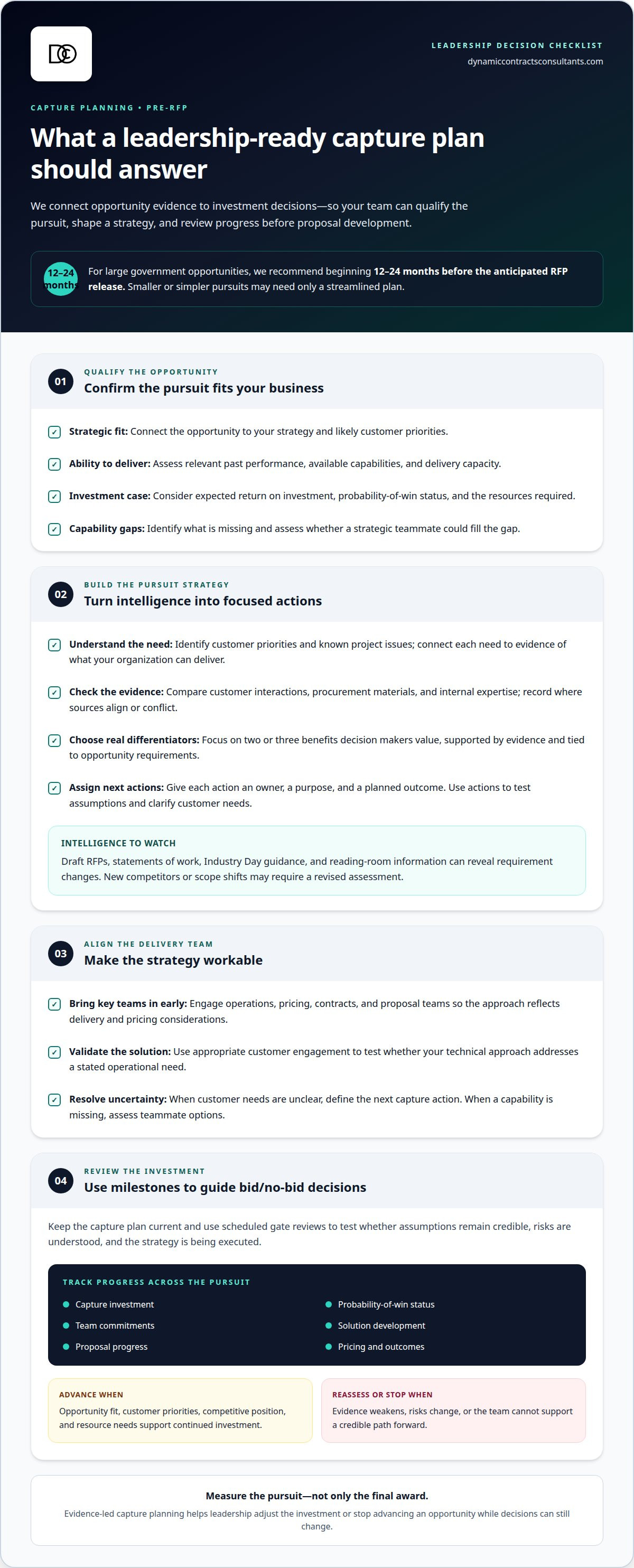
Using a capture plan as a leadership decision document
We use a capture plan to give your leadership team a defined basis for assessing an opportunity and its pursuit risks. At gate reviews, we help leaders decide whether to advance, revise the approach, or stop.
Opportunity Qualification Decisions
We qualify opportunities by assessing strategic fit, capability, past performance, likely return, and probability of win. We document bid/no-bid decisions to help prevent proposal work from advancing before key assumptions are tested.
We use capture planning to help reduce bid costs and wasted proposal effort by identifying weak pursuits before leadership commits substantial response resources. At each gate review, we compare current evidence with the original assumptions. If the opportunity no longer fits, we can stop or redirect our work.
Decision Makers and Their Priorities
We identify decision makers by documenting who influences the opportunity and which priorities shape their evaluation. This matters because we tailor your pursuit strategy to address the customer’s needs, not simply describe your capabilities.
We record project details, known decision makers, their priorities, and the project’s issues, wants, and needs. For example, if a stakeholder prioritizes continuity, we assess whether your proposed approach addresses that concern and identify supporting evidence. We distinguish documented intelligence from assumptions in the capture plan.
Leadership Buy-In
We define leadership buy-in as agreement among executives and key stakeholders on the pursuit strategy, resource commitment, and material risks. We make a go/no-go decision actionable by ensuring the leaders responsible for resourcing and delivery understand the same plan.
We recognize that executives may object that capture planning uses resources before an award is certain. We address that concern with opportunity-specific evidence, defined review points, and explicit stop criteria. Our plan shows what the team will learn, which decisions follow, and how leadership can reassess the pursuit as new information emerges.
Building the Business Case
We build a business case by connecting the capture effort to a qualified opportunity, a resourced plan, and measurable decision points. This gives your leadership team a practical basis for judging whether the investment supports a credible pursuit rather than an open-ended commitment.
We document the opportunity’s strategic fit and capability requirements, then assess customer priorities, competitive position, resource needs, major risks, and planned actions. We define measures such as capture investment, probability-of-win status, team commitments, solution development, proposal progress, pricing, and outcomes. At each scheduled gate, we review progress against the plan with leadership and support an informed go/no-go decision.
Competitive analysis
We use competitive analysis to turn market intelligence into decisions about positioning, solution design, and pursuit priorities. It helps us identify where your technical strengths address customer needs more effectively than competing approaches. We use the analysis to guide influence activities, not to compile unsupported claims about competitors.
We start with the customer’s stated requirements and the issues behind them. We review procurement materials, such as a draft RFP or statement of work, for technical priorities and evaluation signals. We compare those needs with your capabilities, relevant past performance, and available competitive intelligence. We record the source and implication of each finding for the pursuit.
We distinguish verified intelligence from assumptions. A competitor’s past performance on similar work may indicate relevant experience, for example, but it does not prove what that competitor plans to propose. We document what is known, what remains uncertain, and which action could address the gap. This keeps unsupported assumptions from shaping your positioning or customer discussions.
We focus competitive analysis on decision-maker priorities, not simply competitor weaknesses. If a requirement emphasizes integration, we assess whether your technical approach offers a clear, supportable benefit. If the customer is concerned about transition risk, we connect your proposed method to relevant delivery evidence. Each influence message we develop should address a documented need and explain your approach’s value in terms the customer recognizes.
We update competitive intelligence as the pursuit changes. A new competitor, customer meeting, scope revision, or agency budget shift can alter the assessment. We log each development, revise the analysis, and assign a follow-up action. If a technical requirement changes, for example, we identify whether your solution needs a new review and who should lead it.
We keep the comparison focused on decision criteria. A working matrix can connect each customer priority to your evidence, competitive positioning, and next influence action. This makes gaps visible to your leadership and helps your team avoid generic claims. For a government pursuit, we base influence on appropriate engagement and reliable procurement information, while keeping technical assertions evidence-based. Discuss your capture strategy with our team to align competitive analysis with your opportunity decisions.
Dynamic Contracts Consultants: Capture Management
We can support your pursuit when opportunity analysis, capture execution, or proposal development requires focused expertise. Our Capture Management helps organize work between opportunity qualification and proposal kickoff, connecting customer insight, competitive positioning, and a defined pursuit strategy.
Consider our Capture Management when your team needs structured support evaluating an opportunity, developing its win approach, or coordinating pre-RFP activities. We bring relevant intelligence and planned actions into a pursuit framework, giving your internal leaders a clearer basis for resource and go/no-go decisions. Our work is most useful when you have a specific opportunity to assess and a team ready to engage.
When the solicitation is released, our Proposal Writing can help your team develop a response aligned with the requirements and the strategy established during capture. We translate technical and organizational knowledge into clear, compliant content. Your subject-matter expertise remains essential: accurate information about capabilities, past performance, and delivery is necessary for a credible response.
Our Grant Writing may be appropriate when your organization is preparing a grant application and needs support presenting its project, rationale, and intended outcomes. Grant applications differ from government contract pursuits, so we align our work with the specific opportunity and its requirements.
Our DCAA Compliance Consulting may be relevant when your organization needs help with compliance processes related to government contracting. We provide compliance support rather than legal advocacy; our consulting is distinct from legal representation. Each of our offerings addresses different needs and should be selected according to the work your organization is undertaking.
Before engaging our support, define the opportunity or deliverable, the internal stakeholders involved, the information available, and the decisions to be made. For capture work, this could include the opportunity assessment, current win strategy, known capability gaps, and next leadership review. For proposal or grant writing, identify the solicitation or application requirements and the internal experts who can provide accurate source material.
We can help you determine how our Capture Management, Proposal Writing, Grant Writing, or DCAA Compliance Consulting fits your current work. To discuss your needs, contact us.
Turn Your Capture Strategy Into the Next Decision
Put the case for capture planning in terms leadership can act on: connect the pursuit’s strategic value to the decisions, resources, and evidence needed to move forward. If you are considering how to convince leadership to invest in capture planning, frame the discussion around a defined opportunity and show how disciplined planning supports informed choices throughout the pursuit.
We support this work through Capture Management and, when your needs extend beyond capture, Proposal Writing, Grant Writing, or DCAA Compliance Consulting. We tailor our support to the work your organization is preparing to undertake and the expertise needed to carry it forward.
Bring your opportunity, current priorities, and key questions into a focused discussion. Contact us to discuss your next step and move forward with a clearer plan.
Frequently Asked Questions
What is capture planning and how does it improve win rates?
We organize the decisions and preparation that position your team for a specific opportunity before proposal submission. Our approach supports better pursuit decisions by aligning the solution, evidence, and customer priorities before drafting begins. For example, when your team pursues a service renewal, we can examine customer feedback and delivery lessons, then shape an offer around identified concerns rather than relying only on the prior contract’s performance.
What is the ROI of investing in capture planning?
We assess ROI based on how capture investment relates to pursuit outcomes and committed resources. Our practical assessment compares capture and proposal effort with wins, losses, and opportunities stopped before substantial response work. We include reusable intelligence and proposal content as additional value, while accounting for our internal team time. We review results across a consistent set of pursuits rather than drawing conclusions from one award decision.
What data and benchmarks demonstrate the value of capture planning?
We use capture investment, opportunity qualification decisions, proposal effort, probability-of-win assessments, team commitments, and contract outcomes as useful evidence. We compare these measures across similar opportunities and review them over time to identify patterns, such as whether early no-bid decisions redirect proposal capacity. We keep definitions consistent: we record when an opportunity enters tracking and what qualifies as a win. This creates an internal benchmark grounded in your organization’s pursuit history.
How can capture planning be integrated with sales, business development, and proposal teams?
We integrate capture planning through shared opportunity records, clear ownership, and scheduled handoffs. Our sales and business development teams can document customer interactions and qualification context; our capture leads can maintain the pursuit strategy; and our proposal teams can turn that intelligence into a response structure after solicitation release. A shared record can retain the source and date of customer feedback, helping our proposal contributors distinguish current evidence from assumptions and outdated notes.


