

Eligibility shapes competition before an offer is evaluated. This guide explains how HUBZone status affects set-aside opportunities, what to consider when preparing an offer, and which requirements continue after award.
Employee residency is one part of HUBZone eligibility, alongside certification status and offer timing. Understanding how these factors connect can help you assess an opportunity and your organization’s readiness against its requirements.
In this guide, we examine set-aside contracts, performance obligations, joint ventures, and the role of additional socioeconomic certifications. We also outline how Dynamic Contracts Consultants LLC can support proposal development and post-award administration when those needs align with your contracting goals.
Key Takeaways
- Understand how HUBZone certification and offer timing affect eligibility for a set-aside opportunity.
- Plan for employee residency compliance during contract performance, not only when submitting an offer.
- Assess whether a joint venture’s structure and work-share arrangement meet HUBZone requirements.
- Distinguish HUBZone eligibility from other socioeconomic certifications, which can affect who may compete and which preferences apply.
- Consider how post-award administration and compliance support can help manage contract obligations after an award.
What Are Set Aside Contracts?
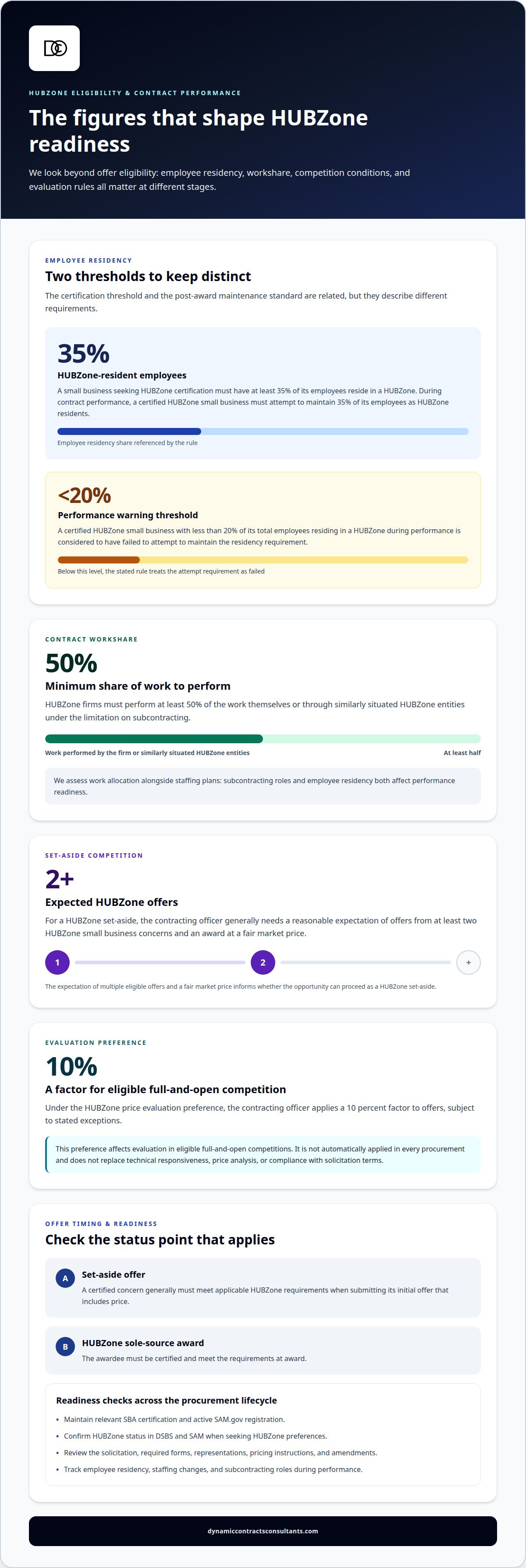
We define a federal set-aside as a procurement reserved for eligible small businesses rather than opened to every vendor. A HUBZone set-aside narrows competition to businesses with current HUBZone small business status. Under the Federal Acquisition Regulation, the contracting officer generally needs a reasonable expectation of offers from at least two HUBZone small business concerns and an award at a fair market price.
We assess HUBZone eligibility by looking beyond whether a business operates in a historically underutilized area. A small business seeking HUBZone certification must have at least 35% of its employees reside in a HUBZone, according to the Electronic Code of Federal Regulations. The SBA determines whether a concern has HUBZone small business status in accordance with 13 CFR Part 126, according to the Electronic Code of Federal Regulations. For businesses bidding on HUBZone set-aside contracts, certification status is central to eligibility.
We also account for offer timing. Under § 126.200, a certified concern generally must meet applicable HUBZone requirements when submitting its initial offer that includes price. A HUBZone sole-source awardee must be certified and meet the requirements at award. HUBZone preferences are available only to firms SBA designates as HUBZone small business concerns in both DSBS and SAM. This makes offer timing important when bidding on HUBZone set-aside contracts.
To certify and maintain status, a business applies for SBA HUBZone certification and continues meeting the program’s eligibility requirements. We note that federal set-aside bidders also need active SAM.gov registration and the relevant SBA certification. A HUBZone contract may carry performance obligations: HUBZone firms must perform at least 50% of the work themselves or through similarly situated HUBZone entities under the limitation on subcontracting, according to the Electronic Code of Federal Regulations.
Follow the solicitation’s instructions for required forms, representations, technical responses, and pricing. The solicitation specifies which documents and representations you must submit. On SAM.gov, search contract opportunities using HUBZone set-aside terms and relevant industry or solicitation details, then review the notice and all amendments.
We advise submitting through the method and by the deadline stated in the solicitation, with every requested attachment and representation. Common grounds for rejection or a nonresponsive finding include late submission, missing required documents, failure to follow submission instructions, or ineligible certification status. For full-and-open competition using the HUBZone price evaluation preference, the contracting officer applies a 10 percent factor to offers, subject to stated exceptions, according to the Federal Acquisition Regulation.
HUBZone employee residency requirements during performance
After award, we treat HUBZone eligibility as an ongoing performance concern, not merely an offer-stage representation. A certified HUBZone small business awarded a HUBZone contract must attempt to maintain 35% of its employees as HUBZone residents during contract performance, according to the Electronic Code of Federal Regulations. We distinguish this attempt requirement from an absolute guarantee about workforce composition.
We consider workforce oversight essential to maintaining a documented compliance effort. A certified HUBZone small business with less than 20% of its total employees residing in a HUBZone during contract performance is considered to have failed to attempt to maintain the residency requirement. Hiring, employee relocation, and other workforce changes can affect compliance during the contract period. We recommend tracking residency alongside staffing changes and contract milestones.
We also account for how residency compliance intersects with contract execution. HUBZone firms must perform at least 50% of the work themselves or through similarly situated HUBZone entities under the limitation on subcontracting, according to the Electronic Code of Federal Regulations. A staffing plan should address both who performs the work and whether the firm can sustain its residency effort. The solicitation’s NAICS code defines the procurement’s scope, while contract requirements shape staffing decisions.
We assess competition requirements when considering whether an opportunity can be reserved for HUBZone firms. Under FAR 19.1305, a contracting officer must have a reasonable expectation of offers from at least two HUBZone small business concerns and expect an award at a fair market price, according to the Federal Acquisition Regulation. If market research does not support those conditions, the officer may not proceed with that HUBZone set-aside as planned. A strong proposal must address the requirement and support a credible price.
We distinguish the HUBZone price evaluation preference from a set-aside. Under FAR 19.1307, a contracting officer applies a 10 percent factor to offers when giving the preference, subject to stated exceptions, according to the Federal Acquisition Regulation. It applies in eligible full-and-open competitions, not automatically in every procurement. The preference affects evaluation; it does not replace technical responsiveness, price analysis, or compliance with solicitation terms.
After award, we recommend documenting workforce decisions and subcontracting roles as part of contract administration. If residency falls below 20%, the stated rule treats that level as a failure to attempt maintenance, making prompt review especially important. A structured post-award compliance process can help organize these obligations. For support aligning your contract controls with performance requirements, contact Dynamic Contracts Consultants LLC.
Can a business hold multiple set-aside certifications?
We help you assess whether your federal small business independently meets the eligibility rules for more than one socioeconomic certification. HUBZone status does not replace the requirements for programs such as 8(a), WOSB, or SDVOSB. Each certification creates a separate path to eligible opportunities, while the solicitation determines which businesses may compete. We help you assess your firm’s size against the applicable SBA standard for the relevant NAICS code.
Agencies use market research to decide whether a small-business set-aside is appropriate. For acquisitions above the Simplified Acquisition Threshold, the contracting officer considers whether at least two small businesses can perform at a reasonable price. The agency also considers eligible socioeconomic programs before using a general small-business set-aside. We help you check the solicitation’s NAICS code and determine whether your business qualifies as small for that procurement under its size standard.
Certification does not remove the need to match your capabilities to the contract. We help you assess whether your company, certified in HUBZone and another program, may compete when the solicitation permits its status. But if a set-aside is restricted to one socioeconomic category, only firms certified under that designation are eligible. We help you review the NAICS code, performance requirements, and set-aside category together to determine whether the opportunity fits your size and certification profile.
A HUBZone small business may also use a joint venture to pursue work with another small business or an SBA-approved mentor. According to the Electronic Code of Federal Regulations, the certified HUBZone partner must perform at least 40% of the work performed by the joint venture. For a joint venture with a large business, the HUBZone firm must own at least 51% of the unpopulated joint venture and perform at least 40% of its total work. The venture must also comply with applicable subcontracting limits.
We help you find opportunities by searching SAM.gov contract notices using HUBZone set-aside terms, relevant NAICS codes, and location filters. Agency procurement forecasts can point to planned acquisitions, but solicitation notices provide the current requirements and submission details. We help you compare forecasts with active notices before planning capture activity: a forecast is not a solicitation or an award.
§ 126.609 Can a HUBZone competition be limited or authorize preferences to small business concerns having additional socioeconomic certifications?
Section 126.609 addresses whether a HUBZone competition may be limited or provide preferences for businesses with additional socioeconomic certifications. A HUBZone firm may also qualify under another small-business program, but that additional status does not automatically change every acquisition’s competition rules. The solicitation identifies the applicable set-aside category and the businesses eligible to compete.
This distinction matters when an acquisition is restricted to a specific socioeconomic designation. Only companies certified under that designation may compete for a set-aside reserved for that category. For example, a HUBZone-certified firm would also need the required certification if an acquisition were reserved exclusively for another program. Additional certifications may expand the opportunities a firm can pursue, but they do not override a solicitation’s eligibility limits.
Agencies consider socioeconomic programs during acquisition planning. For acquisitions above the Simplified Acquisition Threshold, contracting officers must first consider set-asides or eligible sole-source awards under 8(a), HUBZone, Veteran Small Business Certification, or WOSB programs before using a general small-business set-aside. The programs have no order of preference among them. Market research and the acquisition’s requirements inform which eligible path fits.
The HUBZone program’s economic purpose is reflected in the federal government’s annual goal: awarding 3% of prime contracts and subcontracts to HUBZone small businesses each year. That goal guides procurement planning; it does not guarantee an award to an individual firm. Agencies still designate opportunities according to acquisition requirements, competition, and applicable eligibility rules.
Not every acquisition is restricted to HUBZone businesses. A solicitation may use full-and-open competition or reserve the procurement for another socioeconomic category. In the latter case, HUBZone status alone does not qualify a business for the restricted award. Read the solicitation’s designation and representations together. For example, a women-owned small business with HUBZone certification must still meet the stated category requirements when an acquisition is reserved for WOSB concerns.
For your pipeline, map each certification to the opportunities it may qualify you to pursue. Then assess the acquisition’s category and requirements before committing proposal resources. Forecasts and market research can show where your certifications may align with agency demand, but the solicitation determines eligibility for a specific procurement. This helps distinguish a useful certification portfolio from the assumption that every designation applies to every federal contract.
Benefits of set-aside contracts
A federal set-aside limits who may compete, creating a defined opportunity for businesses that meet the solicitation’s eligibility rules. For a HUBZone firm, we help connect its geographic and workforce qualifications with procurement opportunities reserved for eligible concerns. You gain access to competitions designed for a specific small-business category, rather than unrestricted competition with every potential vendor.
A narrower eligibility pool can make your business development more targeted. We help HUBZone contractors focus capture efforts on solicitations that match their capabilities, NAICS size standard, and certification status. For example, a firm providing facilities support can assess whether an agency requirement fits its experience and the solicitation’s HUBZone designation before committing proposal resources. The set-aside defines an eligible lane, but your offer still needs to demonstrate capability, compliance, and a credible price.
Other socioeconomic certifications can expand the range of lanes your business may pursue. A firm owned by a service-disabled veteran, for example, may qualify for opportunities under the Veteran Small Business Certification program if it meets that program’s requirements. Women-owned and 8(a) certified businesses also have distinct procurement pathways. We can help you map opportunities to each designation’s requirements; holding multiple certifications does not create automatic eligibility for every set-aside.
HUBZone status may also matter in full-and-open competition, where an applicable price evaluation preference can affect how offers are assessed. That differs from a HUBZone set-aside, which restricts eligible competition. In either case, a preference or designation does not replace the need to meet technical requirements, submit a responsive offer, and perform the contract. We help you align your certification strategy with the agency’s stated acquisition need.
Set-asides can support your longer-term growth by helping your business build federal past performance and strengthen its procurement pipeline. An award may provide experience relevant to future solicitations, while subcontracting can offer another route to federal work. These outcomes depend on delivery and contract execution, not certification alone. We help HUBZone businesses maintain workforce compliance and disciplined contract administration after award.
Use each opportunity as a strategic decision: confirm the set-aside category, assess fit, and weigh proposal effort against your delivery capacity. We can help you evaluate those factors. When an award moves into performance, our disciplined administration helps protect compliance and operational continuity. Discuss post-award contract administration with our team to align execution with your federal contract obligations.
Dynamic Contracts Consultants LLC: Post-Award Contract Administration
We provide Post-Award Contract Administration to support your federal contracting work after award. This is the next phase of the procurement lifecycle, when performance, contract terms, reporting, and compliance must remain aligned. Structured administration can help your team manage obligations and maintain visibility throughout contract execution.
Post-award work can include coordinating contract requirements, reviewing changes, tracking deliverables, and managing flow-down clauses where applicable. These activities connect awarded terms to operational decisions, including subcontractor responsibilities and performance documentation. We help organize administration around your contract’s requirements, giving your team a clearer view of key obligations as work proceeds.
Strategic compliance starts with understanding which requirements apply to your business and contract. We provide DCAA Compliance Consulting for organizations addressing DCAA-related needs. This service can complement contract administration when financial and compliance processes need attention alongside delivery. It does not replace the need to meet your federal contract’s terms and performance responsibilities.
For future opportunities, Proposal Writing helps develop clear submissions that respond to the solicitation. A proposal should connect your capabilities to the agency’s requirements, present a coherent technical approach, and address requested representations and pricing. We support proposal development when your team is preparing for a procurement and needs a structured process aligned with the solicitation.
Grant Writing is a separate service for organizations pursuing grants rather than federal contract awards. Distinguishing these pathways helps direct effort toward the right funding mechanism and submission requirements. Whether managing an awarded contract, preparing a proposal, or developing a grant submission, make sure the work reflects the applicable requirements and your organization’s capacity.
We support different stages of the contracting lifecycle, from proposal development to post-award administration, with DCAA Compliance Consulting for related compliance needs. The right starting point depends on your team’s challenge: contract execution, a new bid, a grant application, or compliance process improvement. A focused discussion can clarify the work involved and how it fits your priorities.
Contact us to discuss your contract administration or proposal needs.
Turn HUBZone Eligibility Into a Deliberate Growth Strategy
Connect contract opportunities with your capacity to pursue and perform them. Treat bidding on HUBZone set-aside contracts as part of a broader procurement strategy: align target opportunities with your qualifications, proposal resources, and operational priorities. This focus can help your team make informed bid decisions and build a sustainable federal contracting pipeline.
Dynamic Contracts Consultants LLC supports this effort through Proposal Writing, Grant Writing, and DCAA Compliance Consulting. The right service depends on your immediate objective, whether you are preparing a submission, pursuing a grant, or addressing compliance needs. Start with your organization’s specific requirements and priorities.
Bring your contracting goals and current challenge into a focused conversation, and identify a practical next step for your business. Contact Dynamic Contracts Consultants LLC to discuss how we can support your federal contracting work. With a clear strategy and disciplined execution, your next opportunity can become a considered step toward long-term growth.
Frequently Asked Questions
§ 126.600 What are HUBZone contracts?
We define a HUBZone contract as a prime contract awarded to a certified HUBZone small business concern or a qualifying HUBZone joint venture, regardless of where performance occurs. Your awardee’s qualifying status, not the project’s physical location, determines whether the contract is a HUBZone contract. For example, your certified concern may perform outside a HUBZone and still receive one. The solicitation identifies procurement requirements, eligible offerors, and applicable performance terms.
What are the eligibility requirements for a HUBZone set-aside contract?
To qualify, your business must be small under the solicitation’s NAICS code and meet SBA HUBZone program requirements. This includes having your principal office in a certified HUBZone and meeting the employee-residency threshold. Your concern must also hold SBA HUBZone certification and appear as certified in the relevant federal systems. According to the Electronic Code of Federal Regulations, the SBA determines HUBZone status under 13 CFR Part 126. You must also register in SAM for federal contracting.
What are the HUBZone set-aside rules for sole-source awards and competitive bids?
We consider a competitive HUBZone set-aside appropriate when the contracting officer reasonably expects offers from at least two HUBZone small business concerns and an award at a fair market price. A sole-source award is a separate option when the officer does not reasonably expect offers from two or more qualified HUBZone concerns. The solicitation, requirement, and applicable award conditions determine which route the agency uses, helping you assess the applicable procurement pathway.
How do HUBZone contracts compare with 8(a), SDVOSB, and WOSB set-asides?
We assess these programs based on their different eligibility criteria. HUBZone status centers on your business’s location and workforce residency; 8(a) eligibility concerns qualifying disadvantaged ownership and control. SDVOSB eligibility requires qualifying service-disabled veteran ownership and control, while WOSB eligibility centers on qualifying women’s ownership and control. Your company may hold multiple certifications, but each set-aside remains limited to firms eligible under its stated category. The solicitation determines which designation governs competition.


