

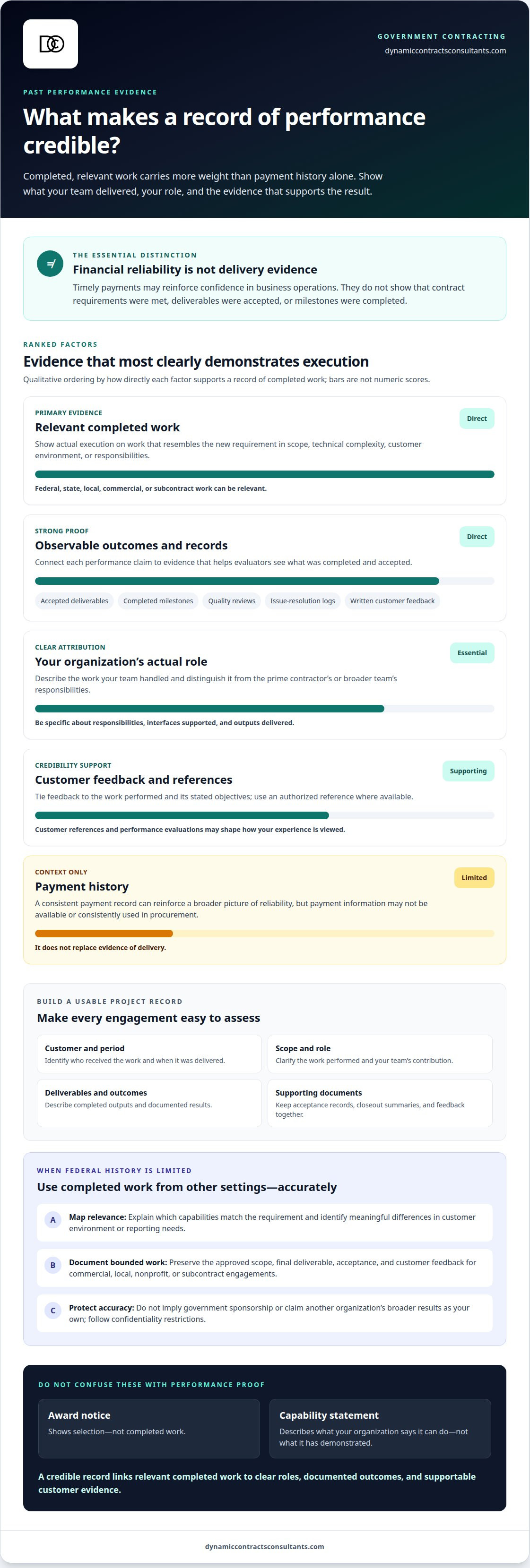
We know strong delivery records carry more weight than payment history alone. We help you build a credible past performance history by documenting completed work and dependable performance. Timely payments can support a broader picture of your reliability, but they do not replace evidence of delivery.
For government contractors, we recognize that distinction matters. A consistent payment record may reinforce confidence in your business operations, while past performance depends on whether prior work is relevant, clearly documented, and supported by credible customer feedback. Because payment information may not be available or consistently used in procurement, its contribution can be limited.
We explain how timely payments can reinforce your credibility, what evidence demonstrates a record of performance, and why payment history alone does not tell the whole story. We also cover practical ways you can present your experience clearly and how proposal writing, capture management, and compliance support can align that evidence with your pursuit strategy.
Key Takeaways
- We help you separate evidence of contract delivery from financial reliability to show a fuller picture of your business.
- We help you use relevant commercial, subcontract, and other completed work to demonstrate capability when federal contract history is limited.
- We help you organize performance records around outcomes, schedule, quality, and customer feedback so your evidence is clear and usable.
- We help you understand how government evaluations and customer references may shape how your past performance is viewed in a proposal.
- We help you align your documented experience with your capture strategy and proposal narrative to present a consistent, credible record.
3. What counts as past performance in government contracting?
In government contracting, we define past performance as evidence of how an organization delivered comparable work. It describes actual execution, not proposed capability or an award announcement. We recommend connecting the customer, scope, delivery period, and documented outcome in each record. For example, if you completed a cybersecurity assessment for a state agency, identify the systems reviewed, your responsibilities, and the deliverables the customer accepted.
Your relevant experience can come from federal, state, local, commercial, or subcontract work. We recommend distinguishing your organization’s role from the project’s overall results. For a cloud migration performed as a subcontractor, describe the work your team handled, the interfaces it supported, and the outputs it delivered. Do not imply that you led the prime contractor’s entire project.
We help connect performance claims to observable records. Examples include accepted deliverables, completed milestones, quality reviews, issue-resolution logs, and written customer feedback. Your project summary might explain that your team delivered a reporting system, resolved documented defects, and transferred operating instructions to the customer. Specific evidence helps evaluators understand your work, rather than rely on broad claims such as “excellent execution.”
Relevance matters because a past project is most informative when its scope resembles the new requirement. We recommend comparing the work performed, technical complexity, customer environment, and responsibilities. For example, if you are pursuing a records-modernization contract, explain how an earlier database migration involved similar data controls and user needs. The project need not be identical, but the connection should be clear and supported with details.
Payment history can reinforce a picture of dependable business operations, but it does not establish whether your contract work met its requirements. On-time invoice payments do not show that a system passed acceptance testing or that a delivery milestone was completed. We recommend keeping financial reliability separate from execution evidence. For each project, record the customer, scope, your role, outcomes, and supporting documents. Building a credible past performance history depends on presenting those elements accurately.
An award notice alone is not a performance record: it shows selection, not completed work. Likewise, a capability statement describes what your organization says it can do. We recommend linking each claim to a finished project, customer reference, or delivery artifact. This distinction gives contracting teams a practical basis for assessing your organization’s experience and prevents proposed capabilities from being mistaken for demonstrated results.
4. How can a new contractor build past performance without federal contract history?
We recommend starting with completed work outside federal procurement. Consider a small software firm that builds a scheduling tool for a regional nonprofit. Its project record can document the client’s need, agreed scope, delivered functions, acceptance, and resulting operational change. We advise you to identify your firm’s actual contribution without implying government sponsorship.
Commercial work becomes more relevant when you map it to a future requirement. If your firm is pursuing facilities support, for example, you could describe a private client’s maintenance program, service workflow, and documented response process. Explain which elements resemble the government requirement, then identify differences such as the customer environment or reporting needs. We find specificity makes the comparison useful without suggesting the projects are identical.
Subcontracting offers another route to documented delivery. Your new cybersecurity firm could support a prime contractor by completing a defined vulnerability assessment. Keep records of the scope you performed, delivery artifacts, acceptance correspondence, and an authorized reference. Clearly distinguish your work from the prime’s broader responsibilities, and follow any confidentiality restrictions that apply to project records.
- Deliver a bounded project. A pilot for a local business can demonstrate a defined output, such as a working inventory dashboard. We recommend preserving the approved scope, final deliverable, and customer feedback.
- Use a teaming role deliberately. For a logistics project, document whether your team handled route analysis, data preparation, or reporting. Describe your contribution rather than presenting the entire team’s outcome as your own.
- Capture customer evidence. After a completed training engagement, request permission to identify the customer and summarize its evaluation. Keep the feedback tied to the delivered work and its stated objectives.
For every completed engagement, we recommend creating a concise project record with the customer, period, scope, team role, deliverables, and outcome. A nonprofit’s signed acceptance email or a commercial client’s approved closeout summary can support the account. Store supporting records together and remove sensitive material that cannot be disclosed. This turns separate engagements into consistent evidence for your future proposals.
Before pursuing an opportunity, compare its requirements with your closest completed project. Note shared capabilities and material gaps, then present the experience accurately in your narrative. For help shaping your acquisition approach, discuss your contracting strategy.
We recommend keeping financial documentation separate from delivery evidence. A credit history does not show that your firm completed a project, met its scope, or earned customer acceptance, so it should not replace project records in a performance narrative. Keep your account focused on documented project evidence that demonstrates what your firm actually delivered.
When comparing a completed engagement with a new requirement, ground your comparison in documented scope, deliverables, customer response, and your firm’s specific role. Separating project evidence from other records keeps your account focused on what you actually delivered.
5. Government Past Performance Records and Storage
We document government past performance through records of how a contractor performed under an awarded contract. These may include an agency evaluation, supporting correspondence, and contract-closeout materials. For example, an evaluation might describe whether a software deliverable met requirements and how the contractor handled defects. We focus on actual performance, not simply a proposal or award notice.
For federal work, the contracting agency maintains official contract documentation through its contract administration processes. Performance evaluations may be recorded in the government’s designated evaluation system and associated with the relevant contract. The record is not necessarily a single document containing every project artifact. A contracting officer’s evaluation, a customer’s acceptance email, and a technical report may remain separate records.
Access and storage depend on the record’s purpose. An agency evaluation used in a later procurement differs from your internal archive of deliverables and customer communications. If your firm completed a database upgrade, for example, retain the accepted implementation plan and completion correspondence. We can help you use those materials to explain the work when preparing a proposal or responding to an evaluation.
We recommend organizing your internal evidence by contract, not just by document type. A practical project folder can contain:
- Contract identifiers: customer, contract number, period of performance, and your role.
- Delivery evidence: approved milestones, accepted reports, and closeout documentation.
- Performance communications: customer feedback, corrective-action exchanges, and resolution records.
For a subcontract, keep records that identify the prime contractor and distinguish your team’s deliverables from the prime’s overall results. Apply the same approach to joint efforts, such as a shared implementation project. We help you keep evidence attributable and reduce the risk of presenting another organization’s work as your own.
If an agency evaluation contains an error, preserve the evaluation, relevant contract documents, and communications addressing the issue. Keep dated copies together so you can trace the facts to the project record. Do not replace an official evaluation with an internal summary. Label your internal notes clearly and retain the original agency document.
During post-award administration, we recommend maintaining an orderly record as work progresses instead of reconstructing it at closeout. For example, file a customer-approved change with the revised schedule and resulting deliverable. This creates a traceable account of scope, decisions, and outcomes, helping your team describe contract evidence accurately in future procurements.
4. How should we document and measure contract performance results
We start with your contract’s statement of work and turn each requirement into a traceable performance measure. If your project requires monthly status reports, we record whether each report was submitted on schedule and accepted. This ties the measure to an agreed obligation rather than a retrospective claim. We keep the requirement, evidence, and result together in the contract file.
We choose indicators that reflect your work. A software implementation may track accepted features, unresolved defects, milestone completion, and user training. A logistics engagement may record completed deliveries, order accuracy, and documented service issues. We use measures relevant to your contract and define how our team records each one. We avoid unsupported claims such as “high quality” without a corresponding acceptance record or customer assessment.
We maintain a consistent evidence trail as work proceeds. For a revised deliverable, we retain your change direction, the updated version, and the acceptance communication. If a milestone moves, we record the cause, decision, revised schedule, and resulting delivery. This sequence helps us distinguish contractor performance from approved scope changes or customer-directed adjustments.
- Schedule: We compare planned milestones with actual completion dates and document approved changes.
- Quality: We record acceptance decisions, defect findings, and corrective actions for each relevant deliverable.
- Customer outcomes: We capture measurable results tied to your scope, such as a completed system handoff or delivered training.
We review results against your contract baseline, not an informal internal target. For example, if you accept a report after requesting revisions, we preserve both your initial feedback and final acceptance. The full record shows our responsiveness as well as the outcome. We separate internal estimates from customer-approved results so our proposal narratives do not present projections as achieved performance.
We use a simple project register to make evidence easy for you to retrieve. We include the contract identifier, requirement, measure, source document, status, and responsible owner. A record stating “milestone completed” is more useful when linked to the approved schedule and accepted deliverable. We apply consistent naming conventions across project folders so our teams can locate comparable evidence during proposal preparation.
At closeout, we reconcile the register against final deliverables, your communications, and unresolved issues. We note outcomes that can be disclosed and protect restricted information. This disciplined approach supports accurate reporting and strengthens the evidence we use to describe contract results. It also makes it easier for us to assess performance trends across projects without overstating what any engagement demonstrates.
5. How do customer references and performance evaluations affect past performance ratings
A performance evaluation gives a customer’s assessment of completed contract work. It can describe delivery, quality, communication, and issue resolution against contract requirements. For example, an agency evaluating a software implementation may discuss whether the contractor delivered required functions and addressed reported defects. That assessment gives future evaluators evidence beyond the contractor’s own proposal narrative.
Customer references provide another perspective on the same work. A reference can explain how the contractor coordinated with users, managed changes, or handled a difficult transition. For a records project, a customer might describe the team’s responsiveness during data migration. A relevant, informed reference helps clarify project context, especially when written records do not explain the work’s effect on the customer.
Evaluations and references support assessment, but they are not interchangeable. An evaluation is a formal or documented customer assessment; a reference is a person’s account of project experience. A procurement team may consider the evidence available under its process and the relevance of the cited work. A positive statement about an unrelated project does not establish performance on a technically different requirement.
- Match the evidence: Connect each reference to a specific completed project and the requirement it demonstrates.
- Prepare the context: Summarize the customer, scope, your role, and the result before presenting a reference.
- Address discrepancies: If a reference describes a schedule issue, explain the documented cause and resolution accurately.
Before naming a reference, get permission and confirm that person’s role in the engagement. For example, a project manager who reviewed deliverables can speak to acceptance and coordination. A contact with limited visibility may not be able to address technical execution. Provide accurate project details so the reference can discuss specific work rather than offer broad praise.
Review each evaluation for factual accuracy and preserve the supporting project records. If an assessment identifies a missed milestone, assemble the schedule, approved changes, relevant communications, and final delivery evidence. A clear, factual response can distinguish a contractor-controlled delay from a customer-approved adjustment. Avoid exaggeration or unsupported counterclaims, which can undermine the credibility of the entire record.
Consistent preparation helps align your references, evaluations, and proposal narrative. Discuss how to strengthen your past performance presentation with our team.
Evaluation practices in other fields also show why the basis for a judgment matters. The 2024 International Codes updated Section 104 on the duties and powers of building officials to support evaluation of alternative materials, designs, and construction methods. Section 104.2.3.7 of the 2024 International Codes allows building officials to require a peer review report when evaluating alternative materials, designs, or construction methods. In that setting, a reviewer’s input can support an evaluation, but the decision remains tied to the requirements being assessed. The same care with evidence and context helps keep a past performance record useful to future evaluators.
The article traces the origins of performance-compliance scoring to insurance rating systems developed in the late 17th century after the Great Fire of London. Fire-safety concerns in existing high-rise office buildings in New York City led to development of a building fire-safety evaluation system in 1973, and similar concerns in Chicago led to development of a building fire-safety evaluation system in 1975. These examples underscore that evaluations depend on the setting and the criteria applied. For contractors, clear records and informed customer references help evaluators understand what the evidence shows about the work at issue.
Dynamic Contracts Consultants LLC
Dynamic Contracts Consultants LLC helps organizations connect documented experience with a clear government contracting strategy. Turn to us when your project records are strong but their relevance to an opportunity is difficult to explain, or when you are preparing to pursue work without federal contract history. The goal is a precise account of your role, evidence, and fit, not an inflated claim.
Our Proposal Writing service can shape experience into a coherent, opportunity-specific narrative. For example, a contractor may have commercial project records, customer feedback, and delivery results but need to explain how they relate to a solicitation’s requirements. We help present that connection clearly while distinguishing your role and documented outcomes from other parties’ contributions.
Capture Management can inform pursuit decisions before proposal development. It supports strategic assessment of opportunities, customer needs, and your organization’s relevant experience. If the evidence does not align closely with an opportunity, that assessment can clarify gaps and identify experience or documentation to develop for future pursuits.
DCAA Compliance Consulting is relevant when contracting readiness involves accounting and compliance considerations alongside performance evidence. Past performance and compliance address different aspects of business readiness, so keep them distinct in your planning. A clear view of both can support more consistent preparation across the procurement lifecycle.
Grant Writing serves a different purpose from government contract proposal development, but it may be relevant if your organization is also pursuing grants. We help align the narrative with the opportunity and your documented capabilities. Across these efforts, start with your current pursuit, the experience you can substantiate, and the gaps you want to address.
Before engaging support, identify the opportunity or growth objective, the project evidence available, and the questions your team needs resolved. This defines the focus, whether you need a stronger proposal narrative, a more deliberate capture strategy, or compliance consulting connected to your contracting plans. We can help turn that assessment into a structured next step.
Contact Dynamic Contracts Consultants LLC to discuss your government contracting goals.
Turn performance evidence into a stronger next move
Building a credible past performance history is an ongoing business discipline, not a one-time proposal task. Treat each completed engagement as an opportunity to strengthen how your organization plans, delivers, and communicates its work. As your pipeline evolves, align the evidence you retain with the capabilities you intend to offer and the customers you aim to serve.
Your next step can be a focused review of your pursuit priorities and the experience available to support them. Identify where your strongest evidence aligns, where your narrative needs greater precision, and which capability gaps deserve attention before the next opportunity. A deliberate approach can connect operational performance with a more persuasive contracting strategy.
Dynamic Contracts Consultants LLC can help you assess that alignment and shape a practical path forward. Discuss your next contracting goal with our team, and move forward with a clear strategy for presenting your organization’s experience.


