

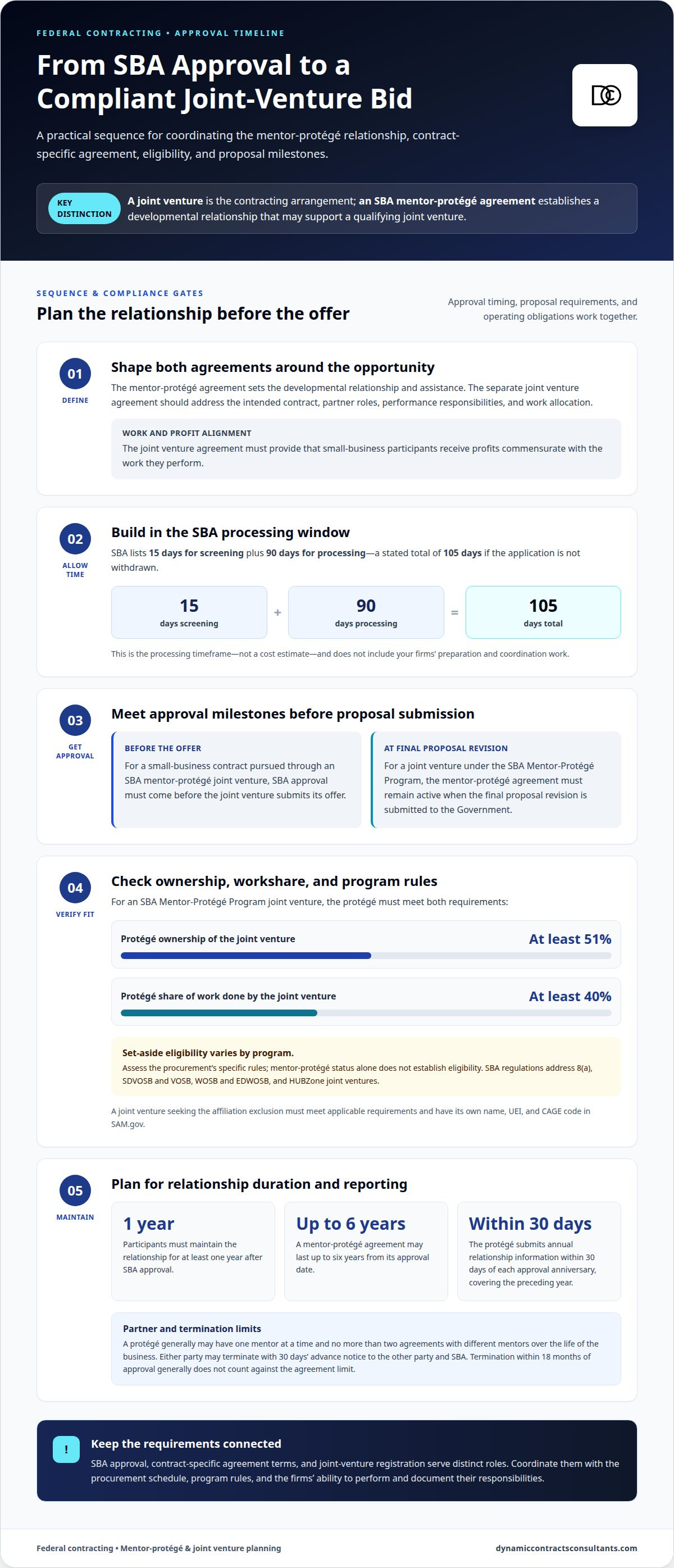
In joint venture vs mentor-protégé for federal contracts, the key distinction is that a joint venture is a contracting arrangement, while an SBA-approved mentor-protégé agreement establishes a developmental relationship that may support a qualifying joint venture. The joint venture can pursue and perform a contract; the mentor-protégé agreement sets out a framework for partnership and assistance. For a small-business contract pursued through an SBA mentor-protégé joint venture, approval must come before the joint venture submits its offer.
Choosing between these structures means weighing potential contracting benefits against eligibility, set-aside rules, and ongoing compliance. Your procurement goals and each firm’s intended role help determine which structure fits.
We compare eligibility, SBA approval, set-aside access, reporting duties, and contracting benefits. We also explain when the structures can work together, so you can assess which approach fits your growth strategy and capacity to manage performance.
Key Takeaways
- We distinguish a joint venture as the contracting vehicle from an SBA mentor-protégé agreement as a developmental relationship that may support a qualifying joint venture.
- We recommend comparing the procurement’s set-aside, partner eligibility, and approval requirements before choosing a structure.
- For a joint venture formed under the SBA Mentor-Protégé Program, we note that the protégé must perform at least 40% of the work done by the joint venture, according to the Electronic Code of Federal Regulations.
- We advise factoring both arrangements’ compliance and reporting responsibilities into your operating plan.
- We help you assess how each structure aligns with your contract strategy, partner roles, and capacity to manage performance after award.
Mentor-protégé agreement approval
SBA approval and a contract-specific joint venture agreement govern different parts of the arrangement. Plan both documents around the procurement requirements and proposal schedule.
Agreement Duration and Limits
An SBA mentor-protégé agreement may last up to six years from its approval date, shaping how you plan assistance and potential joint venture bids. The participants must maintain their relationship for at least one year after SBA approval. This is not simply a short-term arrangement for a single proposal.
A protégé generally may have one mentor at a time, although SBA may approve a second mentor. Over the life of the business, a protégé generally may have no more than two agreements with different mentors. Either party may terminate the agreement with 30 days’ advance notice to the other party and SBA. If termination occurs within 18 months of approval, it generally does not count against the agreement limit.
These limits affect your partner selection and timing. We suggest aligning the agreement’s developmental purpose with the work you expect to pursue together, rather than treating approval as a substitute for bid planning. A protégé must also submit annual relationship information to SBA within 30 days of each approval anniversary, covering the preceding year. Your schedule should account for this reporting obligation.
Approval Timing and Costs
SBA lists a processing timeframe of 15 days for screening plus 90 days for processing, totaling 105 days if the application is not withdrawn. This timeline matters when your procurement schedule depends on approval. The agreement must be approved before the joint venture submits an offer for a small-business contract.
Approval alone does not complete the proposal-stage requirements. For a joint venture under the SBA Mentor-Protégé Program, the mentor-protégé agreement must remain active when the final proposal revision is submitted to the Government. Coordinate application timing, proposal milestones, and any agreement changes rather than relying only on the initial offer date.
Separate SBA processing time from the preparation and coordination work your firms will need to do. Planning may involve drafting the relationship agreement, defining assistance, and aligning the joint venture agreement with the specific contract. The work depends on the arrangement and procurement requirements; the processing timeline is not a cost estimate.
The joint venture agreement should address the intended contract and assign roles, performance responsibilities, and work allocation. Under 13 C.F.R. §125.8(b)(2)(iv), it must provide that small-business participants receive profits commensurate with the work they perform. A joint venture seeking the affiliation exclusion must also meet 13 CFR § 125.8(b)(2), (c), and (d).
Registration is a separate operational requirement. A joint venture seeking the exclusion must have its own name, UEI, and CAGE code in SAM.gov. Keep registration details consistent with the agreement so agencies can identify the bidding entity accurately. Approval, agreement terms, and registration each serve a distinct role in the procurement process.
SBA joint venture rules for different set-aside programs
Set-aside eligibility depends on the procurement and the specific SBA program, not solely on mentor-protégé status. Assess the rules affecting the opportunity, including affiliation, ownership, workshare, and program oversight. Identifying these requirements early helps define partner roles and inform contracting decisions.
For an SBA Mentor-Protégé Program joint venture, the protégé must perform at least 40% of the work done by the joint venture, according to the Electronic Code of Federal Regulations. The protégé must also own at least 51% of that joint venture, according to the Electronic Code of Federal Regulations. These requirements put the protégé’s operational contribution and ownership at the center of your structure. Your agreement and performance plan should reflect those responsibilities.
Set-aside rules also vary by program. SBA regulations address 8(a) joint ventures at 13 C.F.R. § 124.513, SDVOSB and VOSB joint ventures at 13 C.F.R. § 128.402, WOSB and EDWOSB joint ventures at 13 C.F.R. § 127.506, and HUBZone joint ventures at 13 C.F.R. § 126.616. We assess these requirements against the procurement and your firms’ intended roles. A structure that fits one set-aside does not automatically satisfy another program’s rules.
Affiliation is another factor in your analysis. SBA rules provide a broad exception for certain SBA and DoD Mentor-Protégé Program participants under 13 C.F.R. § 121.103(b)(6). The joint venture must still satisfy the applicable requirements to receive the exclusion. Under 13 C.F.R. § 125.8(i), failure to enter a compliant agreement or perform accordingly may be grounds for suspension or debarment from future federal financial assistance. We treat agreement compliance as an operational requirement, not just a formation step.
Program oversight differs as well. SBA merged its 8(a) Mentor-Protégé Program and All Small Mentor-Protégé Program into one SBA Mentor-Protégé Program on November 16, 2020. Other agencies generally cannot operate mentor-protégé programs without SBA Administrator approval of their plans, except the Department of Defense. Protégés must submit annual relationship information under 13 C.F.R. § 125.9(g). The SBA Office of Inspector General found that fewer than 24% of relationships were evaluated during the period examined. We therefore emphasize documented assistance and timely reporting in your compliance planning.
For your contracting strategy, map the solicitation’s set-aside to the governing program rules, then align ownership, work allocation, and performance responsibilities. Discuss strategic compliance planning with our team as you assess the requirements for your federal pursuit.
Mentor and protégé eligibility
We assess SBA mentor-protégé eligibility based on each firm’s size, experience, and capacity to participate. The rules distinguish your protégé’s development needs from the mentor’s qualifications, so we help you select a partner who fits the applicable program.
For an SBA Mentor-Protégé Program protégé, we verify small-business status against the relevant NAICS code. Under 13 C.F.R. §125.9(c)(1), your firm must qualify as small under its primary NAICS code or a secondary code for which it seeks development assistance. Your firm also needs at least one year of industry work experience, performed as a prime contractor or subcontractor on federal, state, or commercial contracts. An owner may demonstrate relevant industry experience through managing two years of related work.
Some eligibility provisions address particular 8(a) firms. Under 13 C.F.R. §124.520(c)(1)(i)-(iii), potential protégés include 8(a) firms in the developmental stage, firms that have never received an 8(a) contract, or firms less than half the size standard for their primary NAICS code. We help you consider your firm’s program status and size alongside its development objectives. A protégé may participate in the SBA program for no more than 12 years in total.
We evaluate a mentor’s suitability as well as its willingness to provide the agreed assistance. The SBA Mentor-Protégé Program requires a mentor to be in good financial condition under 13 C.F.R. §124.520(b)(1)(i). An SBA mentor generally may have no more than three protégés at one time. A protégé generally may have one mentor at a time, although SBA may approve a second mentor. We help you assess whether proposed relationships conflict or compete.
The Department of Defense Mentor-Protégé Program applies distinct eligibility criteria. Under DFAR §219.7102(a), a mentor is a prime contractor with at least one active subcontracting plan. Your DoD protégé must be an 8(a) small disadvantaged business, WOSB, SDVOSB, or HUBZone firm. It must also be eligible for federal contract awards and small under the NAICS code applicable to its subcontracts with the mentor. We help you account for these conditions, which distinguish the DoD program from SBA’s government-wide program.
When selecting a partner, we help you compare each firm’s status with the program governing the intended relationship. If your small firm is pursuing SBA development assistance, align its size qualification and experience with the relevant code; a DoD relationship must also match the listed socioeconomic category and subcontract NAICS code. This eligibility analysis helps you distinguish a developmental partnership from a joint venture formed primarily for a specific procurement.
Joint venture benefits for federal contracting
A joint venture combines firms to pursue and perform a contract, while a mentor-protégé arrangement centers on business development. When you assess joint venture vs mentor-protégé for federal contracts, we recommend starting with your goal: joint performance or developmental support. A joint venture can combine your complementary capabilities for a defined opportunity, but it also brings shared control, detailed compliance, and reporting responsibilities.
A contract-focused joint venture can help you pursue work that requires resources or experience neither partner has alone. For example, one firm may contribute specialized technical capacity while the other supports contract execution. We find that the benefit depends on clear roles, work allocation, and performance planning, not on the joint venture label alone.
The contracting significance is visible in award data. In 2024, joint ventures received 8.3% of contract dollars awarded to small businesses and 2.3% of overall federal contract spending. These figures show that joint ventures participate in federal procurement at meaningful scale, though they do not predict your firm’s award prospects.
For eligible firms, a joint venture may provide a structure for combining capabilities while pursuing an opportunity as a small business. SBA rules allow a qualifying joint venture to receive an unlimited number of contract awards for two years from its first award, according to the Electronic Code of Federal Regulations. This may support your pursuit of multiple opportunities during that period, provided each pursuit meets the applicable requirements.
A mentor-protégé arrangement can complement that contracting structure, but it serves a different purpose. The relationship formalizes developmental assistance; a joint venture creates a vehicle for pursuing and performing contract work. Using both may connect your protégé’s development objectives with specific contract opportunities, while the joint venture must still meet applicable ownership, workshare, and agreement rules.
Operational obligations are a material tradeoff. Joint venture annual performance reports are due 45 days after each operating year, and project-end reports are due 90 days after contract completion. You and your partner also need coordinated decision-making and performance records. Without defined responsibilities, the arrangement can create friction over execution, communication, and accountability.
We recommend that you assess joint venture vs mentor-protégé for federal contracts by starting with the opportunity, your partners’ capabilities, and your readiness to manage performance duties. A defined procurement and complementary roles support the case for a joint venture. If your main objective is sustained business development through assistance, a mentor-protégé relationship may be the more direct fit; a joint venture becomes relevant when you intend to pursue contract work together.
What is a federal contracting joint venture and how does it work?
Under 13 C.F.R. § 121.103(h), a joint venture is an association formed to pursue no more than three specific or limited-purpose business ventures for joint profit over a two-year period. In federal contracting, participating firms coordinate to pursue an opportunity and perform the resulting contract through their agreed arrangement.
The joint venture agreement turns the arrangement into contract-level responsibilities. It identifies the participating firms, explains how they will manage performance, and allocates work and decision-making. For example, one partner might lead technical delivery while the other coordinates a distinct part of execution. We recommend connecting each assigned role to the actual contract rather than relying on general statements about cooperation.
For a qualifying small-business joint venture, the structure can let partners combine capabilities when pursuing an opportunity. The procurement’s set-aside and size requirements determine whether the joint venture qualifies for the intended treatment. A mentor-protégé relationship may support a joint venture, but it does not replace the joint venture agreement or the requirements that apply to the procurement.
Formation also involves operational steps. A joint venture seeking an exclusion from affiliation must be separately identified by name and have its own UEI and CAGE code in SAM.gov. These identifiers establish the bidding entity’s identity in federal systems. We recommend ensuring the agreement, registration, and offer consistently identify the entity pursuing the contract so the agency can connect the submission to the joint venture.
After award, the agreement guides execution. We recommend that partners coordinate staffing, deliverables, performance records, and decisions affecting the contract. Applicable limitations on subcontracting also shape work assignments. For instance, a services contract requires attention to work performed by the joint venture and any non-similarly situated subcontractors. We recommend including performance planning in both the agreement and the operating process, not just the proposal.
Reporting continues after formation. Joint venture annual performance reports are due 45 days after each operating year, and project-end reports are due 90 days after contract completion. These deadlines make recordkeeping part of contract administration from the outset. We recommend that partners maintain clear documentation of work performed, decisions made, and performance responsibilities throughout delivery.
The practical distinction is that a joint venture is organized around joint pursuit and performance, while a mentor-protégé agreement formalizes development between firms. If you are structuring a federal pursuit and need to align your agreement, registration, and performance controls, discuss your contract administration requirements.
Dynamic Contracts Consultants LLC: Post-Award Contract Administration
Dynamic Contracts Consultants LLC provides Post-Award Contract Administration to help federal contractors manage requirements as performance moves forward. This support is relevant when joint venture partners need structured coordination around deliverables, documentation, and ongoing contract obligations.
For teams choosing between a joint venture and a mentor-protégé arrangement, the structure is only part of the decision. Contract execution also depends on clear roles, organized records, and consistent attention to applicable requirements. Our post-award support can help your team maintain that operational discipline throughout performance, while post-award compliance support addresses the compliance demands that continue after award.
If your federal contract requires focused administrative support, contact Dynamic Contracts Consultants LLC to discuss your needs.
Turn Your Contracting Strategy Into the Next Move
Your decision about joint venture vs mentor-protégé for federal contracts can shape more than a single pursuit. Connect your chosen structure to a practical growth plan: the opportunities you target, the capabilities you need, and the support required to carry out your strategy.
We support this work through Proposal Writing, Grant Writing, and DCAA Compliance Consulting. Our services address distinct needs, from presenting a competitive proposal to supporting financial compliance. We align the support we provide with your objectives and the demands of your federal contracting environment.
Bring your contracting priorities into focus and identify where structured support can move your plans forward. Contact us to discuss your goals and determine a practical next step. With a clear strategy and disciplined execution, you can build a stronger foundation for pursuing federal opportunities.
Frequently Asked Questions
What is the SBA Mentor-Protégé Program and how does it work?
We help eligible small businesses understand how the SBA Mentor-Protégé Program formalizes a relationship in which they receive development assistance from an approved mentor. The agreement identifies that assistance and gives SBA a framework for reviewing the relationship. For example, you can align your development objectives with federal contracting goals when building capacity in a specific market. Annual relationship reporting records assistance and progress during the preceding year.
How do joint ventures and mentor-protégé agreements differ for federal contracts?
A joint venture brings firms together to pursue and perform contract work, while a mentor-protégé agreement establishes a business-development relationship. When deciding between joint venture vs mentor-protégé for federal contracts, we recommend considering whether your immediate objective is collaborative performance or structured development. The arrangements can work together, but neither replaces the other’s requirements. A mentor-protégé relationship alone does not create a separate bidding entity for a specific procurement.
Can an SBA mentor-protégé joint venture qualify as a small business or 8(a), HUBZone, SDVOSB, or WOSB contractor?
An SBA-approved mentor-protégé joint venture may pursue a contract as a small business if its protégé qualifies as small for that procurement or sale. This does not automatically confer 8(a), HUBZone, SDVOSB, or WOSB eligibility. For example, your protégé’s small-business status under one NAICS code does not establish qualification under a different solicitation’s size standard. We recommend reviewing the applicable program and procurement requirements to determine eligibility.
What are the size, ownership, workshare, and control rules for federal contracting joint ventures?
Under SBA Mentor-Protégé Program rules, the protégé must own at least 51% of the joint venture and perform at least 40% of its work, according to the Electronic Code of Federal Regulations. The mentor may perform up to 60% of the work on contracts for which it would otherwise be ineligible. We recommend reviewing the applicable size standard and set-aside rules, as well as the management and control provisions for your program and agreement.
How do companies form, register, and bid through a federal contracting joint venture?
We recommend establishing the joint venture and its agreement around your target procurement, then registering the entity when seeking an affiliation exclusion. The venture needs its own name, UEI, and CAGE code in SAM.gov. For a small-business offer using an SBA mentor-protégé relationship, SBA approval must come before submission. We can help you align the agreement and registration with the solicitation, then submit the offer under the joint venture’s identity.
How do joint venture and mentor-protégé rules differ across SBA set-aside programs and agencies?
Rules vary by set-aside and program, so we recommend accounting for the agency and procurement involved in your joint venture vs mentor-protégé for federal contracts analysis. SBA provisions separately address 8(a), HUBZone, SDVOSB and VOSB, and WOSB and EDWOSB joint ventures. The Department of Defense operates a distinct mentor-protégé program. Other agencies generally need SBA Administrator approval for their program plans, except DoD.


